Remember the first time you found a bristleworm in your aquarium? Thankfully, as icky as they look, most of these hitchhikers are harmless or even beneficial. There are a few exceptions, however, the most notable of which is called Hermodice carunculata.
Let’s meet the bearded fireworm, one of the most widely feared and yet one of the prettiest reef hitchhikers you might unexpectedly find roaming your reef.
What’s a bearded fireworm, anyway?
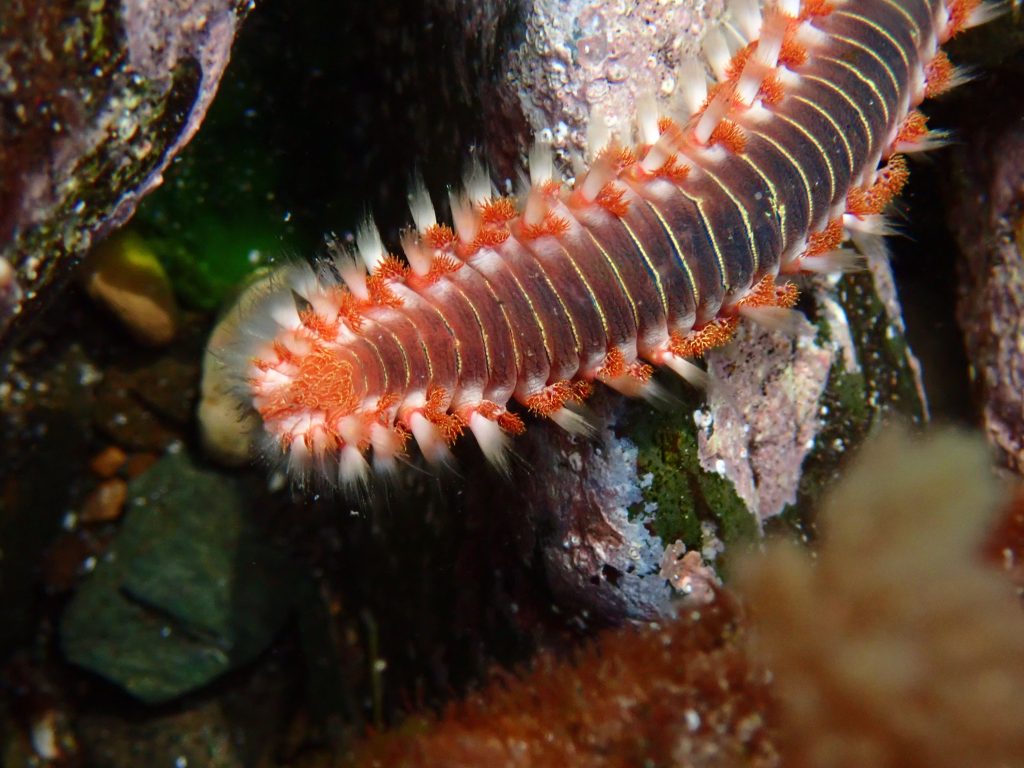
As far as worms go, this is definitely not one of the ugliest. Its colorful mix of orange, white, and muted dark purplish-grey actually looks rather decorative! Members of the of the bristleworm family (Amphinomidae), bearded fireworms can reach almost a foot in length and sport a segmented body. From the side of each segment sprouts a reddish-orange gill structure and a cluster of fuzzy-looking white bristles, also known as chaeta.

If you’ve spotted one of these worms in your tank and think it looks like it would feel nice and fluffy, you’re not alone. You wouldn’t be the first person to fail to resist touching them, nor would you be the first person to regret doing so. There’s a reason these critters are called fireworms. It has nothing to do with their orange gills, and everything with their neurotoxin.
Yep, fireworms are venomous: those fluffy chaeta are hollow and loaded with a potent mixture of toxins. Touching them won’t kill you, but it certainly won’t make your day any better either. Even brushing past the bristles causes them to break off, resulting in an intense, burning (one might say fiery) sensation and nasty skin irritation. Severe fireworm stings can also cause systemic reactions like nausea.
Where does the fuzzy menace hail from?
Bearded fireworms can be found throughout the warmer areas of the Atlantic, including the Caribbean and the Gulf of Mexico. They’re also common in the Red Sea and rapidly spreading in the Mediterranean, likely due to climate change resulting in warmer water. Unfussy and found at depths of up to 130ft, they can thrive wherever the water isn’t too chilly thanks to their versatile nature and bristly defense system.
Marine biologists in the Med are less than thrilled about the increasing presence of these worms. Corals make up a significant part of their diet, and the damage isn’t limited to simple munching either; they’re known to spread certain diseases, including dormant coral-bleaching bacteria, as they work on decimating local colonies.
Bearded fireworms don’t pose too much of a threat to healthy coral populations in their native seas, where their natural predators (mostly crabs, but also certain snapping shrimp and wrasses) help keep their numbers in check. The real trouble starts when they escape their native range, especially if their prey has already been weakened by warming seawater. It goes without saying that swimmers and fishermen aren’t exactly excited to have them around either!
Getting rid of a bearded fireworm
Most reef-keepers have heard of bearded fireworms at some point, even if they haven’t (yet) come across one — they’re one of those critters whose reputation precedes it. Although they’re not as common as the horror stories would have you believe, it’s not unheard of for a fireworm to sneak in on shipments of Caribbean live coral.
Thanks to these worms’ nocturnal nature, it can take a good while before you even realize something is amiss. You’re unlikely to spot the fiery invader unless you take a close look at the tank at night — or you manage to put two and two together when chunks start to go missing from your corals. Or urchins. Or snails. Or sponges… they’re really not picky.
Tip: If you think a bearded fireworm has made its way into your tank but haven’t yet managed to spot it, try checking at night using a blue nightlight or ultraviolet torch. For all their ability to fly under the radar, they do conveniently fluoresce bright green or orange.

Unfortunately, knowing you’ve got a bearded fireworm on your hands is only half the story. Even the longest and fattest specimens are able to wedge themselves into impossibly tight cracks in the hardscape. Catching them can be a real hassle, and you can even make things worse if you accidentally tear one in two while using tongs to pull it out of its hide — both halves can regrow.
Thinking of using biocontrol? You’ll find it’s slim pickings. Cone snails like Conus regius (crown cone) do prey on Hermodice carunculata in the wild, but they’re more dangerous than the worm itself. Additionally, given they only eat bristleworms, your crown cone would starve after getting rid of the intruder — unless you want to introduce more worms, which sounds pretty counterproductive to me.
Halichoeres and Pseudocheilinus wrasses, which are venom-free, have also been noted to take an interest in bearded fireworms. But unless you’ve already got one of those lying around, what will you do with it once it’s gotten rid of your worm problem for you? Or if it can’t be bothered to hunt the invader in the first place?
All in all, your best bet for getting your hands (not literally) on this hitchhiker is to set up a homemade bristleworm trap. You might end up catching all the other small critters in your aquarium twice before the worm finally decides to come out to take the bait, but at least you won’t inadvertently make things worse.
Tip: Managed to catch the worm? Be careful while getting it out of the trap. If you do get stung, try using adhesive tape to remove any bristles stuck in your skin. Try hot water, vinegar, or rubbing alcohol to help neutralize the toxins and relieve the pain.
Conclusion
Bearded fireworms rival dazzling marine flatworms in terms of beauty, but they’re best admired from afar. Coming across a fireworm while snorkeling or diving is pretty cool; finding one in your tank full of prized corals, not so much.
Sources & further reading
Ahrens, J. B., Kudenov, J. D., Marshall, C. D., & Schulze, A. (2014). Regeneration of posterior segments and terminal structures in the bearded fireworm, Hermodice carunculata (Annelida: Amphinomidae). Journal of Morphology, 275(10), 1103-1112.
Righi, S., Prevedelli, D., & Simonini, R. (2020). Ecology, distribution and expansion of a Mediterranean native invader, the fireworm Hermodice carunculata (Annelida). Mediterranean Marine Science, 21(3), 558-574.
Schulze, A., Grimes, C. J., & Rudek, T. E. (2017). Tough, armed and omnivorous: Hermodice carunculata (Annelida: Amphinomidae) is prepared for ecological challenges. Journal of the Marine Biological Association of the United Kingdom, 97(5), 1075-1080.
Simonini, R., Maletti, I., Righi, S., Fai, S., & Prevedelli, D. (2018). Laboratory observations on predator–prey interactions between the bearded fireworm (Hermodice carunculata) and Mediterranean benthic invertebrates. Marine and freshwater behaviour and physiology, 51(3), 145-158.
Verdes, A., Simpson, D., & Holford, M. (2018). Are fireworms venomous? Evidence for the convergent evolution of toxin homologs in three species of fireworms (Annelida, Amphinomidae). Genome biology and evolution, 10(1), 249-268.
Witman, J. D. (1988). Effects of predation by the fireworm Hermodice carunculata on milleporid hydrocorals. Bulletin of Marine Science, 42(3), 446-458.
Wolf, A. T., Nugues, M. M., & Wild, C. (2014). Distribution, food preference, and trophic position of the corallivorous fireworm Hermodice carunculata in a Caribbean coral reef. Coral Reefs, 33(4), 1153-1163.