
This ANIMALS 24-7 guest column originally appeared as the September 1, 2026 installment of author Ed Boks’ own blog, Animal Politics with Ed Boks.
Boks may be reached at [email protected].
Ed Boks’ resumé in animal welfare includes having headed the animal control departments in Maricopa County, Arizona; New York City; Los Angeles; and Yavapai County, Arizona, plus the Spokane Humane Society.
Editors’ note:
Ed Boks, below, appreciates and amplifies Ed Duvin’s message in Is your allegiance to movement leadership or those you serve? by Ed Duvin, which is essentially the same message that Duvin issued 37 years ago in his essay “In The Name of Mercy,” as more-or-less the Thomas Paine / Common Sense author of what became the no-kill movement.
Something more must be added, however, that Ed Duvin emphasized:
“I cannot imagine a social justice organization turning a blind eye to the loss of human lives. Yet, in this movement, leaders seem impervious to such a tragedy, with mounting casualties from dangerous dogs. Only those with shades of misanthropy would remain silent while innocent lives are needlessly lost. This is a regrettable form of selective morality, and yet many defend the indefensible. Justice is not divisible.”

Dog attack mayhem in the name of mercy
Since Ed Duvin wrote “In The Name of Mercy,” in 1989, ten times more Americans have been killed by dangerous dogs than in the entire 131-year previous documented history of the organized humane movement.
Worse, ten times more Americans are killed by dangerous dogs each year than in 1989, 100 times more Americans (at least) suffer Level 3 and up injuries in dog attacks, and the number of Americans killed each year by dogs rehomed from animal shelters now exceeds the total number killed by dogs per year in 1989.
More than 70% of this killing and mayhem is inflicted by pit bulls, 90% by pit bulls and other closely related “bully” breeds, including Cane Corso, Dogo Argentino, Presa Canario, et al, while the no-kill sheltering community disregards breed-specific reality, pushing more and more dangerous dogs out among the public, along with leaving more and more dangerous dogs at large instead of accepting owner surrenders and impounds.

Plummeting anti-rabies vaccination rate
That isn’t all. The U.S. canine anti-rabies vaccination rate has over the same years dropped from upward of 80% to as low as 52%.
The original point and purpose of tax-supported animal control agencies and dog pounds, which evolved into sheltering contracts with humane societies, was to protect the public from dog attacks and rabies.
Until and unless we can return to the level of public safety from dog attacks and rabies that Americans enjoyed in 1989, no-kill is an abysmal failure. Redefining “success” by denying the hardest part of the job is no success at all.
Ed Boks, by the way, has previously pointed this out himself. See How Los Angeles normalized shelter dog attacks, by Ed Boks.

––––––––––––––––––––
Finish the job that no-kill started
by Ed Boks
Ed Duvin, widely considered “the father of the no-kill movement,” has reopened a question he first posed 37 years ago, a question the movement has yet to answer:
Have we confused excellent shelter outcomes with achieving no-kill?
A no-kill movement worthy of the name must be accountable for more than shelter outcomes. Its ultimate test is more fundamental:
Is the community becoming less dependent on its shelter?
That question does not diminish the importance of live release, adoption, foster care, rescue, medical treatment, behavior support, return-to-owner work, or humane euthanasia decisions. Shelter animals deserve every possible opportunity to leave alive and well. Shelters should be judged by how they treat the animals in their care.

Improved shelter performance is not reducing shelter dependency
But shelter performance is not the same thing as reducing shelter dependency.
A shelter can improve its live-release rate, expand foster care, build rescue partnerships, increase adoptions, transport more animals, and save more animals than ever before.
Those are real achievements. They matter to every animal they save.
Yet a community can do all of that while remaining deeply dependent on its shelter. It can become better at managing animal outcomes without reducing the number of animals needing the shelter.
That is the distinction the movement can no longer afford to ignore.

Duvin’s unanswered question
Duvin is not raising this concern for the first time.
In his 1989 essay, In the Name of Mercy, Duvin challenged the shelter world to reject the idea that killing healthy animals was an act of mercy. He warned that shelters had become too consumed by internal operations and daily crisis management while giving too little attention to prevention, public education, reliable data, and the causes of animal homelessness.
Duvin was writing at a time when millions of healthy animals were dying in shelters each year. His language was blunt because the reality was brutal. A movement that claimed to care for animals, he argued, could not call itself humane while accepting the killing of healthy animals as an unavoidable part of sheltering.
Duvin’s concern did not end at the shelter door. He argued that shelters had neglected the community education, outreach, reliable data, and prevention needed to break the cycle of animal homelessness, shelter dependence, and preventable killing.
In January 2026, Duvin returned to that concern. He argued that no-kill had become too closely tied to live-release rates and that the movement had allowed a shelter-outcome measure to stand in for population stabilization and prevention.

(Beth Clifton collage)
Duvin sharpened the question
On August 27, 2026, writing again for ANIMALS 24-7, he sharpened the question further:
“Is the movement loyal to its own leadership, metrics, and institutional habits, or to the animals it claims to serve?”
Duvin’s point is not that live release is meaningless. It is not that foster care, adoption, rescue, and transport do not save lives.
His challenge is more fundamental.
Wrote Duvin:
“No-kill cannot be achieved by getting better at managing animal homelessness. It must also reduce the number of animals dependent on shelters in the first place.”

The community is not the shelter
A shelter’s live release rate tells us what happened to the animals whose outcomes it reports.
It may reflect stronger adoption programs, foster and rescue networks, veterinary care, behavior support, or improved return-to-owner practices. Those are all measures of shelter performance.
But a high live release rate does not answer every question that matters.
It does not tell us whether fewer animals entered the shelter than last year.
It does not tell us whether puppy and kitten intake is declining.
It does not tell us whether residents in high-intake communities have timely, affordable access to spay/neuter and basic veterinary care.
It does not tell us whether families received help before a housing problem, medical bill, behavior issue, or temporary crisis led to a surrender.
And it does not tell us whether the community is becoming less dependent on its shelter. That is the question that reaches beyond the shelter walls.

“A community making real progress should, over time, need its shelter less.”
A community making real progress should, over time, need its shelter less.
That does not mean the shelter should offer fewer services. It means fewer animals should require those services.
It means fewer unplanned litters entering the shelter.
Fewer animals surrendered because a family could not obtain affordable care.
Fewer pets relinquished because housing support arrived too late.
Fewer animals transported across county or state lines because the community has not invested enough in reducing the flow of animals into its own shelter system.

A reliable safety net
It means the shelter can become what a humane community needs it to be: a reliable safety net for animals in genuine crisis, not the community’s default answer to every preventable problem.
When that line blurs, when a community relies on shelters and rescue organizations to absorb animals who are homeless, displaced, surrendered, or otherwise at risk, it creates what Animal Politics calls shelter dependency.
Shelter dependency is not an abstract statistic. It is a measure of how much a community depends on its shelter to manage problems that should, whenever possible, be prevented before they become shelter cases.
The central question is not simply whether the shelter saved the animals whose outcomes it reported.
It is whether fewer animals in the community need the shelter.

Managing dependency is not reducing it
Too much of the modern no-kill movement is devoted to managing a community’s dependence on its shelter rather than reducing it.
The movement has built an extensive downstream system. It has developed adoption campaigns, foster programs, veterinary treatment, rescue networks, transport pipelines, marketing systems, behavior programs, intake diversion practices, and sophisticated ways to move animals through crowded facilities.
These interventions can be humane. They can be necessary. They can save the life of the animal in front of us.
But the need for an intervention does not prove that the crisis that made it necessary is shrinking.
The need for more foster homes, more transports, more emergency rescue pulls, more veterinary capacity, and more adoption events is not proof that we are solving the problem.
In some communities, the growing urgency of those needs may show that we have become better at responding to shelter dependency without reducing it.

“Winning battles inside the shelter while losing the larger war”
We may be winning battles inside the shelter while losing the larger war outside it.
We can celebrate a rising live release rate while intake remains high. We can celebrate fuller foster networks while more animals need foster homes each year. We can celebrate transport numbers while the communities producing those animals remain dependent on sending them elsewhere. We can celebrate managed intake while animals unable to gain admission disappear from official intake counts but not from the community’s unmet need.
The problem is not that downstream programs exist. The problem is that the movement has allowed them to define no-kill success.
When no-kill success is measured mainly by how efficiently animals move through the shelter system, shelters will build more capacity to move animals through their doors. That may relieve immediate suffering. But unless it is paired with serious prevention, it does not reduce the number of animals who will need that shelter next year.
That is not an argument against foster care, transport, adoption, rescue, or shelter medicine. It is an argument against confusing better crisis management with less crisis.

Prevention is the work
If we are serious about ending shelter killing, we cannot be satisfied with becoming more efficient at managing the consequences of animal homelessness. We must reduce the number of animals who need the shelter.
The test is simple: If an intervention succeeds exactly as intended, will the community become less dependent on its shelter next year?
If the answer is no, the intervention may still be humane. It may still be urgent. It may still save lives. But it is relieving pressure inside the shelter rather than reducing the upstream conditions that keep filling it.
Hiring more veterinarians may improve shelter flow. Recruiting more foster homes may reduce overcrowding. Expanding transport may save animals who need placement now.
All of those things can be good.
But targeted prevention can change how many animals need those services tomorrow. That is the difference between managing a crisis and reducing the conditions that create the crisis.

Prevention is easy to undervalue
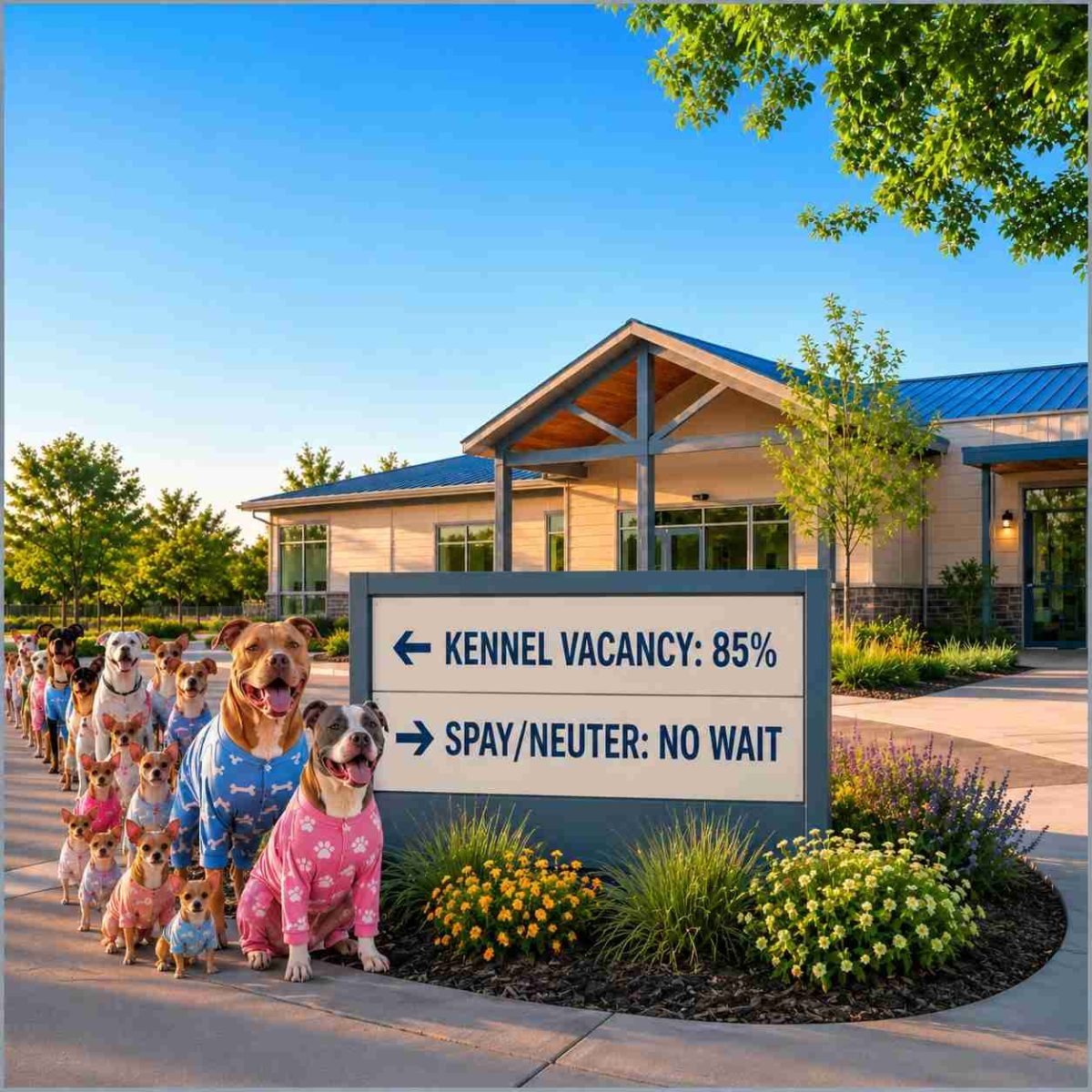
Prevention is easy to undervalue because its success is often invisible. The litter is never born. The pet is never surrendered. The kennel remains empty because an animal never needed it.
But the absence of a crisis is not the absence of accomplishment. It is the accomplishment.
This is where Duvin’s call to restore spay/neuter to the center of animal welfare matters most.
Spay/neuter is not a magic answer to every reason animals enter shelters. No single intervention is.

Accessible, affordable, strategically targeted s/n
But accessible, affordable, strategically targeted spay/neuter is one of the principal ways a community can reduce future shelter demand before that demand becomes a full kennel, a rescue plea, a transport manifest, or a euthanasia decision.
It does not replace adoption, foster care, shelter medicine, rescue, return-to-owner programs, behavior support, affordable veterinary care, or the help families need to keep their animals.
However, it does reduce the future demand placed on all of those interventions.

(Beth Clifton collage)
High-quality, high-volume spay/neuter must return to the center of the no-kill movement. It must be directed where the need is greatest: toward the animals, neighborhoods, and communities producing the highest intake and facing the greatest risk of euthanasia.
It should be paired with affordable veterinary access, pet retention services, community education, housing support, and other measures that keep animals from entering the shelter pipeline at all.
This is not nostalgia. It is not ideology. It is what it means to finish the job.
Please donate to help our work:
More related posts:
Discover more from Animals 24-7
Subscribe to get the latest posts sent to your email.