There were also a couple of leveraged ETFs. Those are often about day trading. I can think of few things less intelligent than day trading a technology that is probably 5-10 years down the line.
So I Made My Own List
The thing that kept nagging me is that once you strip out the megacaps and the quantum-adjacent security software companies, the real list of investable pure quantum companies is tiny. I had about 10-12 names, and 3-5 of those were fairly easily eliminated or worth putting on the watchlist.
I landed on seven, deliberately spread across competing hardware architectures.
Here’s what I bought, including the architecture/focus and the amount of the portfolio that I assigned to it:
- Quantinuum (QNT) – Trapped ion – 22–30%
- IonQ (IONQ) – Trapped ion – 20–28%
- D-Wave (QBTS) – Annealing – 12–18%
- Infleqtion (INFQ) – Neutral atom – 9–15%
- Rigetti (RGTI) Superconducting – 7–12%
- Xanadu (XNDU) Photonic – 5–10%
- IQM (IQMX) Superconducting – 3–8%
I picked the ranges on purpose. I view it as putting them into tiers. This also allows me to buy a little more of stocks that seem cheaper or dollar cost average into them when they miss on an earnings report (but the fundamentals are still solid).
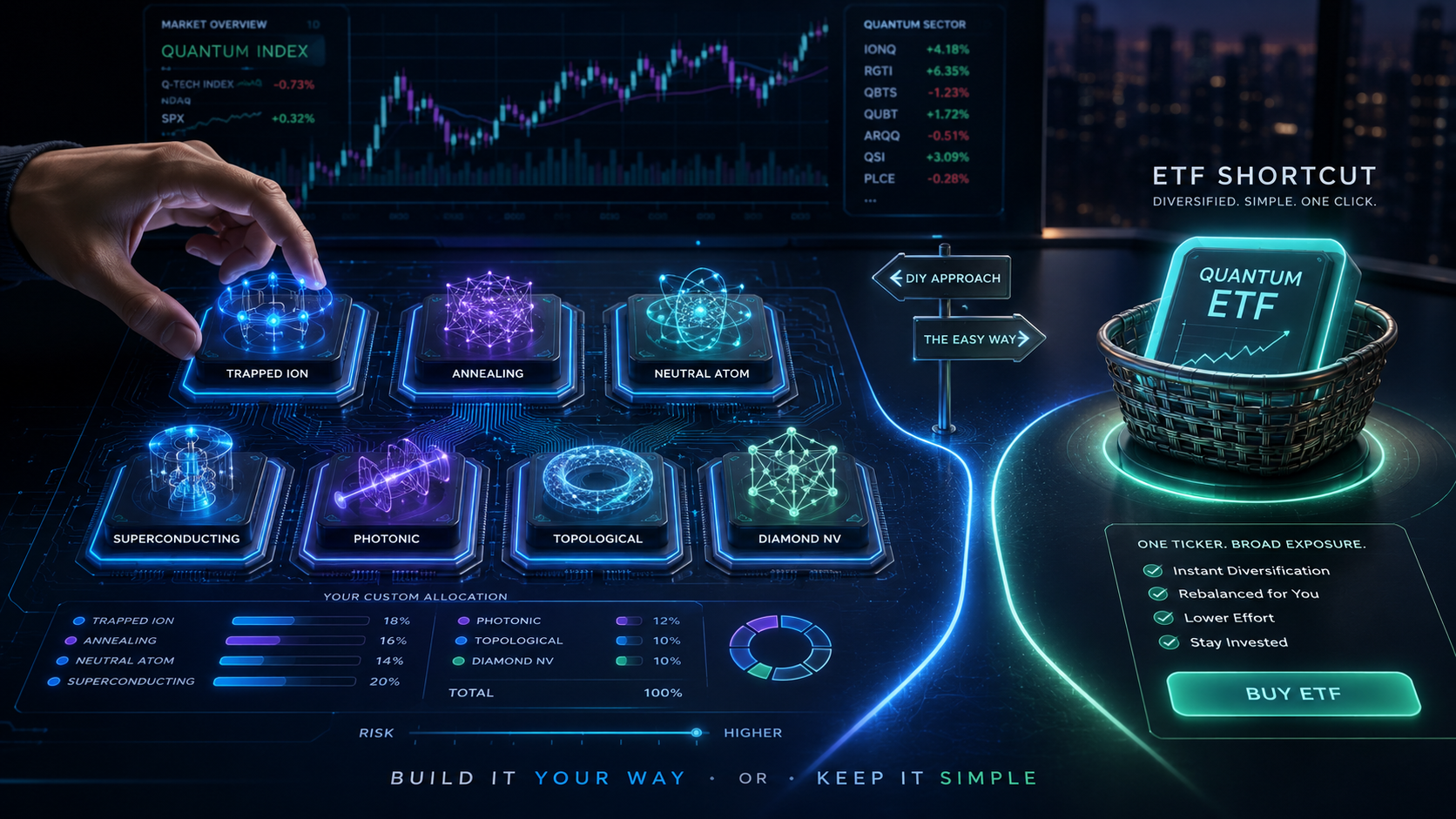
The architecture spread is the whole strategy. Their main technologies are trapped ion, annealing, neutral atom, superconducting, and photonic. I didn’t study what any of those are and couldn’t tell you which one wins. I graduated in the late 1990s with a computer science and linguistics degree with a focus on AI. I wouldn’t have predicted that a gaming hardware company like Nvidia would have been the beneficiary.
It is worth noting how newly investable many of these companies are. Quantinuum only became directly investable in June, when it IPO’d. Infleqtion, Xanadu, and IQM all went public in 2026 too. Two years ago this portfolio was mostly impossible to build.
The Two I Threw Out
I want to include the rejects, because the rejections taught me more than the picks.
Oxford Instruments looked great initially. It is a “picks and shovels” play supplying equipment to everybody, which is a strategy I generally love. Then I found out they completed the sale of NanoScience, their explicitly quantum-focused business, in January. They sold the exact thing that made them interesting. Out.
Quantum Computing Inc. (QUBT) was the harder call. It has an enormous cash pile, evolving photonics strategy, and looks genuinely tempting. I used Claude to analyze all these potential picks and it found something interesting in their Q1 filing. It has about $3.7 million in revenue, but $3.5 million of it came from businesses they’d just acquired. And cost of revenue exceeded revenue — they lost money on the actual work. I already have Xanadu on photonics, and it seems like homerun or strikeout technology. It found a place on the watchlist.
About Using AI for This
I did most of this research by grinding through it with AI assistants, and I asked several of them independently so I could compare. Where they agreed, I gained confidence. Where they disagreed, I dug.
One thing worth reporting: one of them (Google Gemini) confidently told me the only way to own Quantinuum was through Honeywell. That was true until June, and then it wasn’t — the model’s information was stale, and it had no idea. It wasn’t hedging or uncertain. It was just wrong, fluently.
I want to call out Claude for its level of research, though. I don’t use Claude very much, so I let its Opus grind with maximum effort. It ate up a good deal of usage, but the reports on all the companies were amazing.
The Shortcut ETFs
After I finished all this work, ChatGPT said, “I noticed that this portfolio looks a lot like Defiance Pure Quantum ETF (QTUP), which launched in June.
Its July portfolio? Roughly 17% Quantinuum, 17% IonQ, 17% D-Wave, and about 6% each across Infleqtion, Rigetti, IQM, Xanadu, and QUBT.
That is… basically my list. Same companies, mostly. I reinvented an existing product.
There are a couple of differences between QTUP and what I ended up with. QTUP also holds Arqit, BTQ, Horizon Quantum, and QUBT — all of which I looked at and passed on. And it’s roughly equal-weighted, whereas I wanted conviction-weighted.
However, it is worth noting that QTUP’s expense ratio is 0.77%.
Even later, I found Corgi Quantum Computing ETF (CQTM) was similar. It has a 0.35% expense ratio, and it launched in May. It has 19 total holdings and fairly closely matches my seven. That would be my pick if I wanted a shortcut.
Are the ETFs’ expense ratios worth it?
Let’s do the math… Hypothetically, let’s say we’re investing $10,000 for twenty years. I’ll use a 10% annual return, because technology companies seem to do that on average. A lot of these companies are small, which can have even greater growth. Here’s what the results would be:
- 0% (my plan): about $67,300
- At 0.35% (CQTM): about $63,100
- At 0.77% (QTUP): about $58,400
So the 0.77% fee costs roughly $8,900 over twenty years, or about 13% of what you’d otherwise end up with. CQTM’s 0.35% costs about 6%. That’s the real price of convenience, and it seems like a big number. Of course, with inflation, that number may not appear so big.
But here’s where I have to be honest with myself.
Final Thoughts
I bought the seven stocks on August 4th and I’ve been tracking their performance in my Google Sheet. When I wrote this article (August 15th), four of them were up 11-14% and the other three were up an average of 2%. Overall, they were up 10.6%, which, for a 10-day period, amounts to an annualized gain of 2,781%. I knew that was too good to last. Now that I’m finally publishing the article, the portfolio is DOWN about 4.5% or 44% annually. These swings were expected with such speculative stocks over a short period.
There’s a real argument for just buying CQTM or QTUP and being done with it. The professionals will watch the industry a lot more carefully than I will.
Is anyone else looking at quantum, or does it all feel like science fiction? I’m a believer, because I would have told you that the level of AI that we are seeing was complete science fiction five years ago.
* These satellite stocks are currently about 1% of my retirement portfolio, which excludes my wife’s portfolio. It’s a small fraction of our money.