

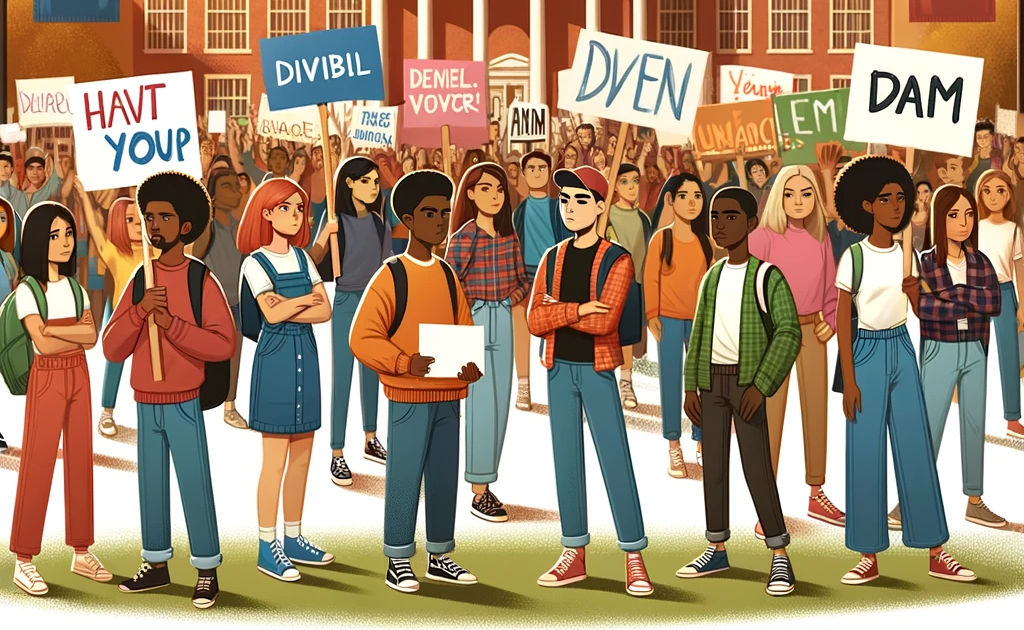
As the Pro-Palestinian protests rattle academic calendars across campuses, let’s not lose sight of the fact that College Students in America do protest a lot. This is fundamental to campus culture and an inherent part of their First Amendment Rights.
Students are inherently vibrant and eager to challenge the status quo, serving as fresh voices in society who confront issues that unsettle them. Positioned in academic settings that encourage the exploration of significant moral questions through various scholarly lenses, they bring an intense vitality to these debates, often surpassing that of their older counterparts.
Rising casualties and extensive devastation in Gaza have shifted public sentiment, as evidenced by a decline in support for Israel’s military actions, which dropped from 50% in a November Gallup poll to 36% by late March.
According to the National Student Clearinghouse Research Center, the U.S. boasts over 15 million undergraduate students, with demographic breakdowns showing 41% are white, 18% Latino, 11% Black, and 6% Asian.
This generation is defined by its intersectionality. It actively leads significant movements such as Black Lives Matter, the Women’s March, protests against the Muslim ban, and rallies for gun safety.
Historical and current divisions in the Democratic Party reflect generational contrasts.
Democratic strategist James Carville recently cautioned that divisive protests could inadvertently aid Trump’s campaign. A YouGov poll indicates mixed public views on the suspension and expulsion of pro-Palestinian protesters, with more substantial support for strict actions among older adults. Reflecting on past political missteps, such as the Vietnam War era, some worry the party risks alienating young voters again. Meanwhile, the Biden campaign intensifies efforts to engage young voters, contrasting Democratic unity with perceived GOP chaos.
Donald Trump described watching NYPD raid Columbia University, where pro-Palestinian students were protesting, as “a beautiful thing.” Speaking at a Wisconsin rally, he portrayed New York as being “under siege,” commended the police for their actions, and labeled the approximately 300 arrested at Columbia and City College of New York as “raging lunatics and Hamas sympathizers.” Trump urged a nationwide crackdown on similar campus protests.
How must these protests be handled?
In a very balanced manner – given the precarious time of the year.

The First Amendment underpins the right to free speech, which is crucial in public colleges and universities, and suggests similar freedoms should be upheld in private institutions to foster academic liberty. Here, I propose a balanced approach to protect these rights while also safeguarding against discrimination and disruptive actions:
1. Universities must ensure viewpoint neutrality. Schools mustn’t discriminate against any opinions, even if unpopular while preventing harassment based on race, ethnicity, or religion. This includes allowing political expressions related to contentious issues like the Israeli-Palestinian conflict, provided they don’t target individuals for harassment.
2. Protect students from harassment while preserving free speech. Schools must intervene when speech crosses into personal harassment or discrimination but should also defend the right to express contentious views without fear of undue punishment.
Implement fair and neutral protest policies. Reasonable restrictions on the time, place, and manner of protests are acceptable, but these rules must be applied without bias toward the content of the expression.
3. Limit police presence during protests. To minimize risks, especially in communities of color, police should only be involved as a last resort in managing protests.
4. Resist external political pressures. Universities should stand firm against politicians’ efforts to manipulate campus dynamics for their own gain.
While most current campus protesters are peaceful, a few disruptive elements, possibly unaffiliated with the universities, have overshadowed their efforts. Their calls for divestment from companies supporting Israel’s actions echo how Trump-supporting organizations suffered just a few years ago when Women grabbed their wallets. However, today’s protests are generally smaller and meet quicker suppression, such as the rapid police response at the University of Texas at Austin, where non-violent protesters were arrested and later dropped. This suggests a shift from the commitment to free speech seen in the 1960s.
Students often protest raw and emotionally, especially during turbulent societal periods. For example, in 2017, following Trump’s election, there was significant student unrest over right-wing speakers on campuses. Now, in 2024, with another tense election looming, a Supreme Court that many feel favors Trump, rollbacks of rights across various groups, ongoing wars visible through social media, and a lack of calming leadership, it’s understandable why students are expressing intense reactions.
What are we doing to ensure, as adults, that we hear their voices and keep them from derailing?
While I don’t condone antisemitism or Islamophobia and recognize that some campus slogans have been rightfully criticized, I urge for more empathy from those quick to judge student protesters for their moral imperfections.
We shouldn’t attack each other based on identity or religious background. However, likely, many students caught up in anti-war protests may not fully understand the implications of specific phrases, which can be perceived differently by different communities.


