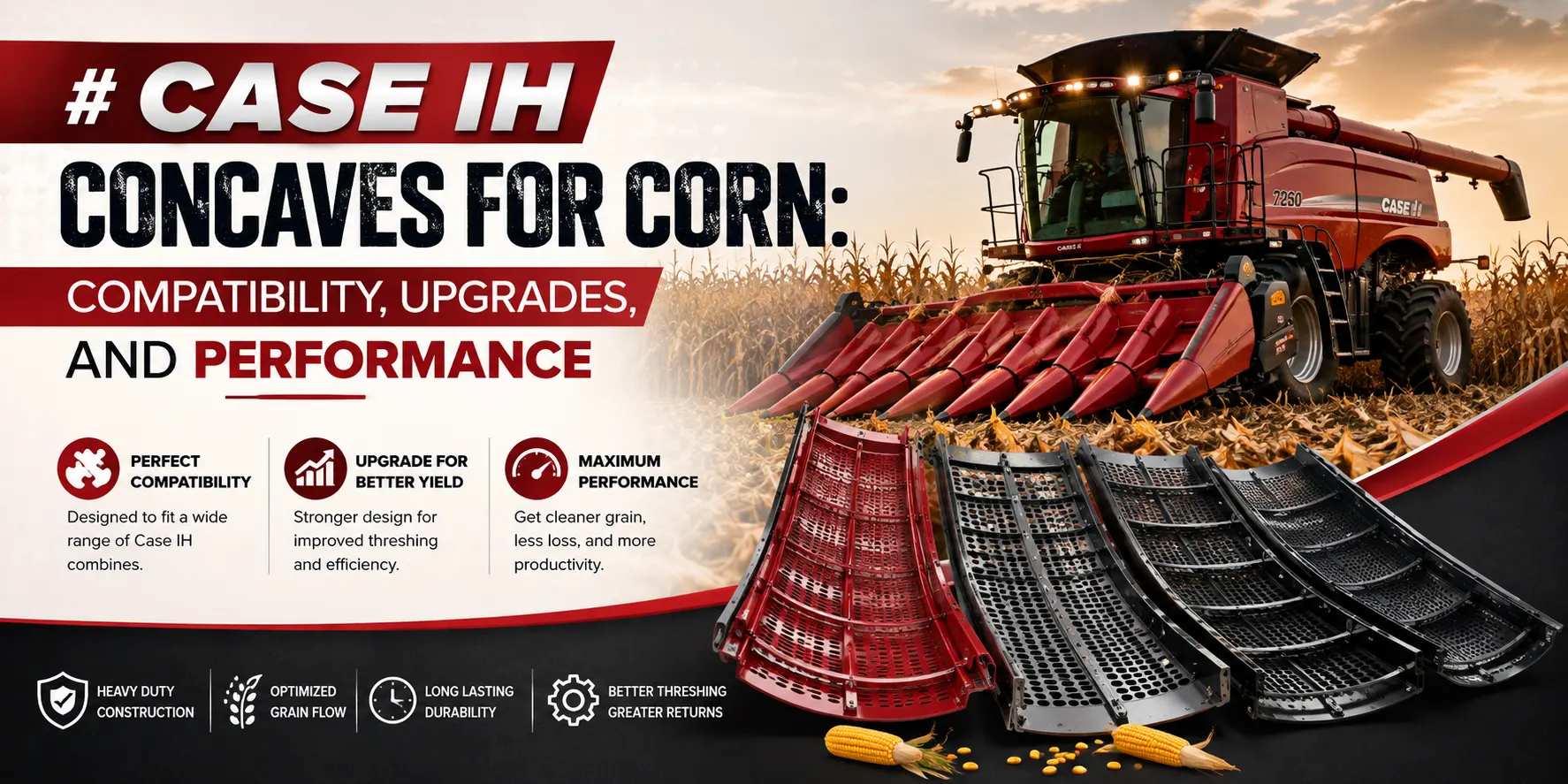
Case IH’s Axial-Flow line has built its reputation on a single-rotor design that’s stayed remarkably consistent for decades, and that consistency is actually good news for anyone shopping for concave upgrades. Because the AFX rotor architecture has carried forward across so many model years, factory and aftermarket concave options tend to have a wider compatibility window than most operators expect. That matters a lot heading into a 2026 season where a smaller, more variable corn crop makes every bushel of threshing efficiency count.
This guide covers how Case IH concaves are built, which models they fit, what separates factory concaves from aftermarket upgrades, and what actually changes in real-world performance when you switch.
Key points in this article:
- Case IH Axial-Flow combines use a consistent 30-inch diameter AFX rotor across most model lines, which is why concave compatibility spans a wide range of model years.
- Concave wrap — how far the concave extends around the rotor — increased from 156 degrees on the 140 Series to 180 degrees of module wrap on the 240 Series, directly affecting threshing capacity.
- OEM concaves are built for general-purpose use across crops; aftermarket options are often engineered to solve specific problems like rotor loss or slow ground speed.
- Corn presents unique demands on these components, including cob breakage control and separation of grain that’s already been threshed but not yet dropped through.
- All-crop aftermarket systems eliminate the need to swap covers or bands when moving between corn, soybeans, and other crops.
How Do Concaves Work Inside a Case IH Axial-Flow Combine?
Case IH pioneered single-rotor threshing technology back in the 1960s, and the Axial-Flow system built on that foundation remains one of the most recognizable designs in the industry. The single in-line Axial-Flow rotor, coupled with a concentric rotor cage, delivers gentle, multiple-pass, grain-on-grain threshing and smoother crop flow. The concave sits beneath and around that rotor, and as material passes through, grain drops through openings in the concave onto the cleaning system below while cob, husk, and stalk continue through and out the back.
Concave and module wrap — the degree to which the concave surrounds the rotor — is one of the most important factors affecting combine capacity, and it’s actually the lever Case IH pulls to gain capacity rather than lengthening the rotor the way some competing brands do. The 140 Series uses 156 degrees of concave wrap, while the 240 Series increased that to 180 degrees of module wrap — a meaningful jump in how much of the crop mat stays in contact with the threshing surface at any given moment.
Because the AFX rotor architecture has carried forward with relatively consistent dimensions across generations, aftermarket options typically cover a broad model range rather than being locked to a single series. Compatibility commonly spans models including the 9240, 8240, 7240, 8230, 7230, 9230, 9120, 8120, 7120, 8010, and 7010, along with earlier 140, 130, and 088 Series models such as the 7140, 6140, 5140, 7130, 6130, 5130, 7088, 6088, and 5088, down through the 2588, 2388, 2188, and 1680/1688 models.
This wide compatibility window is a genuine advantage for operations running mixed fleets or older machines that are still fully capable performers. Rather than needing an entirely new concave design every time a new Case IH series comes out, most upgrades are built to bolt into the existing AFX rotor housing across a wide span of model years.
What’s the Difference Between OEM and Aftermarket Case IH Concaves?
Factory-installed models are engineered as general-purpose components, built to perform reasonably well across the full range of crops a combine might handle in a given season — corn, soybeans, wheat, and beyond. That versatility is valuable, but it also means factory concaves are a compromise rather than a solution optimized for any single crop’s specific threshing challenges.
Aftermarket concaves, by contrast, are typically engineered around a specific performance gap. For corn especially, the two biggest issues operators run into are cob breakage from overly aggressive threshing and rotor loss, where grain that’s already been knocked free from the cob gets trapped in the crop mat and carried out the back of the machine instead of dropping through. Aftermarket designs built specifically to address these issues can meaningfully outperform stock concaves in corn, even on a well-maintained combine.
What Should You Look for in Corn-Specific Case IH Concave Upgrades?
Not every aftermarket option solves the same problem, so it helps to know what to actually look for:
- Threshing surface area: More surface area per rotor revolution means more opportunity for grain to separate before the material moves further back through the rotor.
- Separation performance, not just threshing: A concave that threshes well but doesn’t address how the crop mat wraps around the rotor tube can still lose grain at the separation stage.
- Cob handling: Look for designs that reduce cob shattering, since broken cob fragments are one of the hardest sources of grain to recover once material is past the concave.
- All-crop capability: Multi-crop operations benefit from concaves that don’t require covers, bands, or full swaps between corn and other crops during a tight harvest window.
Estes Performance Concaves built the XPR3 Concave System with these exact priorities in mind for Case IH Axial-Flow combines. The system delivers 135% more threshing surface area than standard concaves, which supports up to a 70% increase in usable capacity and lets operators run 2 to 3 mph faster ground speed without sacrificing separation quality. A 143-disrupter-finger separation grate keeps the crop mat suspended rather than letting it wrap tight to the rotor tube, addressing the rotor loss that standard concaves often miss entirely. Because it’s an all-crop design, there’s no need to swap components moving from corn into soybeans or wheat later in the season.
How Much Does Concave Performance Really Affect Corn Yield?
The numbers here are larger than most operators assume. Every rotor combine loses roughly 3 to 5 bushels per acre to rotor loss under standard conditions — on a 1,000-acre operation, that adds up to close to $30,000 left on the ground in a single season. That loss happens regardless of how well the rest of the combine is maintained, because it’s a function of concave and separation grate design, not engine power or operator skill alone.
For corn specifically, cob breakage compounds the problem. Reducing cob breakage means less unthreshed grain sent to the cleaning system, and because separation begins sooner in a well-designed concave, rotor loss drops as a direct result. In a season where the 2026 crop is running smaller and more variable than last year, recovering that lost capacity matters more than it would in a record year.
Comparing OEM vs. Aftermarket Case IH Concaves for Corn
| Factor | OEM Factory Concaves | Aftermarket Upgrades (XPR3) |
|---|---|---|
| Design focus | General-purpose, multi-crop compromise | Engineered for rotor loss and cob breakage in corn |
| Threshing surface area | Standard factory spec | 135% more than standard concaves |
| Crop switching | Often requires covers or bands between crops | All-crop design, no swapping required |
| Ground speed capability | Limited by standard threshing/separation capacity | Supports 2-3 mph faster ground speed |
| Model compatibility | Matched to specific series | Spans a wide range of Axial-Flow model years |
Pros of Upgrading Case IH Concaves for Corn
- Reduced rotor loss translates directly into more bushels reaching the tank
- Less cob breakage improves grain sample quality and reduces dockage risk
- Faster sustainable ground speed without sacrificing separation performance
- All-crop designs cut downtime spent swapping components between corn, soybeans, and wheat
Cons and Trade-Offs to Weigh
- Upfront cost of an aftermarket upgrade requires justification against expected bushel recovery
- Installation still requires proper setup and calibration to see full performance gains
- Compatibility should be confirmed against your specific Axial-Flow model before purchase
- Older combines with other worn components may need broader maintenance to fully benefit from a concave upgrade alone
Common Mistakes Operators Make With Concave Selection
- Assuming factory concave wrap and surface area are sufficient once a combine has multiple seasons of wear
- Overlooking separation performance and focusing only on threshing when diagnosing grain loss
- Running the same concave setup for corn and soybeans without adjusting for each crop’s threshing demands
- Delaying an upgrade decision until yield monitor data already shows a clear, costly pattern of loss
- Not confirming model-specific compatibility before purchasing an aftermarket concave system
Frequently Asked Questions About Case IH Concaves for Corn
Do all Case IH Axial-Flow combines use the same concave design?
No, but the core rotor architecture has stayed consistent enough across model years that concave wrap and mounting dimensions are similar across a wide range of series. Concave wrap did increase from 156 degrees on the 140 Series to 180 degrees of module wrap on the 240 Series, which affects capacity even within the same general design family.
Can aftermarket concaves fit older Case IH combines?
Yes, in many cases. Aftermarket Case IH concave systems commonly cover models going back to the 1680/1688 and 2188 Series through current 9240 and 8240 Series machines, since the underlying rotor design has remained compatible across that span.
What’s the main cause of rotor loss in Case IH combines running corn?
Rotor loss typically happens when the crop mat wraps tightly around the rotor tube after initial threshing, trapping grain that’s already been knocked loose from the cob. Standard concaves don’t always address this separation-stage problem, even when threshing itself looks efficient.
Do I need different concaves for corn versus soybeans on a Case IH combine?
With standard factory or many aftermarket concaves, yes — covers, bands, or full swaps are often required between crops. All-crop systems, including the Estes Performance Concaves XPR3, are designed to handle corn, soybeans, and other crops without that mid-season change.
How much can upgrading Case IH concaves improve corn harvest performance?
Results vary by combine condition and field conditions, but rotor loss alone commonly accounts for 3 to 5 bushels per acre on standard concaves. Upgrades built specifically to address separation and cob breakage, like the XPR3 system, are designed to recover a meaningful share of that loss while also supporting faster ground speed.