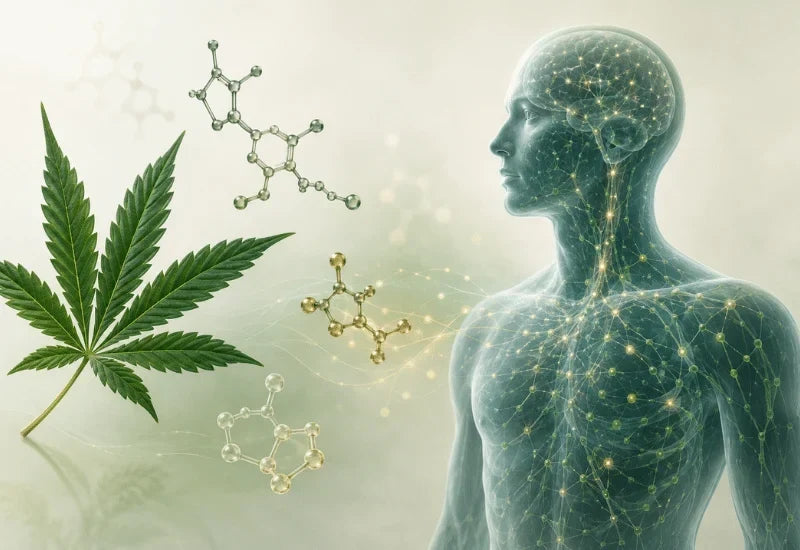
Your brain is constantly repairing, adapting, communicating, and protecting itself. And one of the most fascinating plant compounds researchers are discovering in this conversation is CBD.
CBD—short for cannabidiol—isn’t just about relaxation.
It interacts with a complex network throughout your body called the endocannabinoid system (ECS), which plays a role in maintaining balance across the nervous system, immune system, mood, stress response, pain perception, memory, and more.
And here’s where things get really interesting:
Research increasingly points to CBD as a potentially powerful neuroprotective compound—with antioxidant, anti-inflammatory, and brain-signaling effects that may help protect neurons and support a healthier neurological environment.
Let’s get into the science.
🧠 Your Brain Has Its Own Endocannabinoid System
You don’t have to consume cannabis to have an endocannabinoid system.
You were born with it.
The ECS is made up of cannabinoid receptors, naturally occurring endocannabinoids, and enzymes that regulate these signaling molecules.
Think of it as one of your body’s master balancing systems.
It’s involved in regulating everything from mood and stress to inflammation, sleep, pain, memory, and neurological function.
CBD doesn’t simply “activate” cannabinoid receptors. Instead, it interacts with the ECS and a variety of other molecular pathways throughout the brain and body.
And that’s part of what makes CBD so interesting.
It’s not working through just one pathway.
Researchers have identified interactions involving serotonin signaling, TRP channels, PPAR receptors, adenosine signaling, and other systems involved in inflammation, oxidative stress, and neuronal communication.

🔥 The Brain & Inflammation Connection
Here’s a piece of the brain-health conversation we can’t ignore:
Neuroinflammation.
Inflammation is a normal and necessary biological response. Your immune system uses it to protect and repair.
But chronic or excessive inflammatory activity in the brain can contribute to an environment associated with neurological dysfunction and neurodegeneration.
This is where CBD gets particularly interesting.
Research suggests CBD can influence inflammatory pathways and the activity of microglia—immune cells that act as the brain’s resident defense system.
When microglia become chronically activated, they can contribute to neuroinflammatory signaling. Research into CBD suggests it may help regulate these inflammatory responses.
And researchers aren’t just interested in inflammation.
They’re looking at oxidative stress, neuronal survival, excitotoxicity, and other mechanisms involved in brain health.
🛡️ CBD & Neuroprotection
Imagine your neurons as an enormous communication network.
Every second, billions of signals are firing across your brain.
That incredible activity also creates metabolic stress.
Your brain needs systems that help protect neurons from oxidative damage and excessive inflammatory signaling.
CBD has demonstrated antioxidant and neuroprotective activity in laboratory and preclinical research. Studies have explored its ability to reduce oxidative stress, regulate inflammatory pathways, influence glutamate signaling, and support neuronal survival.
This is why CBD has become such an interesting compound in research surrounding neurological health.
Scientists are investigating its potential relevance to conditions involving neuronal damage and inflammation, including Alzheimer’s, Parkinson’s, multiple sclerosis, and other neurological disorders.
The potential is enormous.
But there’s an important distinction:
Most of the strongest evidence for direct neuroprotection and disease-modifying effects is still coming from laboratory and animal research, while human clinical evidence remains much more limited.
That doesn’t make the research unimportant.
It makes it an area worth watching.
🧬 Could CBD Support Brain Repair?
This is one of the most exciting questions researchers are asking.
The brain isn’t a static organ.
It has an incredible capacity to adapt and reorganize—a process known as neuroplasticity.
Researchers are investigating whether CBD may influence biological processes associated with neuronal health, neuroinflammation, oxidative stress, and neuroplasticity.
Some preclinical research has also explored CBD’s effects on pathways involved in neuronal survival and neurogenesis—the creation of new neurons.
That doesn’t mean CBD is a guaranteed “brain repair” supplement.
But it does mean we’re beginning to understand why CBD has a place in conversations about brain resilience, protection, and recovery.
🧠 What About Memory & Cognitive Function?
This is where we need to separate hype from science.
Human studies have shown that CBD can affect brain activity and neural networks, including regions involved in memory and emotional processing. Brain-imaging research has demonstrated measurable changes in cerebral blood flow and functional connectivity following CBD administration.
A 2025 review of randomized controlled trials found that CBD research has explored cognitive function, sleep, neurological conditions, psychiatric disorders, and other brain-related outcomes—but concluded that the effects on cognition itself remain an area requiring further research.
So no, we’re not going to tell you that CBD is a magic memory pill.
But we’re NOT going to ignore what the science is showing.
CBD clearly interacts with the human brain.
And researchers are continuing to investigate exactly what those interactions could mean for long-term neurological health.
🌿 CBD + The Brain: It’s Bigger Than CBD Alone
There’s another fascinating piece of the puzzle:
The endocannabinoid system is deeply connected to the rest of your biology.
Your brain doesn’t exist separately from your immune system.
Or your gut.
Or your hormones.
Or your stress response.
Or your sleep.
Everything communicates.
That’s why supporting brain health isn’t about taking one supplement and calling it a day.
It’s about creating the conditions in which your brain can thrive.
Think:
☀️ Natural light
🥬 Nutrient-dense foods
💧 Hydration
🏃 Regular movement
😴 Deep, restorative sleep
🌿 Time in nature
🧘 Stress regulation
❤️ Meaningful relationships
🧠 Mental stimulation
🌱 And potentially supportive plant compounds like CBD
The goal isn’t to “hack” your brain.
It’s to support the remarkable biology that’s already working to protect and repair it.
🔬 The Science Is Moving Fast
CBD research has exploded over the last decade.
And we’re learning that CBD is far more biologically interesting than the simple “calm” or “relaxation” narrative that often surrounds it.
Researchers are investigating CBD’s potential effects on:
A 2025 systematic review and meta-analysis examining CBD and Alzheimer’s-related neuroinflammation found consistent anti-inflammatory effects in preclinical models, while noting that clinical evidence remains limited.
That’s a powerful signal.
But it’s also a reminder that we need more human research.
At Anavii Market, we think that’s exciting–because the story isn’t over.
We’re watching science uncover what hemp has been capable of all along.
🌱 So… Can CBD Heal the Brain?
Here’s our take:
CBD has properties that can help protect the brain, regulate inflammatory pathways, combat oxidative stress, and support a healthier neurological environment.
The research is compelling enough that scientists are actively investigating CBD as a potential neuroprotective and therapeutic compound.
But “CBD heals the brain” is still broader than what human clinical evidence can definitively prove today.
And we think there’s something empowering about saying that.
We don’t need to exaggerate the science.
The science is fascinating enough on its own.
Your brain is an extraordinary, living ecosystem.
CBD can be one more tool for supporting that ecosystem—and as research continues, we will likely discover that its potential reaches much further than we ever imagined.
🌿 Your Brain. Your Biology. Your Hemp.
The future of wellness isn’t necessarily about finding one miracle ingredient.
It’s about understanding the body’s own systems and learning how to work with them.
CBD and the endocannabinoid system may be one of the most fascinating pieces of that puzzle.
And we’re only beginning to understand it.
A Note From Anavii
CBD is not intended to diagnose, treat, cure, or prevent any disease. Research into CBD and brain health is ongoing, and many findings—particularly those related to neuroprotection, neuroinflammation, and neurodegenerative disease—are based on preclinical research rather than large human clinical trials.
If you take medications or have a medical condition, talk with your healthcare professional before adding CBD to your wellness routine.
Sources
-
Cannabidiol and brain function: current knowledge and future perspectives — review of CBD’s effects on brain function and potential neurotherapeutic applications.
-
The Impact of Cannabidiol on Human Brain Function: A Systematic Review — human neuroimaging research examining CBD’s effects on brain activity.
-
Neuroprotection of Cannabidiol Against Microglia-Mediated Neuroinflammation — research examining CBD’s potential anti-neuroinflammatory mechanisms.
-
Therapeutic Potential for Cannabidiol on Alzheimer’s Disease-Related Neuroinflammation — 2025 systematic review and meta-analysis.
-
Cannabidiol and cognition: a literature review of human randomized controlled trials — 2025 review of human RCT evidence.