

This is an essay about country music. While the narrative may not initially seem like it’s headed in that direction, trust me, it gets there; after passing through Texas, the story eventually arrives at the hallowed doorstep of contemporary country music: Music Row, Nashville, TN. There, I was welcomed by a clarifying insight not just about the world of country music, but about the Southern storytelling traditions at its core. It goes like this. . .
Over two decades ago, I produced and co-directed a documentary film about the Alamo. It was, not surprisingly, named “The Battle of the Alamo.” My partner, Paul Wagner, and I made the film for the Discovery Channel. It was a noteworthy piece for several reasons—not least of which is that we were (and still are) the only film crew ever allowed to shoot inside the shrine itself. I don’t know what led Paul and me to believe that we would ever be granted such access, but it was part of our grand plan, and we had such utter confidence in our own self-worth that we simply would not be denied.
To garner this permission, we were required to appear in front of a board of inquisitors—the “Daughters of the Republic of Texas”— the organization tasked with managing the shrine. We pled our case to this august, intimidating panel of women—all stolidly built, most north of 60 years old, and each one well-weathered by the Texas sun. They sat rigidly guarded in front of us, as if embodying the ghost of William Travis himself, taking the last stand in defense of the shrine’s legacy.
We were very persuasive. Paul and I spoke about the importance of authenticity in documentaries and how television would connect with audiences around the world, reaffirming the importance of the Alamo as the cornerstone of Texas history and a testament to the principles upon which it is still revered. We had top credentials: Paul had won an Oscar. I was a college professor with joint appointments in the departments of both history and media. We both had many film and television credits to our names. We were well-financed by the people at Discovery, as this was to be their first large, commissioned documentary ever. The Daughters had many questions, and we had many confident answers. Timing in life is everything, and they approved our request, despite having denied the same petition from scores of filmmakers who had previously appeared before them.

The Cradle – Birthplace of The Daughters of the Republic of Texas. Source: Wikimedia Commons
From the Daughters’ perspective, we had been given the keys to the kingdom, and they expected us to deliver an honorific pean to the moment of Texas’s birth. And quite honestly, for the most part, we did just that. It wasn’t all that hard, actually. The Alamo itself is so filled with the awe that visitors and docents alike breathe into its walls that all we had to do was inhale. We shot the film’s intimate scenes inside the shrine itself. The stories so often repeated there gave us inspiration, both in the style and content of our work. We filmed the larger battle scenes on the set of John Wayne’s 1959 Alamo film constructed in Brackettville, TX, near the Texas-Mexican border. The house rule for the location was “if you build it, you can blow it up”—a credo that we had a good bit of fun executing upon. But it was the site of the Alamo itself in San Antonio that gave the film its heart. Authentic places have a way of imbuing a special aura that can drive documentary storytelling forward.
Everything was going extraordinarily well. The Daughters were satisfied with the care we took to preserve the sanctity of the Alamo as a production location (except for one young production assistant who unwittingly spread dirt on an uncovered floor). We were on time, on budget, and in those early years of documentary that employed reenactors, we had the benefit of working with people who fully believed they were the modern-day incarnations of Jim Bowie, Davey Crockett, and William Travis. Indeed, it was uncanny how closely they resembled their characters – in looks, thought, and action – and we learned a lot from them. They had studied far more deeply into the intricate details of the Alamo narrative than we ever could. So, without hesitation, we pretty much gave them free rein to help us plan the action playing out in front of our cameras. The Discovery Channel was so pleased with the film we made that they rented the IMAX Theater adjacent to the Alamo and hosted a premiere screening with a gala reception attended by hundreds of Texas dignitaries, including the Lieutenant Governor, Bob Bullock. Everything was great. Until it wasn’t.
Something occurred that has become an object lesson to me about Southern culture that I have never since forgotten. In introducing the film, Paul commented that the Alamo is the “creation myth of Texas.” The narrator of the film, Hal Holbrook, convincingly read the script that had uttered those same words as the summative statement at the end of the film. For us, those words were both poetic and true. In many ways, the fact of the Alamo’s mythology is what had made it so easy for us to make the film—it is a simple story, with well-defined characters who have a lot at stake, and the narrative is emboldened with such strong emotional thematic undercurrents that all we had to do was follow its lead. The fact of its mythic importance in Texas history was as incontrovertible to us as it has been to others for generations.
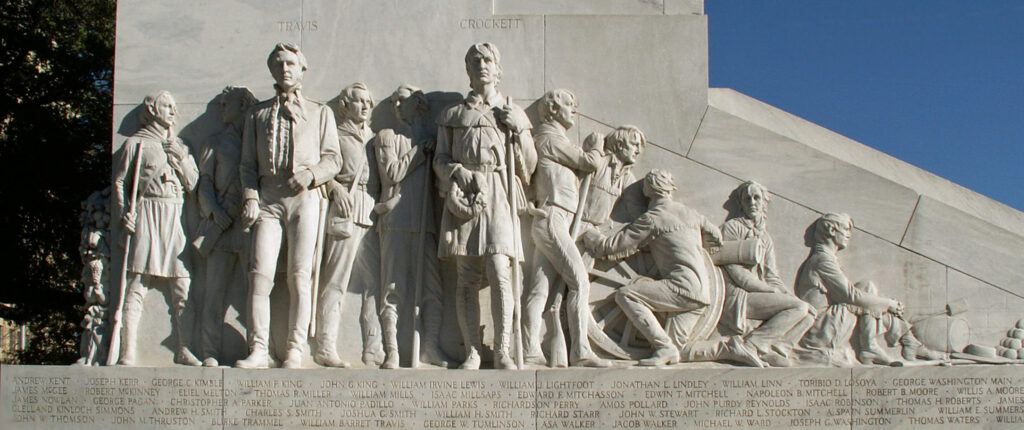
Cenotaph of the Alamo defenders, San Antonio, Texas. Source: Wikimedia Commons
So, there we were standing, cocktails in hand, basking in our success when one of the most stolid of those Daughters came flying across the room—green chiffon flapping and blue bouffant hair trailing in the windstorm she created with her speed. She stopped short in front of us and said, “What do you mean the Alamo is the created myth of Texas?!?!” Paul and I paused. We didn’t know what she was talking about. As we were planted in the middle of a beehive of Discovery executives, neither of us wanted to make a misstep. I gently said, “I’m sorry. We’re not sure what you’re referring to. Can you help us out here?” And again, she repeated, “He” (pointing accusingly at Paul), “said that the Alamo is the created myth of Texas.” And then it clicked with us that what she was referring to were Paul’s opening remarks and the conclusion in Holbrook’s narration. Paul looked relieved when he could report to her, “Oh no, you must have misheard. I said, ‘the creation myth of Texas, not the created myth of Texas.’” Her fury mounted. “You mean you think the story isn’t true?!?!?” she charged. Neither Paul nor I said anything. She continued her attack, “You called it a “myth,” which means you don’t think it’s true!” She wasn’t focused on the creation or created part of the sentence; she was focused on the word myth.
Neither Paul nor I had ever considered that portraying the Alamo story as myth would be a problem. We didn’t think for a moment that the story was factually true. There were but a few survivors of the siege, and their accounts had long been considered suspect. But the “emotional truth” of the story was absolute, and we felt it merited the heraldic treatment we had given it on screen. But for the Daughters, to portray the story as “myth” was tantamount to calling it a “lie.”
The evening devolved from there as the realization of our lack of belief in the Alamo story as historical fact quickly made its way through the grapevine of chiffoned, high-haired ladies in attendance—each one of whom now felt she had been studiously duped by us and by the sleek network executives who had very quickly and unceremoniously fled the room.
Mind you, this wasn’t just a simple Yankee/Southerner cultural misunderstanding. Paul has a lilting accent that betrays his Kentucky roots, and I am a long-time border state girl, born and bred in Missouri. We understood—and have even culturally embraced—the passions that Southerners have with many of their histories, which—like the Alamo— frequently feel so outsized that they can defy credulity. In this case, however, we had never even considered making a film that portrayed the story as true. They had never queried us about our belief (or faith, as they would call it), and we would never have contemplated rendering the story as fact; our innate, unspoken assumptions were simply entirely different from theirs.
Our impulse for using the Alamo itself for production was a search for inspiration conveyed by authenticity, not a commitment to factual depiction. Indeed, the visual style of the film intentionally veered away from reality towards dream-like, ephemeral moments of collective memory. For our part, we found the “truth” of the story in the Alamo as a rich parable depicting tenacity in the face of adversity. Since we never even considered its truth as an option, what we presented on screen was our visual representation of that intention: that it be experienced as myth. Our perceived high-minded stylistic approach notwithstanding, in the view of the Daughters—and to the men who believed themselves to be contemporary incarnations of Bowie, Crockett, and Travis—we were traitors. They had been hoodwinked in plain sight. Of course, that had never been our intention, but there we were—on opposite sides of a cultural belief system as gaping as the Rio Grande itself.
Obviously, we never did cross that divide. They wanted us to believe the story that legions of history lovers and visitors to the shrine have held as true, and we simply didn’t. We felt no remorse about that, and they felt nothing but anger from our dismissal. The film aired, and it was a huge hit for Discovery because it captured, in all its authentic glory, the spirit of the Alamo. At its heart, the film asked the audience to ponder what it would be like to live under siege, when death for your beliefs was all but inevitable. We wanted the audience to posit what that circumstance would be like, and to consider whether there would ever be a cause for which they would make such a sacrifice. That approach seemed sufficient for most general viewers who were less concerned (or, in the case of Southern audiences, didn’t know) about our allegiances; our commitment to the story having been proven by our attentiveness to historical detail and to the genuine spirit of the story. But the controversy taught me something about making films in the South that I have carried forward with me into other projects – and into the world of country music.
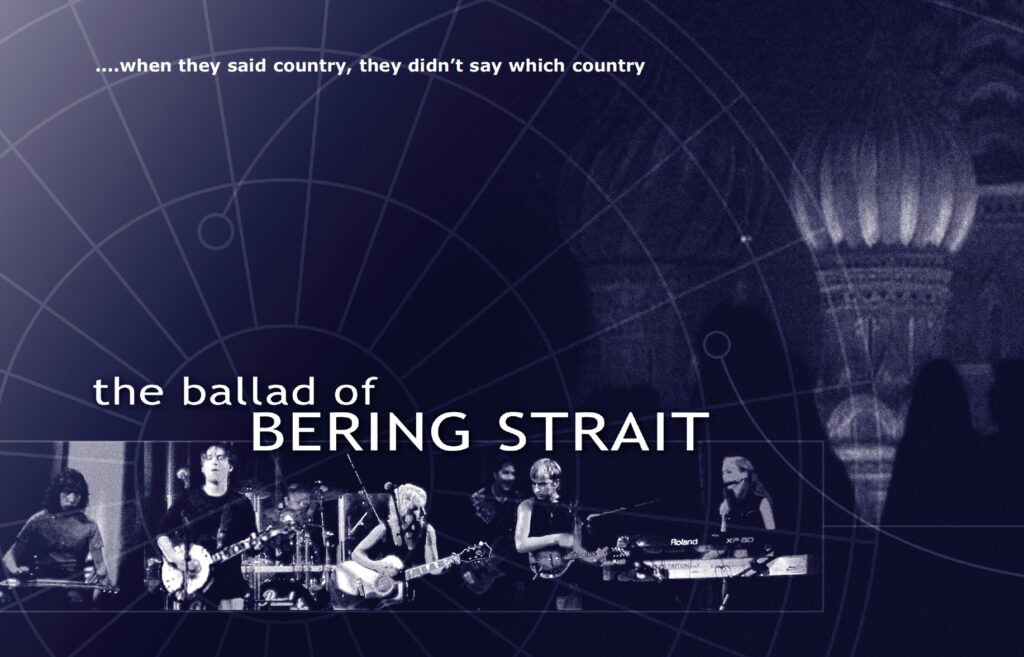
The Ballad of Bering Strait promotional. © Nina Gilden Seavey, 2003.
Some number of years later, I made another film, “The Ballad of Bering Strait.” This time it wasn’t a historical story, but rather one that unfolded in front of the camera (what we call cinéma-vérité). The story explored the musical and emotional journey of seven Russian teenagers who came to America to become country music stars. My experience nearly a decade prior gave me a hook upon which to hang my filmmaker’s hat: could a group of young musicians walk onto Music Row, indeed, perform on the sacred stage of the Grand Ole Opry, and be considered “true country” even if their twang had a Russian accent? Was this only a novelty, almost circus-like endeavor, or was it possible that country music could be exported across the continents, reimagined under the tutelage of the sons and daughters of the Russian intelligentsia, and reimported back to America, particularly Southern country music fans?
Mind you, this wasn’t just any country music group. Each member of the ensemble was a conservatory-educated, classically trained musician who had been brought under the wing of a music teacher who, in the 1990s, had fallen under the spell of American bluegrass and country music. The band’s teacher had found a few cassette tapes in the band’s hometown of Obninsk, a small city about 100 kilometers south of Moscow. Obninsk was a “closed city” in the post-Soviet era, so the tapes were manna from a far-off, inaccessible land. Over several years, the young players learned to imitate every note and its particular tone to perfection.
I found out about the group just as they had been discovered by an American art dealer who finagled a record deal for them with Arista Records in Nashville. As preposterous as the whole set-up sounds, the group’s musical ability was authentic even if their country music roots were decidedly not. The president of Arista Nashville bet on that talent. But the hard-won lesson learned from my battles at the Alamo suggested to me that the question of what was true about the band might become more important than the spirit that they carried with them upon their arrival on Music Row. Within that cultural divide, I bet that an interesting documentary film would emerge.
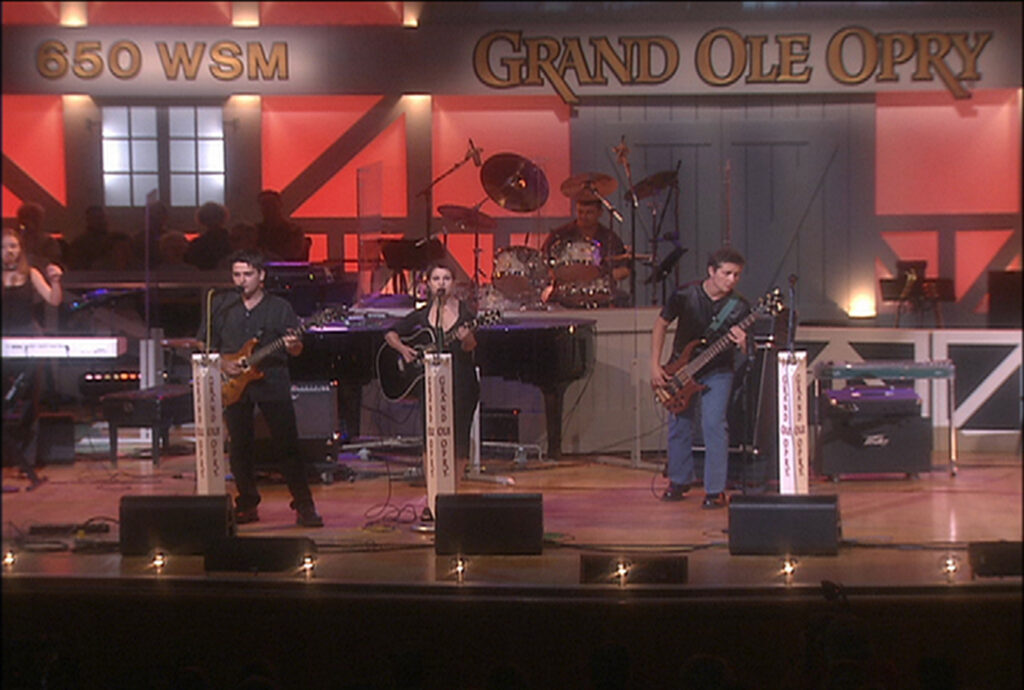
Bering Strait at the Grand Ole Opry in Nashville. © Nina Gilden Seavey, 2003.
I followed the band for three years, from 1999-2001. Their story, like most country music sagas, was full of unanticipated twists and turns and emotional sturm and drang. But that’s no different than the paths of nearly all musical artists. As they say in Nashville, “it takes 10 years to create an overnight sensation.” But this group’s challenges were unique.
In a world where “believing the story of the storyteller” was as important to Southern audiences as its technical delivery, that cultural chasm as large as the Rio Grande that I had met at the Alamo reappeared. In Being Strait’s songs of “lyin’ and ‘cheatin’ and fast cars, and beer” the truth (or the perception of truth) became paramount, specifically to the critical arbiters of success—audiences listening to country music radio. DJ Dan Hollinger of WLX Radio in Lawrenceburg, TN, summed it up best: “I don’t think music by a Russian artist would go in the United States. It’s not so much their vocals, nor the music, nor the lyrics, but the fact that they would be accepted as being from Russia.” This wasn’t a case of xenophobia. This was a question of authenticity, of belief, of faith, and of true stories told by true storytellers. Forget that most musicians don’t necessarily fall into that social or cultural box either. But in the case of Bering Strait, the challenge to the myth of Southern exceptionalism was simply too brazen to ignore.
Granted, some artists have crossed the cultural divide across oceans; most notably Australian phenom Keith Urban. But the outback of Australia shares a pioneer spirit that makes Urban a potentially acceptable stand-in for his small-town country-born musical contemporaries. But Bering Strait? Even their name suggests a bridge to America too far.
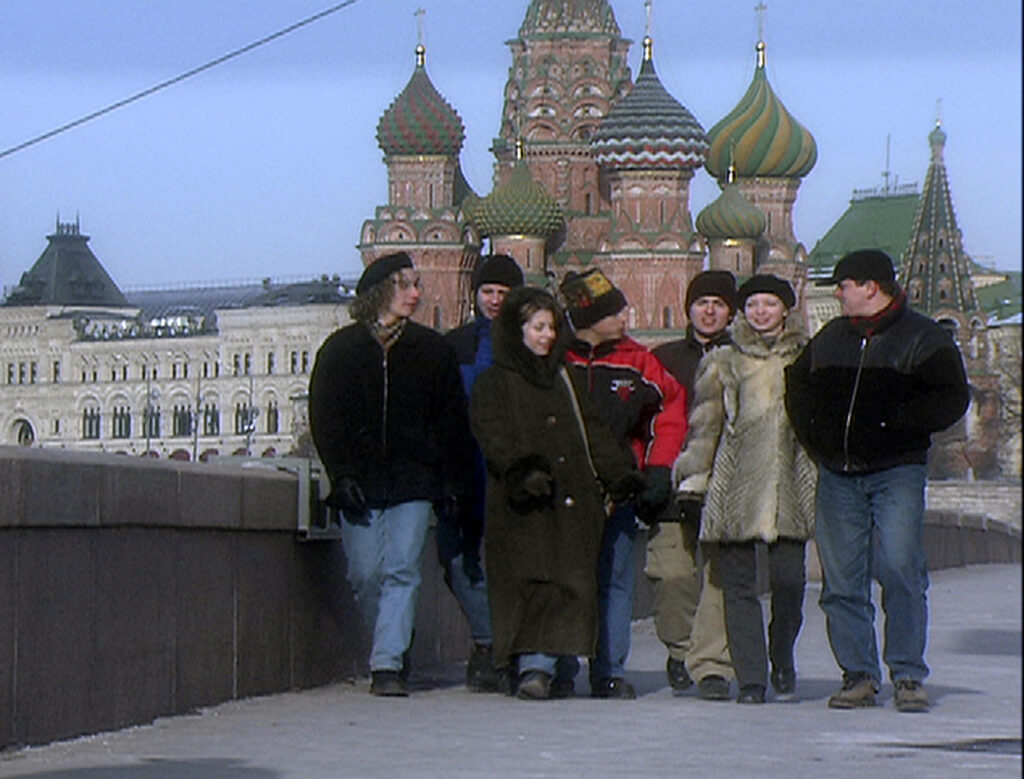
Bering Strait in front of St. Basil’s Basilica in Moscow. © Nina Gilden Seavey, 2003.
When the band dissolved in 2006, only one band member went back to Russia. Their musical acumen was undeniable. They became, in the parlance of the music industry, “session players and sidemen,” musicians who play in recording sessions and appear on stages backing up the more home-grown artists who don’t challenge the “creation myth” of Southern audiences and country radio. These ancillary players are considered Nashville’s best musicians, so the band members have fared well as consistent contributors to the country music sound. Some of them have won major awards for producing and instrumental work. You can regularly see the names Ilya Toshinski, Lydia Salnikova, and Sasha Ostrovsky on the liner notes and in the programs of the biggest acts in country music. But, as a band, the truth of their origin stories was too great a challenge to the stolid belief in the mythology of Southern exceptionalism.
What I hadn’t known was that ours was a losing battle from the outset. Bering Strait’s very existence and Paul’s and my interpretation of the siege of the Alamo were essentially one and the same: a challenge to a traditionalist view of Southern culture and history. Not surprisingly, we encountered the same immutable mountain of core belief in Southern exceptionalism held by a powerful faithful that seek no interference, no revisioning, nor any reinterpretation. It is hard to move civilization forward with such an obstacle so firmly standing at the gate.
Nina Gilden Seavey is an Emmy Award-winning documentary filmmaker, writer, and educator. She is Research Professor Emerita of History and Media and Public Affairs at George Washington University, where she founded and directed The Documentary Center from 1990 to 2020. She is the president of Seavey Media, LLC, and the author of The Documentary Filmmaker’s Workbook.
The views and opinions expressed in this article or video are those of the individual author(s) or presenter(s) and do not necessarily reflect the policy or views of the editors at Not Even Past, the UT Department of History, the University of Texas at Austin, or the UT System Board of Regents. Not Even Past is an online public history magazine rather than a peer-reviewed academic journal. While we make efforts to ensure that factual information in articles was obtained from reliable sources, Not Even Past is not responsible for any errors or omissions.







,_San_Antonio,_Texas,_USA.jpg)