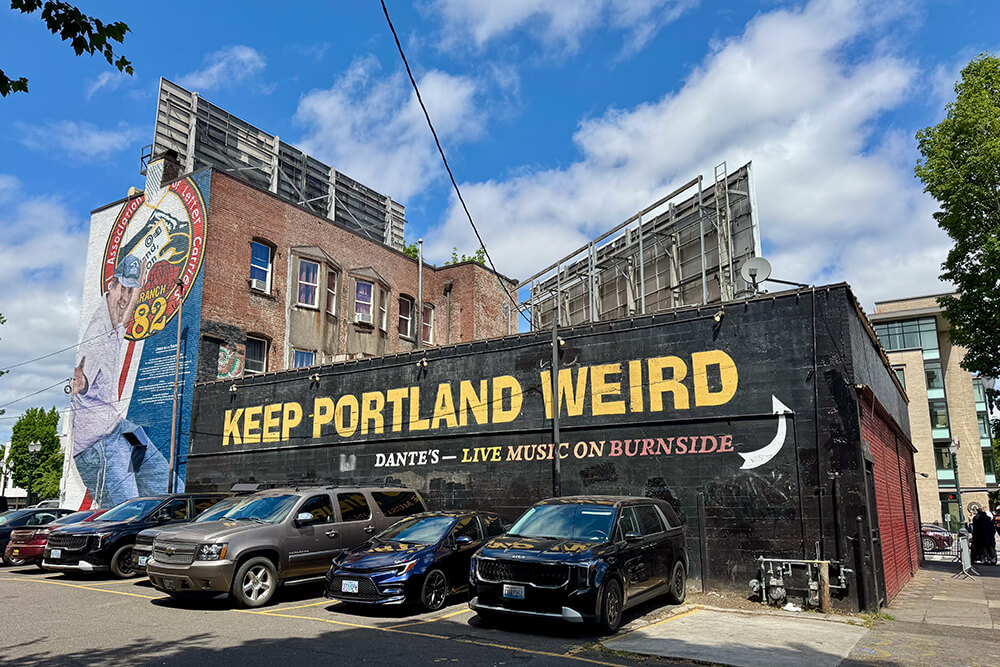

Keep Portland Wierd © Aleney de Winter
Portland, Oregon, has built a reputation for being weird. Look closer and you’ll find something more interesting… a city shaped by individuality, counterculture and a remarkable willingness to let people be themselves.
Most cities want you to arrive with a good excuse for being strange. Portland wants to know what kind of strange, so it can point you towards your people.
Those people might include the guy in the flapping vampire cape dancing down the street like he has somewhere very important to haunt. Or the one dressed as Darth Vader, riding a unicycle and playing bagpipes that shoot fire. Or the man in the purple cowboy hat, well, honestly, purple everything, playing chess with kids at the Portland Saturday Market. They might have blue hair, green hair or neon pink hair. But they could just as easily have mousy brown hair and be wearing a navy twinset and sensible beige trousers, ordering coffee right alongside someone in six layers of velvet and rainbow socks.
Because that’s the thing about Portland, Oregon. Nobody here is particularly interested in asking you to tone yourself down. Or up. Nobody’s asking why, full stop. Portland has spent decades making room for the oddballs, outsiders, artists, activists and people who simply don’t fit neatly into the box. The weirdness is what you see. The acceptance underneath it is what makes the city interesting.
And maybe that’s why the only question anyone seems interested in asking in this city is what you’re doing later… and whether you’ve eaten, which, let’s face it, is probably going to be somewhere weird.
A history of acceptance

Steel bridge in Portland’s historic Old Town © Aleney de Winter
The instinct for making room for people who don’t quite fit goes back a lot further than the Keep Portland Weird bumper stickers you see slapped on every second Subaru.
In Old Town, the city’s historic core, you can still trace the outlines of an earlier Portland shaped by logging and timber workers dragging felled trees down greased wooden skid roads towards the mills. When the work dried up, those same workers ended up in the cheap hotels and saloon-heavy streets nearby. By the 1890s, the neighbourhood had acquired the name Skid Row, a phrase that would eventually travel far beyond Portland to describe places where hard luck had gathered. My point isn’t that Skid Row was some early example of Portland being wonderfully accepting. That would be pushing the history too far. The point is that Portland’s story has long involved making physical and social room for people living outside the polished mainstream.
In 1970, Portland pulled off something that sounds less like political smarts and more like the local government had been gargling bong water. You see, Nixon was due in town. The FBI told Oregon Governor Tom McCall that tens of thousands of anti-war protesters might show up at the same time, with the kind of powder-keg potential that had turned the 1968 Democratic Convention in Chicago into a literal bloodbath. But McCall’s move was not to lock the city down. Instead, he handed the hippies a state park. The result was Vortex I, which ran for a week at Milo McIver State Park, with the state paying for it and police instructed to intervene only when things became genuinely dangerous. Bands played. Food co-ops fed people. Community clinics treated the crowd. Somewhere between 30,000 and 100,000 people showed up. Nixon cancelled his visit. McCall figured he’d just destroyed his political career. He won re-election in a landslide. Duh.
Portland, out loud

Alberta Arts District © Aleney de Winter
The same instinct shows up in Portland’s queer history, although here the story is less about one left-of-field political stunt and decades of people simply refusing to disappear. Sam Adams became the first openly gay mayor of a major American city in 2008.
Long before that, for more than fifty years, Walter Cole performed as Darcelle XV at the club that carried his name, working his way from local curiosity to load-bearing civic institution. Darcelle XV Showplace eventually landed on the National Register of Historic Places, while Cole was recognised by Guinness as the world’s oldest performing drag queen before his death in 2023. When he died in 2023, Portland named a downtown plaza for him, carving his name permanently into its own map.
Portland never developed one neat, designated gay village. Queer life spread through the city instead, becoming part of the broader anything-goes character, and that same sense of acceptance is still visible everywhere from Harvey Milk Street in downtown to Alberta Street in Northeast Portland, where queer-friendly businesses, artists and performers sit comfortably alongside galleries, vintage shops, bars and the neighbourhood’s general bohemian chaos.
Keep Portland Weird
There’s something wonderfully Portland about the way all its history just sits next to itself, unbothered. A drag performer becomes a civic landmark. A Republican governor solves a protest crisis by throwing a festival. A record-store owner decides his city needs more weird and starts printing that opinion onto bumper stickers.
That record-store owner was Terry Currier, who in 2003 started handing out Keep Portland Weird stickers, an idea he’ll happily admit he nicked straight off Austin. What started as a scrappy small-business campaign to keep people shopping local mutated into something bigger, and somewhere along the way it stopped being about commerce entirely and turned into a civic permission slip. And Portland has never been particularly subtle about what that permission looks like.
Where weird gets to thrive

Paxton Gate © Aleney de Winter

Making room for people with unusual ideas shows up in the places Portland has allowed them to create. Weird isn’t tucked away in some designated corner of town. It gets a shopfront, a museum, a patch of riverbank, a cinema, a garden or whatever other space someone can dream up and persuade the city to leave alone.
There’s the Freakybuttrue Peculiarium, a museum crammed with aliens, a life-sized Bigfoot and an entire alien autopsy set up for photos. The gift shop alone is worth the visit for the sheer volume of things you didn’t know you needed. Over on Mississippi Avenue, Paxton Gate serves up soaps, scents and candles alongside taxidermy giraffes and mounted beetles, all displayed with the calm of a shop that may just be the secret love child of Martha Stewart and Morticia Addams.
Then there’s McMenamins Kennedy School, a former elementary school that sat empty for nearly two decades after it closed in 1975. The neighbourhood fought to save it, so McMenamins turned it into a hotel, with the chalkboard-filled classrooms now guest rooms, the cafeteria a restaurant and quirky themed bars tucked into various corners. Even the old girls’ bathroom has been repurposed and is now a brewery, which feels like a fairly Portland solution.
Twenty minutes north of the city, out on Sauvie Island, where the farmland meets the river, someone, or thing, dragged an old boat out to sit in the shallows, spray-painted to look like a crashed UFO, and just left it there. Nobody claims it, nobody explains it, you just walk through a stretch of trees near the beach…. and there she is in all her clapped-out spacecraft glory.
Back in town, Movie Madness holds more than 90,000 titles on actual physical media, but the real reason to go is the glass cases scattered through the store, the actual knife from Psycho, a bar of soap David Fincher personally donated from Fight Club and a prosthetic ear from Blue Velvet that reportedly still has some of David Lynch’s real hair stuck to it. Keep walking towards the back and you’ll hit a section labelled, with zero irony, Bizarre. Because things can always get weirder in Portland.
Even little weirdos are catered to in Portland. The Portland Aquarium has never had a single fish in it. No tanks, no water, not even a puddle, just one local artist’s six immersive biomes of hand-drawn sea creatures with their own soundtracks and a hidden character the kids hunt down room by room. It’s basically the vegan version of an aquarium… all imagination, zero animals and beloved by kids and their grownups alike.
Trolls and Leprechauns and Witches, Oh My!

The Witch’s House. Photo by Li-Ling Chang on Unsplash
The same impulse that makes room for a man in a purple cowboy hat also makes room for a bridge nobody’s allowed to explain. Not every bit of Portland’s weirdness needs a name or a face. Some of the best of it is just whimsy left out in the open for anyone willing to go looking.
Somewhere on a quiet railway trestle at the edge of town, for no reason anybody’s ever properly explained, people have spent years tying tiny plastic trolls to the underside of the bridge, one at a time, just because.
Mill Ends Park is a a two-foot-wide patch of Portland pavement that spent decades claiming the title of the world’s smallest park… until a patch of ground in Japan finally pipped it in December 2024, with Guinness recognising the new record in 2025. It began when journalist Dick Fagan looked out his office window in 1946, spotted an empty hole in the road median where a light pole was supposed to go and decided a leprechaun had granted him a park. He planted flowers, named it Mill Ends and gave the resident leprechaun, Patrick O’Toole, a backstory. Over the years, the tiny park has hosted snail races, rose plantings, a butterfly swimming pool and, in a feat of completely unnecessary engineering, a miniature Ferris wheel lowered in by crane. Because Portland always commits hard to the bit.
The city’s whimsical streak doesn’t stop there. Deep in gorgeous Forest Park sits the Witch’s Castle, a mossy stone ruin that looks like it should be home to a coven of witches, a troll or at least a grumpy goblin. But it is simply a former public toilet, abandoned and later christened the Witch’s Castle by teenagers who apparently looked at a derelict shitter in the woods and thought, yep, that’s a witch’s castle. Because give Portland a crumbling toilet in the forest and they can even turn that into folklore.
Let it all hang out

Zoobomb Pyle © Aleney de WInter
Once a year, the city really lets it all hang out. Literally. More than 10,000 people nude up for the World Naked Bike Ride, technically a protest against oil dependency, but mostly just an excuse to be gloriously, defiantly starkers in public.
Every Sunday night, a different crowd rides kids’ bikes, the smaller the wheels the better, down from the zoo through the West Hills in the pitch dark at speeds that should really require a licence. It’s called Zoobomb, and the city liked it so much they commissioned a seventeen-foot sculpture downtown just to store the tiny bikes in between rides, a gold-plated toddler’s bicycle mounted on a spiral pillar in the middle of a traffic island. Somewhere a city planner signed off on that with a completely straight face.
In April, a third crowd descends on a leafy roundabout in Ladd’s Addition for the Ladds 500, where the whole point is riding around the same roundabout 500 times, dressed as dinosaurs, gnomes or whatever else seemed like a good idea that morning, under a motto the organiser is happy to put his name to…. let’s do something stupid,
And come August, fully grown adults haul homemade soap cars; past entries have included Batmobiles, Flintstones cars and a giant slice of cheese driven by two helmeted mice, to the top of Mt Tabor and let physics do the rest while everyone else drinks and watches from the grass.
Eat weird

Hawthorne Asylum © Aleney de Winter
Even the food here comes with an invitation attached. Whatever you’re hungry for, however strange your taste runs, there’s a plate, a cart or a whole neighbourhood in Portland built specifically to feed it. There are food-cart pods that turned spare patches of asphalt into places where cooks could build businesses without first finding the money for a traditional restaurant. Hawthorne Asylum is one of the biggest, with more than 20 carts, a beer hall, fire pits and coffee served from an actual aeroplane fuselage. And yes, it is named after the asylum that once stood on the site because Portland saw no reason to let a perfectly good former psychiatric hospital go to waste.
Near the Burnside Bridge, which separates Portland’s east and west sides, there’s Voodoo Doughnut, and at 1am the queue still snakes down the block, like everyone in it has been personally hexed into doughnut obsession. Across the road, the Keep Portland Weird mural looks straight down the queue, like it’s keeping tabs. Their most famous doughnut is shaped like a little voodoo doll, jam leaking out where a pretzel stick’s been jammed through it like a stake through the heart. Good for you? Absolutely not. Worth standing in line at 1am for? Obviously. Did I buy the T-shirt too? Also obviously.
Around the corner is a custard shop that isn’t just a custard shop. Order your ice cream at Black Cat Frozen Custard like a normal person… or whisper the right password and a door swings open onto Conspirator’s Coffee, a full speakeasy dressed up like somebody’s snowbound Victorian drawing room. Then there’s Raven’s Manor, a haunted mansion cocktail bar that takes the opposite approach. There’s no secret door because the whole place looks like it might already be hiding a body. Filled with haunted dolls, gothic rooms and bartenders serving cocktails in smoking beakers and skulls, there’s even an interactive elixir experience involving a fictional 19th-century doctor who kidnapped his guests and experimented on them in pursuit of immortality. Because Portland looked at the idea of a normal cocktail bar and thought, no, what this really needs is a deranged Victorian physician.
And if you’re vegan, vegetarian, or just done pretending a lettuce leaf counts as a starter, Portland rewards with meat-free, dairy-free, entirely plant-based everything and manages to make it feel like the main event rather than the sad table in the corner. There’s a vegan strip club here. Yes, a vegan strip club. There are scores of restaurants doing it properly… and serving everything from vegan tacos and ramen to Southern fried “chicken” that’ll have you double-checking the menu. For people who scour other cities for a single decent cube of tofu, this is basically the promised land. Whatever you eat, or don’t, you’ll find a seat at the table.
What makes Portland different?

Portland Saturday Markets © Aleney de Winter
Portland’s weirdness isn’t really about being strange for the sake of it. It’s what happens when people are given a bit of room to be themselves, whether that’s an artist with an idea nobody else quite gets, a drag queen who becomes a civic institution or a bunch of cyclists who think riding tiny bikes downhill in the dark sounds like a perfectly sensible Sunday night. The weirdness is the visible bit. The willingness to make room for it is what matters.
Of course, none of this means Portland is some flawless utopia where the world’s most glorious weirdos hold hands singing kumbaya beneath a rainbow. The city has had its share of serious problems, including downtown vacancies and social challenges that have tested the very idea of the welcoming city it sees itself as. But it hasn’t lost the need to make room for people, ideas and odd little corners of life that might get flattened elsewhere.
Maybe that’s what makes Portland interesting. Not the fact that it’s a little weird. Plenty of places have weird people, weird museums and people willing to set their own musical instruments on fire (well, maybe not that). Portland’s trick is making the weirdness feel like belonging.
So many people who call this quirky city home weren’t born here. Portland has long been a city of transplants. And that’s not really about location or cost of living. Though nobody’s going to complain about either. It’s because this is a place people move to when wherever they started out didn’t quite know what to do with them. Portland didn’t ask any of them to arrive polished or explain themselves before they were allowed in. It invited them to come as they are.
Somewhere among the drag queens, the hippies, the food-cart obsessives, the book nerds, the record-store romantics and the 10,000 people who turn up naked on bicycles every June, I stopped looking at Portland as a city and started seeing it as a collection of people who had figured out how to leave a little room for one another.
And it turns out, that room was big enough for me too.
 An award-winning travel writer and photographer, Aleney de Winter was fresh from school when she first set off to explore the far reaches of Australia with a two-man tent and a beaten-up Kingswood for company. Three decades, and two kids later, and she’s still on the go, with her itchy-footed offspring in tow.