When I say pistol shrimp, you say watchman goby. Right? But not all shrimp belonging to the genus Alpheus actually pair up with gobies. Some pistol shrimp are loners. A few associate with anemones. There’s one that prefers corals, and even one that lives with a crab.
The “other” pistol shrimp aren’t commonly seen in the aquarium hobby. They do pop up in shipments from time to time, however, or you might come across one as a hitchhiker if you’re lucky. Let’s meet a few gobyless pistol shrimp that prefer symbioses of a different kind!
Coral pistol shrimp (Alpheus lottini)
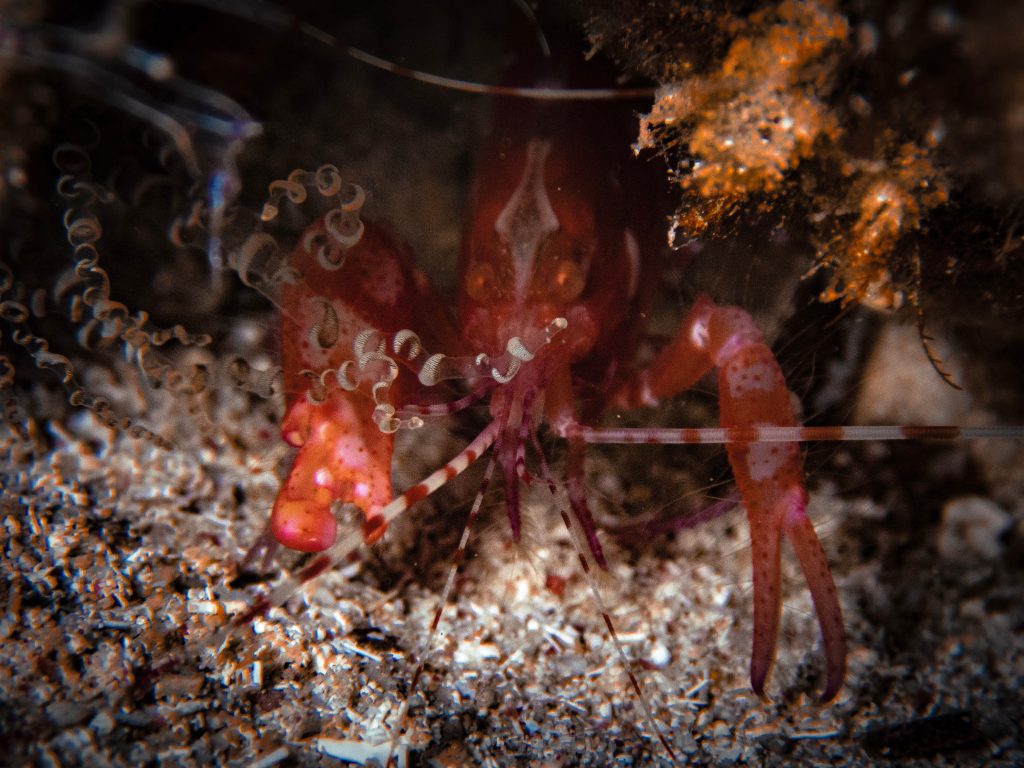
Did you know that on wild reefs, each branching coral forms its own little universe? Their ramified structure and tasty mucus attract a wide range of critters, from crabs to gobies to bivalves — and a pistol shrimp, too. The coral pistol shrimp, Alpheus lottini, rarely strays far from its pocilloporid host. It has even learned to “speak crab-ese”, coexisting peacefully and sometimes working with colorful trapezoid crabs to protect the corals from corallivore crown-of-thorns starfish.
Protection and defense aren’t the only ways in which coral pistol shrimp interact with their host. They also feed on it, but not in a way that makes one clutch their precious coral colony in fear: they go for the lipid-rich mucus the coral excretes to protect its own tissues. It probably doesn’t mind losing some of this gunk, because the shrimp more than make up for what they take by reducing the amount of harmful sediment stuck to its branches.
If you’ve got a sizeable cauliflower (Pocillopora) coral colony, such as P. damicornis, you can give the coral pistol shrimp a try. It’s not exactly a staple invertebrate, but it does come in as a hitchhiker on (coral) shipments from time to time. You may be able to source one with a little effort and patience.
Anemone pistol shrimp (Alpheus armatus complex)
A pocilloporid coral’s branches offer excellent hiding places for species that want to rely on stealth to avoid predators. But what if you prefer brawn? An anemone can be just the thing to send hungry fish packing. The Alpheus armatus species complex, consisting of five snapping shrimp species, has realized the advantage of living among these cnidarians’ stinging tentacles.

Red snapping shrimp (Alpheus armatus) hiding in a corkscrew anemone in the Caribbean Sea, south shore of Roatan, Bay Islands, Honduras, Central America
Snapping shrimp aren’t the only anemone symbionts — cleaner shrimp like Ancylomenes also compete for anemone real estate. But whereas the cleaners are considered commensal, meaning they derive benefit from the symbiosis but the host doesn’t, snapping shrimp are decidedly mutualistic. They more than make up for the protection afforded by the anemone’s nematocysts by keeping it clean and eating its biggest enemy, the bearded fireworm.
Although neither is common and you might have to do some serious searching to find them, two species in the armatus complex have been known to pop up in the aquarium hobby: the original, A. armatus (sold as the anemone pistol shrimp), and the blue-legged pistol shrimp, A. immaculatus. They’re often mixed up, but given they both sport fantastic colors and patterns, I’d say it doesn’t really matter which one you end up with.
Aquarists often avoid anemones because they can be a nightmare to maintain. Both these anemone symbionts conveniently shack up with one of the easier species, however. Their host, the small curlique anemone, Bartholomea annulata, looks fantastic and makes an excellent beginner anemone.
Bigclaw snapping shrimp (Alpheus heterochaelis)
Although it’s not a species that pops up in the hobby very often, at least not on purpose, aquarists have reported the hefty bigclaw snapping shrimp hitchhiking into their tanks. That’s not a bad thing! This burrowing species isn’t just fascinating but also incredibly versatile, adapting to a wide range of temperatures and salinities.
Wild bigclaw snapping shrimp are sometimes found living with small xanthid mud crabs, particularly Panopeus herbstii (the black-clawed mud crab). The crab probably doesn’t derive any benefits from this symbiosis, but the shrimp does: it doesn’t appear to be able to dig its own burrow, so it has to rely on hidey-holes dug by other species.
Mud crabs are rarely kept as pets. They sometimes pop up as hitchhikers, but like most crabs, they’re known for causing mayhem in community systems and considered very bad news. That doesn’t mean you can’t keep the shrimp, though.
I suspect the main reason bigclaw snappers aren’t more popular in the hobby is because they don’t normally leave their burrows much, which gets boring quickly. There might be a solution, though: I’m thinking a 3d-printed tunnel buried under the substrate against the front aquarium panel (ant farm-style, basically) could be just the thing. Feeding the shrimp won’t be a problem, as it should take any kind of meaty food. It does hunt other invertebrates and is liable to shoot shrimp and crabs with its oversized claw, so it’s best kept with fish tankmates only.
Conclusion
Pistol shrimp that associate with gobies dominate the hobby, but they’re not the only symbiotic Alpheus out there. If you come across a coral or anemone shrimp, bringing it home will allow you to observe a different kind of symbiosis very few aquarists get to enjoy. Bigclaw snappers unfortunately can’t collaborate with their favorite crabs in our home tanks, but can still make an interesting and uncommon addition to your reef or FOWLR.
Sources & further reading
McKeon, C. S., Stier, A. C., McIlroy, S. E., & Bolker, B. M. (2012). Multiple defender effects: synergistic coral defense by mutualist crustaceans. Oecologia, 169(4), 1095-1103.
Jonsson, L. G., Lundälv, T., & Johannesson, K. (2001). Symbiotic associations between anthozoans and crustaceans in a temperate coastal area. Marine Ecology Progress Series, 209, 189-195.
Knowlton, N., & Keller, B. D. (1983). A new, sibling species of snapping shrimp associated with the Caribbean sea anemone Bartholomea annulata. Bulletin of marine science, 33(2), 353-362.
Rodriguez, L. (2020). PREY CAPTURE AND RELATED BEHAVIORS OF THE BIG CLAW SNAPPING SHRIMP, ALPHEUS HETEROCHAELIS (Say, 1818)(Crustacea; Decapoda; Alpheidae).
Rouzé, H., Knowlton, N., Anker, A., Hurt, C., Wirshing, H. H., Van Wormhoudt, A., & Leray, M. (2024). An integrative phylogeography for inferring cryptic speciation in the Alpheus lottini species complex, an important coral mutualist. Iscience, 27(10).
Silliman, B. R., Layman, C. A., & Altieri, A. H. (2003). Symbiosis between an alpheid shrimp and a xanthoid crab in salt marshes of mid-Atlantic states, USA. Journal of Crustacean Biology, 23(4), 876-879.
Simoes, N. The Importance of Home Cleaning: Sediment Transport by Alpheid Shrimps Provides a Competitive Advantage to Their Host Anemones. Frontiers in Marine Science.
Stier, A. C., & Osenberg, C. W. (2024). How fishes and invertebrates impact coral resilience. Current Biology, 34(13), R613-R615.