CULTIVATING QUESTIONS
Concerning the Bio-Extensive Market Garden
by Anne & Eric Nordell of Trout Run, PA
My wife Kristan and I milk 45 goats in Northern Vermont and process all of our milk into a variety of organic goat cheeses. We recently purchased a team of Percherons and have been using them for logging and spreading manure. We are also planning on using the horses to cultivate a variety of different forage crops for our goats which they would graze. This year we experimented with forage turnips. Our pastures are very high protein but low energy and we hope to fill the void with turnips and other crops. Next summer we will experiment with small grains mixed with peas.
We are also planning on moving our vegetable garden which has billions of weeds from our neglect. I quit my teaching job last June and Kristan and I are now both full time on the farm. This will hopefully enable us to keep on top of the garden and the weeds (with the help of the horses).
We are eager to employ some of your techniques used in conjunction with our livestock to produce more produce and less weeds. We also have other cultivated land that could be brought into the rotation. Time permitting, any thoughts you have on how your system might be modified with the use of livestock would be appreciated.
Thank you for your contribution to sustainable agriculture.
Regards,
George van Vlaanderen
East Fairfield, VT
Unfortunately, our experience with grazing livestock in the market garden is limited to using our small flock of laying hens for chicken tillage and slug patrol. (See “Problem Solving Reduced Tillage Systems” in the Spring 2004 SFJ.) Fortunately, our good friend, David Fisher, has been gracious enough to write up in detail how he manages the cover crops at Natural Roots CSA for livestock forage.
David’s system of overseeding vegetables with a poly-culture of perennial forages seems like the perfect model for integrating animals with market gardening. In our minds, grazing animals on perennial fallow year cover crops also takes the bio-extensive method to the next level by enhancing soil quality, saving labor and reducing fertility inputs.
The only thing we might add, regarding the van Vlaanderen’s questions, is that a quick fallow year succession of annual cover crops, such as forage brassicas, buckwheat and BMR sorghum-sudangrass, might provide a better energy balance for the dairy goats and realize a faster reduction in weed pressure.
For example, recent research at the University of Maine and Penn State showed that a fallow year cover crop sequence of spring brassicas followed by summer buckwheat followed by fall brassicas led to a much greater reduction in germinable foxtail and velvetleaf seeds in the soil than a full fallow year of perennial red clover. (A fallow year comprised of two annual cover crop mixes, such as oats and peas followed by rye and hairy vetch, resulted in an intermediate number of surviving weed seeds.) Although the weed competitive, allelopathic properties of the buckwheat and brassicas may deserve some of the credit, the researchers determined that the three periods of weed stimulating tillage required to establish and replant this succession of annual cover crops was the primary reason for the significant reduction in the weed seed bank.
Note: According to Thomas Bjorkman at the Geneva Experiment Station, buckwheat can be used as an emergency forage crop, providing 2-3 tons of dry matter with 15-20% crude protein and 140-150 relative feed value just six weeks after planting. However, buckwheat should not exceed 30% of the livestock ration or a skin sensitivity to sunlight, called fagopyrism, might develop.
A couple of forage seed catalogs we receive tout that sorghum-sundangrass can rival corn silage in energy production per acre and even enhance livestock’s ability to utilize the energy in grass pasture. Caution should be exercised when grazing this fast growing, drought resistant forage to prevent prussic acid poisoning after frost or nitrate toxicity as a result of drought conditions, overfertilizing, prolonged cloudy weather or insufficient regrowth. Horses should not pasture sorghum-sudangrass under any circumstances.)
Our suggestions for meeting the high energy needs of dairy goats while knocking down the weed seed bank in the soil are purely speculative. David’s article contains the voice of reason and experience. It also assumes a working knowledge of the bio-extensive rotation. New CQ readers may find the revised booklet and DVD helpful in getting up-to-speed on the principles and practices of bio-extensive market gardening. See the “Weed the Soil, Not the Crop” ad in this issue.

The Sheep Are In The Garden!
Integrating Livestock In The Bio-Extensive Market Garden at Natural Roots Farm
by David Fisher & Anna Maclay of Conway, MA
At Natural Roots we raise produce for our CSA program with the help of our four year old daughter, one to three apprentices, and four workhorses. The produce we raise feeds about 180 local families, plus many people in need in the area. We till seven acres, following a Nordell-style rotation, with half of the land in vegetables and half in a fairly active “fallow” period. Since our beginnings here, about 10 years ago, we have integrated livestock into our operation. We try to manage both the livestock and the cover crops they graze on to help us achieve some of our goals: to maximize fertility and productivity, to improve soil structure, and to minimize weed pressure. First we will give a run down of some of the different cover crops we’ve tried and our experience with grazing them. Then we’ll share some details that we think are important in managing these cover crops in the context of our annual vegetable rotation. Lastly we will share some of our experiences with grazing different livestock on these fallow fields.
FORAGES – We have experimented with many different cover crops in our vegetable rotations, and have tried grazing several of them.
Winter Rye & Hairy Vetch
We have tried extending our grazing season on winter rye and hairy vetch stands. Though this is often the best-looking forage late into December and in late April / early May, we have a few reservations about grazing it in our system. One is that we’ve noticed that given a choice, the animals will graze a mixed grass / legume sod to the dirt before filling their bellies on the rye. Though they will eat it, the rank aroma of freshly grazed rye in spring combined with the loose bowels of the animals grazing on it make us think that it may be hard on the digestion. In the spring it would be the very first forage for new lambs and their mothers, who go straight onto pasture 24 hours a day after coming off of a winter diet of dry hay, so we have chosen to ease them into the grazing season on a mixed pasture of grass and legumes instead, even if it means waiting a week. If we had the option of easing them onto rye and vetch for an hour or two per day for starters, they may adjust more smoothly. On the other end of the season, using rye and vetch in the late autumn seems less harsh on the animals because they are well adapted to a variety of forages by then and the growth seems to be less lush than that of early spring. However, in our flood-prone bottomland we have been convinced that it is wiser to leave our fertility rooted to the earth and the soil as thickly carpeted as possible for the winter, rather than converting our cover crops to buoyant and nutrient-volatile manure, which will quickly depart for Long Island Sound when flood waters sweep over our fields. Even when root growth and stubble are left behind, soil is more likely to be washed away with less topgrowth cover, whereas we are more likely to gain silt where we have a more coarse and thick cover protecting the soil surface.
Oats & Peas
We don’t generally plant oats and peas in the spring, or if we do plant oats, they are destined for a grain or straw crop that we don’t want to compromise by grazing. We have grazed oats and peas in the fall, but again, the concerns of leaving the fields more vulnerable to flooding apply here as well. Even without flood danger, we would be hesitant to graze off the oat and pea cover late in the season because winter weeds tend to establish themselves given the opportunity of open soil. If winter weeds do establish, then we find ourselves tilling more aggressively than we’d like in the following spring to create a clean seedbed in these early vegetable fields. This defeats part of the purpose of planting these winterkill covers in the first place, which is to be able to till minimally and shallowly the following spring before our earliest plantings.
Millet
We have experimented with this heat-loving, quick-growing forage to boost production during the traditional “summer slump” that many cool season native pasture grasses experience. Though it was productive, we soon found that without very careful attention the millet can make a lot of viable seed quickly. We are reminded of our millet experiment of 2004 to this day when we cultivate out volunteers from our row crops in those fields. We also felt that the value of its production did not outweigh the cost of the tillage involved before and after this crop in our already-too-busy summer schedule. Sudex is another annual forage that fits a similar bill, but is less quick to bolt.
Buckwheat
We have never been brave enough to graze buckwheat after reading some extension material on the hazards that buckwheat poses to sheep. However, we have friends in Maine who report grazing sheep on buckwheat with no problems.
Clovers
As most shepherds are aware, grazing high concentrations of clover will cause bloat, a possibly fatal condition, in sheep. I found this out the hard way early on and have never grazed pure clover stands since.

Forage Mix
You may be wondering by now what exactly we do graze, if not any of the above. We have found great success in establishing, growing, and grazing our forage mix. This forage mix started out some years ago as a combination of Perennial Rye Grass, Medium Red Clover, and a Ladino (white) Clover. Initially we started with recommended ratios and found that, despite the predominance of the rye grass, our sheep were having bloat problems. We cut the amount of clover and have finally arrived at a ratio that seems safe to graze.
We also started out using recommended seeding rates, but realized that overseeding vegetables is a very different matter from seeding a prepared and uniform seedbed. We have more than doubled our seeding rates since we first began in order to get an adequately thick stand of forage mix that can out compete weeds for it’s duration, which is up to two years, before it is plowed under. We added a forage chicory to diversify the stand and to bring a broad-leafed, quick-growing weed-competitive player to the team, bringing our current mix to the following recipe seeded at 40 lbs per acre (for overseeding into vegetables): Perennial Rye Grass, variety BG34 (late-maturing) 84%; Forage Chicory 4%; Medium Red Clover 8%; Ladino White Clover 4%.
This fairly diverse mix generally ensures good cover in a variety of weather, overseeded crop, and soil conditions. Certain conditions will favor different components of the mix. For instance, forage mix frost seeded into winter rye and vetch in March or seeded with an oat nurse crop, though they will persist nicely after we harvest off these cereal crops for straw mulch or as animal fodder, tend to be heavier on the clovers and lighter on the grass, which seems not to like the low light conditions in the under story of the grains for their establishment. Another field came in very heavy on the chicory for unknown reasons. The bottom line is that in a diverse mix, there is bound to be at least one component that is thriving, if not all.
I especially like this forage mix because of its effect on the soil. Of the eighteen to twenty different cover crop species we’ve experimented with, I don’t believe we’ve found any that rival the soil building power of this mix. The perennial rye grass develops an impressively dense and fine root system that creates millions of tiny channels in the soil. This plant seems to produce the most carbon underground in the mix. The clovers have a fine taproot, and, of course, work hard to fix nitrogen to fuel this and subsequent crop growth. The chicory always impresses me with its phenomenal taproot. I never have endeavored to dig it up in its entirety, but I know that where I plow this sod at 7” – 8” deep the chicory root is still about a ½” thick! I can only imagine how many feet it plunges down through the soil layers, opening up vertical channels for air, water, and soil life to travel through freely.
I also like the forage mix for its benefits to the sheep. Grown on our high fertility vegetable land, it is the most productive and highest quality of all the forage we graze (including permanent pastures). The chicory is said to have anthelmintic (anti-parasite) qualities due to its high tannin content. Though we haven’t exactly found it to be a cure-all for parasites, we hope that it might help control them to some degree. It is also a bitter, and I can’t help but wonder if it stimulates digestion in the sheep, as bitters are known to do in humans. We find the only shortcoming of this mix to be the relative period of dormancy that the rye grass goes through in mid-summer. For this reason, we will adjust our mix to include a wider variety of grasses in 2008.
Hay Mix
We have just begun to experiment with a fairly generic hay seed mix which includes an assortment of grasses such as Orchardgrass, Timothy, and Perennial Ryegrass as well as a mix of white and red clovers. Although similar to our forage mix, it lacks the chicory and has less clover. Though the hay mix will not provide the benefits that these components lend in the forage mix, it does give us greater flexibility in management. Because the cropland is our most fertile and productive of all the land we manage, the forage sown there is prolific. In some years we can graze a field four or more times. The downside of this is that with each subsequent grazing our sheep are re-exposed to infestation from parasites. The main benefit of the hay mix is that we can graze one crop, then mechanically harvest the next crop with the horses and still feed it to the sheep (or horses) in the winter without the danger of parasite infestation (as parasite eggs and larvae do not survive in dry hay). Furthermore, taking a cutting of hay can help to “clean” a field of parasite larvae, which do not survive the haying process in the field very well either.
The seed cost for our forage mix ($90 to the acre) and the hay mix ($110 per acre) might seem alarming as compared with something like winter rye at about $16 per acre, depending on seeding rates, shipping costs, etc. However, we must consider the host of uses and benefits that we realize from these mixes that we haven’t found in any other cover crops. In addition to those mentioned above, one might consider the cost of additional pastureland that is saved by grazing forage crops in the fallow fields (or the loss in sheep production if additional land is not available and therefore fewer sheep are kept).
In our case, in 2007 we estimate our flock of 15 ewes and their lambs to have consumed 18% of their forage from our fallow fields, which represent only 15% of the total land they grazed. The remaining 82% of their forage was consumed from permanent pastures of varying quality, which represents 85% of the total land grazed. Put more concisely, our fallow fields were about 25% more productive than our average permanent pastures. Our guess is that this has largely to do with the fact that our high-value vegetable crops have warranted high inputs in the form of manure, compost, rock minerals, inoculants, and other amendments. Our small livestock enterprise, because it yields relatively little income as compared with the vegetables, and because it is based on a much larger acreage, has not warranted the same kind of costly inputs. Where the two overlap, however, there is a significant benefit to both enterprises.

Establishing the Forage Mix
We overseed our cover crops into our vegetable rows at the time of the last cultivation of the crop. Our forage mix can be expected to establish well enough to survive the ensuing winter if seeded by mid to late August in our climate. Because one of our ½ acre fields can have up to two dozen different crops growing side by side, we often seed one bed at a time, based on the stage of growth of each crop. As part of our Sunday evening field walks we decide which beds are ready to be overseeded in the coming week. After determining the correct amount of seed per bed at the beginning of the season, we make a scoop out of a plastic yogurt container, trimmed to hold the right amount of seed. This saves lots of tedious weighing throughout the year. Seed is sprinkled by hand over the top of our narrow (32” on center) beds and then followed by our riding cultivator, which works the seed into the soil. (We will use an over the shoulder type broadcast seeder when we have three or more adjacent beds being seeded simultaneously.) The cover crop comes up in the understory, and often when the vegetable is harvested the cover crop is “released” and continues to grow. We have, however, found it necessary to pay attention to several factors in order to have a successful overseeding.
First of all, we must have a good sense of the growth habits of both our vegetable crops and our cover crops. Timing of the overseeding is crucial. If we overseed a relatively slow-growing vegetable like scallions or carrots too early, then the overseeding will compete with the cash crop. Likewise, we are careful not to overseed rapidly growing vegetables like zucchini too late, or the cover crop seeding is smothered and never establishes well.
Many annual cover crops are out of the question for overseeding because they are determined to form seed in the year they are sown and often get way too big and competitive with the vegetable crops. The notable exception to this would be crimson clover, which comes in thick enough to be weed competitive, but stays low enough that harvesting vegetables is still practical late into the season. Biennial and perennial cover crops are most conducive to cohabitation with vegetable crops because their primary goal is to establish root growth in their first year. Only in the second year of their lives, (our fallow year between vegetable crops), do they put on a lot of vegetative and reproductive (tall) growth. Whatever the cover, we are careful not to overseed crops like salad mix or spinach until their last cutting is approaching. If seeded too early we find the cover crop coming up in valuable second or third cuttings, essentially ruining their market value.
Also, we are careful not to overseed crops like head lettuce where hard seeds will be caught by the open head and possibly end up on our customers’ salad plates – crunch! We pull crops like arugula, dill, cilantro, carrots, etc. by the root for bunching, leaving the bed clean for overseeding. If we overseed these crops before harvest, we find the bunches laden with cover crop sprouts. On these types of crops we will wait and seed post harvest, or if we really want to have our soil protected for as much of the time as possible, we’ll seed just the pathways at the time of the last cultivation to get some cover established. Then we’ll come back post-harvest to scratch in more seed on the narrow strip of the bed top that remains with a single horse and the walk-behind cultivator on its narrowest setting. We do this especially in our latest vegetable plantings where we want to get as much of the ground covered as quickly as possible before winter sets in.
Growing, Grazing, and Tilling
In certain vegetable fields, the forage crop is overseeded early enough that it will be ready to graze later in the fall of the same year. However, this forage mix is perennial and will really take off in the next spring after its first winter. We like to spread rotted manure or compost layered with rock minerals and inoculants at that time, when the rapidly growing forage can make quick use of any volatile nutrients before they escape into the air or ground water.
We try to get the most out of our forage and hay mixes because of their soil building powers by keeping them growing as long as possible in the context of our annual vegetable rotation. We grow them for almost two years, from the time they are seeded, through the following fallow year, until they are plowed under in the next vegetable crop year. During that time they will be grazed or harvested for hay as the season dictates.
Finally we will plow them early enough in the next vegetable year to allow ample time for this sod to digest a bit before planting late vegetable crops. This might be as much as four to six weeks, ideally. This also allows time for a bare fallow, or stale bed period to work on weed control. By following this sequence, we are working to eliminate viable weed seeds from the top 2 to 4 inches of soil. This means that no new weed seeds will be brought up from deeper layers after the bare fallow work has been done, before planting the vegetable crop.
LIVESTOCK
We have kept several types of livestock on the farm over the years, some of which we have chosen to graze on the fallow fields and some we have not. One consideration in choosing livestock for these fallow fields is that the forage crops we are grazing here are between 4 months and 2 years old at the most. This means that the fibrous network of roots is not very thick at the time of the initial grazings, and therefore the plants may not be very resilient to abuses from hooves and teeth, and the soil may not be very well protected.
All of our grazing has been managed with the use of portable electric fencing and solar powered chargers, which enable us to graze and be gone from a fallow field with nothing but manure left behind. This allows us to manage the fields with our equipment without interference from permanent fencing.
Hogs
We have kept hogs for the purpose of turning compost at certain times, and haven’t (intentionally) let them venture beyond the barnyard. Though we don’t have experience with these animals on our forages, we think they could work if managed carefully on older, established seedings. We would be very concerned about their weight carried on their sharp hooves and their rooting snouts doing damage to young cover seedings, (where, ironically, they would do a good job scavenging crop residues).
Workhorses
We have always kept the horses off of the fallow fields for a couple of reasons. 1.) They are big and heavy. Though the horses spend plenty of time in the fields tilling, cultivating, etc., we try to minimize their traffic on the crop fields for the sake of the soil structure. 2.) Horses tend to make “toilet” areas in their pastures. Though keeping them in relatively small paddocks and moving them frequently helps to alleviate this problem, it still occurs to a degree. The problem with this behavior is that as the horses graze, they are pulling nutrients (in the form of grass and legumes) from the soil (with their teeth) and then concentrating them through their manure in their toilet areas. This results in uneven fertility for the next vegetable crops.
Chickens
We have kept both broilers and layers in our fallow fields. We think raising chickens is a good way of importing fertility onto the farm via purchased grain, while turning a profit (ideally). In addition to adding fertility, chickens offer the additional benefits of eating insects and particularly weed seeds that may be lurking in your fields. The hazards, as with raising chickens anywhere, is that they can be very hard on the land with their scratching and potholedigging habits if not moved frequently enough (as in once or twice daily).
Cattle
We did run cattle with our sheep flock for several years. The two species seemed to compliment one another’s grazing habits beautifully, leaving every pasture cleaned, sparing us the task of pasture-clipping after them to control undesirable growth. The downside to raising cattle in our system where the animals are out on pasture 24 hours per day, is that when we had heavy rains and the soil became saturated, the heavy cattle would quickly plug up a field, even over night, and would leave a noticeable detrimental effect on the soil structure.
Sheep
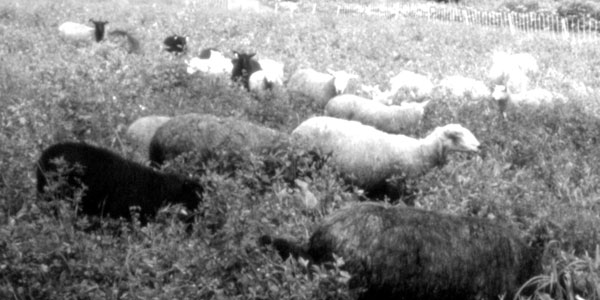
We have found sheep to be the easiest animals to manage in our fallow fields. Stocked at the right density, they will clean a paddock nicely. We have even used them to control weeds that may be forming seed in the very early (milky) stages. Our sense is that these unhardened seeds are likely destroyed in the rumen, whereas clipping the whole plant at the same stage with the sickle bar mower could allow that seed to ripen on the clipped plant and become viable. Sheep are light enough that even in the wettest of times, we have not noticed compaction issues from their hooves on our sandy loam soils. Sheep also spread their manure very evenly, and they tend to be respectful of fences and generally herd easily around the vegetable fields.
Portable fencing, though quick and easy to set up and pack up, requires extra care in setting in the cropland. Electronic fence posts, though sturdy when placed in permanent pastures where root growth is decades old and soil is settled, can be easily knocked over when placed in recently tilled soil. We are sure to give a swift stomp of the heel to the soil where we are about to place a post when setting fence in the cropland. This little bit of spot compaction will really help to keep fences up and effective. Herding sheep in and around the vegetable fields we have found to be fairly predictable most of the time. However, we do keep worn out old rolls of flexinet handy to block off “temptations” to the sheep when we are feeling conservative. At times we will graze the sheep on forage established in a vegetable field after the crop has been harvested. In these circumstances, the sheep will do a fine job converting cull and surplus produce left in the field into meat and wool.
One thing we have found worthy of consideration when integrating livestock into the vegetable operation is the issue of manure and food safety. We try to time grazing and harvesting operations so that animals aren’t manuring too near to growing crops. We will also leave buffer strips of ungrazed (mown) forage between stock and crop if need be.
All in all, we do spend a considerable amount of time and money managing our cover crops. We do this whether or not we plan on grazing them, as we find that careful attention pays off in the form of thick stands which out compete weed species, protect the soil from erosion, and build fertility for subsequent crops. Our cover crops also help to cycle nutrients, such as rock minerals, which become more plant available the more they are acted on by plant and soil life. Adding animals to the mix, when managed by attentive rotational grazing, can help to build fertility by adding a layer of complexity to nutrient cycling. The animals also encourage root sloughing of the forage plants whenever they bite off their top growth which helps to build organic matter in the soil. Furthermore, the animals can help to control weed species in the fallow fields. We like to think that the animals are not only helping to increase the productivity of the vegetable crops through their contribution to soil fertility, but they are also producing valuable crops in and of themselves in the form of meat and fiber. Our shareholders enjoy seeing them on their way to the u-pick berry patch or the snap beans. They are fun, beautiful to look at, and add the thrill of animation to the landscape. We find livestock to be a beneficial component of the integrated farm.