Regular readers will know that I’m a teensy bit obsessed with Dutch wine. I’ve travelled all over the Netherlands, visiting wineries from Limburg in the south to Friesland in the north, seeking out artisanal wine producers everywhere along the way. And – strangely enough – that’s often one of the only ways to taste Dutch wine. There are precious few bars and restaurants in Amsterdam serving Dutch wine, and many shops don’t carry it either. If they do, it’s a slim selection – nowhere near the scores of wine producers that are hard at work in every Dutch province.
Behind the bookcase
Fast-forward a couple of months, and Rose was keen to invite me to experience more of what Design & Wijn has to offer. Namely: what lies behind the bookcase. At the back of the store, you’ll see a set of normal-looking shelves. But (like some sort of Harry Potter novel) they open to reveal a sunken tasting room on the other side. Midnight-blue walls, burgundy seating and a bar that combines a granite top with brass piping complete the industrial-elegant look (you can tell Rose is a designer).

The bar behind the bookcase at Design & Wijn
While wine tastings at Design & Wijn are by reservation only, there’s a lot of flexibility. Unlike at many Dutch wineries themselves, you can book for as many or as few guests as you like, Thursday through Saturday, at two time slots: 4 pm and 7 pm. There are three tastings to choose from: the entry-level tasting of five wines alone; the “Royale” tasting of five wines plus Dutch cheeses, charcuterie and a few other Dutch snacks; and the “Extra Royale” tasting of six top-shelf wines, including one sparkling. Prices range from €39 to €85 per person, and tastings take between 1.5 and 2.5 hours, depending on the package.
Dutch wines fit for royalty (and Obama)
So much for the logistical details. Let’s get into the tasting itself. Our host for the afternoon was Judith, a recent addition to the Design & Wijn team who’s clearly as passionate about Dutch wine as I am. She kicked us off with a 2024 Johanniter from Wijngaard Hof van Twente in the far east of the Netherlands. Learning about Dutch wine means learning about hybrid grapes (or “modern grapes,” as Judith prefers to call them): hardy, disease-resistant crossings developed especially for cool climates. This particular example was citrusy and fragrant with almond blossom, but with a surprisingly rounded mouthfeel.
Next up was a more familiar grape: a Pinot Blanc from Wijngoed Thorn in Limburg – and part of the Maasvallei Limburg BOB (the Netherlands’ answer to the AOC or DOC system you see in France or Italy). It combined ripe fruit with precise minerality, and paired perfectly with two of the cheeses we had in front of us: a creamy, nutty Tynjetaler from Friesland and clover-rind Hooikaas from Twente.

Dutch cheese and charcuterie to go with our Twente wine
It was, however, the third white wine that really blew us away. I was already familiar with Zeeland’s flagship winery De Kleine Schorre (whose wine was served to none other than Barack Obama during a state visit!) but I’d never tasted their barrique-aged Pinot Gris and Pinot Blanc blend. A gorgeous, Burgundy-worthy wine that was zippy on first sip, but butterscotch-smooth on the finish.
Dutch port – yes, really
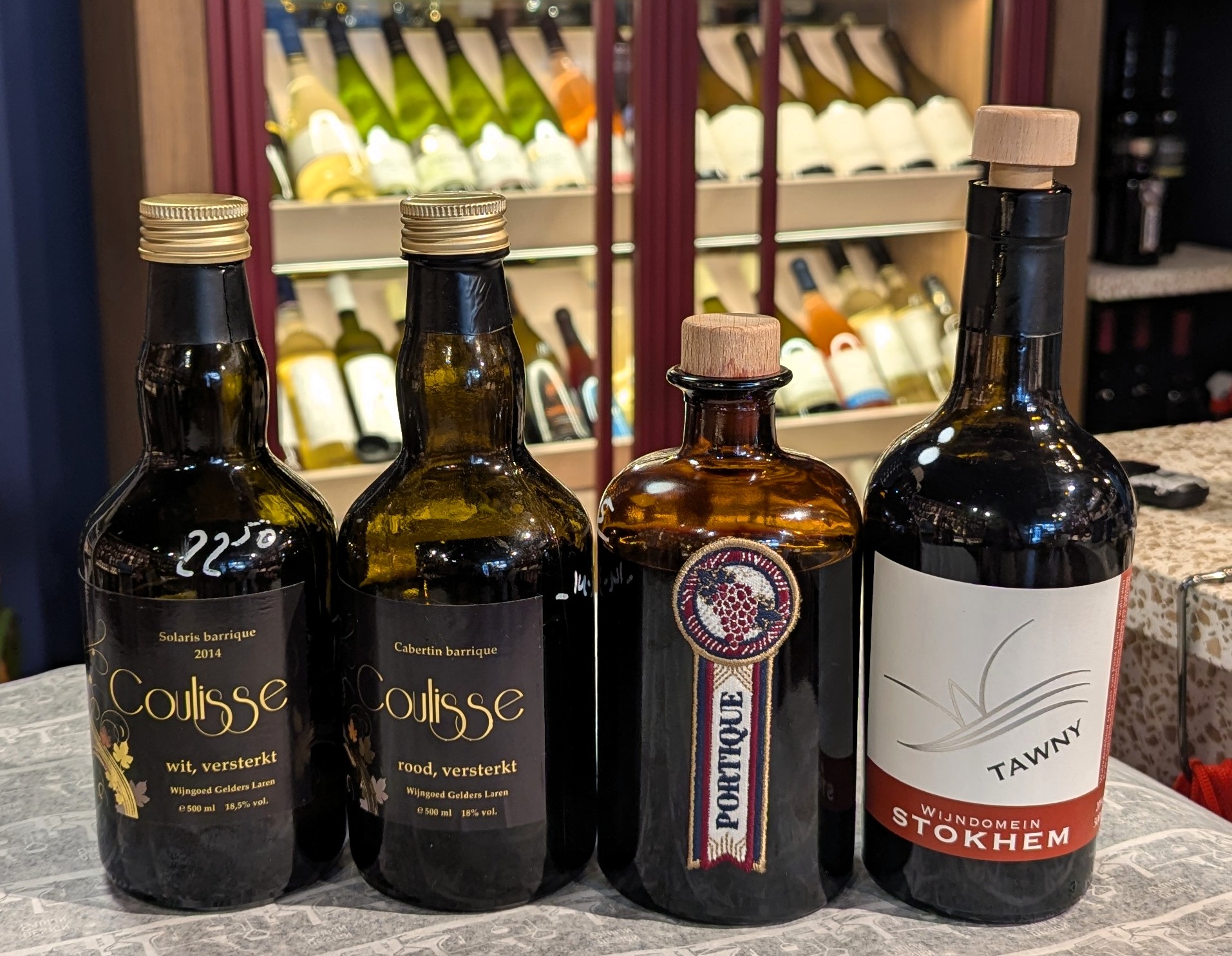
After another barrique-aged wine – this time a Pinotin-Regent blend (more of those modern grapes) from one of my favourite red wine houses, Betuws Wijndomein – we moved onto something I’ve not tried anywhere else. Dutch port. Of course, they can’t call it port – the term is protected by the Portuguese for good reason – but this “Portique” is unmistakeably the same concept. A deeply hued, fortified red wine, in this case made from Pinotin grapes in Gelders Laren. It has all the luxurious cocoa and dried prune flavours of the Portuguese kind – just less of the carbon footprint needed to ship it to Amsterdam. Which is an interesting aside, given that port was historically shipped from Portugal to America as medicine back in the 18th and 19th centuries.

Dutch “Portique”
From Dutch wine to Dutch design
It’s here that Design & Wijn comes full circle. Designer Rose had a hand in the making of this Portique: not the wine itself, but the brown-glass medicine bottle – complete with wooden stopper and fabric, sea-map-inspired label – in which the wine is stored. In fact, it transpires that several of the labels you see around the store and tasting room have been designed by Rose herself, alongside the various wine accessories that are all Dutch by design.
While I’m no expert when it comes to design, it’s become clear to me through years of studying labels that the aesthetics of a bottle are an important window into its contents.
This feature is brought to you in partnership with Design & Wijn, and is part of a paid collaboration. For more about the Netherlands as a wine region, read my explainer on Dutch wine or my guide to Dutch wineries.