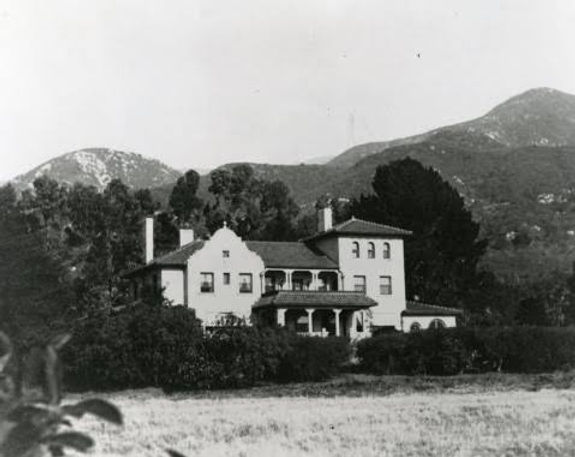
Hidden beneath mature oaks in the foothills of Montecito is a neighborhood whose quiet lanes reveal only fragments of what once stood here.
Long before Riven Rock became one of Montecito’s most private residential enclaves, it was a sprawling Gilded Age estate encompassing approximately 87 acres near the convergence of Hot Springs and Cold Springs creeks. Built for one of America’s wealthiest families, Riven Rock combined grand architecture, extraordinary gardens, art, agriculture and an unusual family history that remains part of Montecito lore more than a century later.
Today, the original estate has largely disappeared, but portions of its landscape, stonework and buildings remain woven into the properties that occupy the land.
The McCormick Family Comes to Montecito
The story of Riven Rock begins with the McCormick family of Chicago.
Cyrus Hall McCormick developed the mechanical reaper and built the agricultural machinery business that eventually became part of International Harvester. The invention transformed the harvesting of grain and helped create one of America’s great industrial fortunes.
The McCormicks began visiting the Santa Barbara area in the late 19th century and acquired the Montecito property in 1896. Construction on the estate began shortly thereafter.
At the center of the story was Cyrus’s youngest son, Stanley Robert McCormick.
Educated at Princeton and interested in art, Stanley traveled through Europe and studied painting in Paris before joining the family business. In 1904, he married Katharine Dexter, an extraordinary figure in her own right who had studied biology at MIT and was one of the institution’s earliest female graduates.
Their lives, however, would unfold very differently from what their extraordinary wealth might have suggested.
Stanley developed severe mental illness as a young man and eventually required constant care. By 1908, he was living at Riven Rock under close supervision, and the Montecito estate became his home for nearly four decades.
His life at Riven Rock later inspired T.C. Boyle’s 1998 novel Riven Rock.
How Riven Rock Got Its Name
The name itself came directly from the landscape.
Near the original entrance stood a large sandstone boulder that had been split apart by an oak tree growing through it—a literal “riven rock.”
That natural feature became the name of the estate and, ultimately, the Montecito neighborhood that occupies the land today.
It is a wonderfully Montecito origin story: architecture and wealth may have shaped the estate, but the name came from an oak tree and a piece of sandstone.
The Architecture of the Original Riven Rock
The centerpiece of Riven Rock was a substantial two-story Mission Revival residence constructed of stone, begun in the late 1890s.
The architectural history becomes particularly interesting when looking at surviving archival material.
The Wisconsin Historical Society holds original architectural drawings associated with Riven Rock by the prominent architectural firm Shepley, Rutan & Coolidge, including drawings for terraces, balconies, mantels, gates and formal garden structures dating from around the turn of the 20th century.
These weren’t merely decorative additions. Together, the architecture and landscape created an estate in which buildings, terraces, gardens and Montecito’s natural topography were conceived as a larger composition.
And the landscape itself had an important designer.
Warren H. Manning and the Gardens of Riven Rock
In 1897, noted Boston landscape architect Warren H. Manning prepared a general landscape plan for Riven Rock.
An original survey and plan preserved by the Wisconsin Historical Society identifies Manning as the landscape architect and depicts the McCormick property at a scale of one inch to 100 feet.
Manning had worked with Frederick Law Olmsted and would become one of America’s influential landscape designers.
At Riven Rock, the landscape grew into something remarkable.
The property included exotic plantings imported from Japan, a six-acre lemon orchard, a dairy, handcrafted stone walls and bridges, and extensive gardens.
One of its most memorable landscape features was the Four Leaf Clover Garden, portions of which have influenced the restoration and design of later residences built on the former estate. Original garden paths, sandstone stairs, walls and columns have survived in portions of the neighborhood.
The estate was essentially its own private world.
Golf, Art, Music and Life at Riven Rock
Riven Rock extended far beyond a grand house and gardens.
A nine-hole golf course was created on the property. There was a swimming pool, an extensive art collection and a theater capable of hosting live performances and films. The household even employed a musical director.
The McCormicks also maintained a beach property at Sandyland, and Stanley was occasionally driven there from Riven Rock in one of the family’s Rolls-Royces.
It’s difficult today to imagine a single Montecito estate encompassing all of those uses across nearly 87 acres, but estates of this scale helped establish the character of early Montecito.
Rather than maximizing development, these properties were conceived as private landscapes—architecture surrounded by gardens, agriculture, native oaks and expansive open space.
That philosophy continues to influence what makes Montecito real estate distinctive today.
Katharine Dexter McCormick: A Remarkable Legacy
Although Riven Rock is often associated with Stanley, Katharine McCormick’s legacy ultimately extended far beyond the estate.
She became a major advocate for women’s suffrage, serving in leadership positions within the movement and helping advance support for the Nineteenth Amendment. She was also a philanthropist with interests spanning medicine, science, education and art. Katharine funded MIT’s first women’s dormitory, helping increase opportunities for women at the institution. She established the Stanley R. McCormick Memorial Foundation for Neuro-Endocrine Research at Harvard Medical School and later provided crucial financial backing for research that led to the development of the first oral contraceptive. Her impact was also felt locally.
Katharine served as vice president of the Santa Barbara Museum of Art and supported its development. She ultimately donated important works of Impressionist art to the museum, including paintings by Claude Monet.
Her story makes Riven Rock more than the history of a great house. It connects this quiet corner of Montecito to major developments in American industry, women’s rights, science, education and art.
The 1925 Santa Barbara Earthquake
The original Riven Rock mansion did not survive.
Following the devastating 1925 Santa Barbara earthquake, the great Mission Revival residence was ultimately demolished. But Riven Rock didn’t disappear entirely.
A handful of original structures survived, including the estate’s theater building, and remnants of the McCormicks’ stonework and landscape architecture can still be found throughout the neighborhood. A Santa Barbara arts organization has described the Theatre House as one of only three original structures remaining from the McCormick estate. For anyone interested in architectural history, this is part of what makes Riven Rock fascinating: the original mansion is gone, yet pieces of the estate remain hidden in plain sight.
From One Great Estate to 34 Properties
Stanley McCormick died in 1947. Katharine sold Riven Rock in 1949, and after another sale the following year, the enormous estate was eventually divided into 34 individual parcels. Those parcels became the foundation of the Riven Rock neighborhood we know today. Rather than one 19th-century estate, Riven Rock evolved into a collection of significant Montecito properties representing different architectural eras and styles. Yet the original landscape continues to define the neighborhood. Mature oaks, sandstone walls, long private drives and unusually generous parcels give Riven Rock a sense of permanence that is difficult to reproduce in newer communities.
Riven Rock Today
More than a century after the McCormicks arrived, Riven Rock remains one of Montecito’s most intriguing enclaves. Its appeal isn’t simply exclusivity.
It’s the layering of history. A contemporary residence might sit where a formal garden once stood. An old sandstone wall may have belonged to the McCormick estate. A mature oak may have shaded the property generations before the current house existed. That’s part of what makes architectural real estate in Montecito so compelling. The value of a property isn’t always contained within its walls. Sometimes the land itself carries the story. Riven Rock is an extraordinary example.
What began as one of Montecito’s great Gilded Age estates has evolved into a private residential neighborhood, yet its original landscape, architecture and history continue to shape the character of the properties within it more than 125 years later.
Interested in Montecito’s architectural and historic homes?
I’m Josh Ramirez, an Architectural Realtor specializing in Santa Barbara and Montecito real estate. I work with buyers and sellers of distinctive properties throughout the area, with a particular interest in architecture, history and the stories behind the homes and estates that make this part of California so unique.
If you’re considering buying or selling in Montecito—or looking for a property that may not be publicly available—I’d be happy to help.