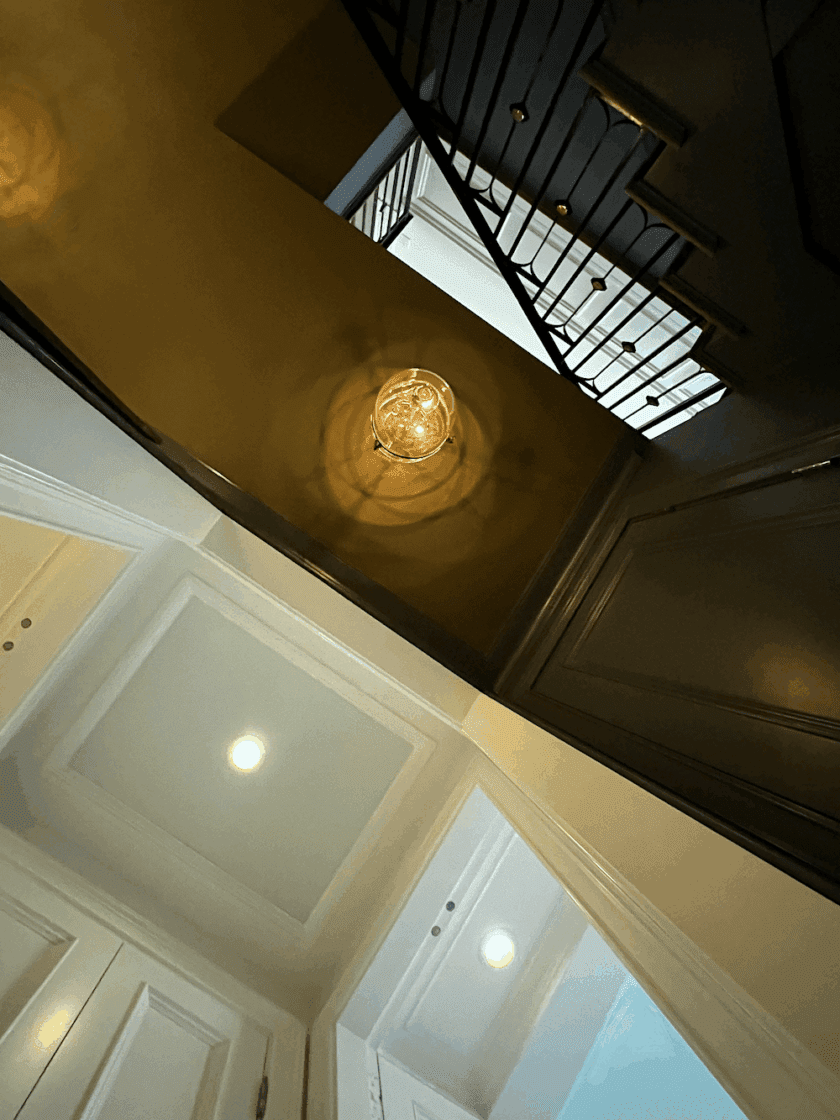
He Everyone,
Welcome to the big Nor’easter of 2026. I hope everyone is faring well with the storm. It’s not too bad here in Boston, just a steady soaking rain, which we really need.
Some of you have asked me to do a post about vaulted and cathedral ceilings. And yes, a beautifully designed vaulted ceiling can be magnificent. However, when the proportions, angles, mouldings, beams, windows, or lighting are wrong, it can wreck the entire room.
This post about problem ceilings began several years ago as a guide to the most common ceiling problems.
Later, I added a much larger section about vaulted ceilings, plus a virtual makeover I spent far too long creating. However, it was great fun getting rid of the fugly. So, today, I’m giving the post a thorough update and putting everything into (hopefully) a more logical order.
Of course, vaulted ceilings are only one category of problem ceilings.
Below are five more types of problem ceilings.
- the ceilings are too low
- too large and expansive
- covered in popcorn
- broken up with strange angles because of stairs and attics
- ceilings weighed down with way too heavy coffers and sometimes mouldings.
And then, there are tray ceilings, and this post below goes into the horrors they often bring.
Okay, you know, a bad ceiling can really bring down a room. (no pun intended) :]

Above is Nancy Keyes’ charming, stylish bathroom.

The ceiling above is definitely not one of the problems. We first saw this beauty here several summers ago.
So, let’s jump in and go over each of the problem ceilings and some of the best solutions.
Probably the most common problem ceilings folks have is:
The ceiling is too low. Luckily, there’s already a post dealing specifically with low ceilings that you can read here.
So, we don’t have to dwell on it too much. Also, please look at this post about boxy, boring homes with low ceilings.
Some of those tricks to make a ceiling appear as tall as possible include the addition of:
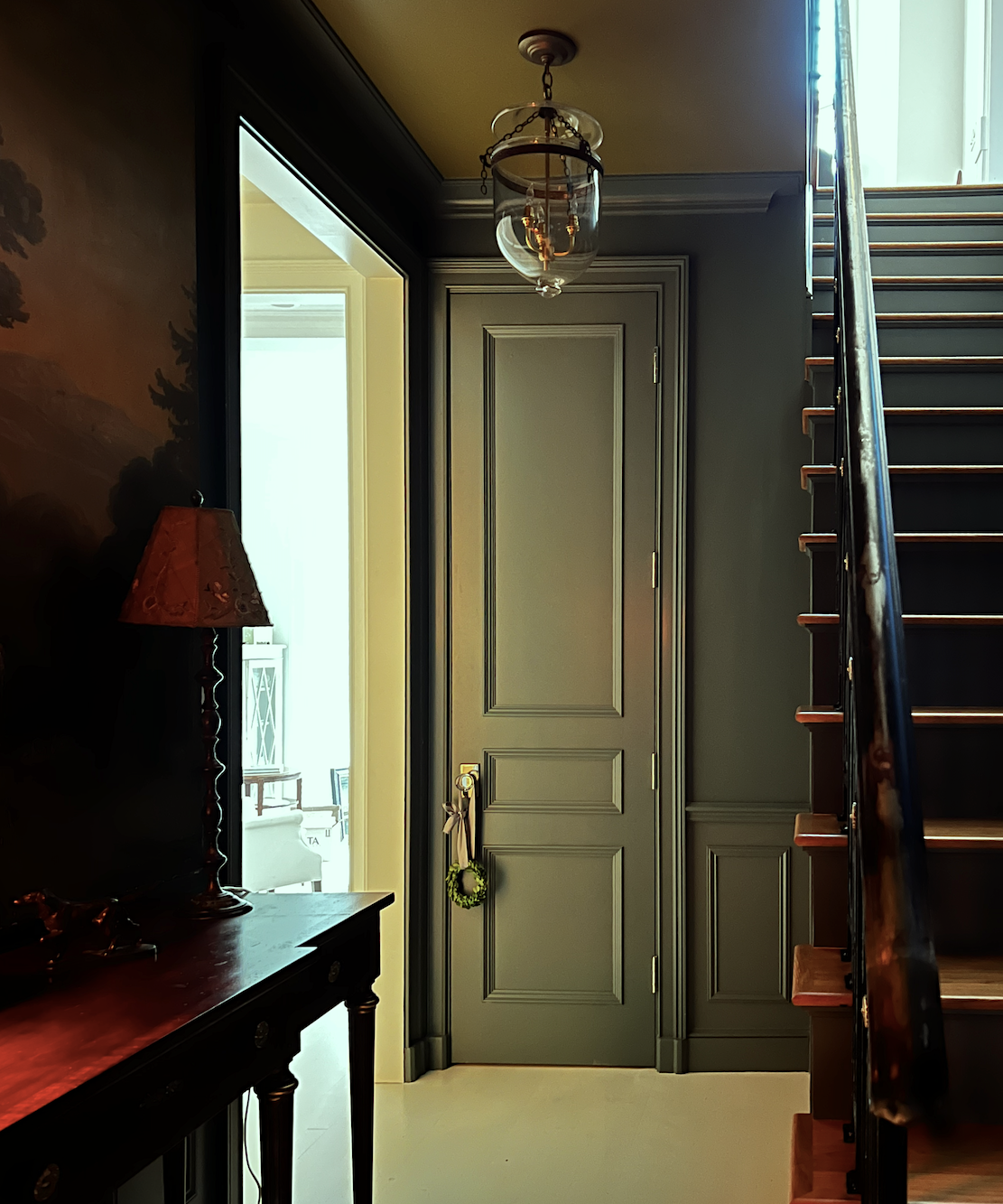
I adore my 96″ doors on the lower level, with a 108″ ceiling height.
Also, please check out 16 ways to make your small rooms look larger.
And, there’s another device for making the ceiling appear higher.
We just looked at this trick in the post about the best ceiling paint colors. There are more terrific ceiling paint colors in the Laurel Home Paint/Palette Collection. What about painting the ceiling super dark? Is that good for a low ceiling? After all, dark colors make walls and ceilings recede, as discussed in this post.
However, a super-dark color will also feel heavy, and if it’s a large room, it’s most likely going to feel oppressive.
Yet, for spaces that are under 150 square feet like Nancy Keye’s bathroom (below), a black ceiling is exceedingly chic.
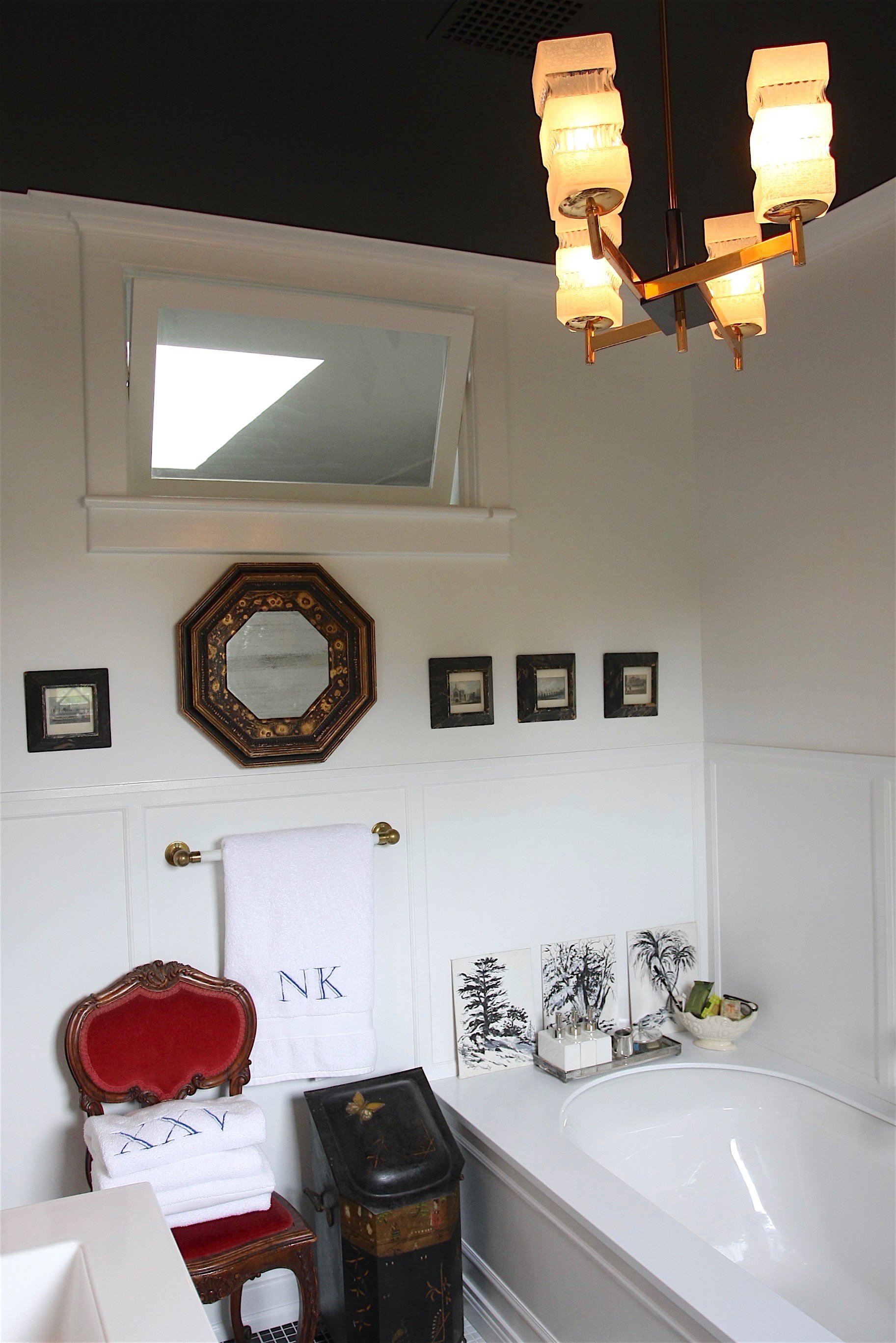
Above and below is Nancy Keyes’ fantastic renovated master bathroom. The ceiling color is a soft black – Benjamin Moore Onyx. And yes, Onyx is one of the Laurel Home collection paint colors. It is a touch softer and warmer than pure black.
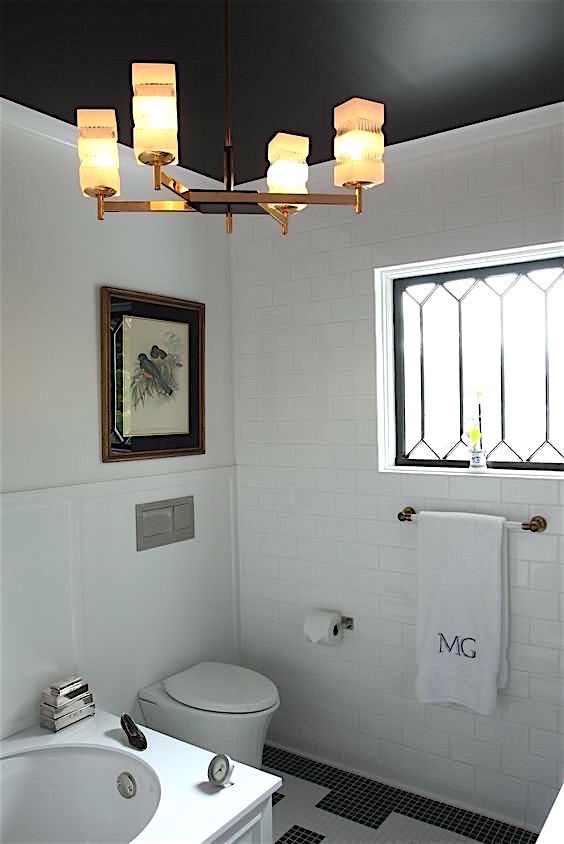
Nancy actually sent me the before images (below), nearly ten years ago!
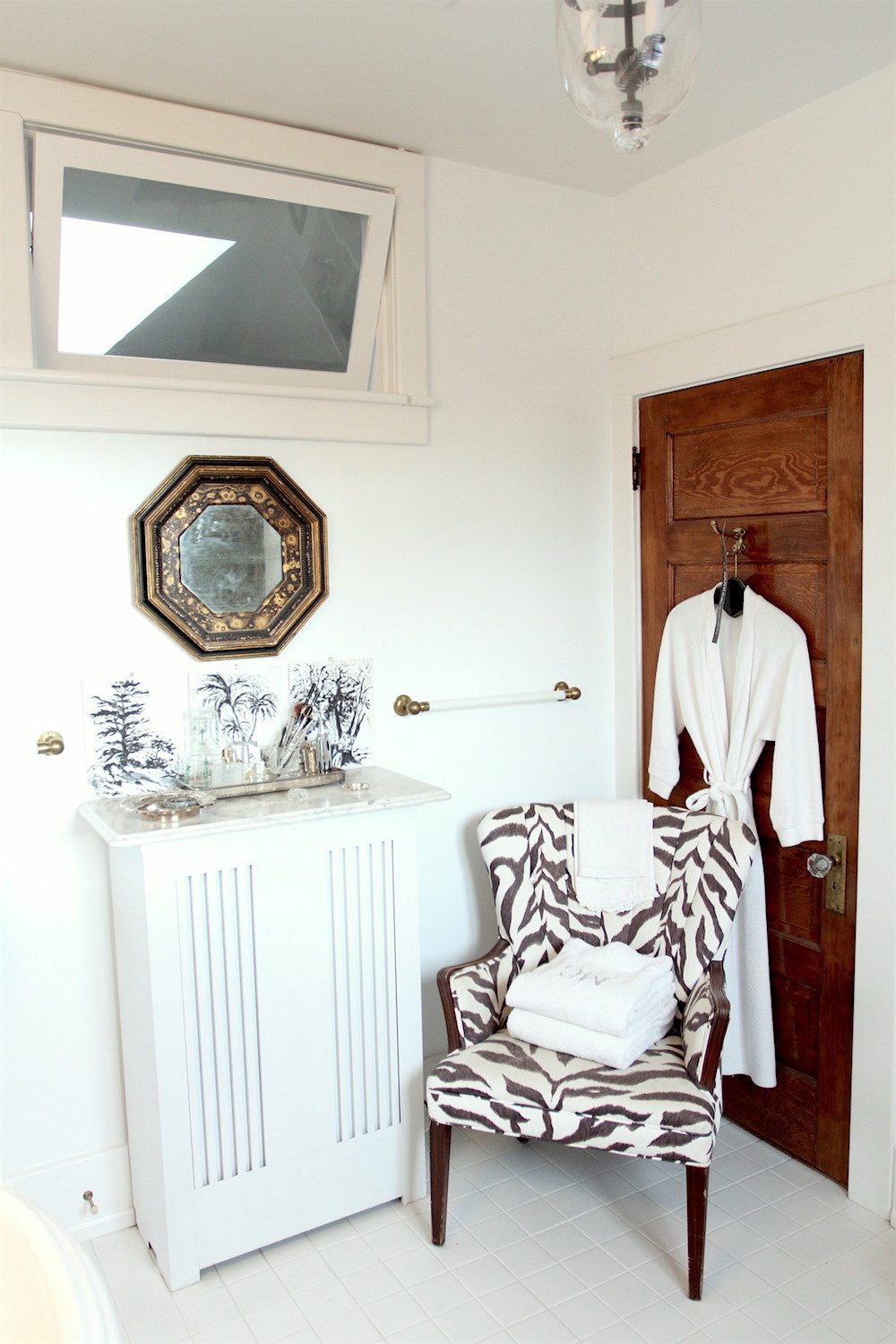
Leave it to Nancy to create a gorgeous room, in any case. There may have been some other issues that led to the renovation, as well. I love both the before and after!
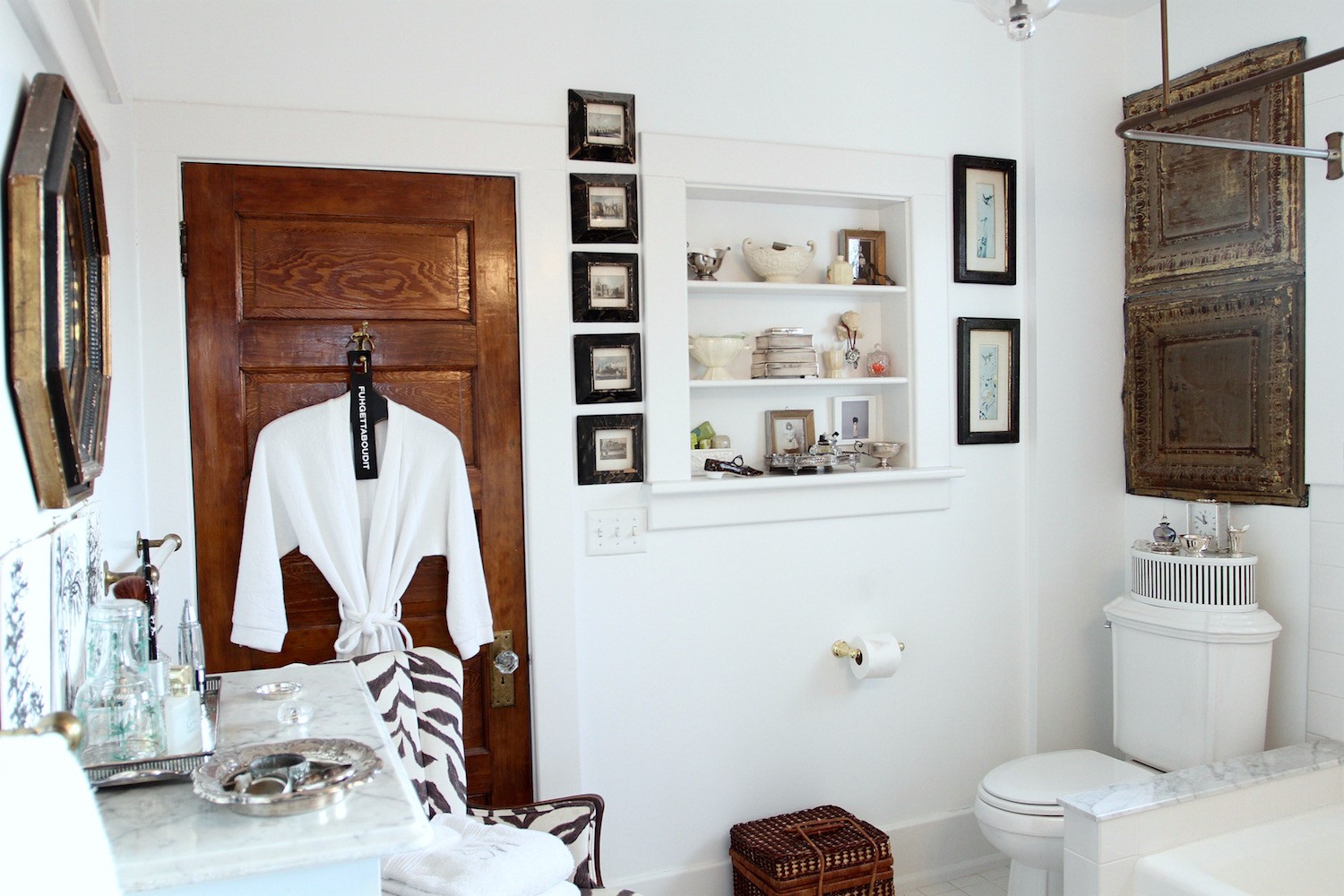
However, Nancy’s ceiling looks to be nine feet. I reckon that the black ceiling would still be fine in a bathroom with an eight-foot ceiling. Here are some more ideas for dark ceilings
Please also check out this other fabulous bathroom that Nancy Keyes did.
But, what if we have a room with a low and expansive ceiling?
Yes, that’s one of the worst ceiling problems. There’s only one worse ceiling issue. A low, large, expansive POPCORN ceiling. (please click on that link for lots of great ideas for problem ceilings)
I can’t think of one decorating issue from the 20th century that confounds me more than the all-too-common popcorn ceiling.
I’m sure that there must’ve been a logical reason for it. Did someone think that it helps with acoustics? Not much, I don’t think. They’re just another of those bad ideas made popular in the second half of the 20th century. Fortunately, most are now eager to rid the planet of popcorn; on problem ceilings, that is.
There are two basic ways to get rid of the hideous popcorn. However, it depends on whether you have a ceiling that looks more like fossilized seven-minute frosting or more like painted coarse corn grits. 😂
In either case, it is possible to remove a popcorn ceiling. But, I definitely recommend having a professional take care of it. If you still insist on DIY, please make sure that your ceiling and paint are free of asbestos and lead. I would also always wear protective gear.
IF the popcorn is very even and low, it is possible to cover it with various products.
What is anaglypta wallpaper?
It is a heavy, embossed wallpaper that can go on the wall or on the ceiling. It is usually made of paper or a cellulose product.
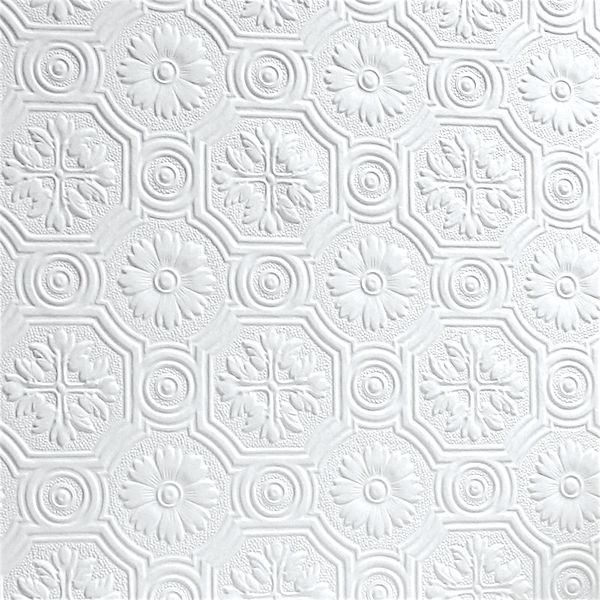
Above is a pattern that’s either the same or very similar to what I had on my kitchen ceiling for 16 years. I loved it! My boys always said it looked like paper towels. Haha. And, yes, it’s paintable. I had it professionally installed, and then the contractor painted the paper high-gloss white. You can see a bad photo of it here.
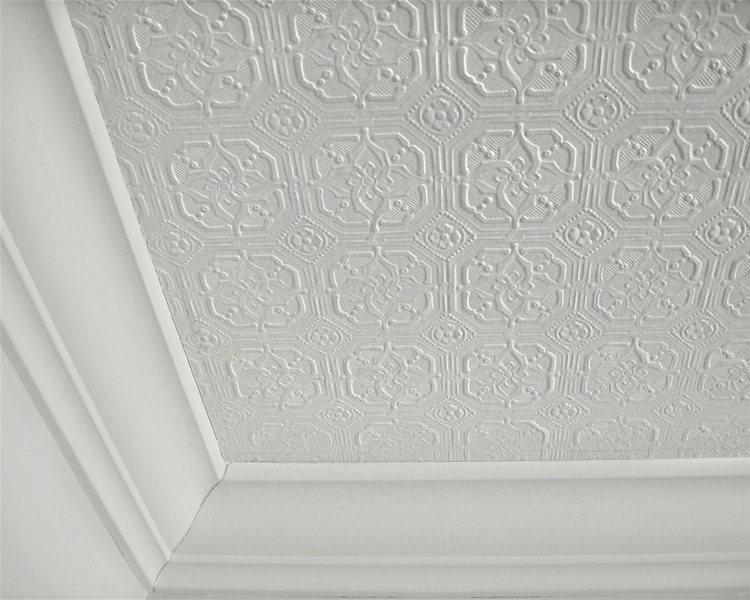
Above is a better photo of anaglypta wallpaper on a ceiling. (Sorry, source unknown) There are numerous patterns to choose from. As you can see, it mimics the look of a tin ceiling and so works best for older homes or a home with a quasi-vintage look like our old townhouse tried to have.
For an expansive and low ceiling, as in an open floor plan, here’s what I think is a good idea.
I would add either beams or very shallow coffers. (we’ll get to that in a sec) Sometimes the beam will make sense because there’s already a post holding up the ceiling somewhere. That is a logical place to run a beam if there isn’t one there already. But sometimes there’s the one post and what would make sense is to add a beam going perpendicular and possibly another post, somewhere else, if necessary for symmetry.
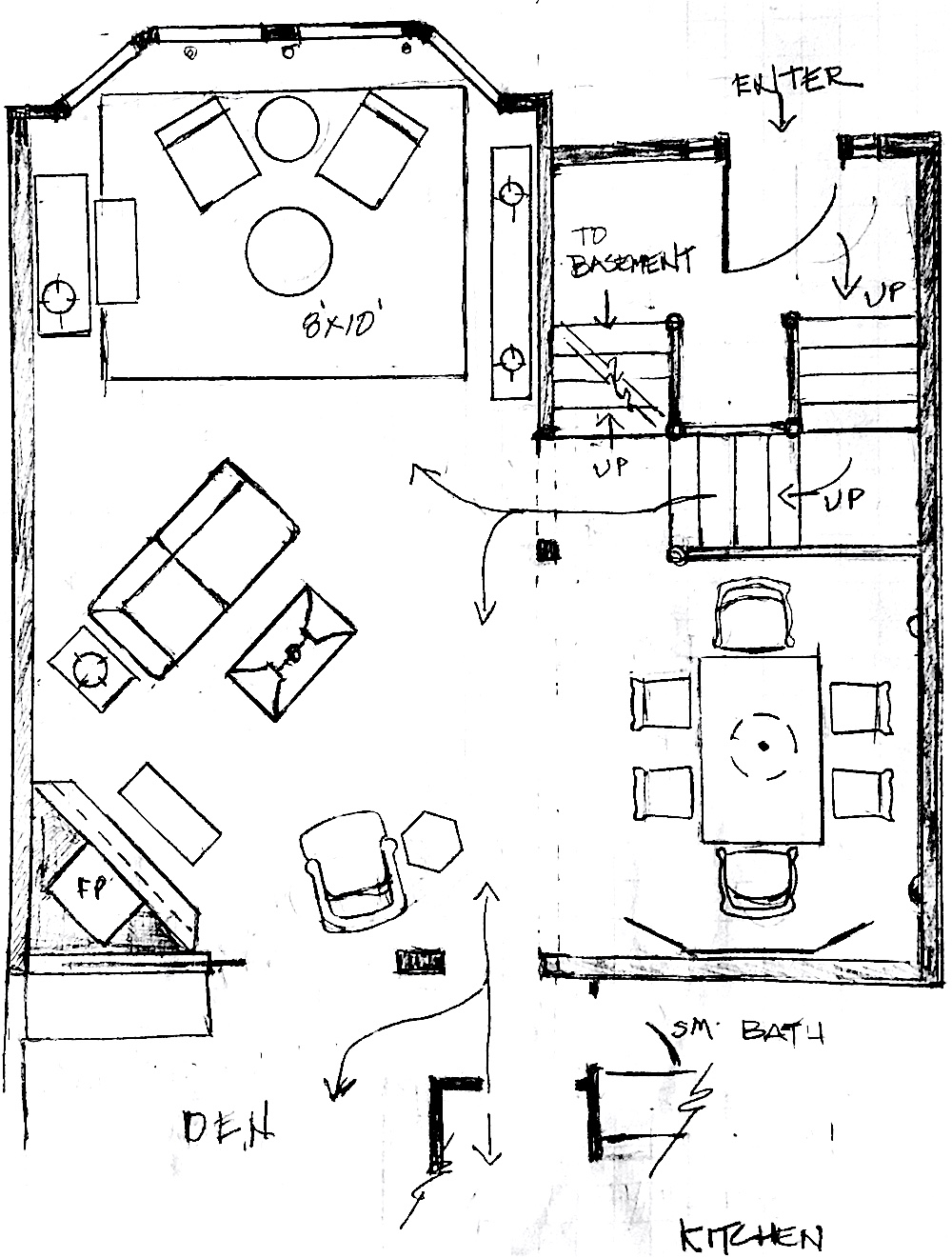
Above is the floor plan of our old townhouse in Goldens Bridge, NY.
There’s a post located just as you come up the stairs from the front door. It’s difficult to see here, but there’s a steel beam covered with sheetrock running along the length of the room attached to the post. You can see it better if you go back to the original post.
We could’ve run a faux beam running perpendicular and intersecting the post if we had wanted to. I think a better spot would’ve been at the bottom of the stairs across that wall parallel with the 8 x 10 rug.
Below is one of my favorite treatments for a low ceiling.
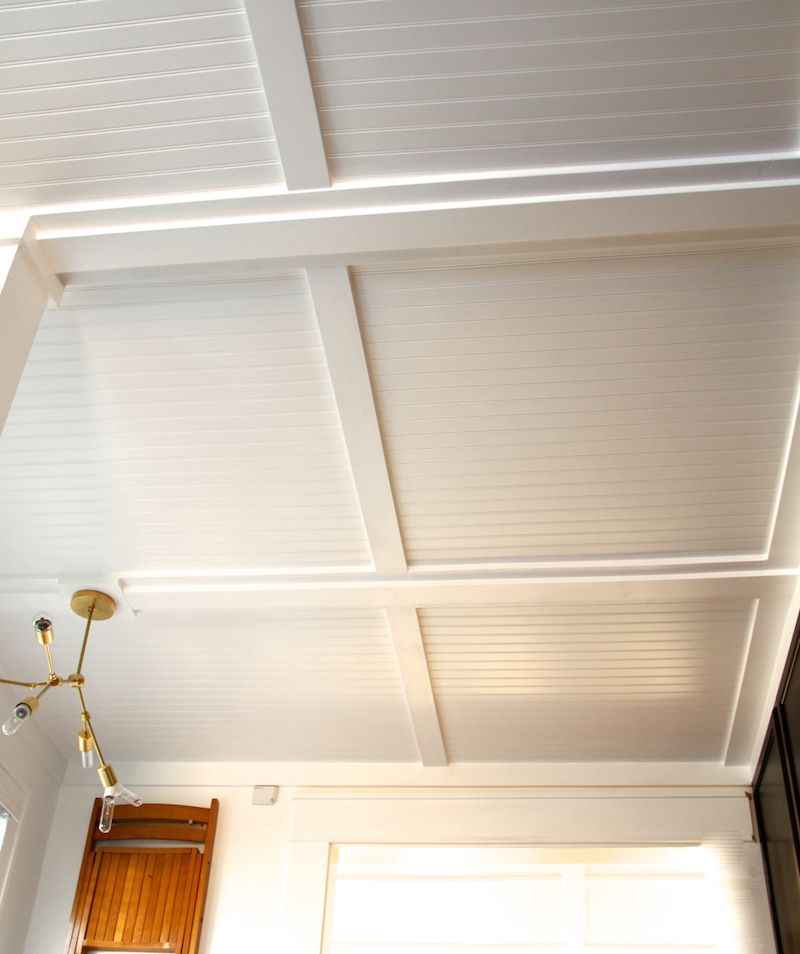
Shallow coffers on a low, expansive ceiling, like above (with or without the beadboard), are a wonderful way to break up a low, expansive ceiling.
It is similar to what my client, whom I worked with on and off from 2003 – 2012, did in her new addition, which became the new family room and dining area.
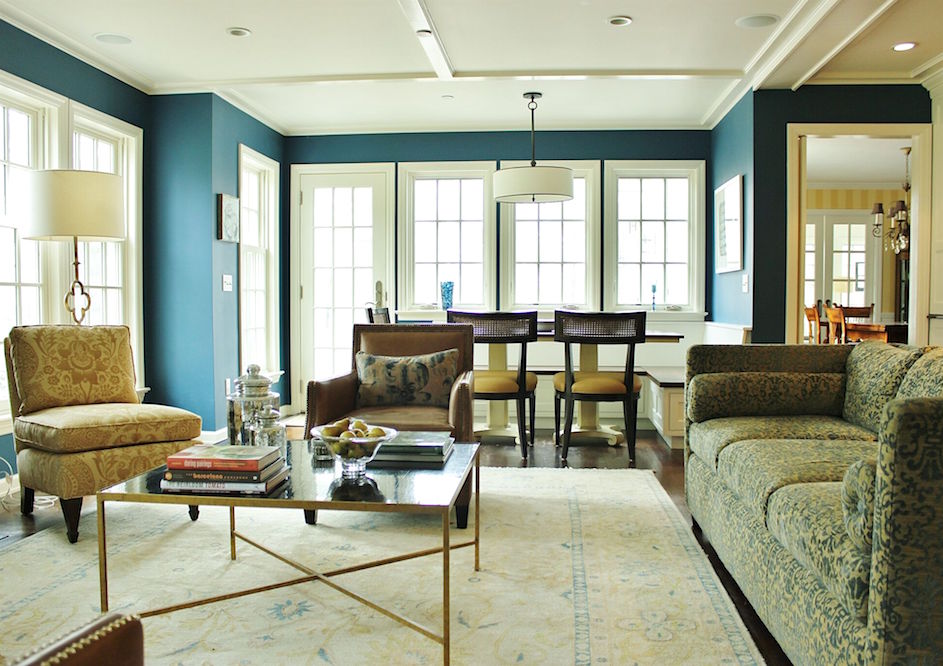
These ceilings are only eight feet high, but they don’t feel low at all. The wide beam on the right is where the Cape Cod style house originally ended.
Another problem with a coffered ceiling might be if it’s dark and heavy AND in a large space, as we saw here.
Should you paint the inside of a coffered ceiling?
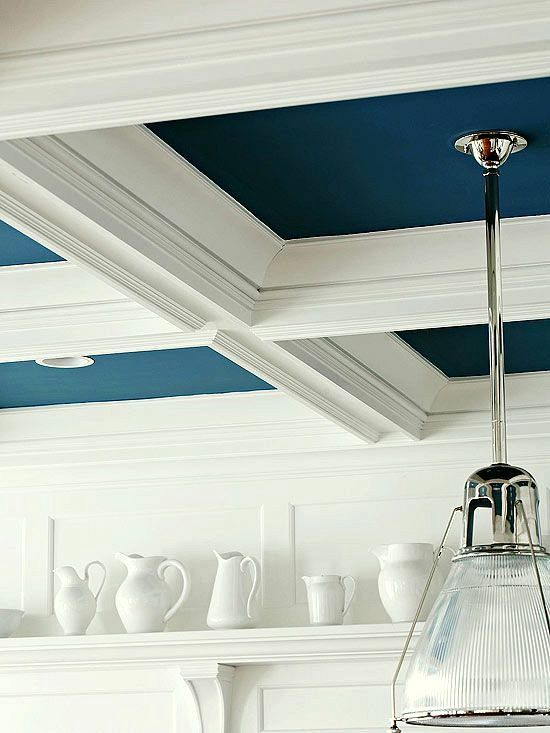
I never have, but you can. I think the ceiling should be high if doing so. And indeed, for a coffer as deep as the one above, it needs to be at least a ten-foot-high ceiling.
Another stunning and inexpensive transformation was done with this family room that I feared was hopeless. I was so happy to be wrong about that one!
Next up in Problem Ceilings are those pesky attic ceilings with all sorts of angles, dormers, and pitches. It can get confusing as to what’s the ceiling and what’s the wall.
I usually paint it ALL ONE COLOR. In so doing, it will help the room look softer and less choppy. I typically do a shade of white or cream. But I’ve also done a light khaki, or any light color is fine.
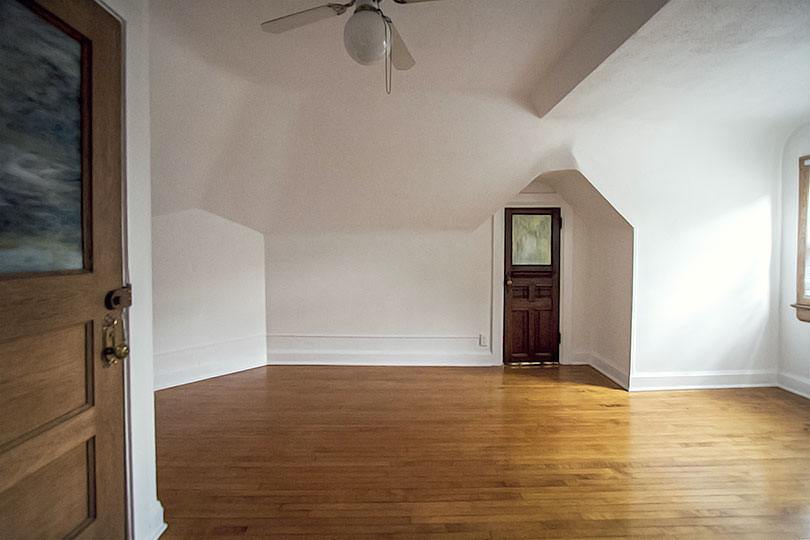
Above is a beautiful office before and after, done by Nicole Balch of Making It Lovely for the One Room Challenge™. Look at all of those crazy angles!
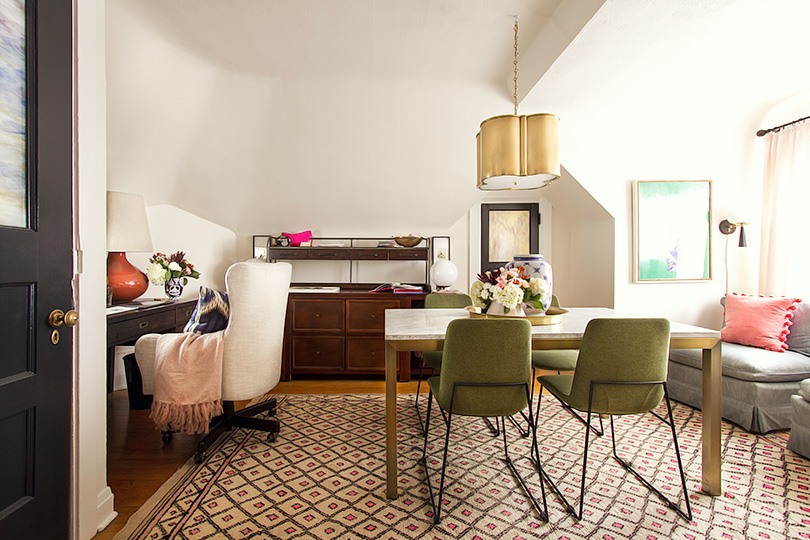
Above is the finished room! Great job!

The wall color is Benjamin Moore Brandy Cream oc-4 and 1030
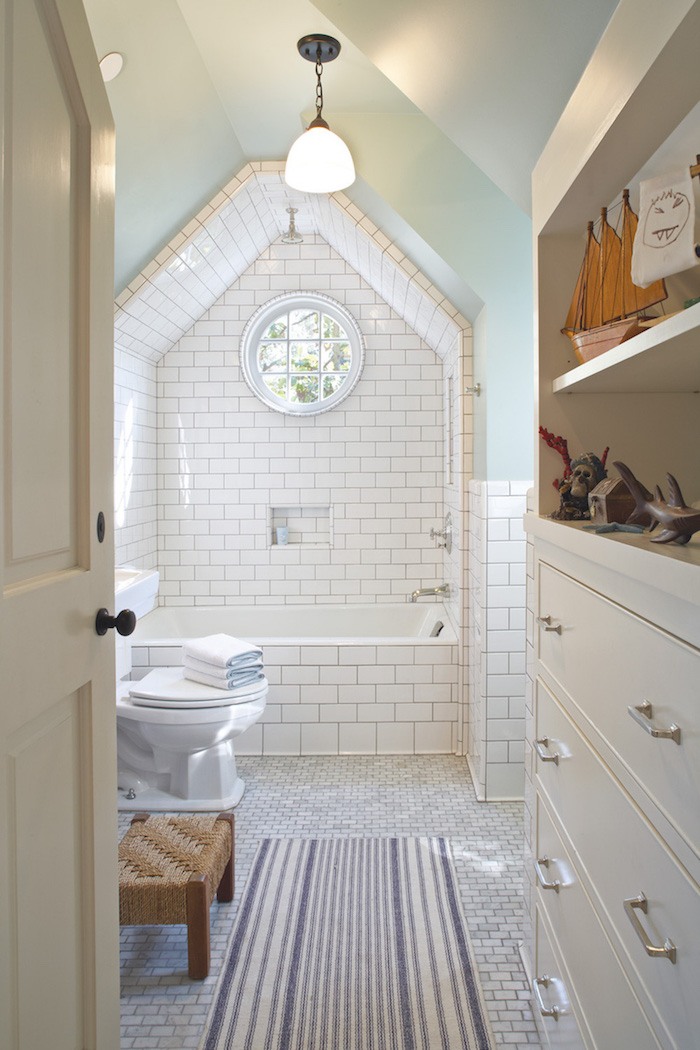
What a fabulous bathroom. I love the accent of the aqua above the tile. No problem ceilings here.
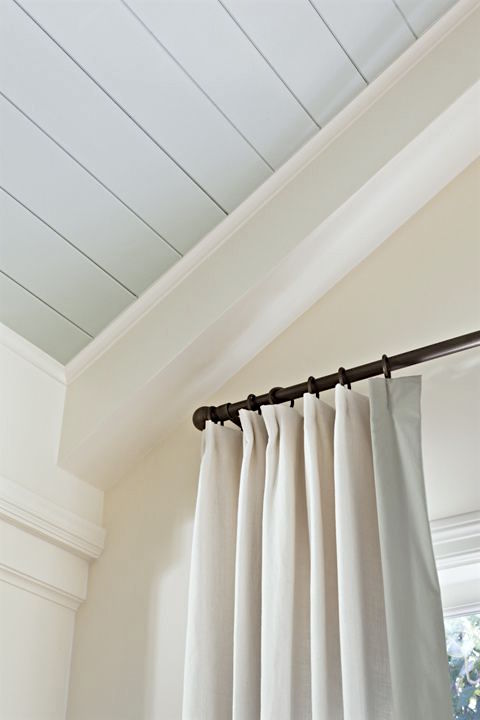
His work is awesome!
For more blue ceiling and wall ideas, click here.
Related to the attic ceilings are the aforementioned vaulted ceilings or cathedral ceilings.
The terms are used interchangeably. However, Cathedral means symmetrical, and vaulted can be asymmetrical. But, sometimes that can be pretty awful.
Okay, let’s look at some things I found that I very much don’t recommend that you do when it comes to vaulted ceilings. It’s not difficult to do.
First, one lovely asymmetrical vaulted ceiling that works beautifully.
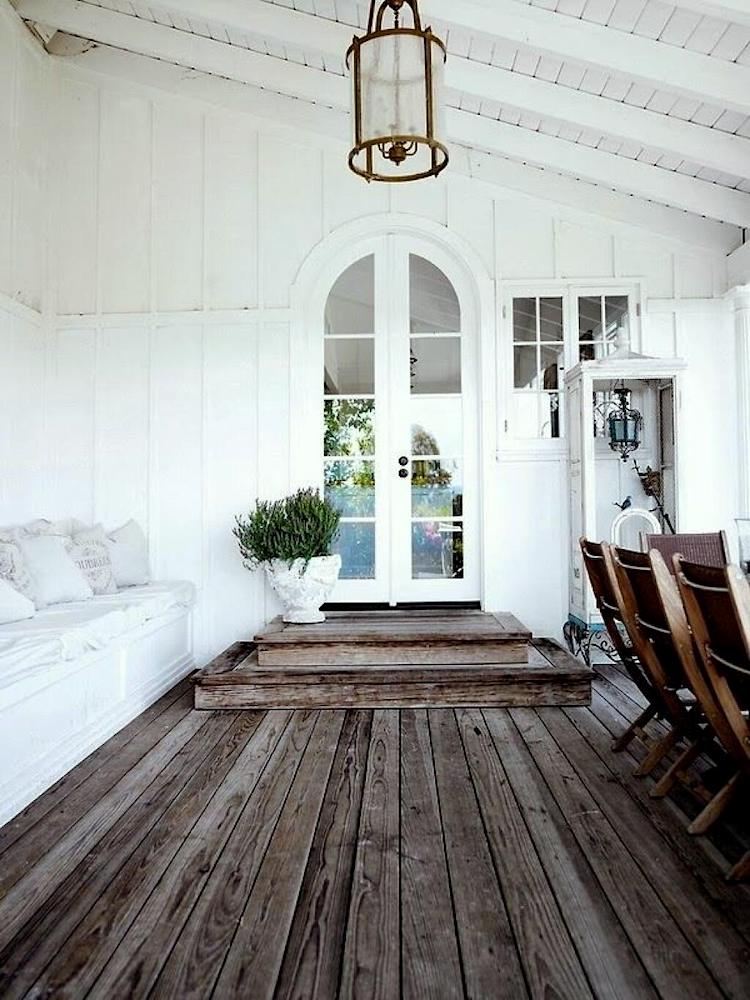
This, of course, is a rustic, farmhouse-type room. Sorry, I don’t have the source available for you. If anyone knows, please let me know.
But then, we have this vaulted ceiling mess below.
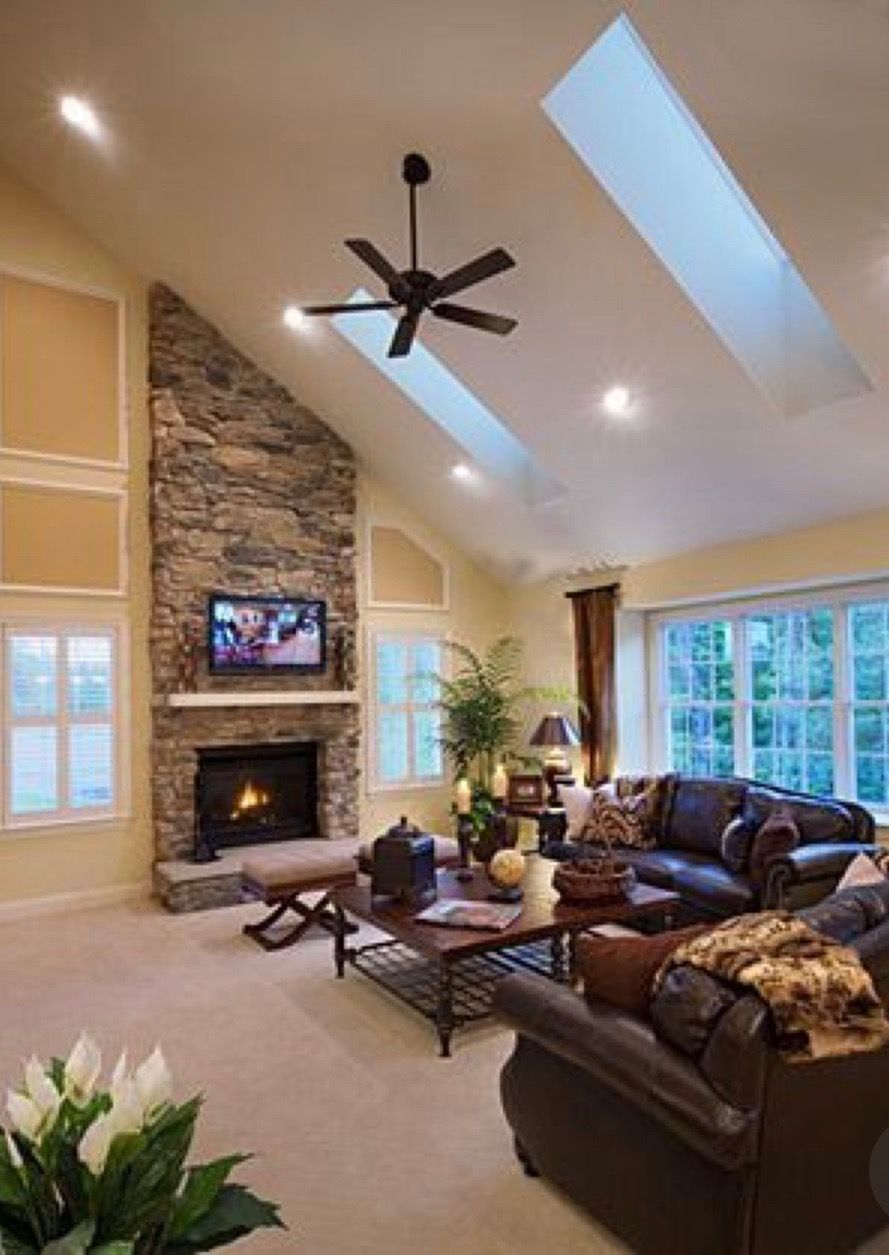
Let’s emphasize how weird this all is by highlighting these bizarre panel mouldings. Horizontal beams going across would be a lot better, I think.
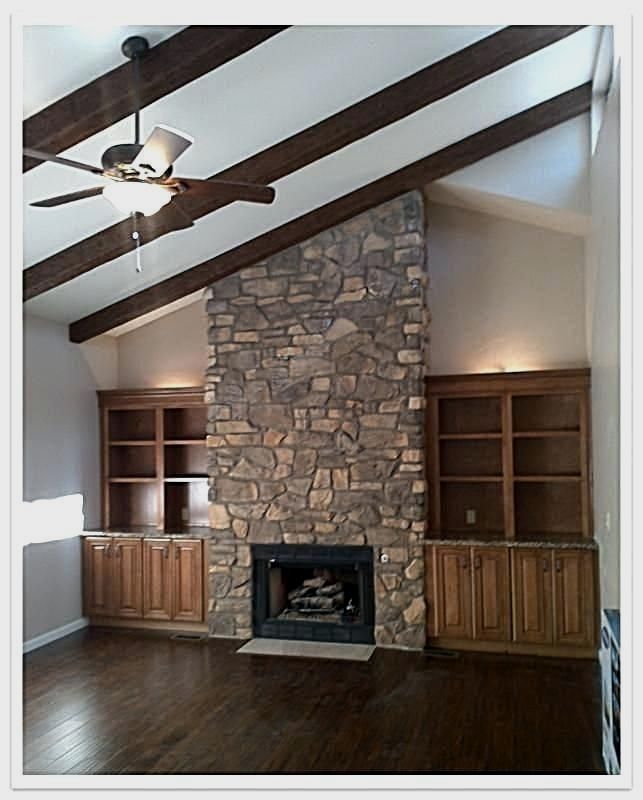
First, the one-sided vaulted ceiling is not easy to pull off.
It can quickly look like a “lean-to.” But add to it these oppressive, heavy beams, heavy stone installed to match the pitch, and dull brown cabinetry and you get heavy, dated fugly.
Remember how we balanced that in this post by painting the wall a hunky color?
What also disturbs me about this space is that it’s trying to be symmetrical but just misses by about three or four feet.
How would I fix this? Well, the most affordable, which Nancy Keyes did, and it looks amazing, would be to paint everything white.
A more expensive way would be to cover the stone and then create more of a deep tray ceiling by following the angle on the left and then bringing the ceiling straight across for the fireplace chimney, and then bringing the angle down to match the left. Then, I would also fill in the space above the cabinets.
Can you ever stain the beams dark?
Yes, but mostly it’s when the walls and ceiling are painted a rich, medium to dark color.
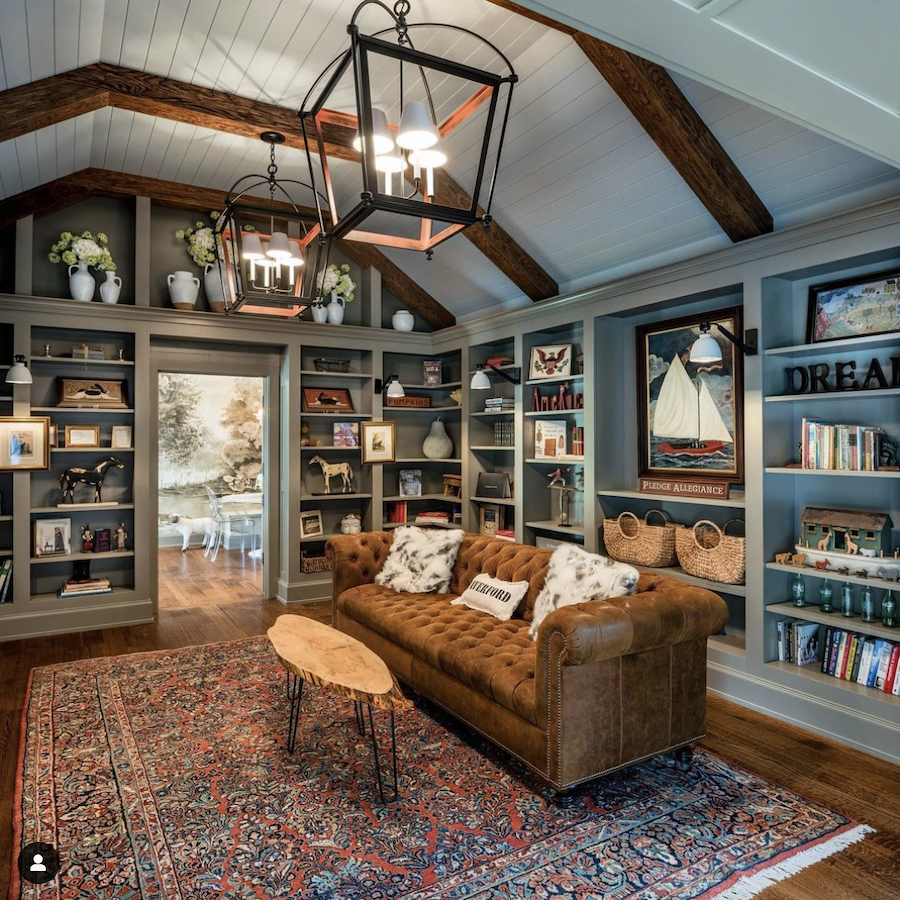
Liz Walton from Liz Walton Home on Instagram (please follow her) did a fantastic job in this lovely family room/library. She achieved the perfect balance with a handsome leather sofa and a gorgeous Oriental rug. – photo – Angle Eye Photography, on Instagram. Plus, Liz’s beautiful website. Angle Eye Photography’s website
Liz is also demonstrating another excellent treatment for a vaulted ceiling, which is the flying crown or flying cornice, as it is known in the carpentry trade.
As you can see (above), the crown sits just under the vault running horizontally, with the effect of flying, I guess.

BHDM, a design firm in New York City, did a fantastic, unadorned soffit. I love it and the white-on-white to unify all of the elements.
Below, however, is another don’t do this when it comes to vaulted problem ceilings.
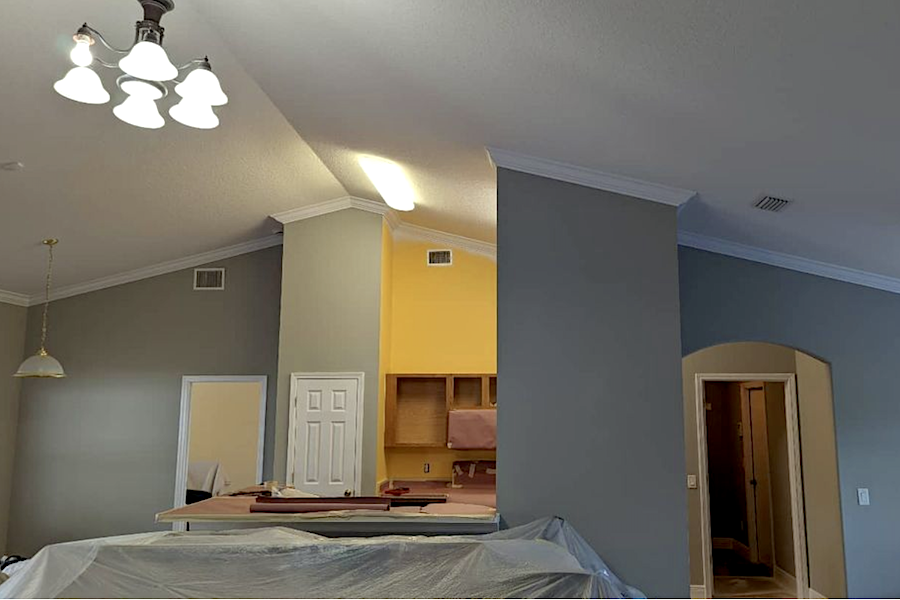
Running a crown moulding on the angle is a poor design choice. What to do instead? Well, it’s fine to run a plain three or four-inch piece of wood, as you see below in the gable way up high above the bed.

Architect Peter McDonald did a fantastic job with this beautiful coastal-style bedroom on Cape Cod. Please check out his stunning portfolio!
Let’s keep going with a few more fugly vaulted ceilings.
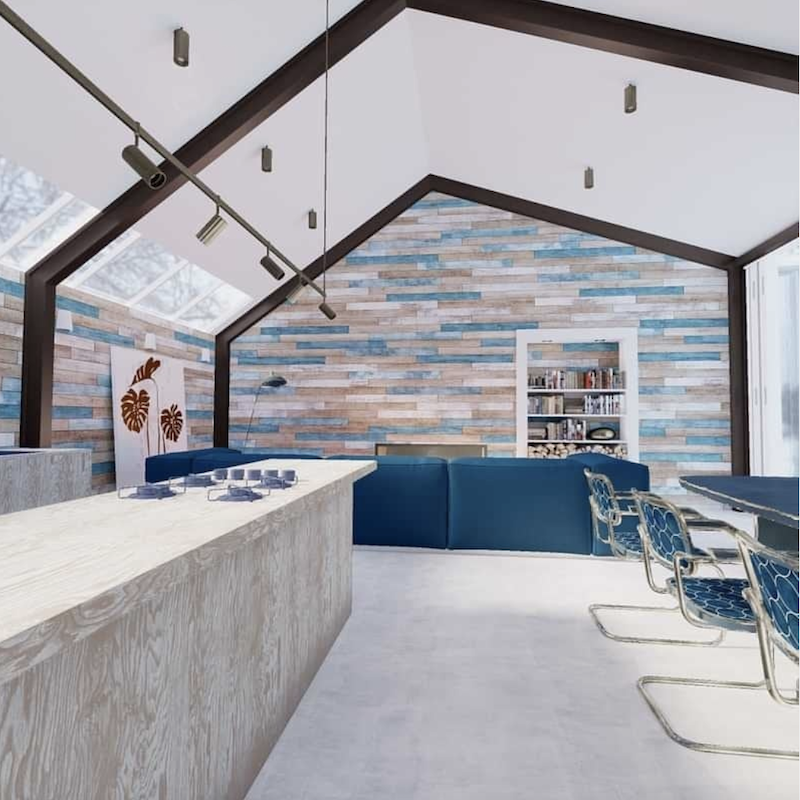
Above is a virtual design I happened upon on Instagram. Fine, we all need to start somewhere, and I had many failures in my early years, but golly gee. I think this one is self-explanatory.
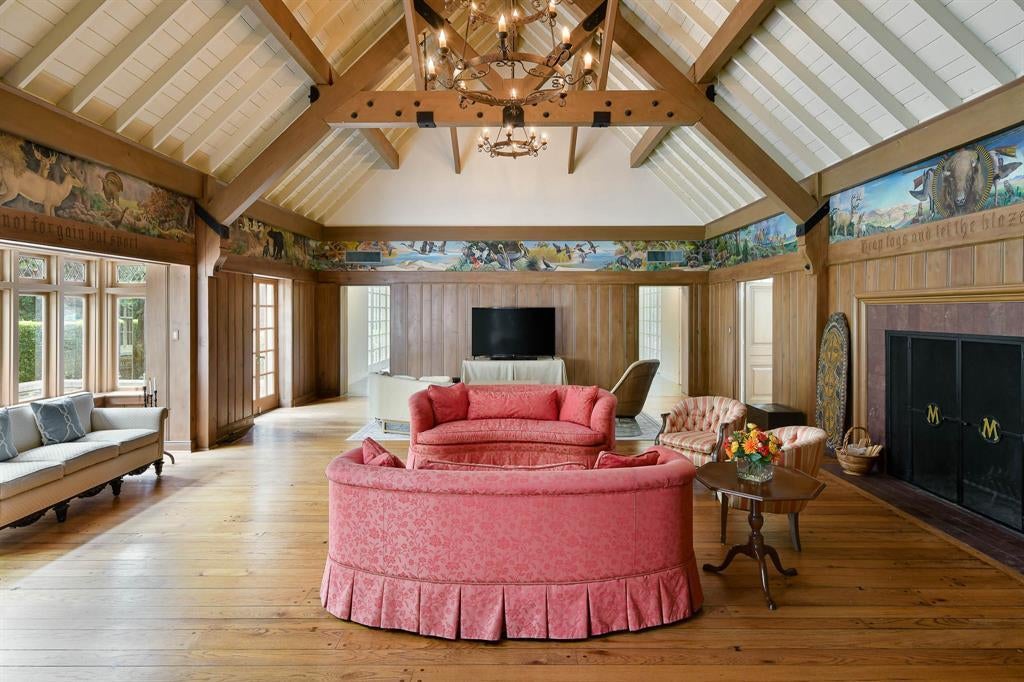
The space above is from a real estate listing. Money and taste do not necessarily go hand in hand. No other words here. And no suggestions on how to make it better except to paint it all out and slipcover the furniture, and add seagrass rugs.
One More Vaulted-Ceiling Problem—and a Virtual Makeover
In fact, I got so into it that I ended up redoing the entire space. If I had known that, I could’ve saved some time.
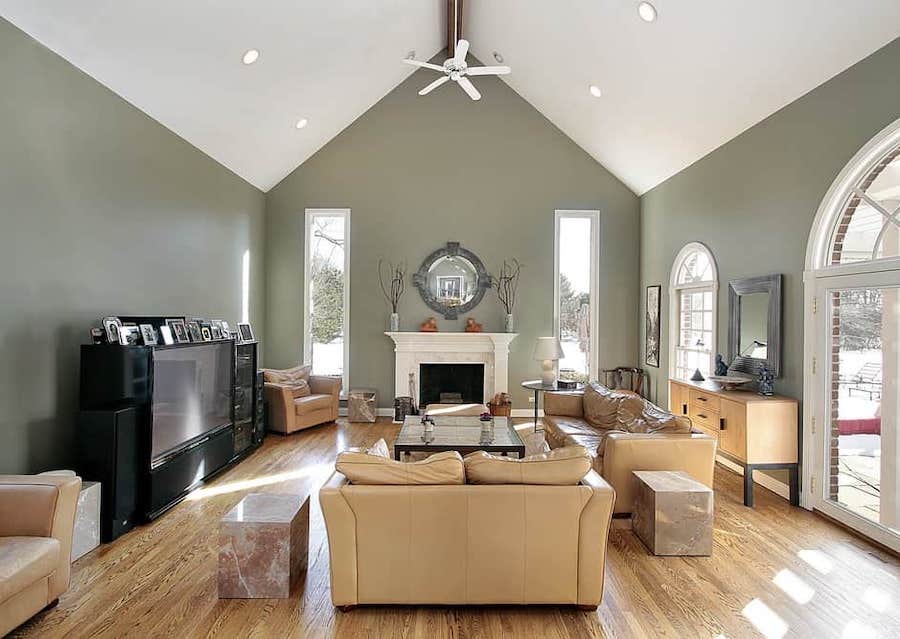
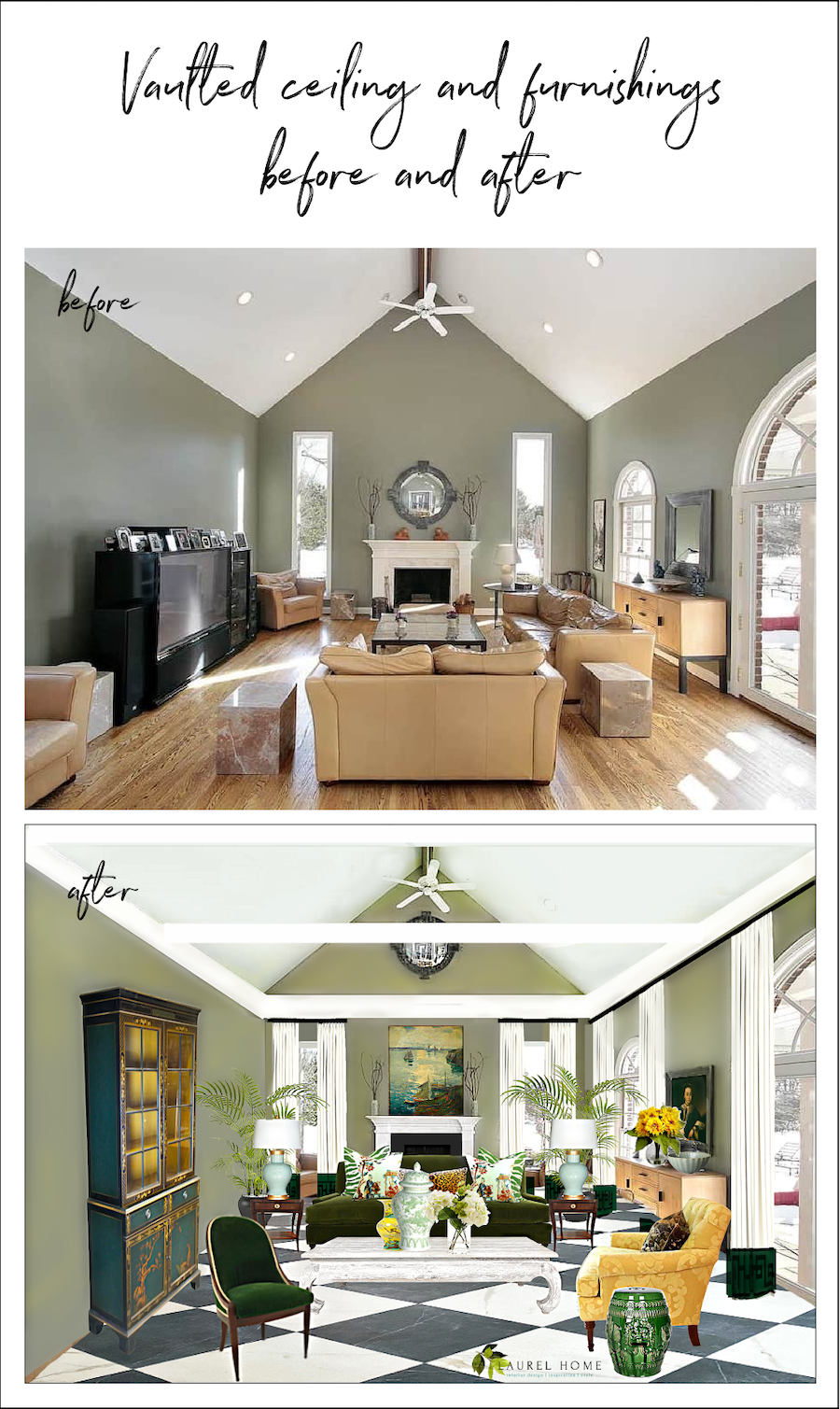
Okay, let’s forget about the horrid furniture and layout and focus on the vaulted ceiling. And, the other architectural elements. As you can see, there is no adornment whatsoever on the vaulted ceiling. Still, something’s off. Can anyone see what it is?
Yes, Pamela. I saw your hand go up first. ;]
It’s those two very long skinny windows flanking the fireplace, right? And why are they so much taller than the Palladian window and door?
Bingo! You get an A+, Pamela. Thank you. ;] Believe it or not, I just noticed that there’s a window AND a door on the right side. So, we have three window/door elements in one room, all at different heights. Who does that? Never mind. People do stuff like that all the time!
Of course, we’re not going to rebuild the house. (You’re going to see it all visually in a sec.) But, here’s what I would do.
I would bring those windows down on the inside. (It’s okay; no one will notice on the outside. It will look like a shade is pulled down part of the way.) Just take off the moulding, add a piece of sheetrock to bring them down to the appropriate height, and then put back the moulding.
I think a relatively simple running crown or horizontal piece for the vaulted ceiling. And then run about three or four horizontal beams painted white.
Below, I did just that in a virtual redoing of this room. It’s not perfect, but I like how it turned out.

Do you like how I moved the mirror up to where it should be, as if it were a window?
That one element alone helps this space a lot! Typically, I don’t face a sofa away from the fireplace, but maybe this is a super deep room, and there’s another sitting area by the fireplace. I thought doing the faux marble charcoal gray and the white-ish floor would be fun. I love how the large diamonds of the floor play off the angle of the vaulted ceiling.
Sorry, it’s slightly off-center. Also, I brightened up the green walls a little. The color is very close to one of the Laurel Home Paint Collection colors, Benjamin Moore, Sherwood Green.
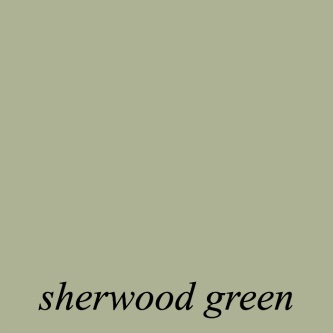
Benjamin Moore SHERWOOD GREEN hc-118
(AKA Palisades Park 439)
The ceiling is the palest blue-green. In fact, it’s probably a cool shade of off-white. I’m not sure which one. At first, I thought white, but it seemed a little too stark. I like this better.
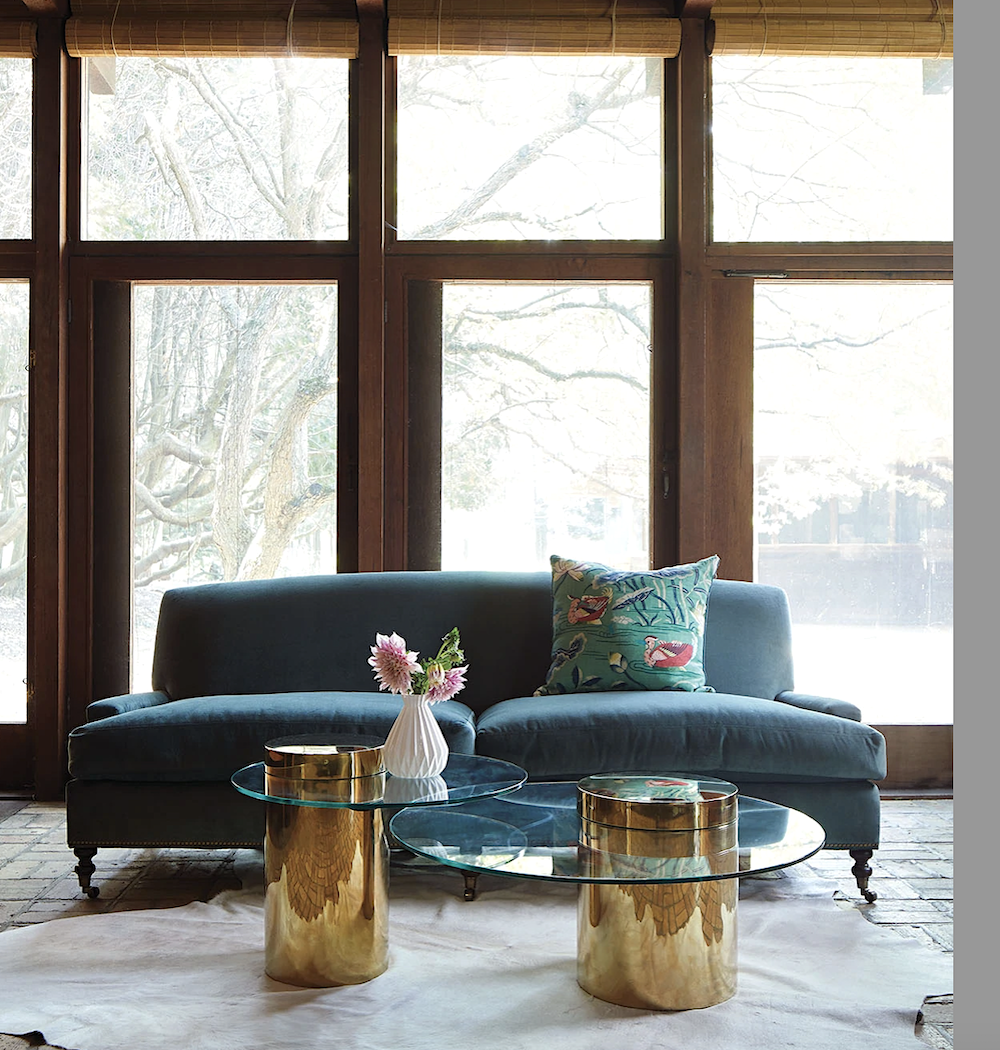
The sofa is the Kennedy from Jayson Home.
I believe they’ve discontinued the beautiful peacock velvet. However, it can be ordered in numerous other fabrics they carry. Or, you can also provide your own material. (COM)
Of course, the yellow chair is my own. Sadly, the manufacturer discontinued it.

If anyone is interested, the painting in the back is by American painter Jonas Lie, 1880-1940. There is a painting over a fireplace in the Bronxville Library by him very similar to this one, only better. It is large and magnificent, and I must take a pic of it the next time I’m in Bronxville for a visit.

The beautiful Chinoiserie china cabinet or bookcase is no longer available.
Please pin to Pinterest for reference.
The next kind of problem ceiling is the tray ceiling.
When I originally wrote this section, I said I didn’t have any bad examples of tray ceilings. I have since found more than twenty, along with some beautiful examples and ideas for fixing the unfortunate ones. You can see them in Tray Ceilings: The Good, Bad, & The Truly Hideous (if you missed the earlier link)
However, let’s look at a few gorgeous examples below of great ways to deal with a tray ceiling.

I think painting the ceiling taupe provides great balance in this elegant dining room. This is also an excellent solution when there’s ample space above the window. The architectural detailing is beautifully done here. This is a flying crown moulding without the vault.
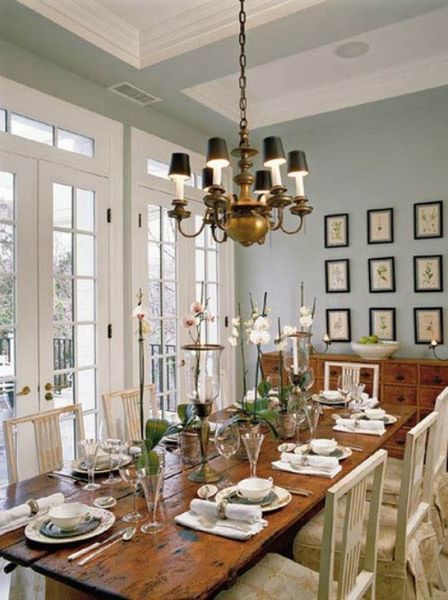
Above is a gorgeous dining room by Darryl Carter.
The color looks like Benjamin Moore Quiet Moments. (one of the Laurel Home colors.)
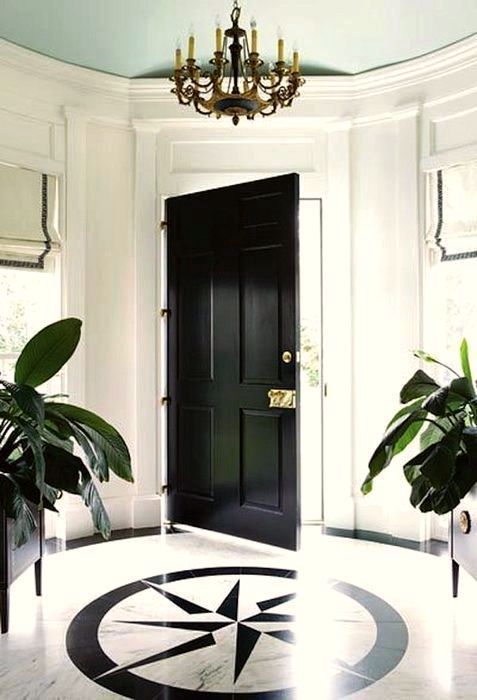
Striking entrance by Laura Covington. Pale blue, grey, greens are absolutely gorgeous for ceilings.
Before we finish, below are a few beautiful treatments for more conventional ceilings.
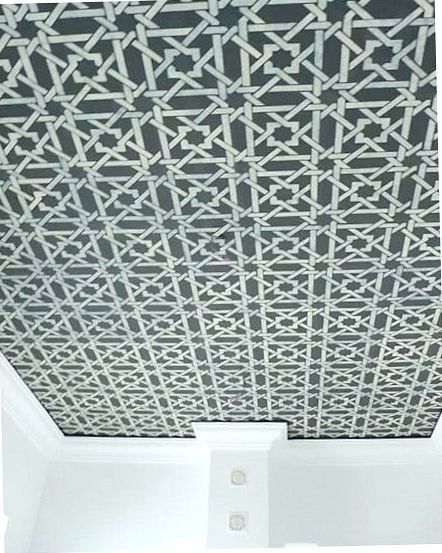
Oh my, this was stenciled on! I have a lot of respect for someone who has the skill, patience, not to mention balance and spinal column strength needed to accomplish something like this.
If you like this or just want to fantasize about the possibility or can afford to have someone else do it, please take a look here. It’s an excellent site filled with tons of wonderful images.
Below, I adore the elegant stenciled geometric design on this hallway ceiling.
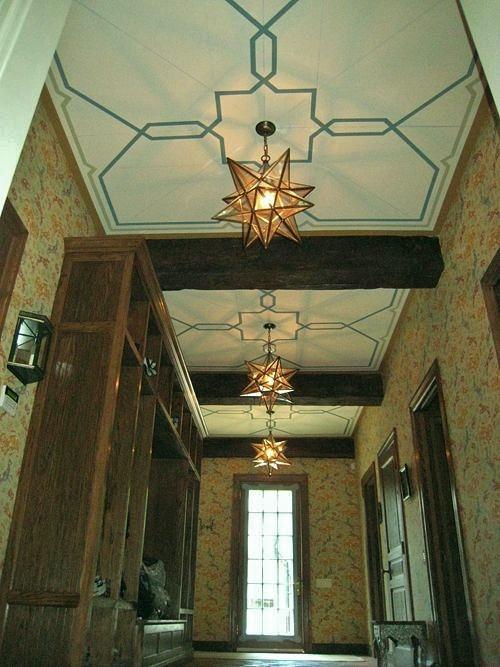
Source unknown.
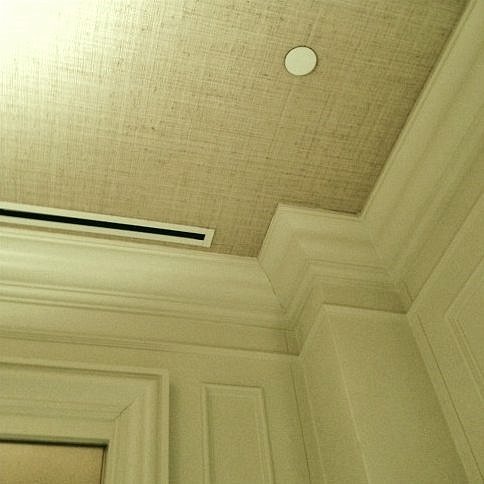
The final image above is grasscloth applied to the ceiling. Its rich texture provides instant warmth to this elegant design by interior designer Brian Gluckstein.
I hope this post gave you some good ideas for how to deal with a problem ceiling.
xo,

Enjoying Laurel Bern Interiors?
You can buy me a coffee below. ☕

You will see an option to buy one, three or five coffees. (or more!) And, if so inclined, it can be a monthly gift. Whatever you can manage is appreciated more than I can say. And if it’s not feasible, of course, that’s okay too.
Also, if you’re doing some shopping on Amazon, please click this Amazon affiliate link or the graphic below.
(Note: It is not a storefront at this time, only the Amazon home page.)
This website is very expensive to run, and in order to keep it (and myself) running, I’m depending on my kind readers clicking on the affiliate links before purchasing something you want to get. It costs you nothing, but if enough do it, it really helps!

Thank you so much!
I very much appreciate your support of this website!