
ESOP Trust Secondary Acquisition: SEBI Rules Since 2013

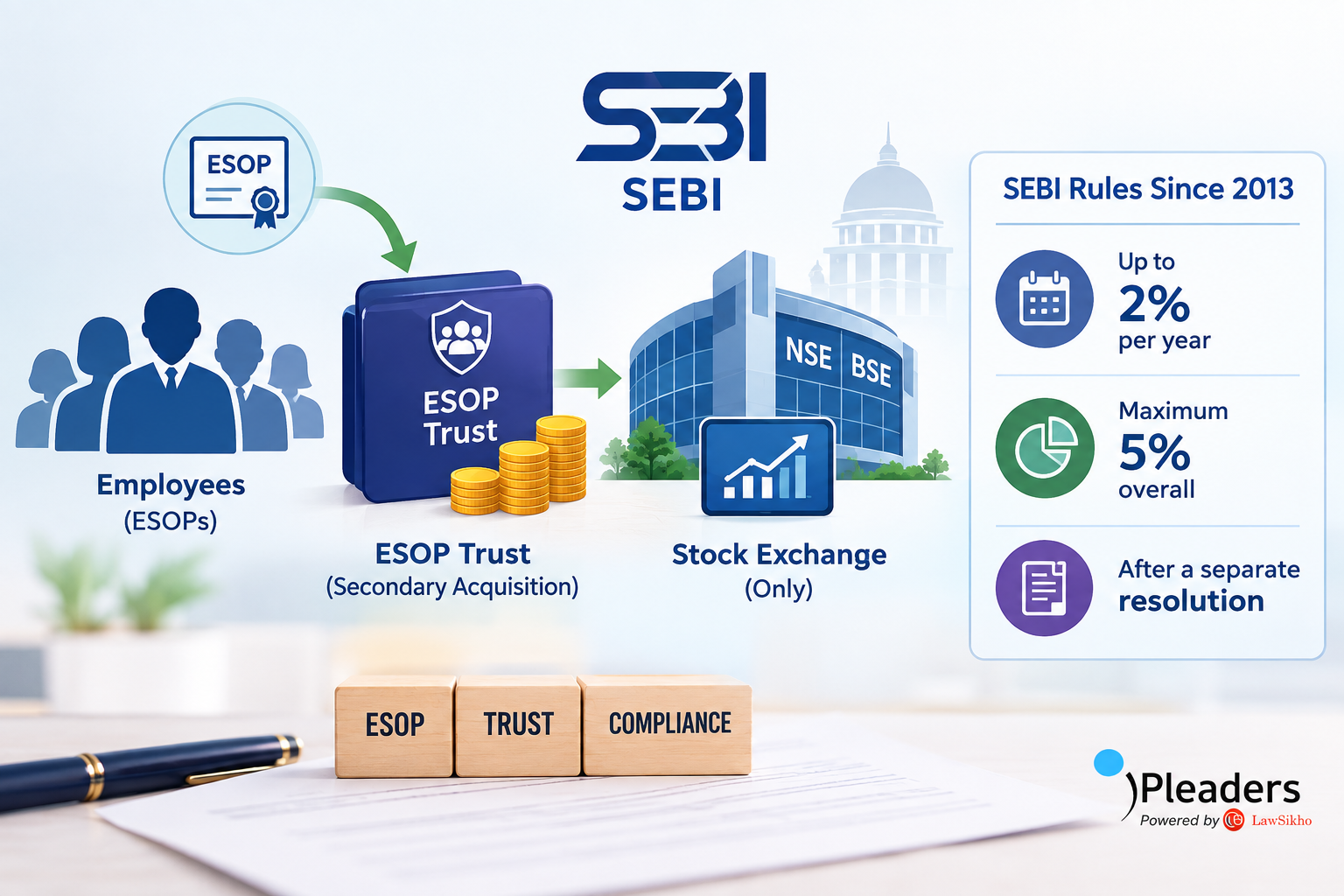

ESOP trust secondary acquisition lets a listed company’s employee trust buy existing shares on the stock exchange for employee grants, so the company doesn’t have to issue new ones. SEBI caps these purchases at 2% of paid-up equity a year and 5% overall, after a separate shareholder resolution.
My advice to any founder is to settle where your trust’s shares will come from before the shareholder meeting, not after it. A listed company needs a separate shareholder resolution that states the maximum percentage the trust may buy, and the explanatory statement has to say whether the trust’s shares will be new shares, existing shares or both. My listed company runs an ESOP and PSOP service for startups and smaller businesses, covering advisory, drafting and implementation. Our annual report for 2024-25 records SEBI’s employee benefit regulations as not applicable to us, and we had no ESOP trust of our own.
You’d think buying existing shares means buying them from anyone who’s willing to sell, but SEBI’s definition is much narrower than that. Regulation 2(1)(nn) of the SEBI (Share Based Employee Benefits and Sweat Equity) Regulations, 2021 defines secondary acquisition as a trust acquiring existing shares of the company “on the platform of a recognised stock exchange for cash consideration”. A private deal for a founder’s block doesn’t meet that definition. Where the company’s money pays for such a deal, Rule 16(1)(b) of the Companies (Share Capital and Debentures) Rules, 2014 requires listed shares to be bought “only through a recognized stock exchange” and “not by way of private offers or arrangements”.
SEBI lets a trust buy on the market at all because market purchases let a company reward employees without diluting its capital. In its November 2013 discussion paper, SEBI called market purchases by trusts “an internationally accepted practice” that allows companies “to grant options to employees without having to dilute their existing share capital”. It tied that freedom to “necessary safeguards to prevent misuse”, and those safeguards include the caps, the separate resolution and the six-month holding period. An unlisted company’s trust sits outside SEBI’s definition, and where the company funds its purchases, Section 67 of the Companies Act, 2013 and Rule 16 apply instead.

Listed trusts still buy within those safeguards. In 2026, Persistent Systems told the stock exchanges that its ESOP trust had bought 107,874 of the company’s shares on the market and would buy up to 40,000 more, in tranches, except while its trading window was closed. The trust passes those shares to employees off-market when they exercise their options. The pause during the trading window is the company’s own practice, and SEBI’s rule in regulation 3(16) requires the trust to meet the insider-trading requirements that apply to insiders or promoters.
Which shares a listed company’s trust may take, and from whom, is clearest in one proposed deal. Take a listed company whose co-founder wants to sell shares equal to about 1% of its paid-up equity. The board would like the ESOP trust to take those shares for next year’s grants instead of issuing new ones, and the company will lend the trust the money.
Two difficulties then appear. A private purchase from the co-founder isn’t secondary acquisition, and because the company’s loan pays for it, Rule 16(1)(b) forbids buying listed shares through a private arrangement. Even on the exchange, the trust needs a separate shareholder resolution stating the percentage it may buy, and it can’t buy more than 2% of the paid-up equity in that financial year.
The answer is that the trust can buy through the stock exchange once the resolution is passed, within the 2% annual cap and the 5% overall cap, and it has to hold whatever it buys for at least six months unless a general exit such as a buy-back or an open offer comes first. It can’t buy the co-founder’s block in a private deal. The company’s loan has to meet Rule 16 as well, including a special resolution of its members and the 5% ceiling on paid-up capital and free reserves. The trust generally has to hold shares acquired through secondary acquisition for at least six months, subject to the permitted transfers under Regulation 3(14), including off-market transfer to employees pursuant to the scheme. Those caps and the separate resolution exist because SEBI stopped these purchases altogether in 2013 and allowed them back in 2014 with safeguards.
ESOP trust secondary purchases under the 1999 Guidelines
ESOP trust secondary purchases had no rules of their own under the SEBI (Employee Stock Option Scheme and Employee Stock Purchase Scheme) Guidelines, 1999, which never mentioned a trust buying shares on the market. The Guidelines came into force on 19 June 1999. A clause on schemes run “through Trust Route” was added on 30 June 2003, and a circular of 22 July 2004 rewrote it to require the company’s accounts to be prepared “as if the company itself is administering” the scheme. SEBI later described the Guidelines as having been “silent regarding acquisition of shares from secondary market”.
That silence came up when Mukta Arts Ltd asked SEBI, in 2004, for informal guidance on a trust that would buy its shares on the market. SEBI replied on 12 May 2005 that the Guidelines applied whether the trust got its shares by a new issue or by market purchases financed by the company. It added that trustees who were insiders couldn’t deal for the trust while holding unpublished price sensitive information. The trust and its promoter-trustees, SEBI said, may also be persons acting in concert under the takeover rules.
SEBI acted against these trusts in 2012. Its Board decided on 16 August 2012 that listed companies must frame employee benefit schemes only under the Guidelines, and that schemes outside them “will be restrained from acquiring their shares from the secondary market”. The circular that followed in January 2013 gave SEBI’s reasons. Some listed companies had set up trusts “to deal in their own securities in the secondary market”, and SEBI feared that such schemes could be used to inflate, depress, maintain or cause fluctuation in the company’s share price.

ESOP trust secondary acquisition from the 2013 ban to the 2014 Regulations
ESOP trust secondary acquisition was banned for listed companies on 17 January 2013. It was allowed again from 28 October 2014, for schemes framed under or aligned with the new regulations SEBI notified that day, and the caps in those regulations still apply. In between, SEBI extended the deadline for companies to align their schemes three times.
SEBI’s 2013 ban on ESOP trust purchases from the market
SEBI’s 2013 ban came through circular CIR/CFD/DIL/3/2013 of 17 January 2013, which prohibited listed companies from framing any employee benefit scheme “involving acquisition of own securities from the secondary market”. It inserted clause 22B into the Guidelines: “No ESOS/ESPS shall involve acquisition of securities from the secondary market.” Companies already running schemes outside the Guidelines had 30 days to report them to the stock exchanges, on a form that asked for the trust’s market purchases and sales since 1 April 2012. They had until 30 June 2013 to bring those schemes into line.
The ban was on buying in the market, not on trusts, and the trust route in clause 22A stayed in place. A clarification of 13 May 2013 applied the January circular to every scheme “set up, managed or financed by the company directly or indirectly”. It moved the deadline to 31 December 2013. It also let trusts keep shares they’d bought before 17 January 2013, provided their schemes were aligned with the Guidelines and the shares were used only under those schemes.
Two more extensions followed. On 29 November 2013 SEBI moved the deadline to 30 June 2014, and on 27 June 2014 it extended it “till the new regulations are notified”, adding that the ban on market purchases “shall continue” until existing schemes were aligned with them. By then SEBI had already published its change of course, in the discussion paper of 20 November 2013. That paper proposed letting trusts buy on the market again, at up to 2% of paid-up equity a year and 5% in all, with a six-month holding period that wouldn’t apply to shares transferred to employees on exercise.
Conditions on ESOP trust secondary acquisition in the 2014 Regulations
The conditions on ESOP trust secondary acquisition in the SEBI (Share Based Employee Benefits) Regulations, 2014, notified on 28 October 2014, allowed a trust to buy only on a stock exchange, only for a scheme run through a trust, and only within fixed caps. Regulation 2(1)(zc) defined secondary acquisition as the trust acquiring existing shares “on the platform of a recognised stock exchange for cash consideration”. A company whose scheme involved secondary acquisition had to run it through a trust, and it had to decide on the trust route “upfront at the time of taking approval of the shareholders”. The same Regulations repealed the 1999 Guidelines.
Shareholders approve the scheme itself by special resolution under regulation 6(1). Secondary acquisition needs a further “separate resolution”, and that resolution has to state the percentage of secondary acquisition the trust may undertake. SEBI’s press release of 19 June 2014 described this approval as a special resolution, but regulation 6(3)(a) says only “separate resolution”, in the 2014 text and again in 2021.
In any financial year, the trust can’t buy more than 2% of the paid-up equity capital as it stood at the end of the previous financial year. Its total holding from market purchases can’t go above 5% for option, purchase and appreciation-rights schemes, or 2% for general employee benefit and retirement benefit schemes, with 5% for all schemes together. That overall cap is measured against paid-up equity at the end of the financial year before the shareholders approved the purchases, and not against the capital on the day the trust buys. Shares the trust gets through a new issue or a gift don’t count towards the caps.
The 2014 Regulations also restricted what the trust could do once it had bought. It could make only delivery-based purchases, it couldn’t deal in derivatives, and its trustees couldn’t vote the shares it held. The trust’s holding is shown to the stock exchanges as “non-promoter and non-public”, and it doesn’t count towards the 25% minimum public shareholding. Regulation 3(15) adds that the trust “shall not become a mechanism for trading in shares”.
The six-month holding period is where the final rule parted from SEBI’s own proposal. Regulation 3(13) made the trust hold market-bought shares for at least six months, with one exception for transfers in an open offer, a buy-back, a delisting or another exit offered to shareholders generally. The 2013 proposal’s exception for transfers to employees on exercise wasn’t carried into the text, and none of SEBI’s FAQs adds it back. An amendment of 18 September 2015 added the words “whether off-market or on the platform of stock exchange” to regulation 3(13).
Secondary purchases by an unlisted company’s ESOP trust since 2014
Secondary purchases by an unlisted company’s ESOP trust fall under the Companies Act, 2013, because SEBI’s 2021 Regulations apply only to companies whose shares are listed on a recognised stock exchange in India. Section 67(2) of the Act bars a public company from giving financial assistance for the purchase of its own shares. Section 67(3)(b) exempts money that a company provides, under a scheme approved by special resolution and “in accordance with such requirements as may be prescribed”, for fully paid-up shares held by trustees for the benefit of employees.
The prescribed requirements sit in Rule 16 of the Companies (Share Capital and Debentures) Rules, 2014, in force from 1 April 2014. A company can’t provide the money unless its members have approved the scheme by special resolution in a general meeting. Listed shares have to be bought only through a recognised stock exchange, and unlisted shares have to be bought at a valuation made by a registered valuer. The value of the shares bought, together with the money the company provides, can’t exceed 5% of the company’s paid-up capital and free reserves.
That 5% isn’t the same limit as SEBI’s 5%, because Rule 16 measures the purchases and the company’s money against paid-up capital plus free reserves, while SEBI caps the trust’s holding against paid-up equity capital. Rule 16 also bars a director, key managerial personnel or promoter of the company or its holding, subsidiary or associate company, or their relatives, from being a trustee, and it bars anyone who holds 10% or more of the paid-up share capital. Breaking Section 67 carries a fine of ₹1 lakh to ₹25 lakh for the company, and imprisonment of up to three years with the same fine for every officer in default. A private company is outside Section 67 altogether under G.S.R. 464(E) of 5 June 2015 if no other body corporate has invested in its share capital, its borrowings from banks, financial institutions or bodies corporate are less than twice its paid-up share capital or ₹50 crore, whichever is lower, and it isn’t in default on those borrowings.
ESOP trust purchases from founders and investors in an unlisted company
ESOP trust purchases from founders and investors in an unlisted company can be made off the exchange, because Rule 16(1)(b)’s exchange-only condition applies only “in case the shares of the company are listed”. Where the company’s money funds the purchase, Rule 16(1)(c) requires a registered valuer to fix the price. The rule doesn’t say this in so many words, and the position follows from the listed-only wording. Where the sellers are founders, the explanatory statement for the special resolution matters too, because Rule 16(2) makes it give the trustees’ relationship with the promoters, directors or key managerial personnel, and say who will exercise the voting rights on the shares bought.
The price also matters to the seller’s tax. If unquoted shares are sold for less than their fair market value, Section 79(1) of the Income-tax Act, 2025 treats that fair market value as the sale price, unless the seller falls in a class that the rules exempt under Section 79(2). Section 92(2)(m) separately taxes a person who receives shares for more than ₹50,000 below their fair market value. None of the exceptions written into that section names an ESOP trust, though the section lets the government exempt receipts from further classes of persons by rules.
ESOP trust secondary acquisition under the 2021 Regulations
ESOP trust secondary acquisition under the SEBI (Share Based Employee Benefits and Sweat Equity) Regulations, 2021 keeps the 2014 definition, the 2% and 5% caps, the trust requirement and the bar on trustees voting. SEBI notified those Regulations on 13 August 2021. A company can now switch between running its scheme directly and running it through a trust, by a fresh special resolution passed before the change, as long as the change isn’t prejudicial to employees. Even so, the third proviso to regulation 3(1) still makes a trust mandatory wherever a scheme involves secondary acquisition.
The caps now adjust when the company’s capital falls, and not only when it rises. Explanation 1 to regulation 3(11) counts “expanded or reduced capital”, including a reduction from a buy-back or a scheme of arrangement, where the 2014 text covered only an expansion, such as one from a bonus issue, a split or a rights issue. SEBI’s FAQs say that a trust pushed over its limit by a buy-back may keep its shares, but “shall not be permitted to acquire any further shares”.
Three further changes affect how the trust runs day to day. Shares the trust has bought but not yet matched to grants have to be appropriated by the end of the following financial year, or the one after that if the compensation committee approves. The trust may now sell shares to fund an employee’s exercise price and “the amount necessary to meet his/her tax obligations”, where the 2014 text spoke only of cashless exercise. The trustee bar also reaches directors, key managerial personnel and promoters of group companies, and anyone holding 10% or more of the voting rights.
The trust has insider-trading and takeover obligations as well. Regulation 3(16) requires it to make the disclosures and meet the other requirements that apply to insiders or promoters under the SEBI (Prohibition of Insider Trading) Regulations, 2015. SEBI’s FAQs also state that shares held by the trust count towards voting rights under the Takeover Regulations, which reverses an informal guidance SEBI gave in December 2016.
SEBI amended the 2021 Regulations twice in 2025, and neither amendment touched regulation 3. Persistent Systems’ 2026 filing records two schemes whose shares can come from a fresh issue and from secondary acquisition, with the trust buying on the exchange in tranches. From 1 August 2026, SEBI’s Buy-back (Amendment) Regulations, 2026 allow open-market buy-backs through the stock exchange again. A buy-back reduces the company’s capital, and under Explanation 1 and SEBI’s FAQ that can leave a trust above its cap and unable to buy more.
Four questions settle a company’s position before its trust places a market order:
- Are the company’s shares listed, which brings SEBI’s Regulations in on top of the Companies Act?
- Have your shareholders passed the separate resolution that states the percentage the trust may buy?
- How much room is left under the 2% cap for this financial year, and under the 5% overall cap after any buy-back?
- Will you need these shares for employees within six months of buying them?
Tax and accounting on shares an ESOP trust buys in the market
Tax on shares an ESOP trust buys in the market arises for the employee when the trust transfers them on exercise, and from 1 April 2026 it’s governed by the Income-tax Act, 2025. Section 17(1)(d) taxes as a perquisite any specified security “allotted or transferred, directly or indirectly” by the employer free of cost or at a concessional rate, which covers shares transferred through the employer’s trust. Under Section 17(4)(h), the value is the fair market value on the date you exercise, less what you paid. When you sell later, that same fair market value is your cost under Section 73, which replaced Section 49(2AA) of the Income-tax Act, 1961, just as Section 17(1)(d) replaced Section 17(2)(vi) for the tax on stock options.
The accounting follows the ICAI’s Guidance Note on Accounting for Share-based Payments of September 2020 for companies that don’t apply Ind AS. Where the company finances the trust to buy shares from the market, the Guidance Note says the company’s standalone financial statements should portray the picture “as if the enterprise itself is administering the ESOP Scheme”, so a “Loans to ESOP Trust” line doesn’t appear. The shares the trust holds are deducted from share capital and securities premium, and they aren’t treated as outstanding for basic earnings per share until employees exercise their options.
Frequently asked questions
What is the limit on secondary acquisition by an ESOP trust? The limit on secondary acquisition by an ESOP trust is 2% of the company’s paid-up equity capital in any financial year, measured at the end of the previous financial year. The trust’s total holding from market purchases can’t exceed 5% for option, purchase and appreciation-rights schemes, 2% for general employee benefit and retirement benefit schemes, and 5% for all schemes together. That overall cap is measured against paid-up equity at the end of the financial year before shareholders approved the purchases, adjusted for corporate actions such as bonus issues, splits, rights issues, buy-backs and schemes of arrangement.
Can an ESOP trust transfer shares bought on the market to employees within six months? An ESOP trust is generally required to hold shares acquired through secondary acquisition for at least six months under Regulation 3(13) of the 2021 Regulations. However, Regulation 3(14)(a) permits off-market transfer of such shares to employees pursuant to the scheme. Regulation 3(14)(b) separately permits transfers in connection with an open offer, buy-back, delisting or another exit offered generally to shareholders.
Do shares held by an ESOP trust count towards open offer thresholds? Shares held by an ESOP trust count towards voting rights under the SEBI (Substantial Acquisition of Shares and Takeovers) Regulations, 2011, according to SEBI’s FAQs on the 2021 Regulations. That answer reverses SEBI’s informal guidance of December 2016, which had said the trust’s shares wouldn’t be counted. SEBI states in the FAQs that they aren’t binding.
Can a company lend money to its ESOP trust to buy shares from the market? A listed company may lend money to its ESOP trust to acquire shares through secondary acquisition, subject to the requirements of the Companies Act, 2013 and the Companies (Share Capital and Debentures) Rules, 2014, as provided under regulation 3(8) of the 2021 Regulations. The explanatory statement to the shareholders’ resolution has to give the loan’s amount, tenure, use and repayment terms. Where a company relies on Section 67(3)(b) of the Companies Act, 2013, Rule 16 caps the value of the shares bought, together with the money provided, at 5% of paid-up capital and free reserves.
References
SEBI (Employee Stock Option Scheme and Employee Stock Purchase Scheme) Guidelines, 1999, as updated to 3 September 2009 (clauses cited: 22A, 23.1)
SEBI, informal guidance to Mukta Arts Ltd under the ESOS and ESPS Guidelines, the Takeover Regulations and the Insider Trading Regulations (12 May 2005)
SEBI, Board meeting press release (16 August 2012)
SEBI circular CIR/CFD/DIL/3/2013 (17 January 2013)
SEBI circular CIR/CFD/DIL/7/2013 (13 May 2013)
SEBI circular CIR/CFD/POLICYCELL/14/2013 (29 November 2013)
SEBI circular CIR/CFD/POLICYCELL/3/2014 (27 June 2014)
SEBI, Discussion Paper on the review of guidelines governing stock related employee benefit schemes (20 November 2013)
SEBI, Press Release No. 63/2014 (19 June 2014)
SEBI (Share Based Employee Benefits) Regulations, 2014 (Gazette, 28 October 2014), and as amended up to 18 September 2015 (regulations cited: 2(1)(zc), 3, 6, 31)
SEBI (Share Based Employee Benefits and Sweat Equity) Regulations, 2021, as amended up to 4 December 2025 (regulations cited: 1(4), 2(1)(nn), 3, 6 and Schedule I)
SEBI, Frequently Asked Questions on the SEBI (Share Based Employee Benefits and Sweat Equity) Regulations, 2021 (November 2021)
SEBI (Prohibition of Insider Trading) Regulations, 2015
SEBI (Buy-back of Securities) (Amendment) Regulations, 2026 (in force 1 August 2026)
Companies Act, 2013 (section cited: 67)
Companies (Share Capital and Debentures) Rules, 2014 (rule cited: 16)
G.S.R. 464(E), Ministry of Corporate Affairs (5 June 2015)
Income-tax Act, 2025 (sections cited: 17, 73, 79 and 92)
Institute of Chartered Accountants of India, Guidance Note on Accounting for Share-based Payments (September 2020), paragraphs 75 to 77
Persistent Systems Ltd, intimation to NSE and BSE of scheduled purchase from the secondary market (15 June 2026)
Disclaimer
This article is for informational purposes only and doesn’t constitute legal, tax or accounting advice. How a particular ESOP trust may buy shares depends on its scheme, its trust deed, the shareholder resolutions passed and whether the company is listed, and parts of the position under the Income-tax Act, 2025 haven’t yet been tested before the courts.


![Call For Papers: Solventia – Journal Of Insolvency And Bankruptcy Laws, NLU Jodhpur [Volume II, Issue 1] ⋆ LAWYERS GYAN](https://som2nynetwork.com/wp-content/uploads/2026/09/CALL-FOR-PAPERS-336x220.jpg)


