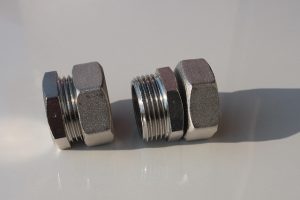

Pipe nuts are available in flared and flareless styles. Both types of nuts are used to create threaded connections between tubes or pipes. In the aerospace industry, pipe nuts are commonly used in pressurized systems, such as hydraulic systems. Hydraulic systems leverage pressurized fluid to transfer power. The pipes used in these systems feature specialized pipe nuts, such as flared nuts and flareless nuts.
What Are Flared Nuts?
Flared nuts are characterized by an internal conical seal. They don’t have a round opening. Instead, the sealing component flares outward, resulting in a conical shape. Some flared nuts have a 37-degree flared seal, whereas others have a 45-degree flared seal. Regardless, all flared nuts feature an internal seal that flares outward.
What Are Flareless Nuts?
Flareless nuts are characterized by a straight design. They are used for the same purpose of creating threaded connections in pressurized systems, but they lack the conical shape of flared nuts.
Flareless nuts use a separate sleeve to hold the connected pipes together and create a tight seal. Known as a ferrule or bite ring, this sleeve grips the outer walls of the pipe. When you tighten a flareless nut, the sleeve will drive into the fitting to create a strong mechanical hold without relying on a conical flare.
Differences Between Flared and Flareless Nuts
Flared and flareless nuts aren’t the same. The main difference between them is that flared nuts have a conical sealing component, whereas flareless nuts are straight and rely on a sleeve. Flared nuts use their geometry to create a connection. As you tighten a flared nut, it will pull the flared end of the pipe against the fitting’s nose.
Flareless nuts use a sleeve to create connections. Tightening a flareless nut will force the sleeve into the fitting. The fitting will then grip the outer walls of the tube. This gripping action holds the pipes together while simultaneously creating a strong seal that prevents fluid or air leaks.
Both types of nuts require the proper torque during installation. Flareless nuts, though, are particularly sensitive to torque requirements. If you don’t apply enough torque, the sleeve won’t be driven into the fitting. As a result, the connection and seal will be weak.
Flareless nuts are typically easier to install. They don’t require any special tools, allowing for quick and easy installation. Flared nuts, in comparison, require a flaring tool. The flaring tool is used to deform the end of the pipe or tube before installing the flared nut.