
Angular misalignment is a common problem in aerospace manufacturing. Airplanes rarely have perfectly flat surfaces where two or more components meet. This can lead to angular misalignment. Fortunately, convex washers offer a simple and effective way to correct angular misalignment.
What Are Convex Washers?
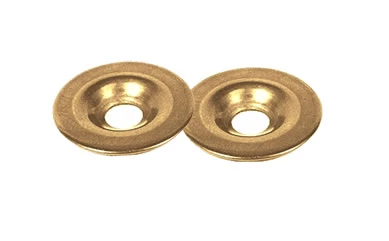
Convex washers are characterized by an outward-curved surface. Like most washers, they are typically used in conjunction with bolts and nuts. A bolt is placed through the open center of a convex washer, after which a nut is twisted onto the end of the bolt. Only convex washers, however, feature a curved, cup-like shape.
Conventional washers are flat. Convex washers, on the other hand, are cupped. The term “convex,” in fact, means to bulge outward. Convex washers are distinguished from conventional washers by their cupped, outward-bulging shape.
Common features of convex washers include the following:
- Round with an opening in the center for a bolt
- Outward-bulging shape
- Available in stainless, steel, carbon steel, brass and other alloys
What Is Angular Misalignment?
Angular misalignment involves two or more connected components meeting at the wrong angle. Rather than sitting flush against each other, the components meet at an angle. If the components have different profiles — or if the manufacturing tolerances of the components are slightly off — angular misalignment may occur.
Flat washers won’t provide proper load distribution in applications involving angular misalignment. They won’t sit correctly, so one side of the joint will experience more stress than the other.
How Convex Washers Work to Correct Angular Misalignment
Convex washers are able to correct angular misalignment with the help of a matching concave washer. The convex washer M45595/6-01, for instance, is typically paired with the M45595/7 concave washer.
Concave washers are similar to their convex washers. Rather than bulging outward, though, they bulge inward. By using the two washers together, you can achieve a curved profile that compensates for angular misalignment.
The newly curved profile essentially creates a dynamic joint. The joint can support a limited amount of misalignment or correction, such as 3 or 4 degrees. It’s not a lot, but it allows bolt heads to sit flat against the washer assembly.
In Conclusion
When fastening components at angled mating surfaces, you may want to use convex washers. They can accommodate a limited amount of angular misalignment and help the fastener sit properly against the joint. Just remember to choose a matching concave washer.