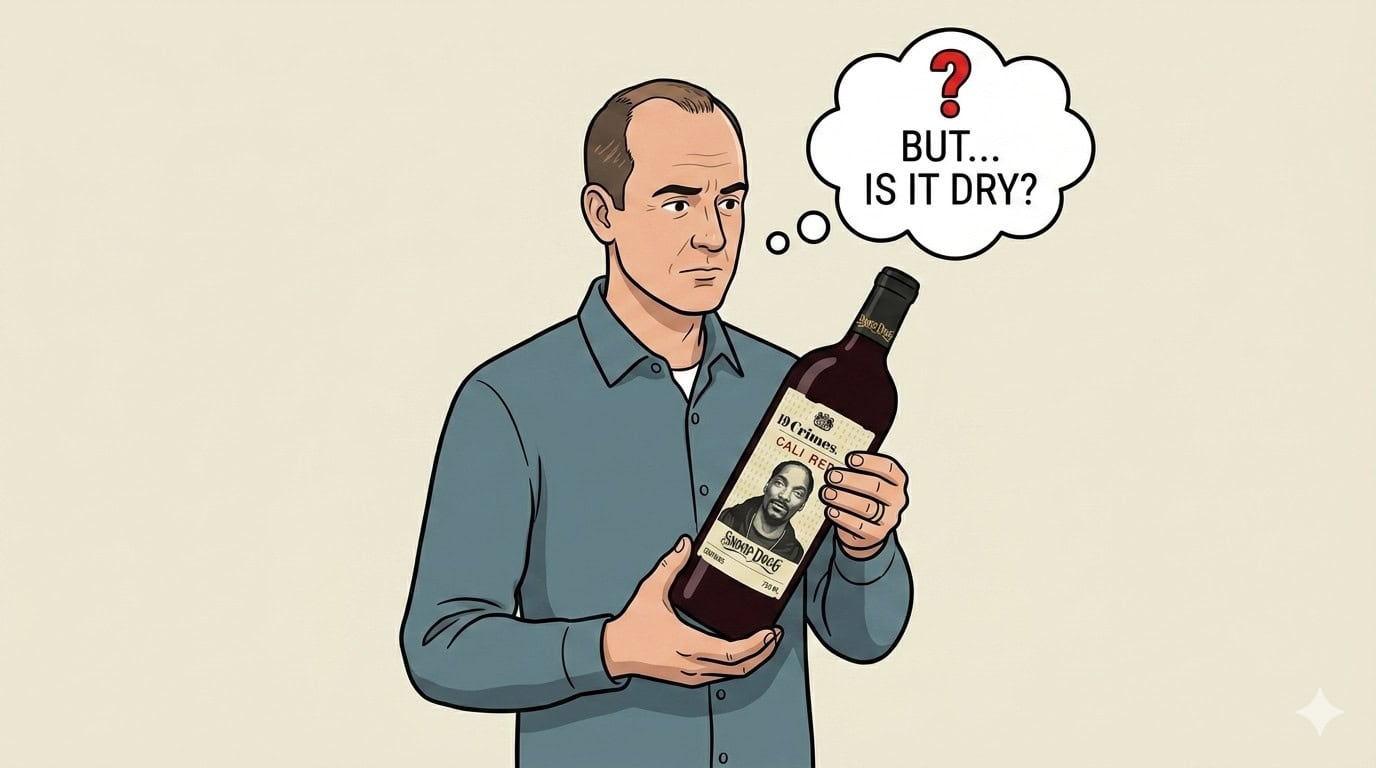
A good $15 California red is genuinely hard to make. Smooth, fruit-forward, low tannin, pleasant acid — that profile pleases a wide range of palates and it sells in enormous volume. What most people don’t know is that producing wine like this profitably, consistently, and in large quantities has a specific history. It didn’t happen by accident.
To pull back the curtain, we analyzed empirical data from Canadian government liquor boards—the SAQ and LCBO—which mandate independent laboratory testing for residual sugar before any wine hits their shelves. The results expose a wide gap between traditional winemaking and mass-market engineering.
September 1933. Modesto, California.
Prohibition ends and Ernest Gallo, 24 years old, borrows $5,000 from his mother-in-law. Teresa Franzia. Yes, that family. He adds what little he and his brother Julio have saved, signs a lease on a warehouse near the railroad tracks, and they’re in business.
They weren’t starting from scratch. The family had been growing grapes in the Central Valley all through Prohibition and shipping them east, where home winemaking was technically legal. Their father had come over from Italy. They knew the land, they knew the buyers, and they had a rough idea of what the market wanted.
What they didn’t have was a winemaker. Or a recipe. Julio found some pre-Prohibition pamphlets in the basement of the Modesto Public Library and they figured it out from there.
Nobody planted Alicante Bouschet because it made great wine. They planted it because it survived.
The vineyards that made it through Prohibition were planted with Alicante Bouschet, Carignan, and Grenache, varieties chosen because they grew fast, shipped well, and didn’t die. Nobody planted them because they made great wine. Meanwhile the people buying wine had spent thirteen years drinking bathtub gin and bootleg liquor, most of it sweetened to cover what it actually tasted like. Americans had developed a sweet tooth and didn’t know it. Dry table wine was never going to satisfy that. The Gallo brothers understood this before most of their competitors did.
Read more: How Grape Bricks Saved the California Wine Industry During Prohibition →
Americans had developed a sweet tooth and didn’t know it. Dry table wine was never going to satisfy that.
For the first several years Gallo sold bulk table wine to local bottlers who slapped their own labels on it. Nobody knew the Gallo name. That changed in 1940 when they launched their own label for the first time — Zinfandel, Dry Muscat, Sherry, and Muscatel. Selling direct to consumers meant understanding what consumers actually wanted to buy.
Things really took off with Ruby Port. A sweet fortified wine sitting at around 20% ABV, nearly double what a table wine delivers, Ruby Port gave American drinkers exactly what they had been trained to want — sweetness, strength, and smoothness at a price that anyone could afford. This is when Gallo started running print and radio ads, building out a dedicated sales force, and pushing for shelf placement in every liquor store they could reach. The strategy worked. By 1948 they were selling 4 million gallons a year. By 1966 they were the largest winery in the country.
In 1975 a batch went wrong. Bob Trinchero bottled it anyway. It sold out.
By the 1960s American producers were trying to move the country toward table wine. The problem was that the public they were selling to had been shaped by two decades of sweet fortified wine. Dry red wine asked something of the drinker that most Americans weren’t ready to give.
In 1972 Bob Trinchero, the winemaker at Sutter Home in St. Helena, was using a technique called saignée — bleeding off juice from his Zinfandel grapes early in fermentation to concentrate the red wine. He fermented the leftover pink juice into a dry white wine and sold it as a novelty. It moved slowly.
In 1975 a batch went wrong. Trinchero was filling a tank that had extra headspace and added some Mission grape juice to top it up. The Mission juice stopped fermenting early, before the sugar had fully converted to alcohol. The result was a slightly sweet, pink wine that wasn’t what he intended to make. He bottled it anyway.
It sold out immediately. By 1987 White Zinfandel was one of the best-selling wines in the country. Sutter Home eventually produced more than 5 million cases a year.
The accident confirmed what Gallo had understood since 1940. Americans would reliably choose sweetness.
“Virtually everyone is using it. In just about every wine up to $20 a bottle anyway.”
— Monterey County winery president, Wired, April 2014
Here’s what’s actually happening at the low end of the American wine market.
To make wine at scale and still turn a profit at $15 a bottle, you need a lot of grapes and you need them cheap. That means high-yield vineyards where the vines produce enormous quantities of fruit, most of it watery and diluted. Machine harvesters go through at night and take everything — ripe grapes, underripe grapes, leaves, the occasional vineyard creature. You start with a lot of volume and not much quality.
That’s where the additives come in. Color concentrates fix the visual profile—because watery, over-cropped grapes make thin, pale wine, and Americans expect their Cabernet to look dark and serious. Oak chips and powder fix the flavor—providing compressed tannins and vanilla notes that suggest barrel aging without the cost or time of a real cellar. Residual sugar fixes the palate—enough sweetness to round off the harsh edges of underripe fruit and deliver immediate satisfaction. Consistent blending fixes the vintage variation—so every bottle tastes exactly like the last one, year after year, regardless of what the weather actually did to the grapes.
There are roughly 70 additives approved for use in American wine. None are required to be listed on the label.
Fact Box
The Role of Concentrates — The Engineering Behind the Color
Mega Purple is the most famous brand name for a grape juice concentrate made by Vie-Del Company of Fresno from Rubired grapes, though alternative commercial concentrates exist across the industry. The structural issue with these additives isn’t their safety—it is that they create a false impression of high-quality, perfectly ripe grapes out of high-yield, cheap, and inherently watery fruit.
What It Does
- False Quality Impression — Imparts deep ruby and purple tones to wines that would naturally look thin or pale due to over-cropped, low-quality grapes
- Artificial Texture — Increases the artificial perception of body, fullness, and weight in the mouth
- Flavor Masking — Contributes heavy blueberry, blackberry, and plum notes to build an engineered flavor profile
- batch Uniformity — Erases vintage variation entirely to secure large-scale manufacturing consistency
What the Industry Says
A Monterey County winery president told Wired magazine in 2014 that grape concentrates were used by “virtually everyone” in commercial wines priced up to $20 a bottle. Wine journalist and plant biologist Jamie Goode, who was physically shown the product during a California winery visit, described it as “widely used but rarely discussed” — noting that it is “a brave winemaker” who shows journalists the product. Normally, he wrote, it is kept hidden away. Read Goode’s full account here.
What the Label Says
Nothing. Concentrates and color additives are not required to appear on any US wine label.
Ridge Vineyards began voluntarily listing all ingredients on their labels in 2011. Their Geyserville label reads: organic grapes, indigenous yeast, naturally occurring malolactic bacteria, oak from barrel aging, minimum active sulfur dioxide. That is the complete list.
Source: Wired, April 2014; Jamie Goode, wineanorak.com, February 2011; Ridge Vineyards ingredient labeling; Vie-Del Company product documentation
The result is a wine that looks like wine, tastes like wine, and reliably pleases a wide range of people. There’s nothing illegal happening. There’s nothing particularly sinister about it.
But to borrow Paul Draper’s framing — the man who spent 50 years making Ridge Vineyards one of California’s great estates — what you’re drinking is not pre-industrial wine. It’s closer to a food product engineered to hit specific sensory targets. Draper spent years trying to change this. Ridge began voluntarily listing ingredients on their labels starting with the 2011 vintage — one of the first California wineries to do so. His sense was that other winemakers were too afraid of telling the public all their secrets. If you’re enjoying it, genuinely great. Just know what it is.
Paul Draper spent 50 years making Ridge one of California’s great estates. When he asked to list ingredients voluntarily, regulators told him it wasn’t permitted. Nobody else was doing it.
Bota Box Cabernet sits at 8 g/L — not sweet by any obvious measure, and it doesn’t taste sweet. Neither does Josh Cellars at 6.9 g/L, or most of the other high-volume California reds. But compare those numbers to the 1.7 to 2.8 g/L you find consistently across Bordeaux Cabernet-dominant reds at the same price point, and a pattern emerges. The highest-volume California reds contain three to five times the residual sugar of their French counterparts.
None of this is a judgment on the people drinking them. Liking a smooth, approachable red wine is a completely reasonable preference. The issue is that most people buying these wines believe they’re drinking a traditionally dry wine when the reality is something quite different. Acid and alcohol mask the sweetness perception. The brain registers the sugar anyway and rewards you for it — which is exactly why these wines sell in the volumes they do.
Knowing that changes nothing about whether the wine tastes good. What it changes is whether you’re making an informed choice or just following a biological response that was engineered into the product. Those are two different things, and only one of them puts you in control of what you’re actually buying.
This is where a reasonable person is entitled to feel frustrated.
Wine labeling in the United States is regulated by the Alcohol and Tobacco Tax and Trade Bureau — the TTB — not the FDA. The Federal Alcohol Administration Act does not require alcohol beverage labels to disclose ingredients, allergens, or nutritional information. A bottle of orange juice tells you exactly what’s in it. A bottle of wine doesn’t have to.
There is no legal definition of “dry” in US wine law tied to a residual sugar threshold. A wine can call itself dry and contain 22 g/L of residual sugar — as Meiomi Pinot Noir does, according to LCBO laboratory data. Austria defines “dry” as a maximum of 4 grams per liter and requires it to be stated on the label. The European Union introduced mandatory ingredient labeling for wine in 2023.
The Wine Institute — the lobbying arm of California’s wine industry, representing more than 1,000 wineries — has consistently argued against mandatory on-bottle disclosure. Their preferred solution is a QR code linking to nutritional information. Their stated reason: “Wine is not a recipe product. It varies from vintage to vintage and can even vary from barrel to barrel in a given year.” That may be true of a small estate making 2,000 cases of single-vineyard Pinot Noir. It is harder to apply to a brand producing millions of cases of an engineered, laboratory-consistent red blend.
None of this is illegal. None of it is secret. It is simply a system that has never been designed with the consumer’s right to know as its primary concern — and an industry that has not rushed to change that.
Fact Box
What Your Wine Label Is Required to Tell You
Wine in the United States is regulated by the Alcohol and Tobacco Tax and Trade Bureau (TTB), not the FDA. Unlike food and most other beverages, wine is not required to list its ingredients.
What Must Appear on Every Bottle
- Brand name — required
- Wine type — required (e.g., Cabernet Sauvignon, Red Blend)
- Alcohol content — required
- Net contents — required
- Producer name and address — required
- Health warning — required
- Sulfite declaration — required if sulfites exceed 10 parts per million
What Does Not Have to Appear
- Residual sugar level — not required
- Added concentrates (Mega Purple, Rubired) — not required
- Oak alternatives (chips, powder, staves) — not required
- Winemaking interventions — not required
- Calorie count — not required
- Country of origin for all grapes — not required
There are approximately 70 additives approved for use in American wine production. Zero are required to appear on the label.
Source: TTB Federal Alcohol Administration Act; Federal Register, January 2025
Fact Box
What “Dry” Actually Means — Country by Country
In the United States, the word “dry” on a wine label has no legal definition tied to a residual sugar threshold. A winery can use the word on any wine regardless of sugar content.
Legal Definition of “Dry” by Country
| Country | Max Residual Sugar | Disclosure Required? |
|---|---|---|
| Austria | 4 g/L | Yes — on every label |
| European Union | 4–9 g/L* | Yes — from 2023 |
| United States | No legal limit | No |
*Up to 9 g/L permitted if total acidity is sufficiently high
What the Numbers Look Like in Your Glass
- Traditional dry estate Cabernet — 1–3 g/L
- Bordeaux Cabernet blends (SAQ verified) — 1.7–2.8 g/L
- Josh Cellars Cabernet Sauvignon — 6.9 g/L (labeled dry)
- Apothic Red — 16 g/L (labeled dry)
- Meiomi Pinot Noir — 22 g/L (labeled dry)
Meiomi Pinot Noir contains more residual sugar than a glass of orange juice per serving. Under US law it may be labeled as a dry wine.
Source: SAQ (Société des alcools du Québec); LCBO (Liquor Control Board of Ontario); Austrian Wine official guidelines; EU Regulation 2021/2117
Fact Box
What “American” Wine Actually Means
When you buy a bottle labeled “American” wine, you may not be buying wine made entirely from American grapes.
The Federal Rule
Under TTB regulations, a wine labeled “American” or “U.S.A.” may legally contain up to 25% foreign wine — grapes grown in South America, Europe, Australia, New Zealand, or anywhere else in the world. There are no national, continental, or hemispheric restrictions on where that 25% comes from.
How This Compares
- California AVA wines — Must contain 75% or more from that AVA. The remaining 25% must still be from California.
- French wines labeled “French” — Must come from French grapes. No exceptions.
- Italian wines labeled “Italian” — Must come from Italian grapes. No exceptions.
- American wines labeled “American” — Can include 25% from any country on earth.
Where This Stands Legislatively
California Assembly Bill 1585, introduced in 2026, would require wine labeled “American” to contain 100% American-grown grapes. The California Legislature’s own findings note that the existing loophole creates a “significant carbon footprint” and may expose consumers to wine produced under lesser labor and environmental standards than California requires.
81% of American wine is from California. More than 90% of California wine production is certified sustainable. The state leading on environmental standards is also the state where the labeling gap is most visible.
Source: California AB 1585 legislative findings, 2026; TTB labeling regulations; Wine Institute
The wine industry spent 90 years perfecting the formula. It takes about 90 seconds to start seeing through it.
None of what you’ve just read requires you to stop drinking the wines you enjoy. That’s not the point. The point is that the information the industry prefers you don’t have is actually pretty simple once you have it.
Residual sugar is the number that matters most. Canadian government liquor boards — the SAQ in Quebec and the LCBO in Ontario — test wines before they’re approved for sale and publish the data publicly. We used their numbers throughout this piece. You can look up any wine in their databases before you buy it. If a wine labeled dry contains 15 g/L and a Bordeaux at the same price contains 2 g/L, that’s a fact you now know how to find.
The next step is knowing what to reach for instead. We’ve done that work for the five most Googled California reds — verified the sugar data, identified smaller independent producers making wine at the same price in a more traditional style, and put them side by side in a single guide.
The CWA Value Wine Series
The $15 Bottle Trade-Up Guide
100% independent and unsponsored recommendations. SAQ and LCBO verified residual sugar data on ten wines — five popular and five independent alternatives at the same price.
The wines on the left are good at what they do. The wines on the right taste like the land and climate that produced the grapes. Once you know the difference, you get to decide which one you’re reaching for — and why.
That’s the only thing this series is actually about.