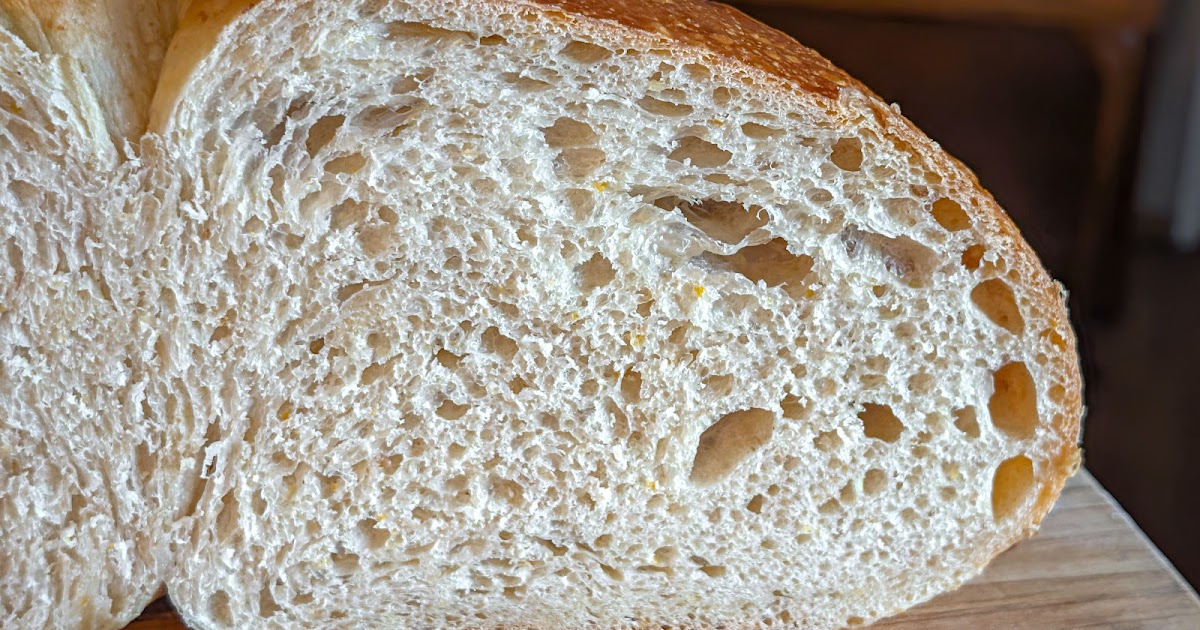

Well I wasn’t sure what result I would get with this recipe, but I loved how it turned out! Our Bread Baking Babes pick for this month was an olive oil brioche. It was soft but toothsome, simple and mildly flavored, and sturdy enough to stand up to butter that wasn’t super soft. Just a little bit of tang and chew from the sourdough, a tender crumb, and a wonderfully bouncy texture. I would totally make this again as two sandwich loaves! It’s the perfect sandwich bread and soup bread. This is the kind of loaf we would have demolished in an afternoon, with butter and jam or honey as kids.

Now here are my admissions. I didn’t actually use olive oil. *Gasp* I know, I know, it’s specifically an olive oil brioche! But I switched to avocado oil and that’s what I keep around, so that’s what I used. There would have been a little more flavor from the olive oil had I used that, and I don’t know that I would have liked it any better. Also, I used bread flour and so I added ~75g more water to my dough to make up for the difference in absorption between bread and all purpose flour. The dough is firm but elastic, and just slightly sticky, or tacky really, for my results. I added as much extra water as it needed until it looked right, so there. We babes typically do what we want, regardless of the written recipe. 🤫 Let’s see, oh, I also added half a tsp maple syrup to the egg wash to enhance browning. Yolk + splash of milk + dash of maple syrup. Since sourdough tends to brown a little less… I did add the orange flower water from the original recipe, though not in the ridiculous amount originally called for, that stuff is strong! Subtle is good, soap is not. This loaf had a divine aroma during baking. Floral and citrus notes, not overpowering, not assertive, just hints.
We would love for you to bake along with us this month and try out this tasty round. Check out our Facebook group to see
the participants’ baking results. We’d love to see your results there as well!
 |
| Back to my childhood here. |
Pompe à l’huile: Olive Oil Brioche
based on Patricia Wells’ recipe in “Patricia Wells At Home in Provence”
makes one large ring
Starter:
50g water
50g 100% no-additives whole wheat flour (I used Edison white wheat)
spoonful (15-20g) of sourdough starter from the fridge
Dough:
600g all-purpose flour (I used bread flour + an extra 75g/~⅓ cup water for the substitution)
15g wheat germ (I used golden flaxseed meal)
4g sugar
Grated zest of 1 orange, preferably organic
Grated zest of 1 lemon, preferably organic
1 tsp orange flower water (optional) (I did add this, nice and subtle)
200g lukewarm water
1g (⅜ tsp) active dry yeast (optional) (I did add a pinch of yeast)
all of the starter from above
45g extra-virgin olive oil (yeah, I used avocado, not sorry)
2 large eggs, room temperature
12g sea salt + 10g water
Wash/topping:
egg yolk, cream or milk, for brushing to make a glaze (optional)
Starter:
Late in the evening on the day before baking the bread: Put the starter ingredients into a small bowl. Mix until the flour is stirred in well. Cover the bowl with a plate and set aside overnight in the oven with only the light turned on if it’s still cool in the kitchen, or with the light turned off if the nights are warm.
Dough:
Once the starter is ripe, prepare the dough. If you are unsure about the strength of your starter, you may elect to add a little commercial yeast.
In a stand mixer, combine the flour, wheat germ, sugar, the lukewarm water, the eggs, the zests, and if desired, the orange flower water listed in the yeast based recipe below. (I used only 1 tsp, it goes a long way.) Combine into a fairly stiff dough but do not add any more water. Cover the bowl and allow to rest for about 30 minutes.
After resting, add the olive oil, and the salt mixed with water.
Knead the dough with the dough hook until it is well combined. (This will take some time; first it will be impossibly sloppy, then impossibly messy and shaggy, and then finally it will start cleaning the sides of the bowl.) Let it rest for 15 minutes, then knead again until the dough is smooth and elastic. (Dough may also be kneaded by hand and developed with 4 stretch and folds over a couple hours. It will be a challenge to work the egg and oil into the stiff dough, but still doable unless you have arthritic hands.)
Transfer the dough to a dough bucket or covered bowl and move to the refrigerator. Let the dough rise in the refrigerator until doubled or tripled in bulk, 8 – 12 hours. (The dough can be kept for 2 – 3 days in the refrigerator. Simply punch down the dough as it rises.)
When ready to bake, bring the dough to room temperature, about an hour.
Shape the dough into a round by folding in the ends and pinching together, then pulling toward yourself with the seam side down to tighten the outside of the top. Cover the round and leave to rest for about 10 minutes.
Gently press the round into a circle that is not too thick and not too thin. Poke an oiled finger or the handle of a wooden spoon into the center to start the hole and then enlarge it with gentle stretching to form a ring. Put the ring on a parchment covered baking sheet, with a well floured, well oiled oven-proof cup (tea or round measuring cup) to keep the hole from closing. Cover with a clean tea towel and allow to rise to about double, around 60-90 minutes.
Preheat the oven to 425ºF. The original author removes the teacup prior to baking, but our host says leave it in as long as it is oven safe. (I took mine out and my hole closed, but I’m not fussed about that. You could possibly use the center insert of a tube cake pan for an oven safe mold.) Gently brush the top of the loaf with egg yolk, cream or milk, if using. Put the baking sheet into the center of the oven. Immediately turn the oven down to 400ºF. Bake for 30 to 45 minutes, until the ring is a deep, golden brown and the internal temperature is around 190 – 205ºF. (Mine took 35 minutes.)
When the bread is done, remove it from the oven and allow to cool fully on a wire rack. Wait until it is cool before removing the cup in the center or slicing.
 |
| Pink lemons yield a yellow and green zest! |
 |
| Nice and firm, slightly sticky dough. Just the slightest dusting of flour to manage it. |
 |
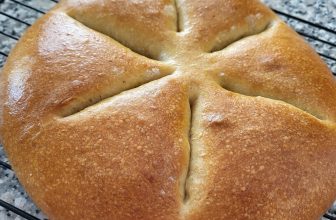
| Recipe didn’t call for slashing, but I figured just in case. Didn’t really need them, oh well. |
 |
| They added visual interest… And the egg wash did its job wonderfully. |
 |
| Tastes like the quintessential white bread. Totally loved the texture. Zest and flower water was super subtle. |
Ingredients list for yeast risen Pompe à l’huile in Patricia Wells’ book:
1 tsp active dry yeast
1 tsp sugar
250 ml water
50 ml extra-virgin olive oil
2 large eggs, room temperature
2 tsp fine sea salt
Grated zest of 1 orange, preferably organic
Grated zest of 1 lemon, preferably organic
1 tbsp orange flower water or tap water (that’s a lot, I would use 1 tsp orange water, 2 tsp plain water)
665g unbleached all-purpose flour
1 beaten egg yolk, for glazing
In the bowl of a heavy-duty stand mixer fitted with a paddle, combine the yeast, sugar, and water, and stir to blend. Let stand until activated and foamy, about 5 minutes. Stir in the olive oil, eggs, salt, zests, and orange flower water, and stir to blend.
Add the flour, a little at a time on the lowest speed, until most of the flour has been absorbed and the dough forms a ball. Switch to a dough hook and knead until soft and satiny but still firm, 4 to 5 minutes, adding additional flour to keep the dough from sticking.
Move dough to a covered bowl and place in the refrigerator.
Continue with dough as above.
The rest of the Bread Baking Babes