
My daughter Chhavi and I often visit Jaipur as it is as easy stop from Delhi/NCR. The downside of having visited a place so many times is that you have visited all the major tourist attractions a long time ago. So, for this short visit I was looking to do something different, and as Chhavi is interested in crafts, we decided to visit Kripal Kumbh, the studio of the late legend Shri. Kripal Singh Shekhawat, famous for his Blue Pottery. The space is now run by his two daughters Ms. Meenakshi Rathore and Ms. Himani Rathore.

Blue pottery, with its origin in Persia, always held a fascination for me. The striking shades of blue, the floral and other nature inspired motifs managed to cast its spell! When I realized that Jaipur Blue Pottery has a Bharat Geographical Indication (GI) Tag, my curiosity was further piqued.
When we arrived at Kripal Kumbh in Bani Park, Jaipur, the place was closed. There was a roadside vendor nearby, selling food, who told us that that it would open in an hour. Chhavi and I decided to look for a cafe. But we barely walk for a few meters, when the vendor came after us, saying the place is open now.
We met Meenakshi Rathore ma’am at the gate and walked inside with her as she opened the studio and the office situated in a spacious home-like building. We went on a Sunday so the artisans working with Kripal Kumbh were having their weekly off. While Chhavi and I were admiring the stunning blue pottery creations in the main hall, Meenakshi ma’am joined us in a while and answered all my questions.
I asked her how it all started for her? She said her father was a painter who went to study at Tokyo University in that era when there were no flights to Tokyo! So, he went to Burma and took a ship from there to Tokyo, Japan!

Blue Pottery grew under the royal patronage right from the beginning. The first tryst of Jaipur with blue pottery was when Sawai Ram Singh II (1835-1880) rewarded some artisans for winning a kite competition. The artisans used glass material from blue pottery on their kite twine. When the king asked the artists what they wanted as a reward, they said they made blue pottery for the Mughals, but they wanted to come to Jaipur, Rajasthan to practice their craft. The king suitably rewarded them and that was the first wave of blue pottery in Jaipur. However, this initiative has run its course until the 1950s.
In the early 60s, Shri Kripal Singh Shekhwat has returned after completing his studies in Japan and worked at Birla house where he met Maharani Gayatri Devi. She wanted to revive blue pottery at Jaipur. But Mr. Shekhawat was a painter, with no ties to a pottery-making family! Still, the Maharani convinced him to open the crafts school and hire the right people to revive the art of Blue Pottery! And with this meeting started the modern renaissance of blue pottery for the second time. Shri Kripal Singh ji was the first director of Sawai Ram Singh Shilp Kala Mandir in Jaipur which opened in 1963. Shri Kripal Singh Shekhawat went on to win a Padmashri and Shilp Guru for his contribution to the revival of Jaipur Blue Pottery. Chhavi and I were lucky to see his pictures from the award ceremony hanging in the hall of the Kripal Kumbh.
Now, it is the two sisters, Meenakshi and Himani ma’am who work on keeping the legacy of their father alive. When I asked if there was a member from the younger generation who was interested in doing this, Meenakshi ma’am replied that her daughter was not interested at all. But her grandson takes interest in the art and history of Blue Pottery.

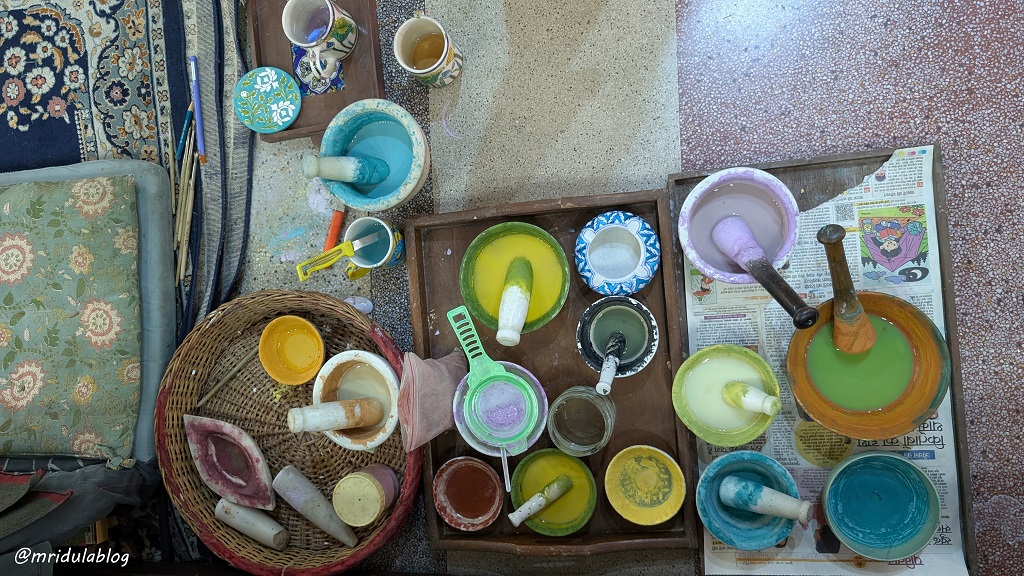
Both the lovely sisters explained the craft to me. The elegant blue pottery uses no clay and hence no potter’s wheel. The dough is a mixture of quartz and glass powder mixed with Multani mitti (Fuller’s Earth), borax and water. It is then mixed to the required consistency and molded into the desired shape by hands. So, each piece is unique. The alchemy of the striking hues of blue is derived from cobalt oxide and green from the copper oxide. Once the clay is dry after being kept in sun, each piece is hand painted to perfection. I saw Himani ma’am mixing colors in small pots and it was fascinating to see her work with it. I also the huge kilns one wood operated (not used much now) and other gas operated. Meenakshi ma’am told us it was tricky to operate the kilns and require considerable skill.

I asked Meenakshi ma’am if she wrote about the things she told me, because if she would not record this legacy who else would? She said her grandson, who is 17, is writing a book and I would eagerly wait for its release
Chhavi and I pick up a few pieces of unique blue pottery to carry home with us. They are brilliant and add so much cheer to my home!