

Two founders, one fundraising goal
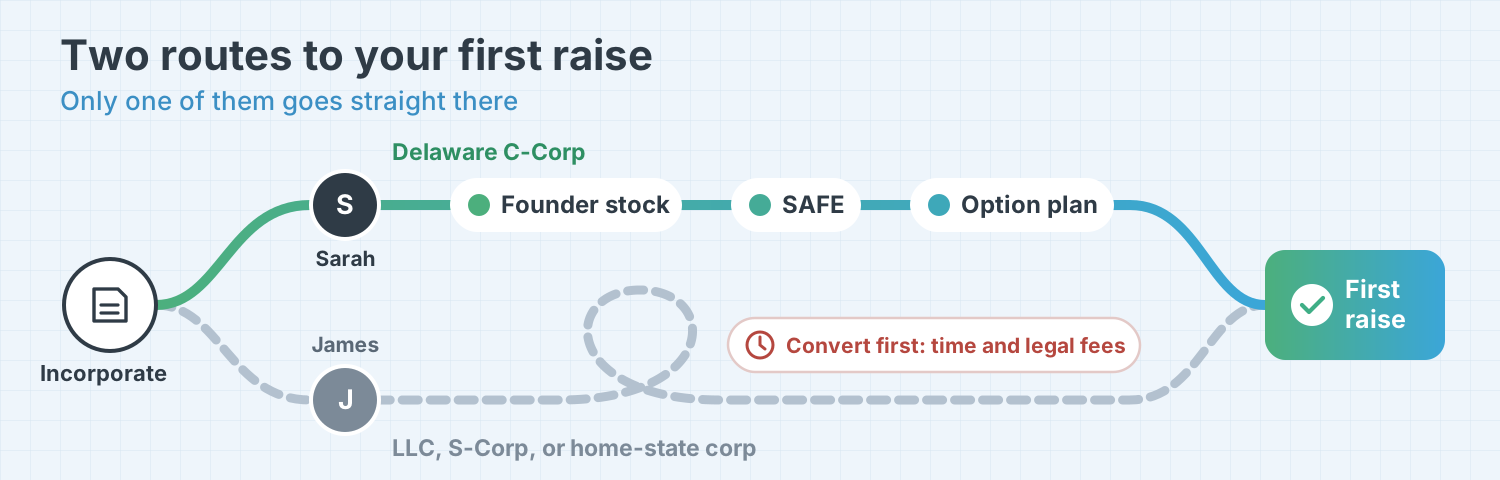
James forms an LLC in his home state. It’s quick to set up, the paperwork is light, and an LLC’s profits are taxed only once. For a new business, it’s a sensible choice.
Sarah incorporates as a Delaware C-Corporation. It takes a little more setup and costs a little more upfront, but she issues stock to herself and her co-founder and gets back to building.
A year later, both are talking to the same angel investor. Sarah’s conversation moves straight to investment terms. James’s conversation hits a roadblock. Before the investor can write a check, his company needs to become a Delaware C-Corp. That means converting the entity, translating his LLC’s ownership into corporate shares, and taking on additional legal work, all while he’s trying to close his first round.
Neither founder did anything wrong. James simply made an early decision without fully considering what investors might expect down the road. That’s the subject of this post: why the Delaware C-Corporation remains the standard for startups planning to raise venture capital, and when an LLC might still be the right choice.
Why investors expect a C-Corp
An LLC also protects you from personal liability, so why do most angel investors and VCs insist on a C-Corp? It comes down to how ownership works.
Investors need a clean ownership picture. To know what percentage they’ll own after investing, investors need to know exactly who owns what today. With a C-Corp, that’s a share count. With an LLC, ownership is usually expressed through mechanisms like profits interests, which are a share of future profits from the date the interest is granted, and capital interests, which are a share of the company’s value if it were liquidated. These can be made to work, but they don’t map neatly onto stock, and they eventually have to be translated into shares anyway.
Your team expects stock options. Options are how most startups give employees and advisors a stake in the company’s success. Most LLCs can grant option-like awards, such as unit options or profits interests, but they can’t grant incentive stock options (ISOs), the tax-advantaged options many startup employees expect. Equity in an LLC also adds tax and legal complexity for both the company and its employees. A C-Corp can set up an option plan backed by shares of its stock, without that complexity.
Investable companies need more than one class of stock. Startup investors typically receive preferred stock, which carries rights that common stockholders don’t have. A corporation can create classes of stock like this. An S-Corp, which some founders choose for tax reasons, is limited to a single class of stock and 100 shareholders, who generally must be U.S. individuals rather than partnerships or corporations, which rules out most investment funds.
The result: a company formed any other way almost always has to convert before it can raise from investors. Conversion is usually possible, but it takes significant time and legal fees, right when you’d rather be focused on the details of your round.
What about taxes?
Many founders choose an LLC to avoid the “double tax” on C-Corp profits paid out as dividends. For most early-stage startups, it rarely applies, because they reinvest everything into growth instead of paying dividends. C-Corp stock also has an advantage of its own: only C-Corp stock qualifies for qualified small business stock (QSBS) treatment, which can exclude some or all of the gain from federal tax when shares are sold, if holding-period and other requirements are met. If you expect profits right away and never plan to raise, an LLC can still make sense. For the full picture, see S-Corps, LLCs, and Tax Savings for Startups by Gust founder David S. Rose.
Why Delaware?
Most Delaware corporations don’t operate in Delaware. They choose it because investors and startup lawyers know its corporate law and its specialized business court, the Court of Chancery, which keeps diligence simpler and deals moving faster. The trade-off is that you’ll usually also register in your home state, which means filings and fees in both states. For startups planning to raise, that familiarity is worth the extra paperwork. If you don’t plan to raise, incorporating in your home state may be simpler.
If you’ve already chosen something else
If you’re in James’s position, already set up as an LLC or a corporation in another state, you haven’t made an unfixable mistake. Companies convert to Delaware C-Corps all the time. The key is timing: converting before you start fundraising is far less stressful than doing it with a term sheet waiting on you.
How Gust Launch fits
We built Gust Launch around a single structure, the Delaware C-Corporation, because it’s what most founders who plan to raise will end up needing. From incorporation onward, Gust Launch helps you issue founder stock, keep your cap table current, assign your IP to the company, and put the right agreements in place as your team and funding grow.
The goal is simple: help founders get the foundation right from day one, so they can spend less time dealing with administrative and legal complications and more time building their business.


Gust Launch can set your startup right so its investment ready.
This article is intended for informational purposes only, and doesn’t constitute tax, accounting, or legal advice. Everyone’s situation is different! For advice in light of your unique circumstances, consult a tax advisor, accountant, or lawyer.