

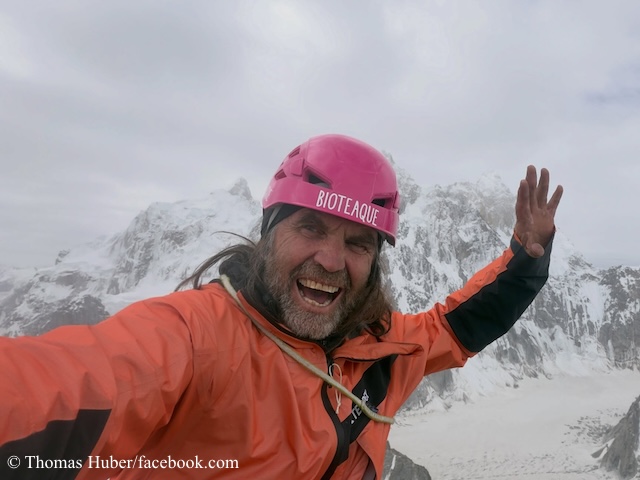
“If we’re lucky, the conditions on the mountain are right, and we’re healthy, we can still really make a splash,” Thomas Huber once told me when we were talking about what it’s like to grow older as a mountaineer. Today, the top German climber is celebrating his 60th birthday. The older of the two Huber brothers proved once again last summer that his words in our conversation were not empty promises.

Together with Spaniards Miquel Mas and Victor Sans, Thomas opened a 600-meter-high, steep route in the Karakoram in Pakistan to the previously unclimbed 5,700-meter-high summit of the granite tower Biacherahi Central.
“After five intense days, long hours and great climbing we were rewarded with this exposed summit that had been calling us from base camp every morning,” Huber wrote on Instagram about the first ascent.
“A dream come true in one of the wildest places on Earth.”
His second living room: Choktoi
The mountain lies at the Choktoi Glacier. The area – home to, among others, the legendary seven-thousanders Latok I and Ogre – is something like his second living room. When he talks about it, his eyes light up. “Choktoi is so incredible; it has such energy. I feel really good there,” Thomas told me. “That’s why I keep going back.”
As early as 1997, he accomplished one of the many first ascents of his long career there: Together with his brother Alexander, Toni Gutsch, and Conrad Anker, he was the first to climb the West Face of the 7,108-meter-high Latok II, a milestone in high-altitude big-wall climbing.
In 2001, together with Iwan Wolf and Urs Stoecker, he made the first ascent of Ogre III (6,950 meters) in the Choktoi Range and the second ascent of the 7,285-meter-high Ogre I, which is considered one of the most technically challenging and dangerous mountains in the world.

Thomas Huber also made climbing history on the granite cliffs of Yosemite National Park, in Patagonia, Antarctica, and the Indian Himalayas. In 2000, for example, he and Iwan Wolf opened a new route on the North Pillar of the 6,543-meter-high Mount Shivling in India. For this achievement, the two first ascenders were awarded the Piolet d’Or, the “Oscar of mountaineering.”
“I try to minimize the risk”
But Thomas has also gone through difficult times. In 2016, he fell twelve meters while climbing and suffered a skull fracture. He had to undergo emergency surgery due to a blood clot. “I have become humble,” Thomas told me later, looking back. “I was very lucky. I am so grateful that I am alive. I prayed and thanked that I had a guardian angel and everything went well.”
However, the accident did not change his attitude toward mountaineering, according to Thomas Huber: “As long as I know it’s dangerous, I’ll do everything I can to minimize the risk as much as possible – even on the most difficult walls in the world.”
“Mountains can be unforgiving”
Another life-changing experience was the death of former world-class German biathlete and mountaineer Laura Dahlmeier in late July 2025 on the six-thousander Laila Peak in the Karakoram. Thomas was friends with Dahlmeier.
At the time, he was once again on an expedition in the Choktoi. He immediately had himself flown by helicopter to the site of the accident to take part in the rescue operation. Later, at the request of the Dahlmeier family, he returned once more to Laila Peak to search for Laura’s body – in vain.

“The mountains give us moments full of freedom and happiness. At the same time, they are relentless and, by our human standards, cruel,” Thomas Huber wrote on Instagram this fall. “They remind us of how small and fleeting we are.”
Still many ideas
He certainly won’t be retiring to a life of leisure even after his 60th birthday. “I still have many ideas,” Thomas said. “I still carry that childlike curiosity within me. What has changed is that I no longer have a list of mountains I have to work my way through.”
To describe what mountaineering means to him, he quoted to me the top U.S. climber Dean Potter, who died in a fatal accident in 2015: “‘Mountaineering is not an extreme sport, but an art.’ A special engagement with nature. Art is boundless and dissolves all boundaries. And that reveals a personal freedom to you.”
I wish you, Thomas, many more moments of art and freedom in the mountains.


