

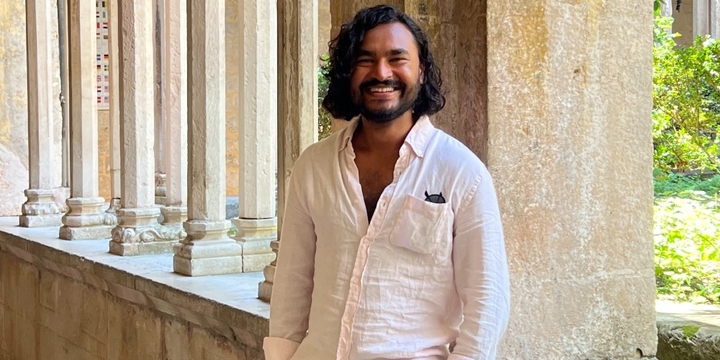
Meet Amogh Meshram, a serial entrepreneur, builder, and community-driven founder based in Berlin. From launching his first telecom company in India to scaling ventures across Silicon Valley and Europe, Amogh has spent over a decade turning complex everyday challenges into practical technology solutions.
Today, he is building both Flock, a local experience marketplace with over 30,000 participants in Berlin alone, and Garden, a cybersecurity startup securing the relationship between humans and AI agents. We sat down with Amogh to discuss his entrepreneurial journey, his core advice for founders, and his candid perspective on the Berlin startup ecosystem.

Around 2006–07, when I was 16, I watched a Discovery Channel documentary series about startups and Silicon Valley. It sparked a fire in me: I knew I would build a company and move to San Francisco.
In 2010, in my second year of electrical engineering, I ran into a problem with no market solution, so I built one. That became my first company, Aznog, a VoIP telecom provider offering free offline phone calls, before WhatsApp calling existed. The journey was fun and painful in equal measure. It took me from Nagpur, a small town in India, to startup hubs in India and Romania, and finally to San Francisco. Along the way, I met amazing people, built a great team, failed more often than I succeeded, turned down an early angel round, struggled to raise, and then oversubscribed our seed round in minutes.
Flock grew out of LifeTap, an AI company I built in 2020 to help groups make decisions using psychometrics and consensus theory. Many LifeTap users wanted to meet new people with similar interests, and that became Flock. Its mission is to connect people over shared experiences in their city, curated by locals for locals. In Berlin alone, over 30,000 people have joined Flock experiences.
Garden is a cybersecurity startup in private beta. We’re building a trust and permission layer between the internet, humans, and their AI agents. Our mission is to let consumers and businesses fully use agentic AI in their daily operations without compromising their security or identity: no phishing attacks stealing data and money, and no data surveillance by big tech.
- You’re passionate about solving real-world problems that affect millions of people. Tell us more about why you’re into entrepreneurship.
I come from a civilization where people dedicated their lives to solving problems for others. I grew up on stories of people who gave back to their community by fighting for rights, freedom, equality, and opportunity, and whose impact has lasted for generations. I realized early on that I have eyes to see problems, a brain to build solutions, and a voice to rally people to a cause. Entrepreneurship is my way of giving back.
- Please share three pieces of advice for founders that are vital for a startup’s survival.
– Beggars can’t be choosers. One of my first investors told me this. Build a great product with traction so you’re never begging. Be ready to walk away from a bad deal; with more work on product and traction, a better one usually follows.
– Be frugal. Spend as little as you can without slowing product development and growth. You never know when the market will turn, or when a political shift, tariffs, or sanctions will hit.
– Pivot until you find product-market fit. It can take years. The founding team has to iterate fast and adapt.
- Tell us about the Berlin startup ecosystem. What are the opportunities? What are the challenges? What do you predict for the near future?
Berlin’s ecosystem has changed noticeably in the last two years. More expats, especially from India, are trying to build companies here. That’s a great sign, and it’s part of what made Silicon Valley successful, but Germany lacks the infrastructure to support them.
Berlin is also being shaped by geopolitics. German manufacturing is under pressure: its products struggle to compete with Asian equivalents, Asian markets are becoming self-reliant in technology, and “German quality” is no longer a selling point for many everyday consumer goods. Meanwhile, Germany has neither a strong service industry nor an environment where a bunch of college kids can build something novel. According to the IMF, Germany’s ten largest companies are on average 145 years old. Innovation and wealth here are concentrated in generationally old companies, which are also the biggest beneficiaries of German bureaucracy and regulation. They use both to stay relevant and keep startups from disrupting them.
German manufacturing won’t disappear, but it is changing direction. After WWII, companies that made arms and supplies switched to consumer goods. Now the political and industrial trend is to go back to arms, this time for the European defence industry. The tech narrative has shifted too: the 2000s were about startups disrupting incumbents for society’s benefit, while the 2020s are about big tech controlling attention and startups combining AI and robotics for war and surveillance.
Three paths are opening up for startups, and I’d only recommend two of them:
– Building for war. German and EU budgets are being drafted for it, and investors are excited; those are facts. But I don’t support it, and I’d ask founders not to work in this space. Human values matter, and diplomacy is a far greater weapon for peace. Billions of us would prefer to live, so please don’t build for war.
– Building for sovereignty, without building a bad product. Trump’s second term exposed how vulnerable it is to rely on US tech. There’s a big opening for German and European consumer tech.
– Building for expats, so they can build. Walk through Berlin in 2026, and you’ll see the demographic shift. Much of the gastronomy and service industry is staffed by people from South Asia, many of them highly skilled with successful careers back home, who came for a dream that was sold to them. The reality is grey, like the Berlin weather. Many study at expensive private universities, in courses with fancy names but poor job prospects, and then face exploitation in their “20-hour-a-week” jobs and the housing crisis. Those on job-seeker visas find a much tougher market than advertised. Many see entrepreneurship as a way to build something of their own and enjoy the European lifestyle, but the bureaucracy and cost of starting and running a company in Germany are daunting. When most startups never turn a profit, the cost of trying and failing here is too high for an expat to risk.
Thank you very much for sharing your journey and opinion with us. We wish you the best of luck in your future endeavors.
Join our network of startups & investors!


