“Songbirds and Willows” invites us to reflect on the passage of time, the fragility of memory and our connection with nature, offering a meditation on the cyclical and ever-changing rhythms of life.
With a new series of paintings, the British artist questions contemporary western society’s linear conception of time, inviting viewers to re-examine their memories within a circular framework.
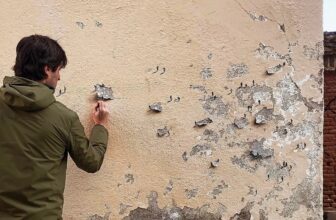
The first two rooms of the gallery present a new series of works born from Almond’s visits to Lucian Freud’s west London studio. After he was invited to spend time in the space, Almond’s eye was caught by what remained of the revered artist’s practice, namely, the left over paint- stained cotton rags that he used while painting. The discovery led Almond to a profound exploration of light and form, transforming Freud’s rags into monumental landscapes. These images when printed and then over painted on large canvases, render the emotional weight of presence and absence while touching upon the liminal space between life and death. With their muted tones of earth and dirt, with sudden flurries of colour, Almond refers to these works as his, ‘Songbirds’ as they reflect a similar palette to that of indigenous British avian species.
The exhibition then continues with the Willow Works, where the circularity of time is ever present. Seasons present themselves through watery veils of pigment that fill the canvases, each etched by the suspended branches of a willow tree. Buried within, the zero emerges, a conceptual emblem of infinity, focus and the interconnectedness of all things. As the vanishing point of perspective or signifier of the infinite, the zero acts as the bookends of life.
Read as a contemplation of mortality, the zero is the moment when existence meets non- existence, a continuation in Almond’s long-standing interest in the philosophical questions of being and nothingness.
In the final gallery of the Willows series, Almond applies precious metals of gold, copper and palladium to the canvas to draw upon the dynamic qualities of reflected light. These gossamer foils simultaneously evoke sun or moonlight reflecting across the surface of water and the changing of the seasons. Each panel depicts the willow in different stages of growth and rebirth, from the budding leaves of spring set against sunny gold to the bare branches of winter that creep over cold palladium.
The properties of these metals allow light to be attracted, reflected and altered in a way that mirrors the passage of realtime, evoking the fluidity and grace of nature, while their geometric patterns recall traditional Japanese byōbu (folding screens).
This synthesis of Japanese artistic traditions and materials show how Almond has not merely appropriated these influences, but rather uses them as a physical and conceptual framework to to further explore his interest in the nature of time, light and perception in new ways. Just think of Jun’ichirō Tanizaki’s In Praise of Shadows (1933), which shows how traditional Japanese aesthetics value shadows and subtle reflections over direct lighting. This concept relates directly to the way Almond uses metal surfaces to create subtle, shifting effects rather than static images.
at Alfonso Artiaco, Naples
until March 8, 2025