

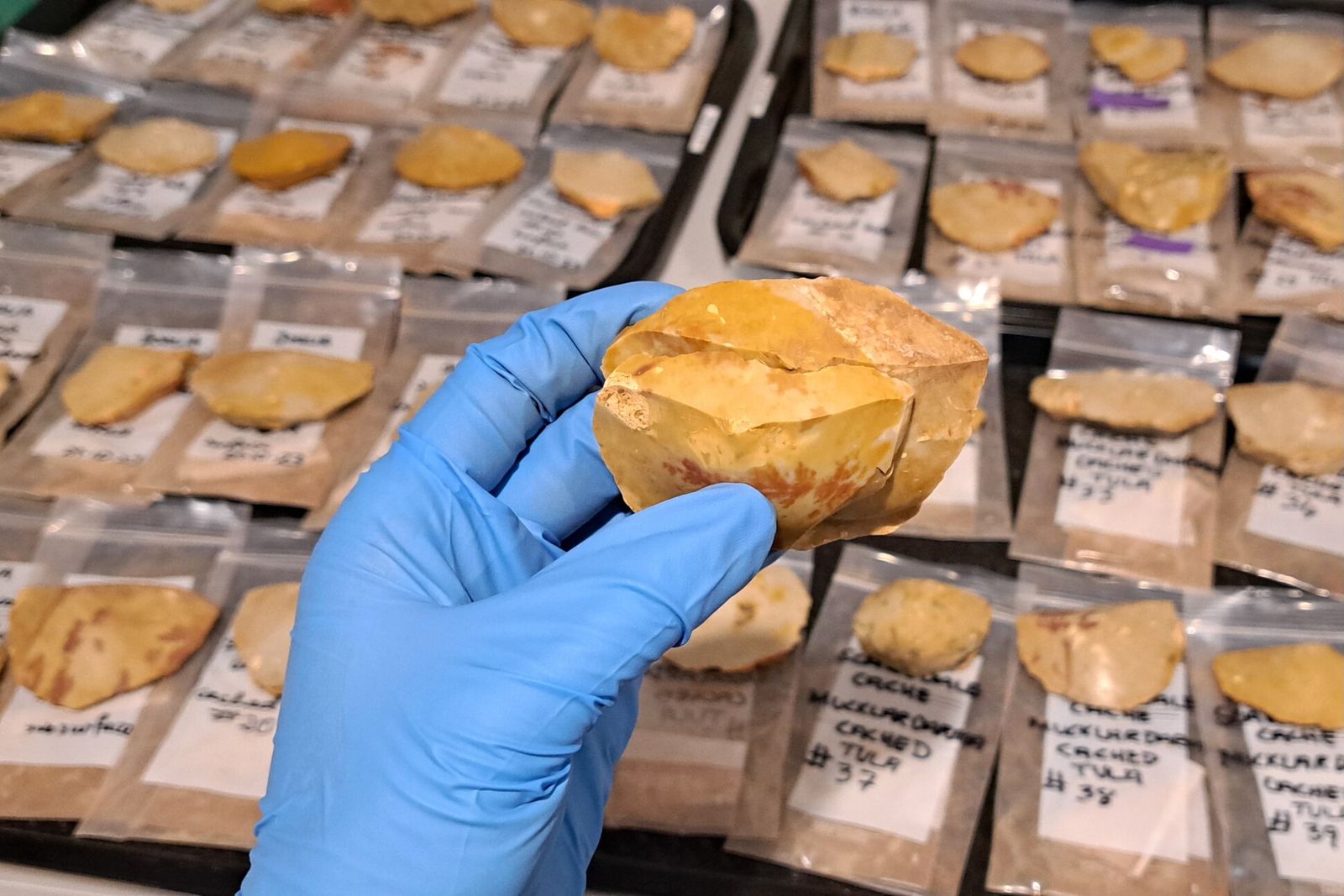
Known as “tulas,” the 60 artifacts are only the second discovery of this size to be found in Australia. Researchers think they may have been created for trade
/https://tf-cmsv2-smithsonianmag-media.s3.amazonaws.com/accounts/headshot/Sonja_headshot.png)
:focal(974x649:975x650)/https://tf-cmsv2-smithsonianmag-media.s3.amazonaws.com/filer_public/92/35/923543e2-4caa-4bfa-9fd3-a0bf4182d7ee/credit-_yinika_perston.jpeg)
The trove included 60 complete tulas.
Yinika Perston
Archaeologists in the Australian outback have discovered a stash of dozens of stone tools. According to a study published in the journal Archaeology in Oceania, these artifacts are 170-year-old “tulas” made by Aboriginal groups.
Researchers from Australia’s Griffith University excavated the tulas in western Queensland in 2023. They were surveying a small body of water nearby when they glimpsed a cluster of jagged edges emerging from the earth.
“As soon as they saw it, they knew it was something special,” lead author Yinika Perston, an archaeologist at Griffith University, tells Abbey Halter and Maddie Nixon of the Australian Broadcasting Corporation (ABC). “We could tell they were stone tools that someone had made there and, because they were all clustered together, we thought maybe it might be a deliberately buried bundle of tools.”
Yinika Perston excavating the cache Griffith University/https://tf-cmsv2-smithsonianmag-media.s3.amazonaws.com/filer_public/12/e8/12e81bab-073b-475a-ac9a-dbf3d305387a/dr-yinika-perston-excavating-1-2048x1365.jpeg)
According to a statement from Griffith University, the Pitta Pitta people likely created the tulas, which are meant to be attached to handles and used for woodworking, before burying them near a waterhole. Three pairs of the tulas fit together, indicating they were created from the same stone at the same time.
“We think the Pitta Pitta ancestors were likely planning to trade the tools in these caches when the time came, but for some reason never retrieved them,” says Perston in the statement. “One possible reason for this may be due to disruption caused by European arrival—but the dates aren’t precise enough to be sure.”
Quick fact: When did the first Europeans arrive in Australia?
The Dutch explorer Willem Janszoon landed on the coast of Cape York Peninsula in 1606, making him the first confirmed European to reach Australia.
According to the study, radiocarbon and optically stimulated luminescence dating techniques suggest the recently discovered tulas were buried sometime between roughly 1793 and 1913, Perston tells ABC.
“[Tulas] were still used quite a lot during the contact era,” Perston says. “There’s lots of photos of people using them; there’s written record accounts of people using them.”
The tools might have once been buried in a container made of kangaroo skin, tree bark, woven string or cloth, write the study authors in the Conversation. However, high-powered microscopes revealed no traces of a container, possibly because plant and animal material “does not survive well in desert conditions,” they add.
The region where the tulas were found, near the town of Boulia, is prone to both bushfires and sudden flooding, per the Conversation. The Pitta Pitta people once built stone shelters to shield themselves from harsh sun and winter winds.
“Innovation and connection helped them survive the region’s harsh climates,” Perston says in the statement. “If they could not find resources locally, they bartered along vast trade routes. ” Among the goods traded by Pitta Pitta communities were stone axes, pearl shells, ochre and pituri.
An example of a wooden handle with a tula attached to it Archaeology in Oceania/https://tf-cmsv2-smithsonianmag-media.s3.amazonaws.com/filer_public/8c/c5/8cc59bf8-587a-4860-86d1-54ee32da9917/tula_hafted_onto_the_end_of_a_wooden_handle_using_resin_ethnographic_example.jpeg)
The cache of tulas is only the second collection of this size to be unearthed in Australia, reports ABC. The other discovery of this nature, excavated in 1988, was also found on Pitta Pitta land. Perston tells ABC that this kind of tool is “found and used pretty much all over Australia.”
“It just so happens that that other bundle is only seven kilometers [roughly four miles] away from where we found this one,” she adds.
The 1988 discovery featured just 34 tulas and 18 items known as flakes, which may have been unfinished tulas. Meanwhile, the newly discovered collection includes 60 complete tulas. “It is now clear this caching practice was no fluke,” write the researchers in the Conversation. “Burying bundles of unused stone tulas was a repeated practice here.”
Trevina Rogers, a Pitta Pitta artist and co-author of the study, tells ABC that the cache is “a very exciting discovery.” She’s been documenting Pitta Pitta culture since childhood and has more recently been collaborating with Griffith University to discover what her ancestors left behind.
“That’s the only way to find out, to get out there, and you always find something new,” Rogers adds. She hopes the recent discovery will make local residents proud. The researchers have created 3D models of each artifact in the cache and made them available to the public.


