

Compressed air demand in real industrial environments is rarely steady. Machines start and stop, operators intervene, actuators cycle, valves open and close, and peak loads appear unexpectedly, while future expansion adds further uncertainty.
Yet compressors are often selected based on assumption of steady variation and that gap between theory and real-world operation is where energy waste begins.
The Real Challenge: Demand Fluctuation Reduces Usable Pressure
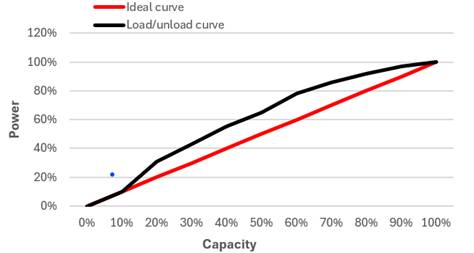
In theory, power consumption should follow air consumption proportionally (the ideal efficiency curve). In reality, demand fluctuates sharply and unpredictably. When this happens, traditional fixed-speed compressors operate using load/unload control between cut-in and cut-out pressures.
On the plant floor, the pressure band between cut-in & cut-out is often already narrow with downstream pressure drops across filters, dryers, and piping make the effective usable pressure band even narrower. As a result, even a small 5-10% demand variation can trigger frequent cycling, forcing the compressor to repeatedly shift between load and unload.
The consequences are practical and measurable:
-
a higher average operating pressure than required
-
increased energy consumption (every 1 bar excess can mean ~7% more power)
-
frequent cut-in/cut-out cycling,
-
mechanical stress on valves and bearings, and
-
reduced operational stability.
This is not misuse of equipment; it is simply the natural outcome of real-world demand behavior.
Will VFD Be the Solution?
Variable Frequency Drive (VFD) compressors are widely accepted as an efficient solution for varying demand because they adjust motor speed to match airflow requirements. They perform exceptionally well when demand changes gradually, load patterns are periodic, and consumption trends are predictable.
However, many industrial plants experience short, sharp, high-frequency fluctuations. In these situations, motor speed must change continuously , and frequent speed variation can introduce electrical and thermal stress while reducing efficiency gains. This does not make VFD ineffective, it simply means not all demand behaves the same way.

The real question is:
Is variable speed required 100% of the time, or is there a more effective way to manage rapid, real-time fluctuations?
Demand=Match: Designed for Rapid Fluctuation
Demand=Match is an intelligent airflow management system available in ELGi’s EG and EQ oil-lubricated compressors (11 – 75kW), with an extension planned up to 250 kW. Instead of continuously altering motor speed, it regulates output by smartly recirculating excess air internally and using efficient valve control to match real-time demand, while maintaining stable system pressure.
It can manage demand variations of up to 40% of compressor capacity without triggering cut-in/cut-out cycling. The result: no pressure overshoot, no unnecessary cycling, and stable pressure even during sharp fluctuations.
Demand=Match does not compete with VFD, it complements the capacity control spectrum, excelling in rapid, real-world fluctuation conditions where gradual speed variation may not be ideal.
Proven in Industry
Across industries, Demand=Match has delivered measurable improvements:
| Industry Sector | kW | Energy Savings | Cut-ins/hr Before | Cut-ins/hr After |
| Automotive Components | 11 | 10% | 46 | 26 |
| Metal Fabrication | 22 | 17% | 51 | 21 |
| Industrial Press Operations | 30 | 14% | 28 | 4 |
| Packaging | 37 | 16% | 24 | 0 |
| Textile Processing | 37 | 11% | 142 | 3 |
| Electrical Equipment manufacturing | 45 | 11% | 56 | 8 |
| Heavy Fabrication | 55 | 6% | 43 | 10 |
| Cable Manufacturing | 75 | 11% | 34 | 2 |
Energy savings ranged from 6% to 17%, with cut-in frequency in some cases dropping dramatically from 142 cycles per hour to just 3. Pressure stability improved, resulting in smoother operations and more consistent production.
These results come from real operating plants with natural demand variation. Additional references are available here: https://www.elgi.com/in/demand-match-system/
Choosing the Right Control for Your Demand
Industrial air demand is not uniform. Some plants see gradual variation – where VFD is ideal. Others experience sharp, high-frequency fluctuations – where Demand=Match performs best.
The real question isn’t “VFD or Demand=Match?” it’s “What type of demand behavior does your plant have?”
When demand fluctuates unpredictably, running at constant output is inefficient, and continuously varying motor speed may not always be optimal. Sometimes, the smartest solution is simply to match demand intelligently.
Demand=Match.
Saves like VFD. Costs like Fixed.