This is a guest blog post by Grace Hennessy, a recent graduate of Wellesley College where she earned a B.A. in Art History and Middle Eastern Studies. Grace is a 2026 Buchanan Burnham Fellow.
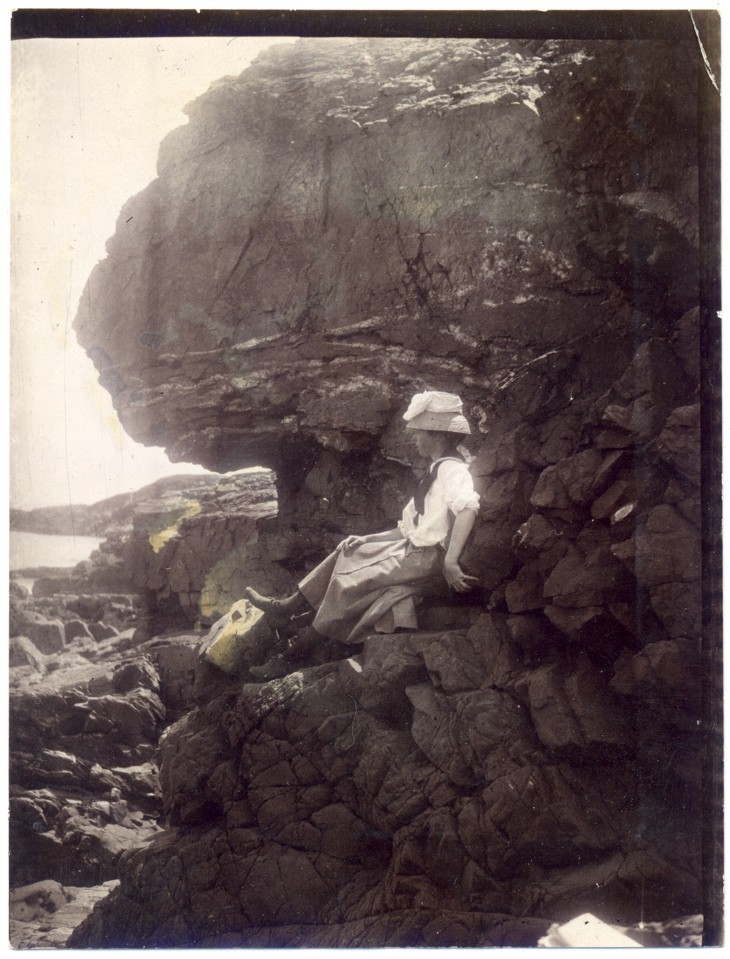
A photograph of Mabel Norman Cerio, circa 1905, seated on coastal rocks in Middletown. Newport Historical Society, P2780.
When we think of Mabel Norman Cerio (1876-1949), we think of the Norman Bird Sanctuary in Middletown, RI—the organization founded through a bequest in Cerio’s will. It is this legacy of natural preservation and environmental education that informs our perception of her. But beyond her philanthropic efforts, we know very little about the woman herself. So, we must take this opportunity to ask who Mabel Norman Cerio really was. What were her passions? What were her opinions on current events? What were her likes and dislikes? How did she interact with the people around her? How did her socio-economic status shape the way that she could move through the world? Most importantly, what does her story tell us about broader movements or historical conditions? These are the questions we aim to answer when we research a figure from the past—we attempt to contextualize their individual experiences within the larger tapestry of history. But how do you complete this task when you only have one side of a person’s story, and it’s written by another person? This is the question I was forced to grapple with while investigating a batch of correspondence held in the Newport Historical Society’s collection from the renowned Italian sculptor Hendrik Christian Andersen (1872-1940) to the then Mabel Norman at her residence in Rome.
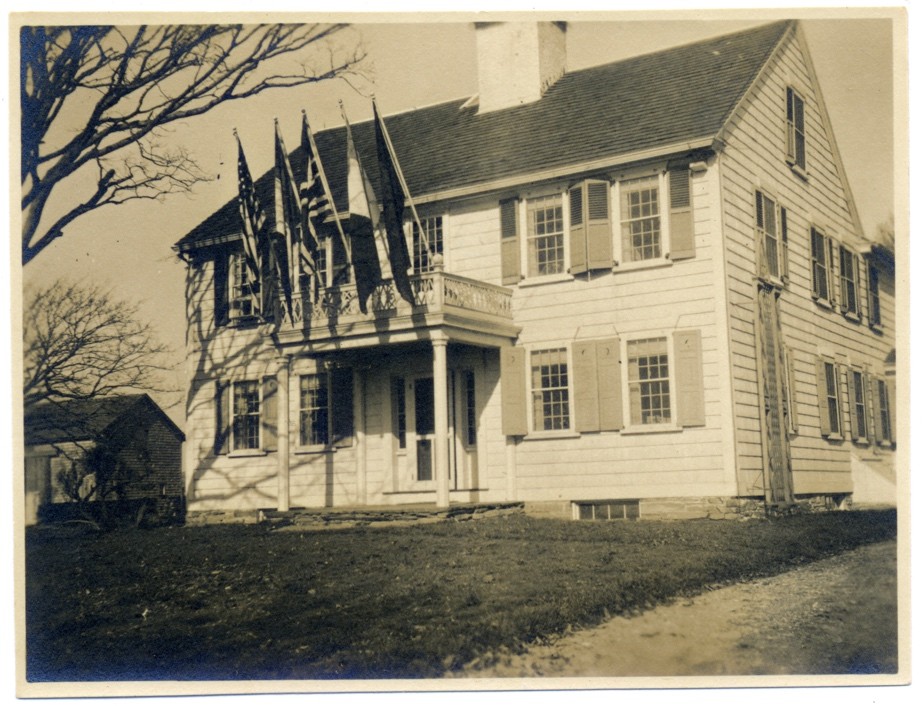
Exterior view of Paradise Farmhouse, which still stands at the present-day Norman Bird Sanctuary, in Middletown, RI. Newport Historical Society, P5558.
Born in Newport in 1876 to parents George H. Norman—the owner of the Newport Waterworks and the Newport Daily News—and Abbie Durfee Kinsley, Mabel Norman led a comfortable life. She spent her early years at her family’s Newport estate, Belair, before continuing her schooling away from home. Eventually, she grew into a dedicated artist whose primary medium was painting. Mabel would go on to have seven of her portraits displayed at the Panama-Pacific exhibition of 1915.[1] While she was developing her creative chops, Mabel’s father had purchased another estate in Middletown called Paradise Farm. At some point after her father’s death in 1900, the farm was inherited by Mabel’s older brother Guy. In 1908, however, Mabel bought the farm from her brother and used the estate as her new home and studio.[2] It was during this period on Paradise Farm that Mabel began to demonstrate an interest in conservation. Soon after she purchased the property, she began formulating plans for a bird sanctuary and wildlife refuge.[3] Upon her death in 1949, she bequeathed Paradise Farm for this very purpose, and the space was turned into what is now the Norman Bird Sanctuary. Though this is the project for which she is best recognized, we know very little about the other aspects of Mabel’s life—especially the time she spent working as an artist. It is only through Hendrik Christian Andersen’s correspondence that we begin to learn more about this other part of her.
Hendrik Christian Andersen was a Norwegian-born artist who eventually settled and developed a career in Italy. Soon after he was born, he and his family immigrated to Newport from Bergen, Norway. Hendrik and his two brothers, Andreas and Arthur, grew up in Newport before Hendrik moved to study art in Boston, Paris, Naples, and finally Rome. Hendrik made Rome his permanent residence and remained there for the next 40 years.[4] Though it is unclear exactly when and how Andersen and Norman met, it is very likely that they first connected while growing up in the same Newport circles.

Undated studio portrait of Mabel Norman Cerio in a feathered hat holding a dog. Embossed mark on paper attributes photo to “MARSHALL/BOSTON.” Newport Historical Society, P8911.
Between May 1911 and September 1912, Andersen sent 35 postcards, eleven short letters, and four notes on calling cards to Mabel Norman’s address in Rome, 25 Via Gregoriana.[5] In this correspondence, Andersen updates Mabel on everything from his work to his travels to his moods—always including in his musings on various things and his affection for the recipient. Though we can only speculate what Mabel said to elicit such responses from Andersen, this correspondence helps us understand the closeness of both their personal and professional relationship. These writings are equally useful for tracing Mabel’s time in Italy, her work as an artist, as well as her social mobility as a single wealthy woman living abroad.
Andersen’s postcards lead us to believe that his and Mabel’s relationship was a close one. One of the main ways that this is signaled is through his use of her first name in all addresses. Unlike other correspondence addressed to Mabel from this period, Andersen does not use the formal “Miss Norman.” Andersen also implements casual, intimate, and even vulgar language throughout his correspondence. In one letter from September 8th, 1911, Andersen mentions that he is very anxious to return to Mabel in Rome. In another, he mentions that it is “hotter than hell in the mountains” of Saltino. In an undated letter, he tells Mabel to “work like hell, eat like hell, and sleep well.” He calls her a blessing and signs off. Together, these comments indicate a deep sense of familiarity. Andersen does not feel the need to waste time with formalities and convention—instead conveying his thoughts directly and with great emotion. Lastly, the frequency of the letters even further bolsters the idea that they were close friends. During the summer of 1911 alone, we have fourteen postcards that Andersen sent to Mabel. These small musings, according to him, were an additional form of communication beyond their regular, lengthier correspondence.
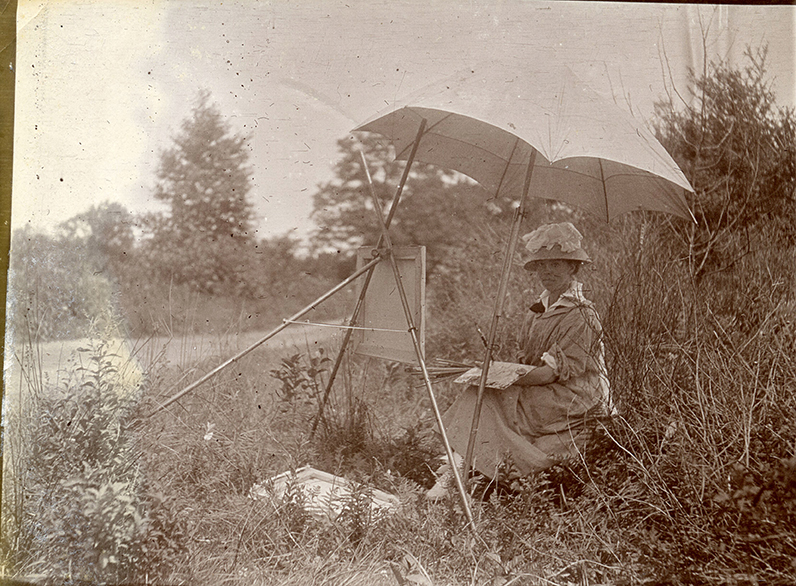
In this photograph, Mabel Norman Cerio paints in the plein air style. She is dressed in a smock and sits under an umbrella. She holds her brushes and paint palette while looking at the camera. Newport Historical Society, P2784.
Andersen’s correspondence also sheds light upon Mabel’s practice as an artist. In many of his postcards, Andersen writes to Mabel about her work, asking after the progress of her painting. It is evident from both his tone and the questions that he asks that he sees her as a colleague—though maybe not a peer of equal talent. Mabel’s more novice status as a creative is best evidenced by Andersen’s frequent encouragement and help. In one undated postcard, he asks if Mabel wants the services of a 13-year-old blonde model named Otensia for her drawings. He describes the girl’s availability and suggests that Mabel take advantage of the opportunity to work with her. Through this offer, we see that Andersen views himself as somewhat of a mentor—aiding Mabel with her journey as an artist. At the same time, his notes help us learn more about Mabel’s own practice, specifically her ventures into sculpture. In another undated letter, Andersen mentions that he wants to send Mabel more figurines. In another, he instructs Mabel on how to work with the cast figurines he has made. This suggests that Mabel was actively exploring and working in the medium of sculpture as well as painting. Though he seemingly has taken up a mentorship role in this context, it is clear that Andersen has respect for Mabel as an artist—constantly assuming that Mabel is “up to her eyes” in work like he is.
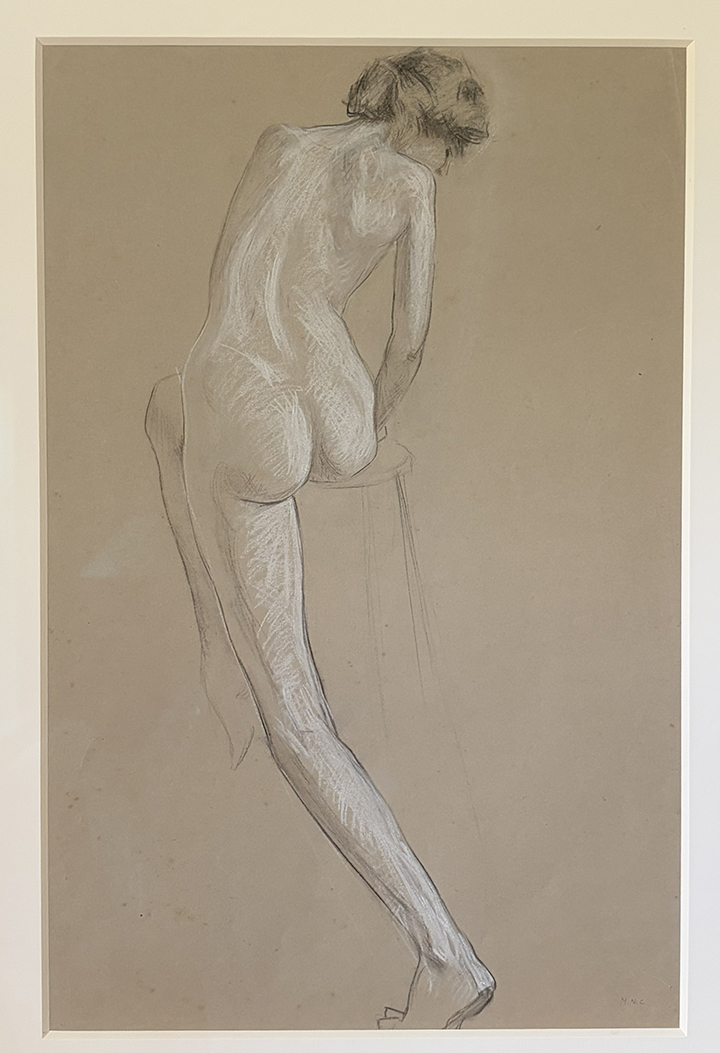
Figure drawing in pastel, likely by Mabel Norman Cerio. The initials “MNC” are inscribed in the bottom right corner of the piece. Collection of the Norman Bird Sancturary.
On a broader scale, these responses from Andersen help us to better trace the social mobility of an elite American woman living and working abroad. Beyond the postcards, we also have the quick notes Andersen wrote on the back of calling cards. In these scribblings, he invites Mabel out for fun activities with friends or tells her to swing by his studio at a given time. These invitations suggest that Mabel would have been able to move about relatively freely and unaccompanied. This is notable because although the women’s liberation and suffrage movements had gained significant traction in the U.S. by the early 20th century, the same could not be said in Italy. Therefore, Mabel’s ability to move unencumbered through Italian society as an unmarried woman artist suggests that her status as an American heiress deeply shaped her social mobility. She was afforded greater freedom and autonomy than her Italian counterparts.[6] In many of his postcards, Andersen also frequently encourages Mabel to join him wherever he is in the world—whether that be in Florence, Philadelphia, or Munich. This further indicates that Mabel’s position and means as an elite woman allowed her to travel beyond her immediate surroundings while stationed in Rome.
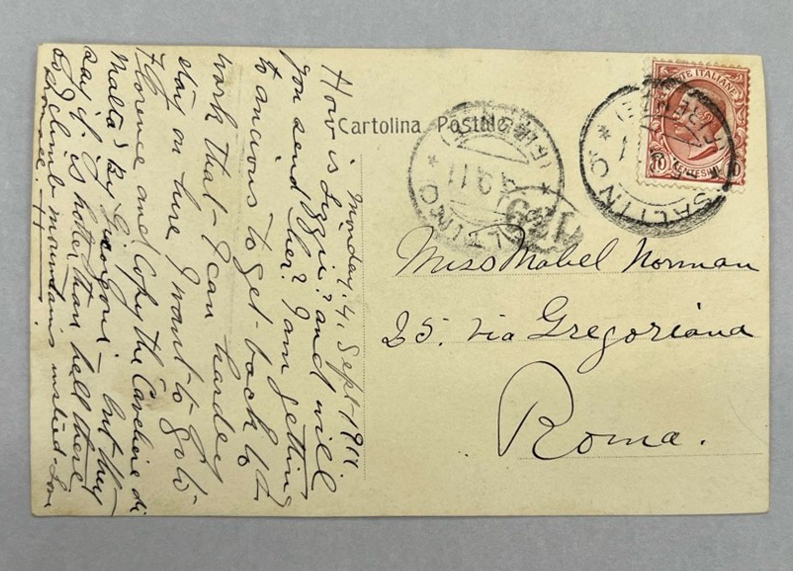
Recto of postcard from Hendrik Christian Andersen to Mabel Norman dated September 4th 1911. Newport Historical Society, Mabel Norman Cerio Collection, Box 5, Folder 4.
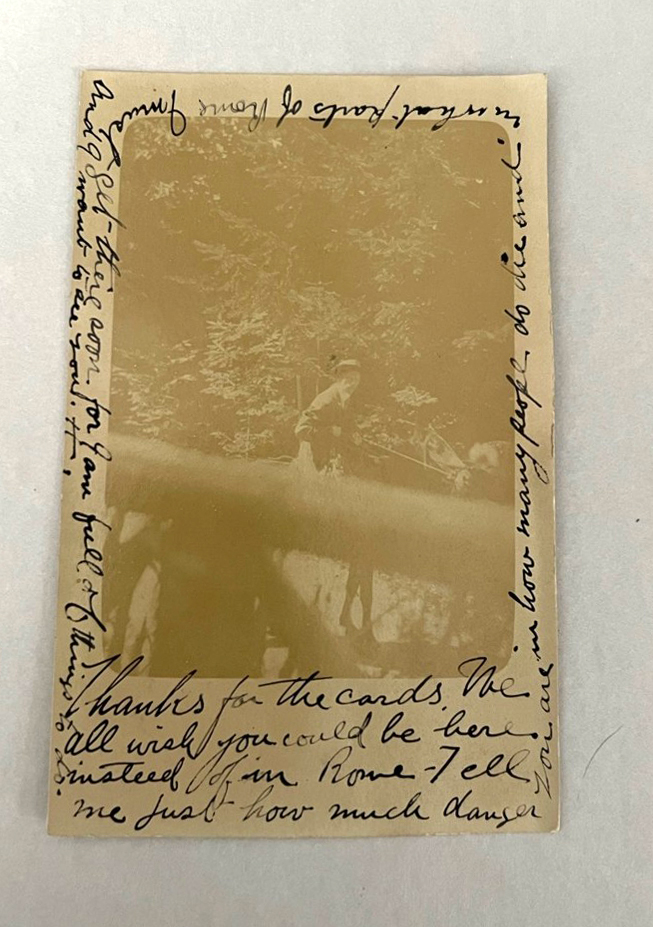
Verso of postcard from Hendrik Christian Andersen to Mabel Norman dated September 4th, 1911. On this side, Andersen asks about the number of cholera deaths in Rome and wonders if Mabel is in any danger. Newport Historical Society, Mabel Norman Cerio Collection, Box 5, Folder 4.
We also see the ways that both Andersen and Mabel, due to their class and wealth, were protected from the hardship of the period. In two postcards, one from Monday, Sept. 4th, 1911, and the other from Sept. 6th, 1911, Andersen discusses recent cholera outbreaks in Italy. Having escaped Rome, Andersen feels himself relatively unaffected by the problem, but asks after Mabel, who remains in the heart of things. He asks how many have died so far and wants to know if Mabel is safe. He also mentions that a cholera scare has occurred in Saltino, but things seem to be quieting down. The casual way that Andersen frames the discussion of cholera indicates how little he and Mabel needed to pay attention to the issue. The disease is not in the main content of their correspondence but is instead relegated to postscripts. It is an afterthought, a piece of news, but not something that either of them has been directly impacted by. This speaks to both his and Mabel’s ability to separate themselves from the realities of the world due to their socio-economic status.
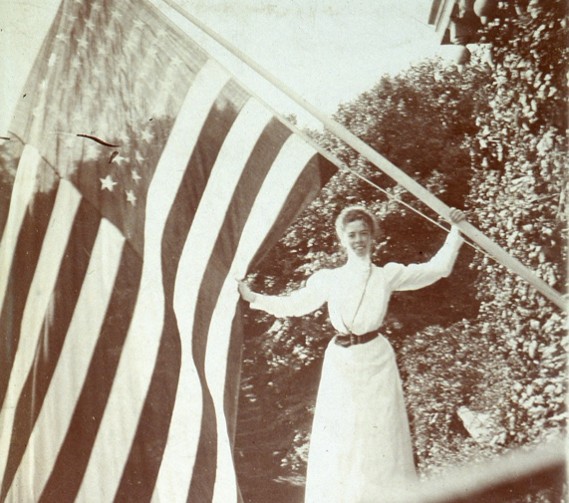
Undated photograph of Mabel Norman Cerio in a white dress holding up a large American Flag. Newport Historical Society, P2781.
By examining Andersen’s correspondence, we see that one-sided narratives can be historically useful. At the same time, we must also acknowledge the gaps that his musings leave. At the end of the day, we do not have Mabel’s voice, perspective, or opinions on any of the matters at hand. We can only make educated guesses about what she wrote to Andersen to evoke certain responses. We do not know for certain if she addressed him with the same familiarity or wrote him as frequently as he did her. We cannot be sure that she commented upon or asked about his artistic endeavors. We also do not know if she treated the discussions of social interactions and worldly issues with the same flippancy as her friend. That being said, we can still find value in Andersen’s words. It is through his responses that we come to see Mabel as a respected artist, worldly colleague, and dear friend. His postcards, notes, and letters are equally critical for contextualizing Mabel’s individual experiences within broader historical events and conditions—like the Italian cholera epidemic of 1911. They help us understand how members of the American elite were thinking about, discussing, and engaging with the issues impacting the world around them. This information, however one-sided, is critical for building a more nuanced understanding of who Mabel Norman Cerio was beyond the dominant legacy of the Norman Bird Sanctuary.
[1] Newport Historical Society, Mabel Norman Cerio Collection, Box 5a, Folder 61, telegraphs describing sale of Paradise Farm to Mabel from Guy.
[2] Newport Historical Society, Mabel Norman Cerio Collection, Box 5a, Folder 61, artwork submissions to the Panama-Pacific Exposition.
[3] Newport Historical Society, Mabel Norman Cerio Collection, Box 1, Folder 66, correspondence from ornithologist Herbert K. Jobs to Mabel Norman Cerio.
[4] Richard L. Champlain, Catalogue of the Julia Ward Howe & Hendrik Christian Anderson Exhibition at The Redwood Library and Athenaeum (Newport Restoration Foundation, 1969), 6-7.
[5] Newport Historical Society, Mabel Norman Cerio Collection, Box 5, Folders 4 & 34, postcards, letters, and calling cards from Hendrik Christian Andersen to Mabel Norman.
[6] Maud Anne Bracke, Ilaria Favretto, and Nicola Pizzolato, “Introduction: Gender and Work in Twentieth-Century Italy: New Approaches,” in Modern Italy 29, no.2 (2024): 121-29. https://doi.org/10.1017/mit.2024.7.
The post Mabel Norman Cerio: Artist and Friend appeared first on Newport Historical Society.