


In his book Rope, author Tim Queeney takes readers on a unique and compelling adventure through the history of rope and its impact on civilization. In the article below, Queeney takes a look at the Nuremberg executions during WWII, which rope played a critical role in as the men were executed by hangings.
In October 1946, the victorious World War II Allies were in need of a hangman. The 1945-46 International Military Tribunal convened by the British, Americans, Soviets and French at Nuremberg had resulted in death sentences for 12 of the highest-ranking Nazis, including Adolf Hitler’s one-time successor Herman Goering. Who would place the noose and throw the gallows lever? The man ultimately given the job turned out to be a curious choice.

The British executioner Albert Pierrepoint, an experienced hangman who had executed 15 German spies in Britain during the war, seemed the obvious candidate. Albert’s father Henry had been a hangman, along with his uncle Thomas. As a family-proud schoolboy, Albert had written of his wish to be a hangman, too. Pierrepoint was involved in his first execution in 1932 at age 27 when he assisted Thomas in the hanging of an Irish farmer charged with murdering his brother. During the war, Pierrepoint not only hanged spies but also American soldiers convicted of capital crimes in Britain.
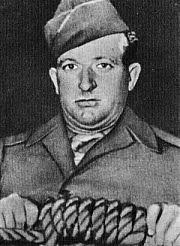
Yet the job of dispatching the Nuremberg Nazis went to a boastful and inexperienced U.S. Army private from Wichita, Kansas, named John C. Woods. When he applied for the job of hangman in 1944, he claimed he had assisted in hangings in Texas and Oklahoma before the war, even though both states had switched to using the electric chair when Woods was still a child. The Army, evidently pleased that someone actually wanted the job, overlooked Woods’s inflated claims, made him hangman, and promoted him from private to master sergeant.
In 1944, Woods received some quick training at the Paris Disciplinary Training Center. Then while the war was still being fought on the western front, Woods executed more than 30 American soldiers convicted of various crimes.
For the October 1946 Nuremberg executions, Woods eschewed Pierrepoint’s accepted British method of the “long drop” in which the weight of the convicted was used to calculate a sufficiently forceful drop to ensure the neck was broken in the so-called “hangman’s fracture.” Woods also rejected the approach of employing a metal ring through which the rope was passed instead of the bulky hangman’s noose. Instead, Woods tied a traditional hangman’s knot. He later explained, “I like what I call the Thirteen Knot noose.” He used a separate rope for each execution, pre-stretching each one to make the sudden stop at the end of the rope more effective. There were claims that Woods botched the executions since almost all the Nazis died by strangulation, not by neck fractures. In addition, Woods further miscalculated and many of the men’s heads struck the platform as they fell through the trap door opening. Woods, who was unperturbed by his role—he ate a hearty dinner that night after it was done—remarked following the last drop, “Ten men in 103 minutes. That’s fast work.”
Following the executions, Woods claimed in an interview quoted in a 1950 Time magazine obituary that vengeful Germans attempted to poison him and that someone even took a shot at him in Paris. He said that he wore two 45 caliber pistols at all times. “If some German thinks he wants to get me, he better make sure he does it with his first shot because I was raised with a pistol in my hand.”
In 1950, Woods was serving with the Army’s 7th Engineer Brigade at Eniwetak Atoll in the Marshall Islands, in support of atomic bomb testing. Some of the scientists working on atomic weapons and rocketry programs were Germans who had been brought to the U.S. as part of Operation Paperclip, the effort to scoop up German scientists before the Soviets to ensure German technological secrets would be in American hands. On July 21, Woods was working on a set of lights while standing in a pool of water and was suddenly killed in what the Army later called an accidental electrocution. Some, including French MacLean, author of American Hangman, a 2019 biography of Woods, have suggested the possibility that Woods’s death was not an accident, that perhaps one or several of the Paperclip scientists exacted revenge for their countrymen hanged by Woods at Nuremberg.
Sources:
Queeney, Tim. Rope – How a Bundle of Twisted Fibers Became the Backbone of Civilization. New York, St. Martin’s Press. 2025
MacLean, French L. American Hangman: MSgt. John C. Woods: The United States Army’s Notorious Executioner in World War II and Nurnberg. Atglen, Pa.: Schiffer Publishing, 2019
From Nuremberg to Nineveh via Google Books. Retrieved Nov. 11, 2015
The Nuremberg Hangings—Not So Smooth Either via The New York Times. Retrieved Nov. 11, 2025
Armed Forces: Hangman’s End via Time. Retrieved Nov. 11, 2025
Nazi Executioner from Wichita Found Fame, but Died His Own Mysterious Death via The Wichita Eagle. Retrieved Nov. 11, 2025


