

If you ask primatologists to list the behaviors they expect to see while watching bonobos, chimpanzees, or orangutans, you will hear about grooming, aggression, alliances, and food sharing. You probably won’t hear about kissing. It is a surprisingly understudied act, often overshadowed by more conspicuous forms of social behavior. Yet a new comparative analysis by Matilda Brindle, Catherine Talbot, and Stuart West argues that mouth-to-mouth contact has a far longer lineage than many researchers assumed.
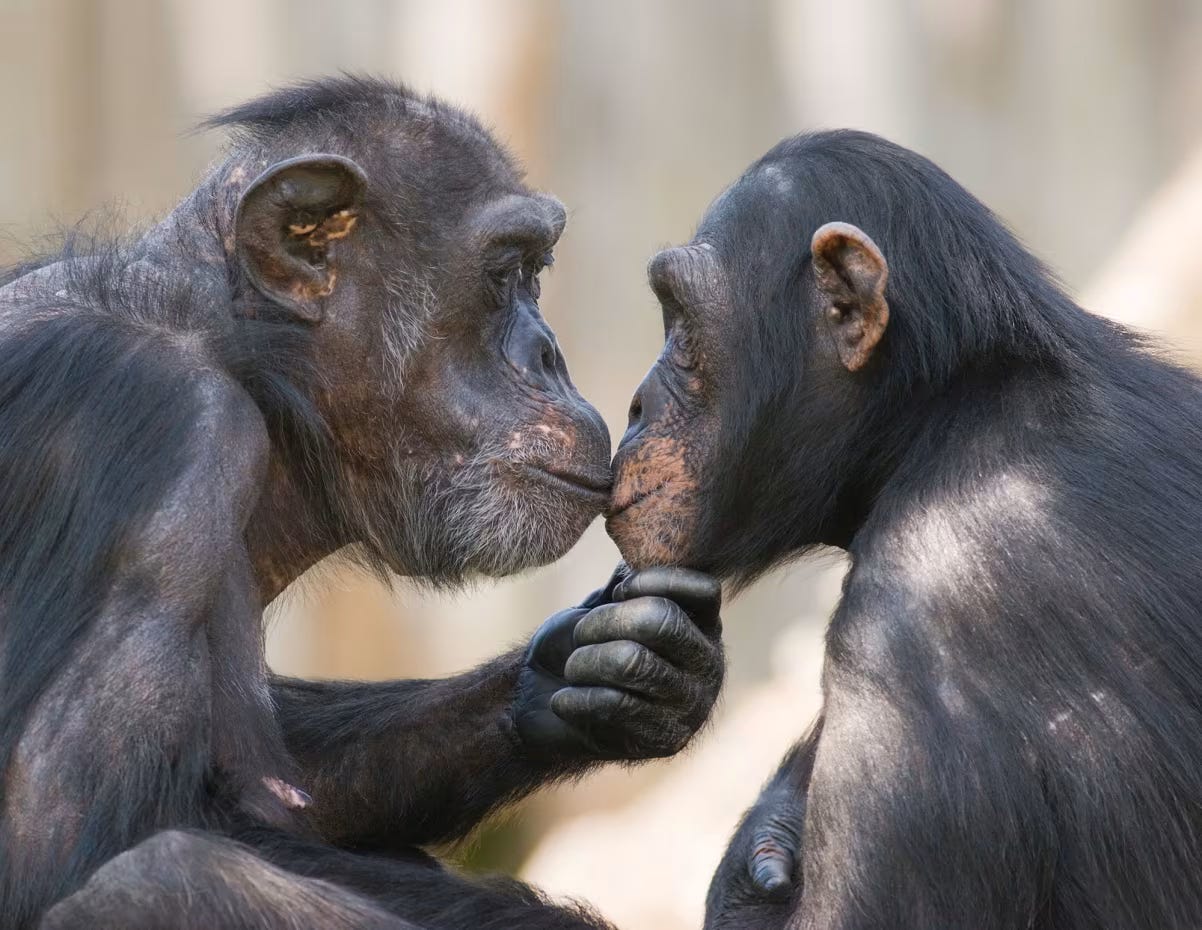
The team examined records across Afro-Eurasian primates and mapped those behaviors onto the primate family tree. Their findings suggest that kissing is not a quirky human habit but an inherited feature within the great ape lineage, one that likely emerged between sixteen and twenty-one million years ago. That places the origins of the kiss deep in the shared ancestry of Gorilla, Pongo, Pan, and Homo.
“Kissing is often treated as a cultural idea, yet the comparative evidence shows patterns that culture alone cannot explain,” says Dr. Lina Corbett, a behavioral anthropologist at the University of Michigan. “It behaves like an evolved social tool, not a decorative add-on.”
This insight reframes a long-standing puzzle. Humans use kissing to signal affection, intimacy, reconciliation, or romantic interest, but many societies do not kiss at all. If the gesture is both ancient and variable, what exactly is it doing in primate lives?