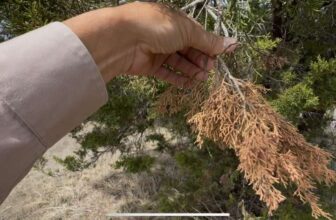

In Santo, Texas, I recently evaluated multiple native Post Oaks (Quercus stellata) that had been severely damaged by improper pruning practices. The cuts observed were flush cuts driven deep into the trunk, completely removing the branch collar and branch bark ridge.
This is not cosmetic damage. This is structural damage with long-term biological and mechanical consequences.
As an ISA Certified Arborist, and in alignment with Texas A&M University Extension guidance, I cannot stress enough how critical it is to follow ANSI A300 pruning standards when performing structural cuts on mature hardwoods.
The effects of improper pruning often do not show up immediately. They manifest five to ten years later when decay advances internally, structural integrity declines, and catastrophic failure occurs.
What Went Wrong – Flush Cuts and Collar Removal
The images clearly show flush cuts made tight against the trunk, cutting past the branch collar and eliminating the branch bark ridge.
Scientifically, this is a violation of proper pruning protocol.
The branch collar is specialized protective tissue containing chemical and anatomical defense systems that allow the tree to compartmentalize decay through the CODIT process (Compartmentalization of Decay in Trees), a concept developed through research led by Dr. Alex Shigo.
When a flush cut is made:
- The collar is removed
- The branch bark ridge is eliminated
- Defensive boundary tissues are destroyed
- Xylem and phloem are unnecessarily exposed
- The wound surface area increases significantly
This dramatically increases decay potential.
Texas A&M University Extension publications consistently emphasize correct pruning placement to preserve the branch protection zone and reduce internal decay column formation.
The Science of Proper Pruning – ANSI A300 Standards
ANSI A300 standards were developed to protect tree structure, vascular function, and long-term stability.
Proper cuts are made:
- Just outside the branch bark ridge
- Just outside the branch collar
- Without cutting into trunk wood
- Without leaving stubs
When cuts are made correctly:
- Wall 1 restricts vertical decay spread
- Wall 2 limits inward movement
- Wall 3 reduces lateral decay progression
- Wall 4 forms woundwood over time
When flush cuts are made, Walls 1 through 3 are compromised immediately. The tree must defend a much larger wound surface, and compartmentalization becomes incomplete or delayed.
Internal Consequences of Improper Pruning
When the collar is removed:
- Decay fungi colonize exposed xylem
- Sunscald increases bark desiccation
- Cavitation increases in stressed tissues
- Brown rot and white rot fungi may establish
- Internal decay columns expand vertically
These decay columns are often invisible from the exterior.
Five to ten years later:
- Scaffold unions weaken
- Fiber strength declines
- Shear resistance reduces
- Load-bearing capacity decreases
- Structural failure occurs
By the time failure happens, the original improper cut is long forgotten.
Why Hiring an ISA Certified Arborist Matters in Santo, Texas
In Santo, Texas, native hardwoods like Post Oaks are long-lived structural trees.
Improper pruning shortens that lifespan dramatically.
An ISA Certified Arborist understands:
- Tree biomechanics
- Vascular anatomy
- CODIT principles
- Proper reduction cuts
- Load distribution
- ANSI A300 compliance
Texas A&M Extension and the International Society of Arboriculture both emphasize science-based pruning practices for structural longevity.
Chainsaw operators cut wood.
Arborists manage biology and structural engineering.
The Long-Term Liability Risk
The real danger of improper pruning is delayed failure.
A tree may appear stable today.
But ten years later:
- A scaffold fails over a home
- A limb drops into a yard
- A codominant union splits during wind
- Property is damaged
- Someone is injured
And it all started with one improper flush cut.
Proper pruning is preventative structural engineering.
Mechanical Stress and Lever Arm Effect
When flush cuts are made on large scaffolds:
- Lever arms remain long
- Structural taper is reduced
- Compartmentalization is weakened
- Stress concentration increases at junctions
In mature oaks, this can translate into thousands of pounds of dynamic load resting on decayed attachment points.
Physics does not forgive poor pruning decisions
Protecting Native Oaks in Santo, Texas
If you own mature oaks in Santo, Texas:
Ask your tree professional:
- Are you ISA Certified?
- Do you follow ANSI A300 standards?
- Do you understand branch collar anatomy?
Improper pruning does not show immediate damage.
It shows up years later as structural failure.
ANSI A300 protects trees.
Improper pruning ruins them.
For general tree-care best practices, homeowners can also reference guidance from the Texas A&M Forest Service, https://tfsweb.tamu.edu/trees/, a trusted authority on Texas tree health.
Schedule a professional inspection. Early detection and scientific intervention are the difference between preservation and loss. If you’d like to speak to an arborist, please call us at 817-880-6130 or visit https://www.arboristusa.com/
In this video, we’re in Santo, Texas, looking at a clear example of improper pruning on native Post Oaks (Quercus stellata). What you’re seeing in these images are flush cuts driven deep into the trunk — cuts that completely removed the branch collar and branch bark ridge. This is not cosmetic damage. This is structural damage. And the consequences will not show up immediately. They will show up five to ten years later — when a scaffold fails, when decay columns expand, when a storm event hits, and when property damage or bodily injury occurs. Let’s break down the science. When a branch is removed properly under ANSI A300 standards, the cut is made just outside the branch bark ridge and branch collar. Those two structures are not “extra wood.” They are biologically specialized tissues designed to defend the tree.