

The evolution of artificial intelligence is on the cusp of its next major transformation, catalyzing both an economic and technology supercycle.
In one of his latest interviews, NVIDIA’s CEO, Jensen Huang, explained the structured progression through three distinct phases of AI development that are reshaping our technological landscape.
We started three years ago with Generative AI and are now in the Agentic AI phase before we embark on the fundamental transformation: Physical AI.
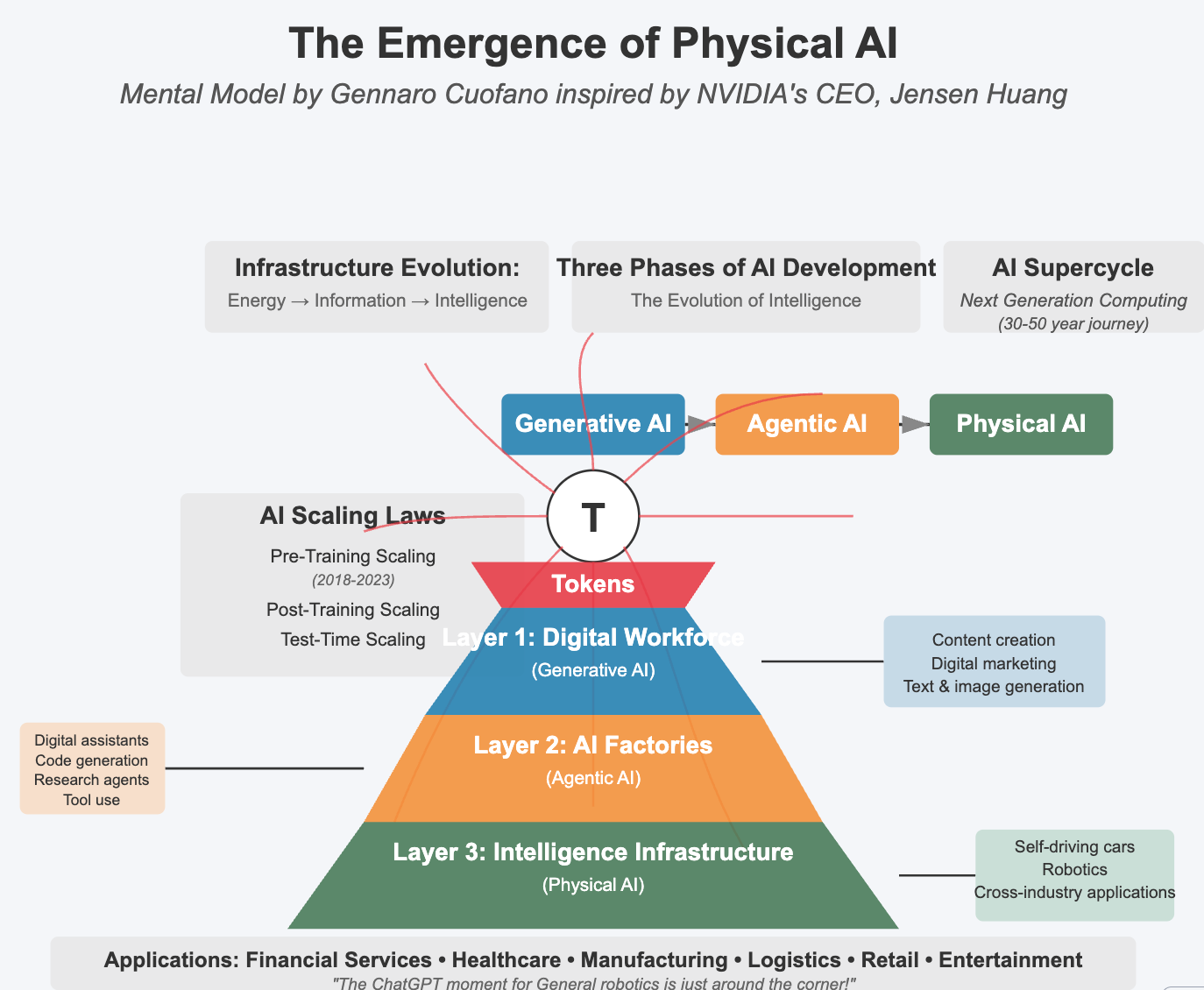
The development of artificial intelligence follows a clear evolutionary path that can be broken down into three major phases:
The first phase, which we’ve experienced most prominently since 2018, centers around Generative AI. This technology forms what Cuofano describes as the “Digital Workforce” layer – AI systems capable of creating content, handling digital marketing tasks, and generating text and images.
This phase has already transformed creative industries and knowledge work, with tools like large language models and diffusion-based image generators becoming increasingly integrated into workflows. The foundation of Generative AI lies in the ability to perceive, understand, and create content based on vast training datasets.
The second phase, which we’re currently entering, involves Agentic AI. This represents the “AI Factories” layer – systems that can take autonomous actions, make decisions, and use tools to accomplish complex tasks.
We’re seeing this emerge in digital assistants that handle increasingly complex functions, AI systems that can generate code, research agents that can synthesize information, and AI tools that can effectively use other tools.
While Generative AI creates content, Agentic AI operates with greater autonomy and purpose.
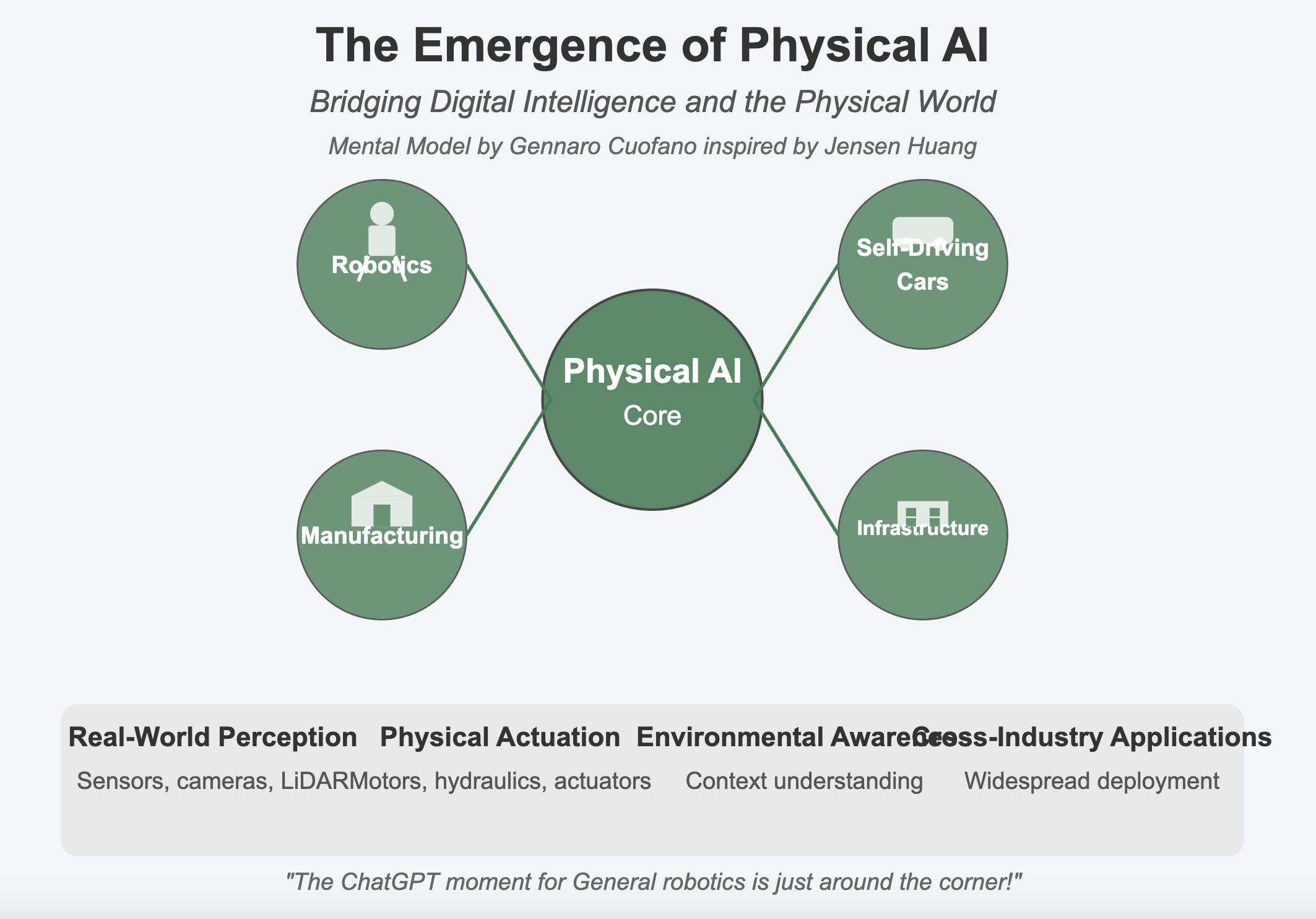
The culmination of this evolution is Physical AI, representing the “Intelligence Infrastructure” layer.
This is where AI extends beyond the digital realm to interact with and impact the physical world directly.
This phase includes self-driving cars, advanced robotics, and AI systems embedded across industries.
As Jensen Huang has noted, “The ChatGPT moment for General Robotics is just around the corner,” suggesting we’re approaching a breakthrough in which AI’s physical capabilities will advance as dramatically as language models did in recent years.
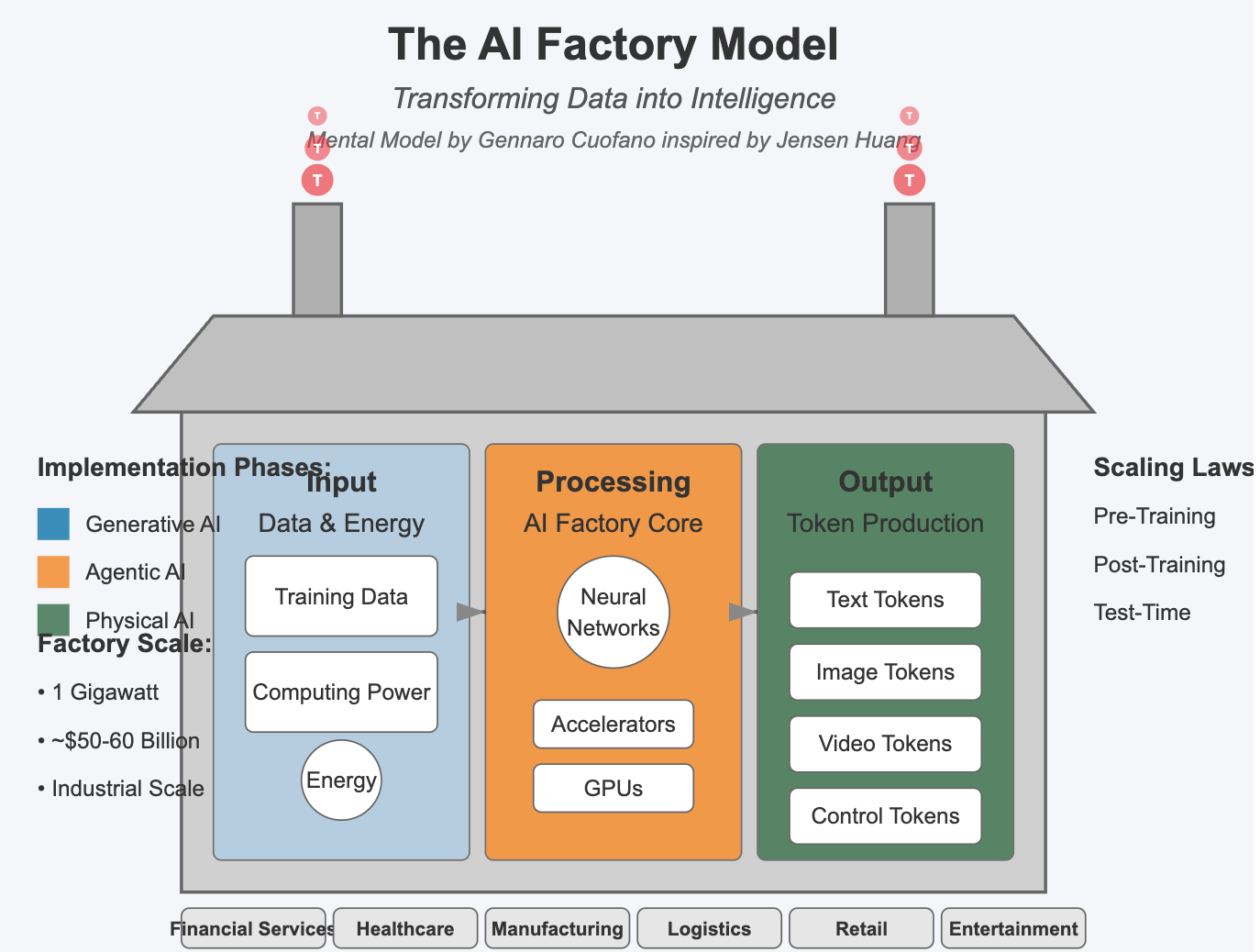
Tokens, in this case, represent the fundamental units of AI computation.
These tokens flow through each layer of the pyramid:
-
Layer 1: Digital Workforce (Generative AI) – The creation of content and digital assets
-
Layer 2: AI Factories (Agentic AI) – The autonomous operation and decision-making layer
-
Layer 3: Intelligence Infrastructure (Physical AI) – The foundation that enables AI to impact the physical world
This model reflects how each phase builds upon the previous one, creating a complete technological stack that transitions from digital output to physical world impact.
Historically, we’ve seen infrastructure evolve from Energy to Information and now to Intelligence. Different scaling paradigms have driven this evolution:
-
Pre-Training Scaling (2018-2023): More data, more computing power, better algorithms
-
Post-Training Scaling: Fine-tuning and adapting pre-trained models
-
Test-Time Scaling: Improving reasoning capabilities during inference
These scaling laws have governed how AI capabilities improve, with the focus shifting from training larger models to optimizing how they reason and operate.
The impact of this AI evolution will be felt across virtually every sector, including:
-
Financial Services
-
Healthcare
-
Manufacturing
-
Logistics
-
Retail
-
Entertainment
Each industry will be transformed as AI progresses through these phases, particularly as Physical AI becomes more prevalent.
According to my Web² Framework, we’re beginning an “AI Supercycle” – a 30-50-year journey that will fundamentally reshape technology and society.
In my framework, I suggest that the transformation we’re witnessing isn’t just a temporary trend but a long-term technological revolution akin to previous industrial revolutions.
The emergence of Physical AI represents the culmination of an evolutionary process that began with Generational AI and progressed through Agentic AI. As we move toward this third phase, we’ll see AI systems increasingly capable of meaningfully impacting the physical world.
Jensen Huang’s vision provides a valuable framework for understanding this progression.
As we stand at this technological frontier, the implications for society, industry, and daily life are profound.
The emergence of Physical AI will not just change what computers can do; it will fundamentally reshape how we interact with technology and how technology interacts with our world.
-
Phase 1 – Generative AI (Digital Workforce)
-
Timeframe: Prominent since 2018
-
Focus: Content creation (text, images, media)
-
Key Tools: Large Language Models (LLMs), diffusion models
-
Impact: Transforming creative and knowledge work
-
Analogy: Digital workers creating outputs from training data
-
-
Phase 2 – Agentic AI (AI Factories)
-
Timeframe: Emerging now
-
Focus: Autonomy and tool use
-
Capabilities: Task completion, decision-making, agent-based operations
-
Examples: Coding agents, research tools, digital assistants
-
Analogy: Factories where AI systems act independently to solve problems
-
-
Phase 3 – Physical AI (Intelligence Infrastructure)
-
Timeframe: Imminent frontier
-
Focus: Real-world interaction through robotics and embedded AI
-
Examples: Self-driving cars, industrial robotics, AI-integrated machines
-
Jensen Huang: “The ChatGPT moment for robotics is near”
-
Analogy: Infrastructure that lets AI reshape the physical world
-
-
Top: Tokens – fundamental units of AI processing
-
Layer 1: Digital Workforce – content generation
-
Layer 2: AI Factories – autonomous agents
-
Layer 3: Intelligence Infrastructure – physical world integration
-
Insight: Each layer builds on the previous, evolving from output to action to impact.
-
Pre-Training Scaling (2018–2023)
-
Drivers: More data, compute, and better models
-
Outcome: More powerful foundation models
-
-
Post-Training Scaling
-
Test-Time Scaling
-
New frontier: Improving AI’s real-time reasoning and adaptability
-
Enables: Smarter behavior during deployment, not just in training
-
AI evolution will deeply transform major sectors:
-
Finance – smarter analysis and automation
-
Healthcare – diagnostics, personalization
-
Manufacturing – robotics, predictive systems
-
Logistics – optimization and automation
-
Retail – adaptive commerce and personalization
-
Entertainment – AI-generated media and interaction
-
Web² Framework: Suggests we are entering a new AI-driven supercycle
-
Duration: 30–50 years of structural change
-
Parallel: Comparable to the Industrial or Digital Revolutions
-
Core Thesis: This is not a passing phase but a new foundational era
The evolution from Generative to Agentic to Physical AI represents a shift from passive content creation to autonomous operation and finally to embodied intelligence in the real world.
Jensen Huang’s layered pyramid helps visualize this transformation as a complete technological stack.
As Physical AI becomes a reality, it will expand AI’s capabilities and redefine our relationship with machines, productivity, and the physical environment itself.
With massive ♥️ Gennaro Cuofano, The Business Engineer
This is part of an Enterprise AI series to tackle many of the day-to-day challenges you might face as a professional, executive, founder, or investor in the current AI landscape.