Obstruction of a Police Officer: Cases That Should Have Gone to the Supreme Court of Canada, But Didn’t!

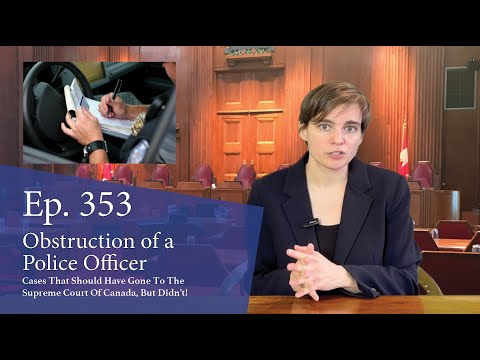
Welcome to “Cases That Should Have Gone to the Supreme Court of Canada, But Didn’t!”
In this episode, Kyla Lee from Acumen Law Corporation examines a case involving an arrest for obstruction in the context of a routine traffic enforcement encounter. A person who was pulled over for a regulatory traffic matter—such as speeding or running a red light—was arrested for obstruction when they attempted to leave. Although the trial judge found the arrest unlawful, the Court of Appeal reversed that decision. The Supreme Court of Canada declined to hear the case, leaving unresolved questions about the scope of police powers in regulatory versus criminal contexts.
Key Points Discussed
– The individual was pulled over for a traffic violation and later arrested for obstruction after trying to walk away.
– The trial court agreed the arrest was unlawful, but the appellate court overturned the decision.
– The appellate ruling allowed for obstruction charges even when police were acting under regulatory—not criminal—authority.
– The defence argued that turning a regulatory investigation into a criminal arrest blurs important constitutional lines.
– The Supreme Court of Canada denied leave to appeal.
Why This Case Matters
This case raises concerns about the growing overlap between regulatory policing and criminal law. If obstruction can be used to justify arrest during regulatory traffic stops, individuals may be criminalized in situations where Charter protections like the right to counsel are not usually triggered.
This decision also raises concerns about fairness and consistency:
– When police are not acting under criminal law authority, arrest powers should be narrowly constrained.
– Expanding obstruction to cover regulatory encounters could lead to more people being arrested for non-criminal matters.
– Without Supreme Court clarification, lower courts are left to determine when an obstruction charge is appropriate.
Missed Opportunity for a National Standard
This case offered a chance to clarify the limits of obstruction as a criminal offence during regulatory encounters. The Court could have provided guidance on:
– Whether obstruction applies when police lack explicit power to arrest under regulatory statutes
– How to balance public compliance with individual rights during minor traffic stops
– When Charter protections should be triggered in quasi-criminal or regulatory investigations
Need for Clarity and Accountability
As police powers continue to expand through interpretation and practice, the line between criminal and regulatory enforcement becomes harder to distinguish. Clear guidance from the Supreme Court is essential to prevent unjustified arrests and ensure that citizens’ rights are not eroded through backdoor criminalization.
Topics Covered
– Obstruction of a peace officer
– Police powers during traffic enforcement
– Regulatory versus criminal law authority
– Charter rights in roadside encounters
– Expansion of police powers through appellate decisions