

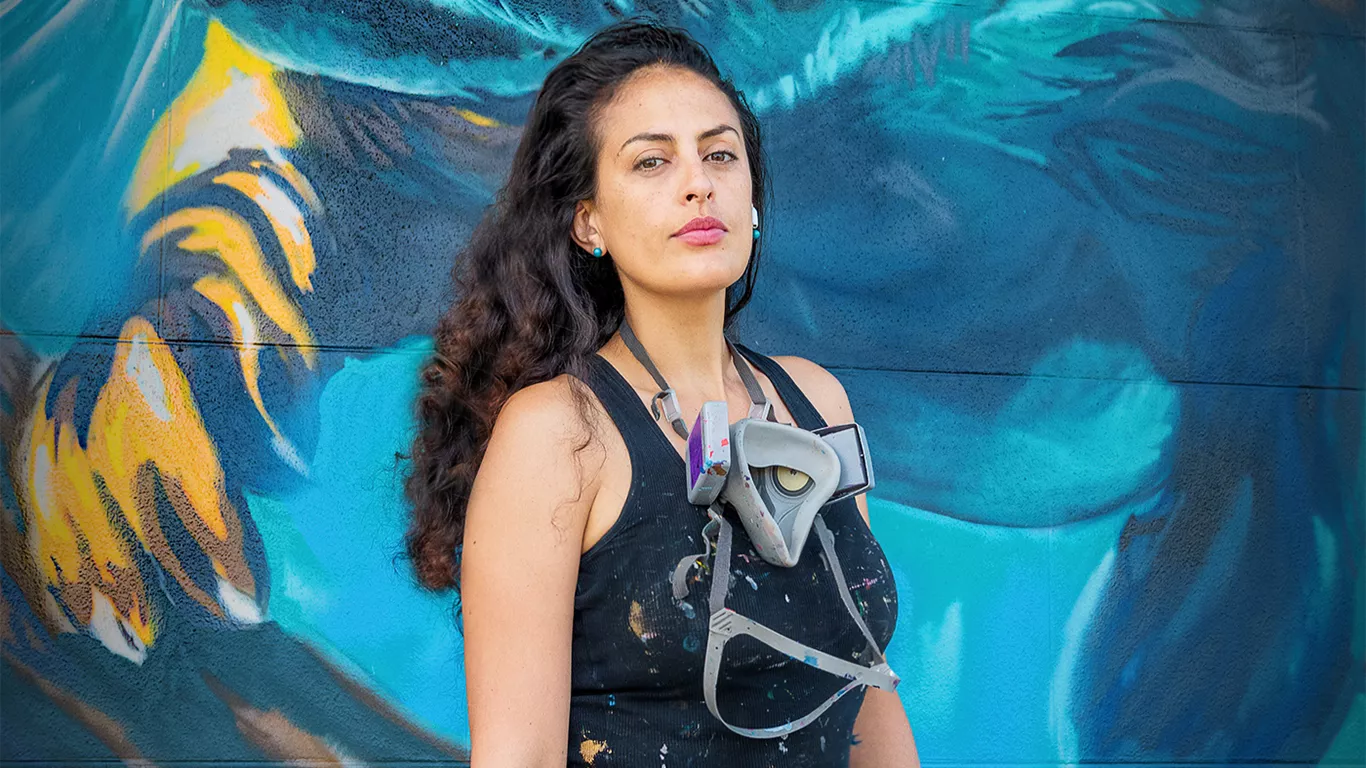
Miami-based interdisciplinary artist Samara Ash merges murals, technology and ecology, using research and neighbourhood listening to make public works that hold complexity without smoothing it over
Miami mornings have a way of making everything look freshly polished. The light is so direct it turns blank walls into backdrops and murals into landmarks people move around and talk about. Miami-based interdisciplinary artist and educator Samara Ash works with that idea: art as both an image and a gathering point. Something you see, and something that happens between people.
Her own life carries that same sense of motion. Ash was born in Bogotá and trained in Florida, studying at the University of Florida and New World School of the Arts, where she earned a dual BFA spanning Painting, Electronic Intermedia, and Art History.
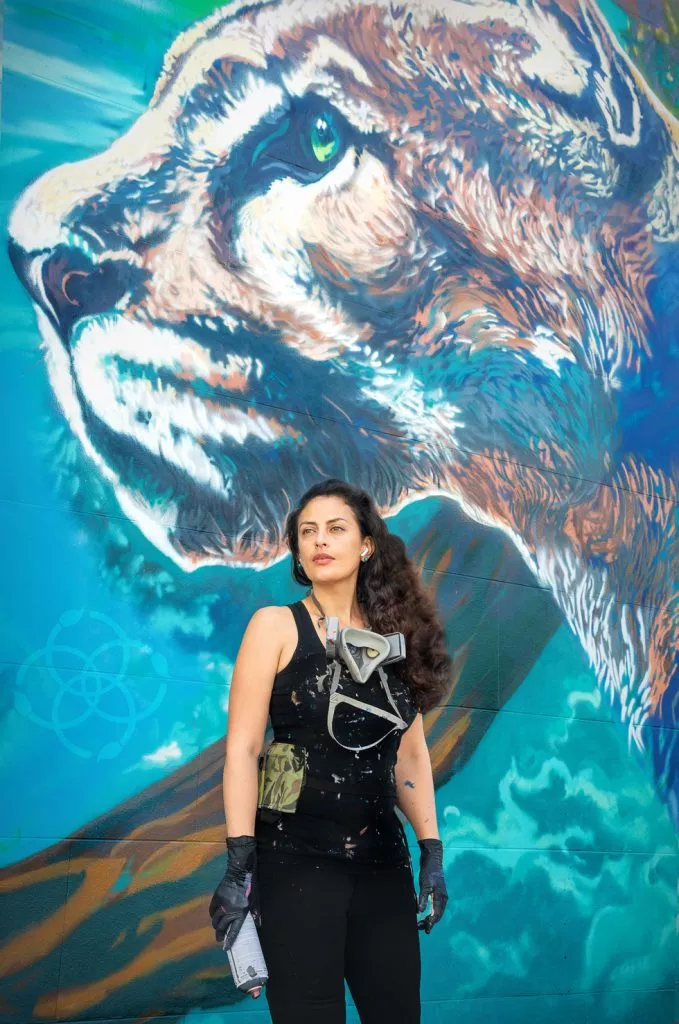
When I describe artists as “ambassadors of hope,” I’m speaking to a responsibility that extends beyond aesthetics
Samara Ash
When she talks about belonging, it isn’t a fixed place so much as a practice—an attentiveness to what’s around you, and who’s there with you. That sensibility shows up in the breadth of her work: painting, photography, large-scale murals, installations, and emerging technologies. The medium isn’t the point; the point is what it can carry.
Nature appears often in her work, but not as decoration. Flora and fauna become a language for endurance and exposure—what survives, what gets worn down. Ash frames her research in terms of “power and frailty”, a pairing that lands especially hard in public art, where a mural must be tough enough to live outdoors and open enough to live with interpretation.
Before she draws a line, she listens. She walks neighbourhoods, studies the deep history of a place, talks with residents in everyday spaces, and pays attention to the language people already use to describe themselves. The goal isn’t to mine stories—it’s to understand the emotional climate that’s already there.
Two convictions come up again and again in how she describes her work, less as slogans than as a working ethic. Artists, she says, are “ambassadors of hope”, responsible for making work that does more than beautify a wall. And art, at its best, can “open the door to dialogue” when conversation otherwise hardens into fixed positions.
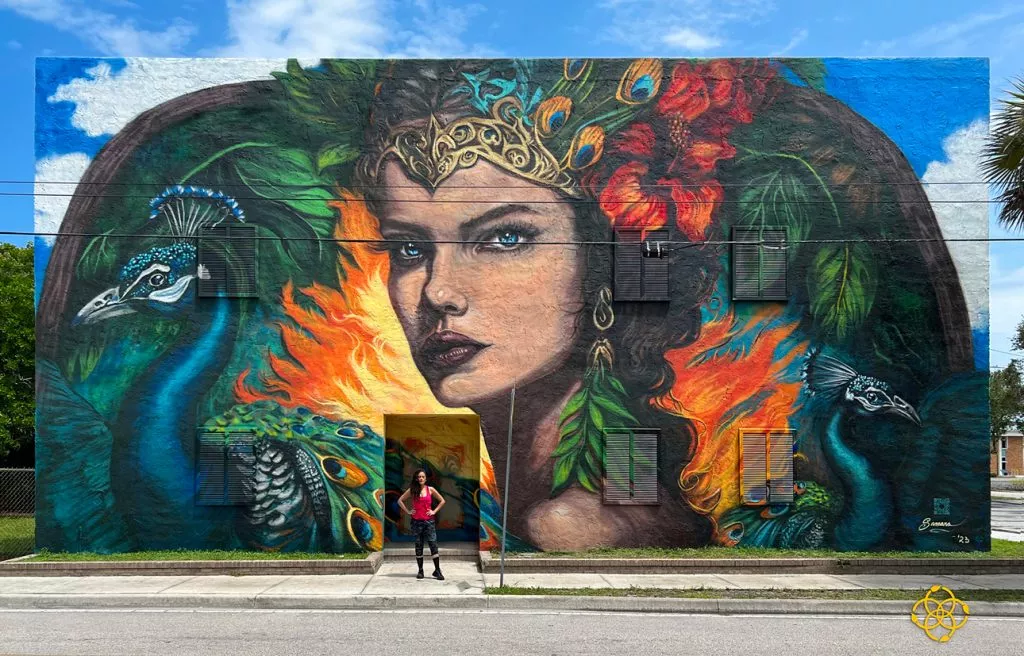
Her mural, Awena, in Fort Pierce made that lesson tangible. Painted while she was seven months pregnant and spanning more than 185 square metres, the work drew immediate anger from some residents worried about development and representation. Over time, that reaction shifted into discussion, and then, for many, into reconsideration. Public art, she learned again, doesn’t always arrive with its meaning fully formed on opening night.
In a cultural moment that often rewards detachment, Ash’s refusal of cynicism reads less like a mood and more like a discipline. A mural can’t solve the pressures around it, but it can offer a shared point of focus, a place where a community can see itself without being reduced to a slogan. Across Miami and beyond, her work returns to a question with real stakes: what would it mean to make beauty that doesn’t look away?
You’ve described artists as “ambassadors of hope”, a role that carries social as well as aesthetic weight. How does this belief influence the choices you make when initiating a new public artwork, especially in communities facing strain or rapid transformation?
Samara Ash: When I describe artists as “ambassadors of hope,” I’m speaking to a responsibility that extends beyond aesthetics. That belief guides every stage of initiating a new public artwork, particularly in communities navigating strain or rapid transformation.
I begin by listening – actively and with intention. Before I ever sketch, I spend time in the place. I walk the neighborhood, visit local restaurants, talk to people in shared spaces, and pay attention to how residents speak about their town, including on community forums. I also research the history of the area, often looking back more than a century to understand the deeper context that shapes the present. These gestures help me feel the community’s pulse – its strengths, its tensions, and the values people are trying to preserve.
From there, I create with a clear purpose. Nature often becomes the conduit, offering a visual language tied to resilience, renewal, and interconnectedness. I think carefully about the symbolism and emotional tone of the work so that it acknowledges reality while pointing toward possibility. I also hold a personal practice around this. I pray and meditate that the work, when encountered by others, carries a sense of hope – genuine, grounded hope that arises from seeing themselves reflected with dignity and potential.
My role is to create spaces where people feel seen and strengthened, where the artwork becomes not just a mural or a sculpture, but a reminder of the community’s capacity to endure and transform. I also know my approach may evolve depending on the community and their familiarity with their local environment. Not everyone has the same historical connection to the flora and fauna around them, and I strive to introduce these ideas with tact. Meeting people where they are is an essential part of public artwork.
Courtesy of the artist
Your practice moves fluidly between painting, photography, installation and emerging technologies. What draws you to resist a single medium, and how does this interdisciplinary approach help you articulate the tensions you observe between power and vulnerability?
I’ve never felt that a single medium can hold the full range of questions I’m exploring. Each medium offers its own intelligence – its own way of shaping how we perceive time, emotion, and presence. Painting holds history and permanence; photography captures the immediacy of fleeting, vulnerable moments; installation work shapes how the body inhabits space; and emerging technologies introduce the unknown in a way that mirrors our anxieties and aspirations about the future.
Chronos Vital is a clear example of why I resist a single medium. In that piece, the heartbeat of a fellow artist becomes a visual form through technology, then transforms again into an analog, ephemeral print through anthotypes and transparencies. The work needed more than one medium because the concept itself – our experience of time, the fragility of the body, the mythic weight of Chronos – could not be contained by a single form. Technology allowed me to express the immediacy and vulnerability of a living pulse, while the anthotype process offered a slow, fragile, light-dependent transformation. Together, they articulated a tension between power and vulnerability that neither medium could have conveyed alone.
Working across disciplines also allows viewers to enter the work from different points of connection. A younger viewer might feel naturally attuned to technology-driven pieces, while someone with a background in fine art may resonate more deeply with painting. Those without formal art experience often connect intuitively to the physicality of an installation. In this sense, different media become access points – ways for people to bring their own lived experience into the work.
For me, the interdisciplinary approach is ultimately about accuracy. The tensions I explore are complex, and sometimes they require the solidity of paint, the transparency of light, or the interactivity of a digital system. Multiple mediums allow those nuances to surface more fully. They give the work a dimensionality that invites people not only to observe, but to feel.
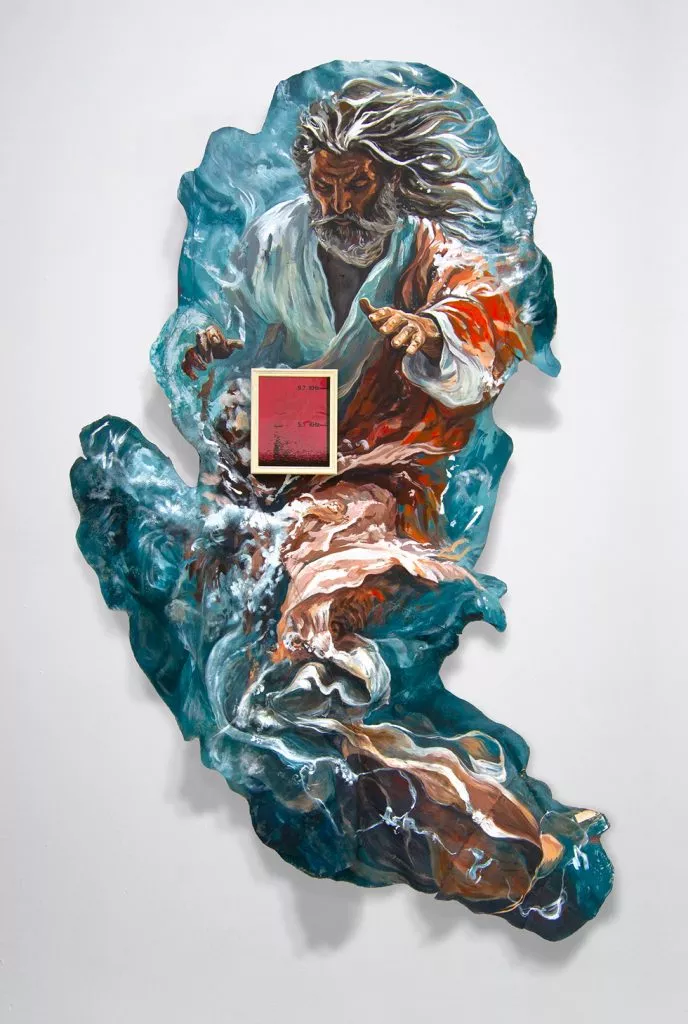
8 ft × 6 ft
Mixed-media painting
Samara Ash
Human experience and natural forms often intermingle in your work. In a time when the natural world is both idealised and endangered, how do you navigate the ethics of representing nature while acknowledging our complicity in its fragility?
For me, it’s a relationship. At this stage of my career, my first goal is to help people fall in love with the natural elements – the local wildlife, the flora, the color. I want them to feel an emotional attachment and a sense of belonging. The ethical dimension emerges after that connection is formed. Once someone is drawn in through wonder, the conversation expands toward stewardship.
This happens gradually – through unveilings, community talks, articles, or small cues integrated into the project. With Echoes of Resilience (commissioned by the Florida Wildlife Corridor Foundation & Disney) for example, viewers first encountered the beauty of the animals. Then a QR code on the work invited them deeper, offering insight into their ecological importance and vulnerability. It’s a poetic dance: connection first, awareness second.
I also understand that my approach may evolve as communities evolve. Public art reaches a wide range of people, each with different levels of familiarity with their local ecosystem. I aim to meet each audience with tact – acknowledging their background while gently opening the door to deeper understanding.
Your murals frequently act as sites of collective memory. How do you research, interpret and translate a community’s identity into visual form without flattening or romanticising its complexity?
When I approach a mural as a site of collective memory, my responsibility is to represent the community with accuracy, depth, and respect. That begins with research, but not only in the academic sense. I prioritize embodied, on-the-ground understanding. I spend time in the neighborhood, speak with residents, visit local businesses, and observe how people use shared spaces. These conversations – formal and informal – reveal stories, values, and tensions that formal archives often miss.
Alongside that, I conduct historical research, often looking back a century or more to understand how the past informs the present. I pay attention to patterns of migration, cultural shifts, ecological changes, and the events that have shaped the community’s sense of identity. This layered approach helps me avoid relying on a single narrative or presenting a simplified version of the place.
This methodology connects with the lineage of muralists like Diego Rivera, whose practice was grounded in rigorous historical study and a deep commitment to dignified representation. Rivera never flattened the communities he depicted; he allowed their complexity to remain visible. That ethos resonates with me, particularly when translating a community’s lived experience into visual form.
Interpreting this information requires restraint and discernment. My aim is not to illustrate every detail, but to distill emotional truths of the community – its resilience, aspirations, contradictions into a symbolic language that feels both authentic and open. I choose natural forms, colors, and rhythms that honor lived experience without romanticizing it. The goal is always to acknowledge complexity rather than smooth it out.
Most importantly, I remain in dialogue with the community throughout the process. Collective memory is not mine to define; it’s something I’m invited to translate. By listening closely, researching deeply, and designing with intention, I strive to create murals that reflect the community’s multifaceted identity while leaving space for people to see themselves, their history, and their future within the work.
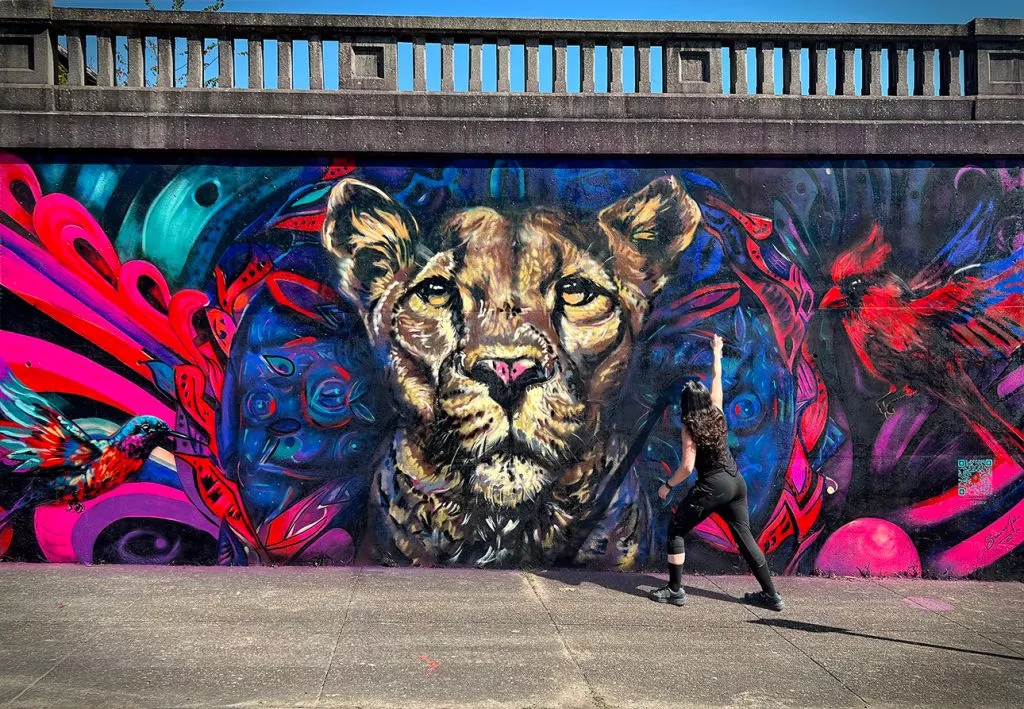
Samara Ash
You’ve said that art can “open the door to dialogue” in ways other forms of communication cannot. In which project have you seen this most clearly, and what aspects of the public’s response surprised you?
I experienced this most clearly with Awena in Fort Pierce, an outdoor mural of over 185 square meters that I painted while seven months pregnant. Named after a Native American term for sunrise, the work centers on a female figure symbolizing the interwoven lineage of the Ais people and the generations that followed – a portrait of the community’s resilience and potential.
The public response opened the door to a dialogue I couldn’t have anticipated. Many felt represented, while others – shaped by anxieties about urban development – initially believed they were excluded. Their reaction weighed heavily on me; for a time, I felt creatively crushed by the misunderstanding.
But art often works on a longer timeline than we expect. Over nearly two years of continued conversation, some of those tensions began to soften. As the symbolism became clearer, residents who had once felt unseen came forward with appreciation. One individual – who had initially been quite angry and whose family had lived there for seven generations – later thanked me and encouraged me to continue.
That experience affirmed for me that public art can reveal truths, bridge tensions, and cultivate understanding – not just in the moment of unveiling, but across time. It remains one of the clearest examples of how art can open conversations other forms of communication cannot.
With more than two decades in fine art and over fifteen years in education, how has teaching shaped your understanding of authorship, mentorship and the transmission of creative knowledge?
Teaching continually brings me back to the foundations of my practice. After many years, certain processes feel instinctive, but students remind me there is intention in every choice. Their questions keep me alert and offer fresh perspectives.
Teaching also feels ancestral. I recently discovered deep Indigenous roots in my family, and it made me reflect on how knowledge was once passed through storytelling rather than writing. I feel a responsibility to ensure that what I’ve learned doesn’t disappear with me. Knowledge grows when it’s shared. I tell my students that learning and teaching form a symbiotic cycle: we expand by giving back.
There is a scientific longevity to that idea as well – knowledge evolves when it is handed down, adapted, and continued. For me, mentorship is both a lineage and a form of preservation.
Your studio spans bespoke commissions and deeply personal conceptual work. How do you maintain artistic integrity while navigating the aesthetic, commercial and narrative expectations of clients and public institutions?
Maintaining artistic integrity while navigating the expectations of clients and public institutions is not always smooth sailing. Over the years, I’ve learned that different organizations – particularly cities – often have specific parameters and tend to prefer artwork that isn’t overtly confrontational. Understanding those nuances has become part of the process.
See also

What allows me to hold my artistic voice is a combination of strong communication and discernment. I’m selective about the projects I take on, and I approach each one through open dialogue. The back-and-forth of discussion, negotiation, and adaptation teaches me as much as it resolves; seeing a project from the institution’s perspective expands my professional vocabulary and better prepares me for future collaborations.
I also always return to research. By the time I propose a design, it’s grounded in a deep understanding of the site – its history, its community, and its visual language. That foundation strengthens my ability to translate the project’s needs into symbolism that remains true to my intentions.
It requires patience and sensitivity, but honest communication almost always leads to a meaningful outcome. That balance – between listening and standing firm, between adaptation and integrity – is what allows me to move fluidly between bespoke commissions and deeply personal conceptual work without losing my voice.
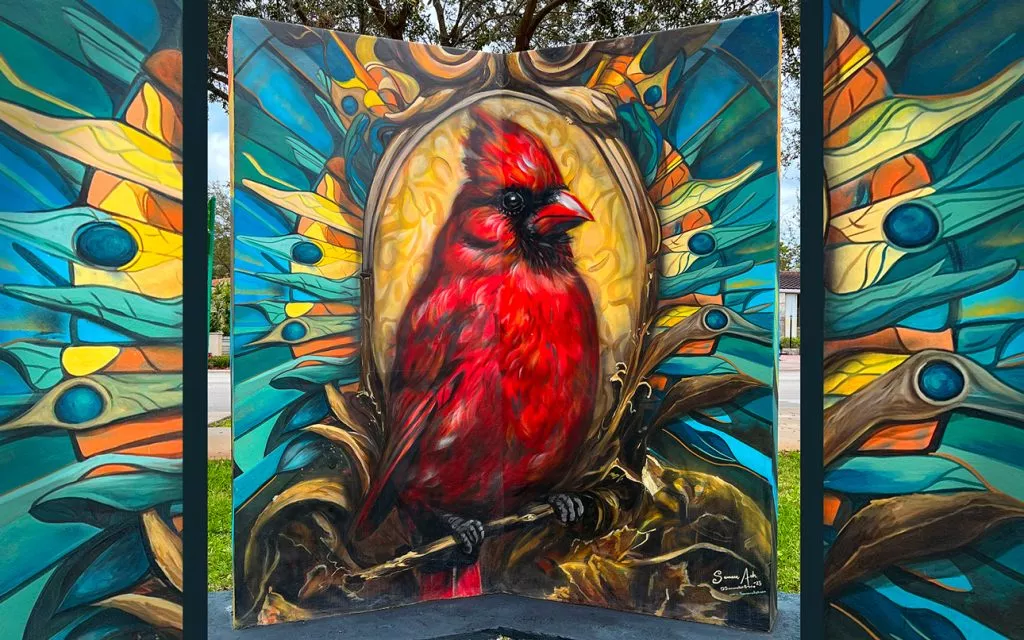
Samara Ash
The botanical and symbolic elements in your work often appear both luxuriant and intimate. Do these motifs arise from instinct, research or autobiography, and what guides your decision to scale a piece from a small painting to a monumental mural?
It’s a combination. Research, autobiography, and environment shape my choices. Living and working in Miami has made me acutely aware of environmental fragility – from issues surrounding Lake Okeechobee to the pressures of rapid development. Over time, that awareness has guided me to depict flora and fauna that embody both resilience and vulnerability.
As for scale, it depends entirely on the project and the feeling it evokes. Some ideas demand intimacy; others require the expansiveness of a monumental mural. Both can be personal. Much of this decision-making is intuitive – I get a sense of the scale required for the work to speak the way it needs to. It’s not something I can fully intellectualize; it’s a felt understanding of what the project calls for.
Your recognition by organisations ranging from wildlife foundations to municipal public art programmes suggests broad resonance. How do you safeguard the experimental or critical edges of your practice as your institutional visibility grows?
I preserve that edge by diversifying the types of projects I take on. While I value institutional collaborations, I also intentionally work with artist-driven festivals – often with graffiti roots – smaller independent projects, and experimental cultural spaces like Espronceda Institute of Art & Culture in Barcelona. These environments allow for more risk & exploration.
As institutions grow more defined in their expectations, I find myself pushing harder into abstraction and experimentation as a personal practice. It keeps the work alive. Maintaining a balance between structured commissions and more open-ended creative environments allows me to expand while staying grounded in the spirit of inquiry that fuels my work.
Living between Bogotá, Miami and various European residencies has placed you within multiple cultural contexts. How has this movement shaped your understanding of hybridity, and where do you locate “home” within your artistic language?
For many years, I lived in between – no longer fully rooted in my birth country, yet not entirely at home in my adopted one. That feeling made me resilient, but it also made me aware of the fluidity of belonging. As I grew older, I realized that my sense of home was not tied to nationality but to a shared human experience. Across borders, we carry similar fears, desires, needs, distractions – and even shared traumas.
Traveling and creating work across continents has shown me that hybridity is not a fragmentation but a home in itself. It allows me to hold multiple influences at once, to honor my past while expanding through every place I’ve lived or worked.
Home, in my artistic language, is the merging point – the place where human experience and natural form meet, where personal and collective histories overlap, and where hope becomes a connective thread in times of change.
Your belief in art’s capacity to “uplift everyday life” suggests a refusal of cynicism. How do you sustain that optimism in a cultural climate that often rewards irony or
detachment, and what do you see as the artist’s responsibility in turbulent times?
Sustaining optimism is a conscious choice. Living between different cultural contexts has taught me that everything is in flux, and that growth – even when nonlinear – is the only true way forward. It’s not about rejecting cynicism outright, but choosing not to stay anchored in it. In recent years – amid uncertainty, collective fatigue, and rapid shifts in the world – I’ve felt an even deeper responsibility to keep that flame of hope alive.
Art history reminds us that profound creativity often emerges from difficult times. Francisco Goya’s Disasters of War is a clear example: created in response to the brutality of the Peninsular War, the series confronts darkness directly, yet ultimately affirms the resilience of the human spirit and the power of bearing witness.
Another moment that resonates with me is the early Italian Renaissance. After the devastation of the Black Death in the 14th century, artists like Sandro Botticelli helped usher in a renewed visual language – one grounded in beauty, spirituality, and human potential. Works such as The Birth of Venus emerged from a society rebuilding itself, turning collective grief into artistic rebirth. These moments show how creativity can rise not in spite of turmoil, but in response to it.
That perspective informs the way I work. In turbulent times, I don’t see the artist’s role as providing definitive answers, but as offering clarity, connection, and emotional grounding. I’ve learned in my own life that nothing stays dark forever. That understanding fuels my commitment to create work that uplifts everyday life, invites reflection, and serves as a source of light when it feels most needed.
©2025 Samara Ash
Contributing writer at Art Plugged chronicling contemporary art’s beautiful mess, when he can get there. Now edging behind the camera, making insightful documentaries about artists and the work that haunts them. Survives on openings, opinions, one gallery, one artwork at a time. Considers espresso a meal.


