

Whether you’re an average Joe, an F1 driver, or a Martian, you’re still tied to the laws of gravity. Capable of pushing, crushing, and stretching everything in its path, humankind has innovated methods of battling this unstoppable force. From countering its devastating impact to escaping its clutches and flying to the skies, gravity has shaped some of humankind’s most triumphant tales. Yet “G-force” and “shock resistance” are taken for granted and often misunderstood — especially in luxury watchmaking.
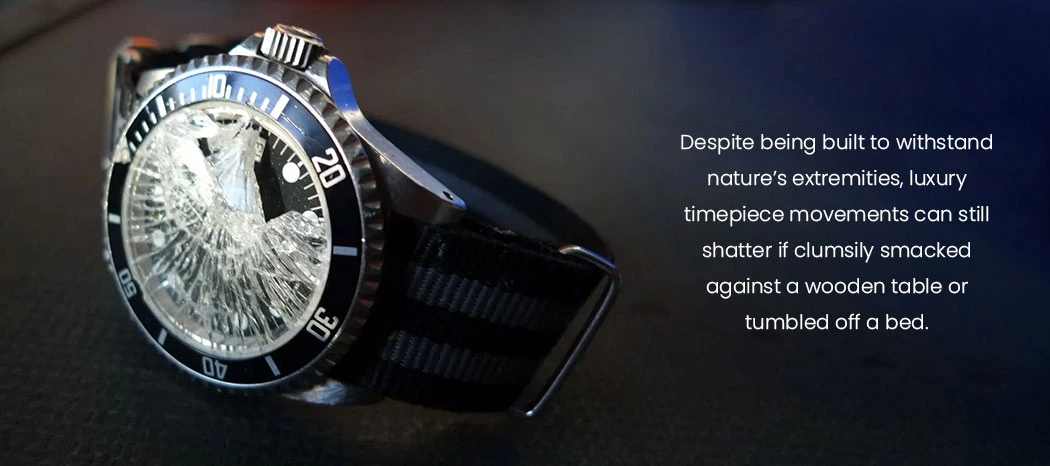
Despite being built to withstand nature’s extremities, endure abysmal depths, and ‘tick’ accurately even in space, luxury timepiece movements can still shatter if clumsily smacked against a wooden table or tumbled off a bed. Watchmakers certainly claim their timepieces to be shock-resistant, but what exactly does that mean?
Quite the Shocker
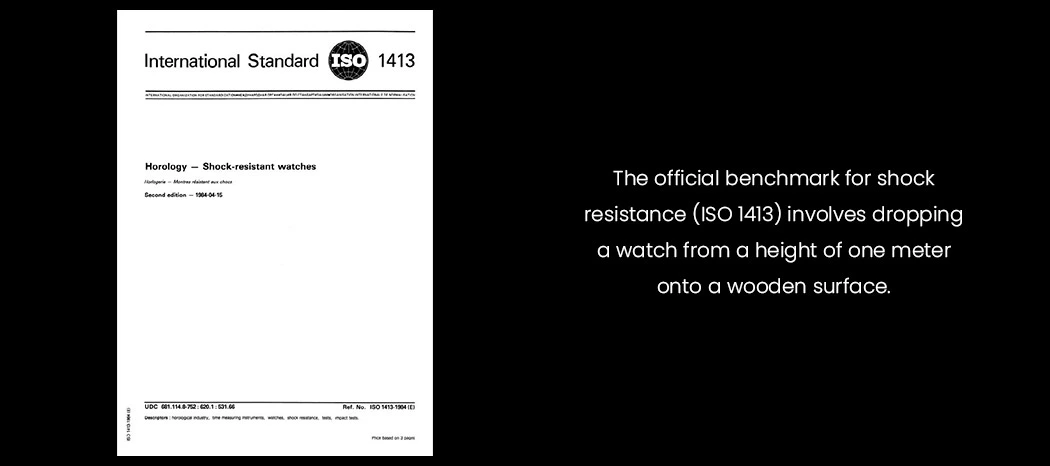
The official benchmark for shock resistance (ISO 1413) involves dropping a watch from a height of one meter onto a wooden surface. Diver’s watches, which are naturally engineered for tougher environments, are tested under the more demanding ISO 6245. In essence, this means most modern luxury watches can survive an accidental tumble off a table without major consequences. Yet paradoxically, they might not, even though their spec sheets boasting insane tolerance figures of 5,000G, 10,000G, or more. In case you’re wondering why, it’s because those numbers and ratings stem from lab-simulated ultra-fast impacts, a stark departure from the chaotic, unpredictable knocks of daily wear.
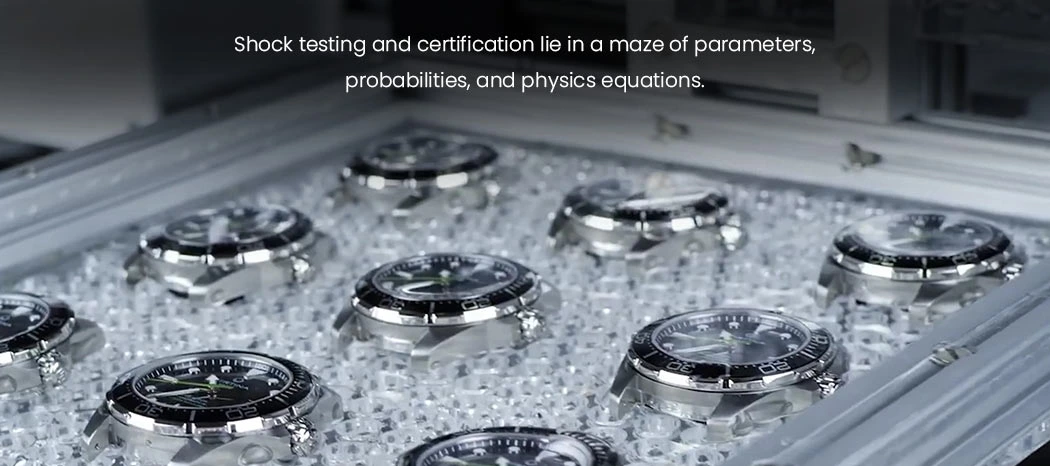
A timepiece’s fate rarely depends on data or simulation. Shock testing and certification lie in a maze of parameters, probabilities, and physics equations. Delicate complications made of hundreds of micro-components, the pliancy of precious metals like gold, or even the direction and frequency of impact can all play a role. So, while your luxury watch might defy gravity in the lab and score a 10, it still has real-life limitations and is far from being indestructible.
History of Shock Resistance & the “Incabloc”
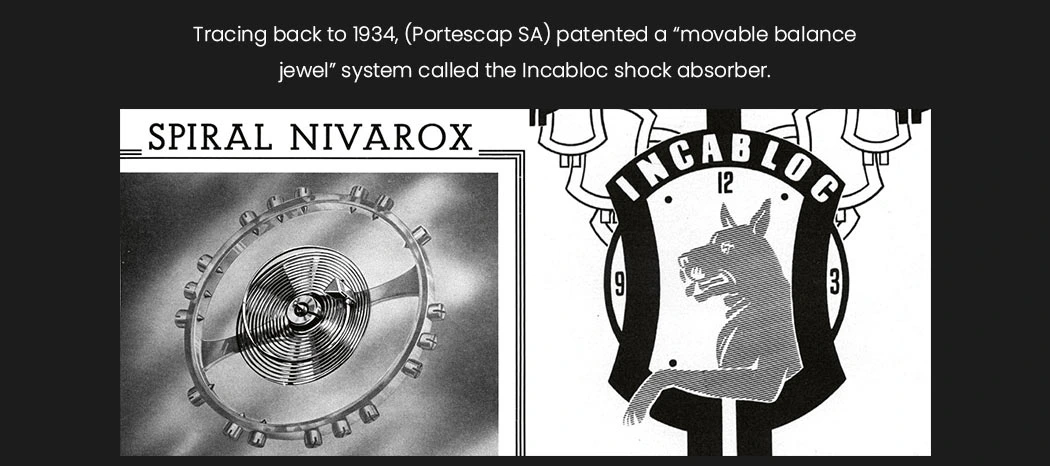
Tracing back to 1934, when La Chaux-de-Fonds engineers Fritz Marti and Georges Braunschweig founded Porte‑Échappement Universel SA (Portescap SA) and patented a “movable balance jewel” system called the Incabloc shock absorber. Wristwatches at the time were innovative yet vulnerable to life’s unpredictable dangers. Unlike pocket watches, which were cushioned in coat pockets, wristwatches were exposed to the elements and easily suffered jolts and drops. Back then, a movement’s most fragile component was the balance staff and its pivots — tiny, finely machined axles that could fracture under shock.
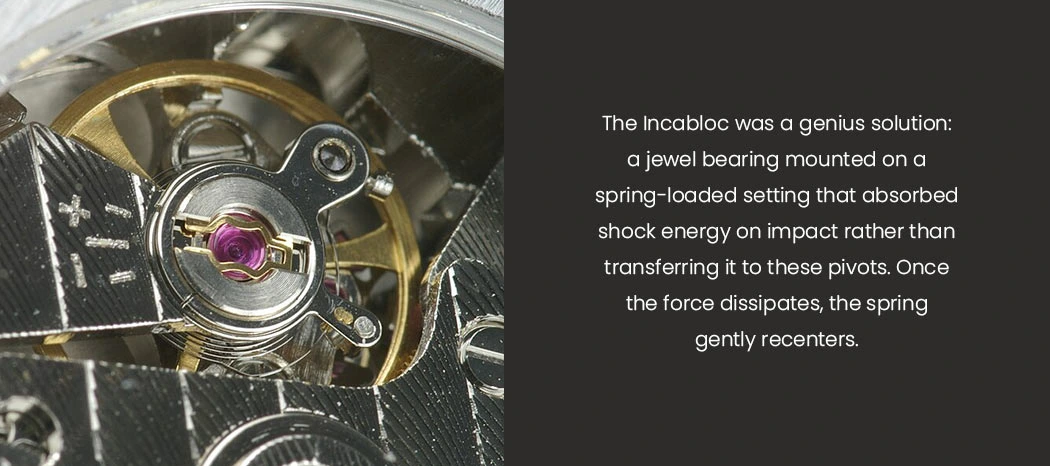
The Incabloc was a genius solution: a jewel bearing mounted on a spring-loaded setting that absorbed shock energy on impact rather than transferring it to these pivots. Once the force dissipates, the spring gently recenters.
As the Quartz Crisis nearly derailed Switzerland’s titan watchmakers, Portescap SA’s Incabloc division branched off as Incabloc SA in 1988, which continues to innovate and supply high-end brands with shock absorbers to date. While Incabloc became watchmaking’s premier shock-protection reference in the 90s, brands developed proprietary systems such as Seiko’s Diashock, Citizen’s Parashock, and Swatch’s Nivachoc.
Putting G-Forces into Perspective
G-Force (gravitational force or acceleration force) quantifies how quickly an object changes velocity — and when that object is a 1000-component timepiece, this number matters.
- Under 500G: Common misfortunes like a timepiece tumbling off a table or slipping off a bed come under this category. These impacts won’t do too much damage as long as your timepiece isn’t vintage, lands on a carpet/hardwood, and avoids impact on its crown. On the shock scale, most everyday falls come under the 500G mark.
- 500G: When Austrian driver Roland Ratzenberger fatally crashed his F1 car while qualifying for the San Marino Grand Prix, the impact was recorded at 500G. Sure, that sounds like a massive leap comparing a few hundred Gs to a clumsy bedside tumble. The difference is simply scale.
- 1,000G: This is a solid bang against a wall or a jolt in motion. These seem harmless, but these 1,000G jolts can completely rattle your movement. At this stage, impact is sharp, concentrated, and damage spreads like a shockwave across the movement.
- 5,000G: This force is equivalent to the impact of a golf club striking a golf ball or the hammering of metal. Every component of the timepiece is meticulously designed to absorb and dissipate energy without compromising precision.
- 12,000G: Only a handful of watches can withstand 12,000Gs of force. Also, this is the maximum traditional impact resistance testing machines can go. Imagine a baseball travelling at 100 miles per hour colliding with a bat swung at full throttle; that’s 12,000Gs of force. One of the few watches capable of enduring this force would be Richard Mille’s RM27-04, specially developed for Rafael Nadal.
- 30,000G: If 5,000Gs was an F1 car crash, could one even imagine what 30,000Gs would be? Yet the IWC Big Pilot’s Watch Shock Absorber XPL can withstand it, thanks to its SPRIN-G Protect system and cantilever spring that suspends the movement within the case and absorbs impacts before it reaches its delicate components. This stands as the pinnacle of shock resistance in modern watchmaking and perhaps the world’s only timepiece capable of withstanding such force.


