

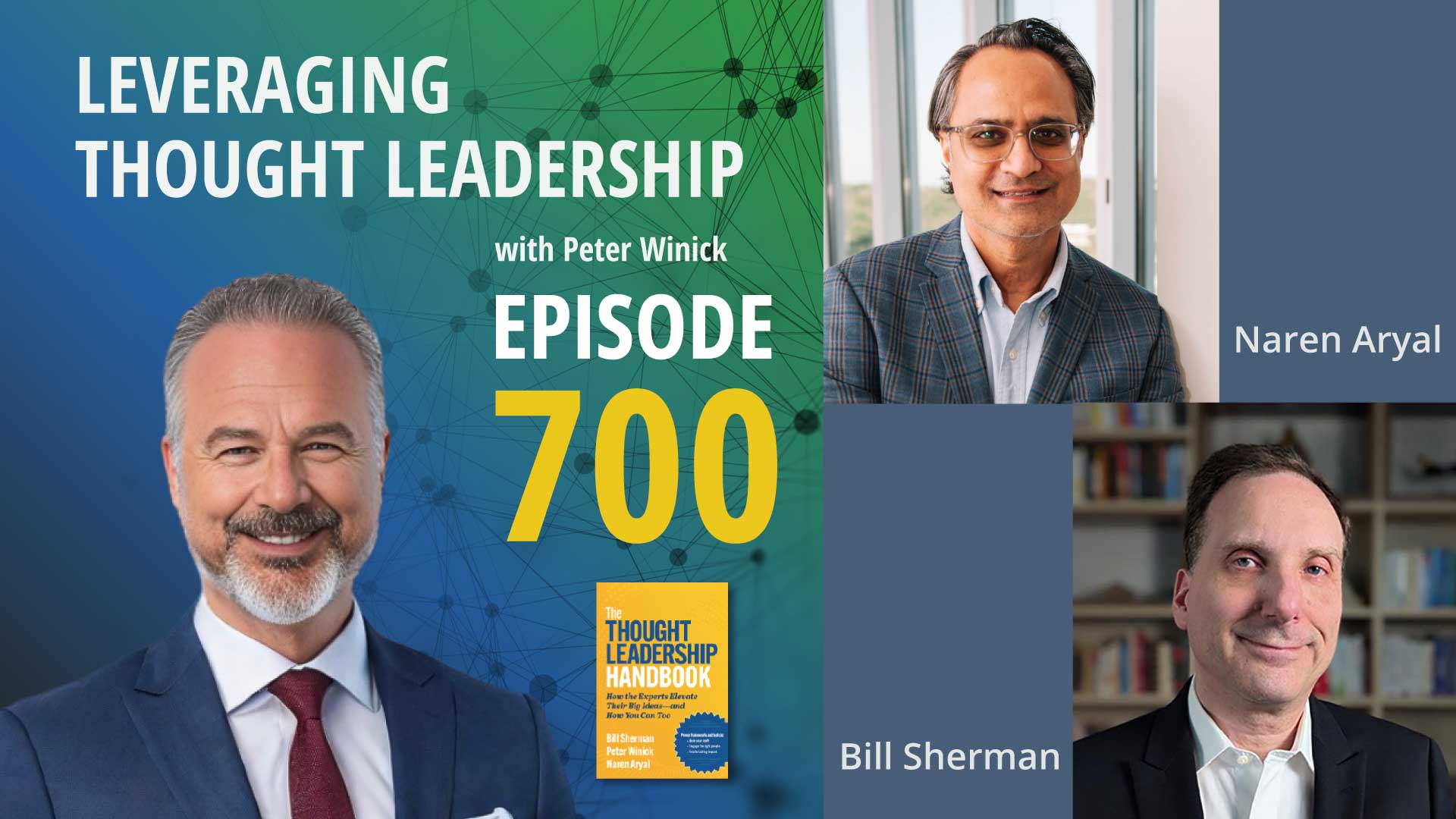



Announcing The Thought Leadership Handbook and the real work of turning expertise into impact
In this special episode, we announce The Thought Leadership Handbook and explore what it really takes to build thought leadership that creates impact.
What does it really take to turn expertise into influence that lasts?
In this special episode of Leveraging Thought Leadership, host Peter Winick is joined by Bill Sherman and Naren Aryal to announce their book, “The Thought Leadership Handbook” published by Amplify Publishing Group. This is not a conversation about writing a book for the sake of writing a book. It is a conversation about building a body of work that creates value, sharpens thinking, and expands impact.
Drawing on hundreds of podcast conversations, client engagements, and years inside the thought leadership space, Peter, Bill, and Naren explore the patterns that separate real thought leadership from noise. They dig into what makes ideas useful, why strong frameworks matter, and how leaders can turn lived experience into practical tools others can apply. The focus is not on hype. It is on clarity, utility, and long-term relevance.
The episode also challenges one of the most common myths in the market: that sharing your best ideas weakens your business. Peter, Bill, and Naren make the opposite case. Generosity builds trust. Trust builds platform. And platform creates opportunity across books, speaking, consulting, advisory work, and beyond. Thought leadership works best when it is designed to help first and monetize with integrity over time.
What makes this discussion especially valuable is the candor around the real work. The book is positioned not as a magic formula, but as a handbook. A practical asset. A centerpiece of a broader platform. The conversation shows how strong thought leadership is built through process, pattern recognition, disciplined thinking, and a willingness to put useful ideas into the world before they are perfect.
For leaders, authors, experts, and advisors, this episode offers a grounded look at how big ideas become scalable assets. It is about frameworks that hold up in the real world. It is about creating impact in service of others. And it is about why the best thought leadership does more than elevate a brand. It moves people, opens doors, and creates meaningful commercial value.
If you want to understand how experts elevate their ideas, extend their reach, and turn insight into lasting business value, this episode is the place to start.
Three Key Takeaways:
- Thought leadership only works when it creates real value for others.
The conversation keeps returning to service, generosity, and usefulness. The point is not to protect your “secret sauce.” It is to share ideas in a way that helps people, builds trust, and creates impact. - A book is not the whole platform. It is a strategic asset within it.
Bill, Peter, and Naren frame the book as a centerpiece, not the end game. The real power comes from the broader platform around it: the podcast, the frameworks, the body of work, the audience trust, and the conversations the book can spark over time. - Strong thought leadership comes from disciplined thinking, not shortcuts.
The transcript makes clear that writing the book forced them to sharpen their models, clarify their frameworks, and trust the process. The message is simple: do the hard work, make the ideas cleaner and more useful, and ship something valuable rather than waiting for perfection.
Stay close to the conversation by subscribing to Leveraging Thought Leadership and joining our newsletter. You’ll be the first to know when The Thought Leadership Handbook is available for preorder, plus get the latest updates, insights, and behind-the-scenes news as the launch unfolds.
Transcript
Bill Sherman Welcome today. I’d like to welcome to the show my friend and publisher and CEO of Amplify Publishing Group Naren Aryal.
Naren Aryal Bill, great to be here, Peter, hello. As a publisher, I just want to ask you two a question. What do you have against books?
Bill Sherman Nothing.
Peter Winick Nothing against books. We love books.
Bill Sherman Yeah, they’re great.
Naren Aryal Really?
Bill Sherman Yeah. Yeah.
Naren Aryal That’s not what I’ve heard.
Bill Sherman No, no, no. We don’t plan on ever writing a book.
Peter Winick I believe I’ve talked more people out of writing books than anyone I know.
Bill Sherman I don’t need a book chapter.
Peter Winick I have sworn for over 15 years that I’ll never write a book.
Bill Sherman You don’t need a book published.
Peter Winick And welcome, welcome, this is Peter Winick. I’m the founder and CEO at Thought Leadership Leverage and you’re joining us on a super special edition of our podcast which is Leveraging Thought Leadership. I’ve got not one but two guests. One guest is my dear friend and co-host Bill Sherman, now my co-author, and my other guest today is another co- author and friend, Naren Aryal, the founder and CEO of Amplify Press. So, we did something guys, what did we do? We wrote a book, and why would we do that?
Naren Aryal So first of all, so first of all, let me just say congratulations to you too. I listen to this podcast all the time and I’ve been fortunate enough to be a guest. So what I’m aiming for is this show is going to be the second most listened to episode. Congratulations. Excellent.
Bill Sherman Yes, so this goes back to the summer of 2024. And we had a question around, so we’ve done at the time about 650 podcast episodes. There’s a lot of good stuff in there. We should do something with it. Peter, you said to me, hey, what do you think about writing a book? And I’m like, oh, yeah, that should be easy.
Peter Winick Yeah. And I, I obviously did the typical underestimate. This will be a little side thing. It will take up a couple, not all that much time and this should be fairly easy to do. We’ll get the transcripts of all the episodes. We’ll, we’ll punch around in it, get some information and how hard could it be to write a book? We, you know, like this can’t be that tough. And then, yeah. So
Bill Sherman You and I scheduled a zoom call quite literally and said, okay, we’re going to need some examples from the book. What stories do you remember, Peter? And then you asked me and then we realized all the stories we were telling were episodes we’d recorded in the last few months.
Peter Winick And so then I called Narin and I said, hey, Narin, I’m gonna write a book. And he said, I knew eventually you’d call me to be my publisher. And I said well, you’re kind of half right. I said we’re only gonna do this if you write it with us. So we kind of painted the publisher in the corner. And what’d you, how did you?
Bill Sherman So my question is why yes, and why did you join us on this crazy adventure?
Naren Aryal Well, a year and a half later, I’m asking myself the same question.
Bill Sherman Yeah, fair.
Naren Aryal And well, I think the the big answer is I wanted to prove you two wrong. A book is still a valuable asset in a thought leadership puzzle. And, you know, I’ve heard you two say a few disparaging works, words about books in the past. And so what better way to get you over onto the good side than to experience together. And you know I gotta tell you, we had a lot of fun. Um, we went through a lot of content from a lot of incredible people that have incredible knowledge, expertise and willingness to share. And I’ve learned a lot in this process myself. And, and, you know, this is somebody who’s published now, gosh, going on a thousand books. And so it’s, it’s amazing. One of the things that I love so much about this world and this space and this content medium is the fact that you’re always learning and I learned a lot and I’m guessing that’s the same for you too, just going back and and hearing all the things that you’ve done and all the conversations you have. And so there’s just so much goodness in here that we just can’t wait to get it out in the world.
Peter Winick Yeah, and that being said, this is probably the longest podcast I’ve hosted with an author or two that have been remiss in not naming the book. So it’s the Thought Leadership Handbook, let’s be clear, and we want you to run out and buy not one, not 10, but hundreds of copies because we think this is, we know it’s a great book and we’ve gotten some amazing, amazing feedback. So Naren, you were on the other side of the desk and got to learn a little bit what it’s like to be pushing deadlines and having. Chapters that are due and all that other stuff was that What if you like to be on the receiving end of that?
Naren Aryal You know what? It was a great experience and I really put myself in the shoes of the folks that we work with day in and day out. And, um, you know, it’s not easy, right? Writing a book is hard work. And the thing that people underestimate is, you know, if you have the ability to go away, go into a cave and write a book for three months, that’s great. Awesome. But that’s not the reality for most authors. They’re juggling their businesses. They’re running a company. Keynote practice. They’re writing articles not related to the book. So it just reinforced what I tell people all the time. Writing a book is hard. And so you just have have to have clarity of why you’re writing a book in order to go through this. Okay, I’ll say pain of writing a book.
Peter Winick And Bill, I want to ask you, Bill did most of the heavy lifting in terms of the, the writing, the structure. He’s clearly the smartest one of the three.
Naren Aryal Without question, without question. I’m number two, just to be clear. Well, we’ll give you that.
Peter Winick What was it like, Bill, because this isn’t your first foray into writing. You’ve got an academic background and all that. But what would you what’s the before, during and after look like for you?
Bill Sherman Yeah. So a little bit of context and then through the journey. So my parents who were in their eighties live with us, right. And so I’d be working during the day evening after dinner, I’d steal time and I’d. Be writing and inevitably mom or dad would come to the door and knock in once something. And so I would set aside whatever I was doing go solve the challenge they had, whether the TV remote wasn’t getting them to the channel they wanted or whatever, and then come back and ask the profound question, where am I on this book? What am I doing? And so then day to day, because I would spend so many evenings and weekends writing, my mom and dad would ask me at the dinner table, how’d it go today? How’d the writing go, right? And there was a little bit of twinge to that, because I knew I could spend more time with them if I wasn’t writing. And my wife looked at me and she’s like, you know, I’ve watched you do this. And I said, yeah, I could have written an easier book. And she’s, like, no, you couldn’t have. You really couldn’t to have, it’s not you. But there are so many great stories of vulnerability. Amazing thought leaders, people who we think of as icons in the field or in corporate life, who in our podcast opened up, talked about their thought leadership journey, and shared their vulnerability. And when we extracted those and we looked at it and we said, The right book is not the safe book. The safe book would be, yay, thought leadership, here’s a framework or two, off you go. The real book is, how do you do this? How do you wake up in the morning loving what you’re doing? And how do create impact for it? Whatever impact means to you, whether that’s financial, whether that lives touched, corporate jargon changed, impact can be anything, but just because you have expertise in your field, It doesn’t mean you have expertise in thought leadership.
Peter Winick Yeah, I want to pick up on that, Bill, because one of the things that you and I have always stuck with in terms of the vision for the podcast is we didn’t want it to be another, hi, I’m brilliant, I wrote a book, my book’s great, buy my book, because I feel like that’s 80% of the podcast that I come across. And there’s a place for that, right? Yeah, and that’s fine, but to me, that always reminded me of the old days of the actor doing the circuit on The Tonight Show and then you watched him an hour later on Jay Leno or whatever and they were doing the same shtick for the movie. Like, I didn’t- point there. So a lot of what I know focus on, on the episode, just what’s the origin story? How the hell did you get here? Right? Cause nobody goes to school to become a thought leader. We go to school, to become lawyers, right? And Aaron dentists dot we do whatever. Um, so there isn’t a, this is the path that everybody goes to be a thought leader. So the origin stories are always great. And then the personal stories, you know, and we’ve had, and there, there’s so many of them in the book in terms of the transitions people made, the, the risks they took, the imposter syndrome from people that sold zillions of books. Bill and I were chatting the other day and we’re trying to figure out, wow, we, we’ve got a pretty slick network in here. And a lot of people that really opened up and we, we played with chat because that’s what people do today. And I think we came up with the people that gave us the testimonials and that we talk about in the book in aggregate have probably sold over 50 million books. Like that’s, that’s that was an aha.
Bill Sherman Us. And there’s two ways of thinking of that. You can look at that and say, they’ve always been that way. Or you can ask, how did they get there? What were the steps they took and which were the ones that worked and which ones were the one that caused them to struggle, right? And by looking across, and we’ve looked at not only 700 desks for podcast now, but also then all of our client work. All of Naren’s client work as well. When you sit in the seats that we sit, you start to see patterns. And even though it feels like an individual journey, people get stuck in similar places.
Peter Winick Let me add on to that real quick, Bill, is that we eat our own dog food, meaning that clients come to us all the time and we have clients, many clients over the years that have said, well, I can’t put it all out there. I can give it all away. Then they won’t hire me to speak or consult or buy my books or whatever. That’s absolute nonsense. That just is not true. There’s a market for people that buy books. There’s market people that want your advisory services, whatever, but just because you put it out there in one format, it actually doesn’t cannibalize the others. So. A big decision that Bill and I made is, it’s the Thought Leadership Handbook. There’s 20 years of blood, sweat, and tears of our models, our methods, and our frameworks, not built in academia, but built on the road in real situations for real clients that we’re sharing or hoping to share with everybody out there. So that was a big step for us to say, let’s just put it all out there,
Naren Aryal Yeah. Hey, you know, Bill and Peter, uh, Bill, you said something about pattern recognition and so in, in doing what I do and, and of course, doing what you all do, I always ask people, you, I, this project is important to them and inevitably the first answer, and I get worried if this isn’t close to the first answer is something like, I want to help people, right? I’ve got this, this knowledge that was come by through blood, sweat and tears that can benefit people. Time and time again. And if I don’t hear that as the, you know, one of the top two drivers in a project, I start to, I started to get worried. And you know the others are of course, you know, enhance your, your own platform as a leader and help you monetize however you may monetize. But it’s usually the in-service piece that I hear first. And I think, and I know that in this project, you Know, collectively, we got a lot of experience we’ve, we’ve seen if not all very close to it all. And I think there’s something that can benefit people on their journey, their journeys to help others. And I’m really proud of that.
Bill Sherman I want to ask you a question, Naren, how often when you ask people why they’re doing this, do they say, well, service, but what I’m interested in is how many times have you heard someone completely not mention it and do those people ever finished the book?
Naren Aryal Yeah. So as a percentage, I would say it’s more like 90% that people want to do something in service of others. Right. And, and when I don’t hear that, I jump in and say, Hey, you’re about to go through this long journey, sometimes arduous journey. Um, if that isn’t one of the pillars of the project, you need to rethink it because, um, you know, who doesn’t want to sell, you know, a million copies of a book. Right. That may or may not happen, but what can happen… What should happen, what will happen, is that you will put content out there that will help others, and you have to be A-okay with that being one of the primary drivers of a project, and I’ve seen it time and time again.
Peter Winick Yeah, no, I think that’s great. I think one of the things that I’ve heard a lot over the years from lots of authors is as What was the benefit of you were writing the book? They won’t say it before because they don’t know but after they’ll say, you know, if no one ever read it would have been okay Because it forced me to get my thinking tight It forced me too tighten up the models it forced Me to get all this stuff that was rattling around in my head and my laptop and my files out in a way that I can effectively communicate it to others. Now, obviously they want the book to do well. And I would say being on the other side of this, that’s true as well. Like, oh, we’ve got a lot of stuff we could like tell the stories and we’ve gotten, you know, blah, blah blah, this should just be easy to put all the pieces together. But sometimes you’ve got to just, and it’s not being nutty about like the word or the whatever, but what’s the best way to tell the story of this model or this formula of this framework and how do you put it out there in a way that somebody could use it and actually benefit from it right now?
Bill Sherman Yeah, that’s one thing that I can say is a hundred percent true. I mean, we’ve used our frameworks to explain what is thought leadership, how does impact work for years. In fact, some of the models in the book have been once we’ve used for 10 years, I can stay confidently. The version that’s in the manuscript that will be the book is the cleanest articulation we’ve ever had of those frameworks.
Peter Winick Yeah, it forced us to sharpen our tools. What are you thinking, Naren, in terms of, because again, I feel like there’s a boomerang effect here. I’ve told many, many, many authors that have come to us right at this point, hey, the book’s done, it’s boom, it at the publisher. Well, that was really tough. Now the real work begins. You gotta market a book, right? Now I’m like, okay, I fell more comfortable, I think, than most, because we do a lot of that sort of there, but where’s your head at?
Naren Aryal You’re right. Congratulations. You’ve reached the 50 yard line.
Peter Winick Thank you, sir.
Naren Aryal Right. And so, you know, again, if you’re going to put yourself through this, all the effort, the time, the resources, the ideas to get this into as many hands as possible, so they can benefit. Right. And so we’re fortunate enough that we have a nice network of folks that we’ve worked with over the years. And, so, I’ll, you, know, we’ll follow the playbook that we tell our authors to follow the book, a playbook, same playbook is start talking about the book. Put content out related to the book generously. Peter, you said something earlier that I’ve also heard. Hey, I don’t know if I want to reveal everything. This is my secret sauce. Nobody’s gonna buy it. That’s nonsense. One thing that we know and got reinforced from putting this book together is every journey is different. And that’s what makes the content that we’re talking about, the people we’re profiling here, so unique and can be beneficial to the reader And that, you know, there’s There’s a hundred different ways to go about building your thought leadership practice and you can get bits and pieces from each one of these folks. And I guarantee you that none of these folks are going to have walked the same path that you’re walking. And you can learn something in the aggregate.
Peter Winick No, and I think that’s a critical point because this is a handbook. It’s not the five steps to be the greatest thought leader ever. And that’s click bait. That’s not what we did, right? So everybody’s journey’s gonna be different. Everybody’s gonna. Wait a minute, can we go back in time?
Bill Sherman To write that article and then we call it done. Yeah, that would have been good. I could be done in like June of 2024 if we were on that.
Peter Winick But we know from experience that everybody’s journey is different. Everybody’s objectives are different. Some people it’s more about the commercial. Some it’s about the service piece of it. Some it is more about I’m using this to increase the deal flow I get, to get access to board operators, whatever it is, then there’s a different formula that needs to go in based on a set of frameworks.
Bill Sherman Yeah, I think one of the things that stands out to me as well going forward is you have to look at this as a capital asset, and it takes work to create the book to begin with. So we were a year and a half on this project even before we go to print Now we’ve got five to seven years of getting this book and the ideas out in the world, sparking conversations. Some people may go, Hey, this is great. This is exactly what we’re looking for. Someone to say, you know, I disagree with you and I’m going to be, I was afraid of disagreement before writing the book now it’s, Oh, you see it differently, tell me more. I want to see your perspective. What do you think? This is what we see from our corner of the world.
Naren Aryal Yeah. Yeah. And one thing that I tell authors all the time is think about the book and this applies to us as a major piece of our platform. Yeah. A centerpiece. It can never be the entire platform. That’s where sometimes people have incorrect expectations, right? And so we’re putting this book out there. We know that it is gonna deliver a lot of value, but that’s not the end all be all. It’s gonna spark conversations. It’s going to spark debate. And hopefully it’s gonna help a lot of people.
Peter Winick Let me ask you a question I ask a lot of our guests. I’ll ask it to both of you. It’s sort of the version of what would you tell your younger self, right? But what would tell someone sitting in the chair that each of you were sitting in a couple years ago, well, a year and a half ago when this was just an idea? Right, well, what advice would you give them now that we’re on the other side and maybe a couple of gray hairs more? Narin, what would your tell them?
Naren Aryal Um, it’s a process. You have to embrace the process. You know, I’ve seen too many times where people try to circumvent the process and it for works out as well, then as opposed to going through the process and you know, there’s a hundred pieces here, uh, you got to go through each step and the results, um, will be better than if you try to shortcut something and so, gosh, we put this to the test and we guys, So that’s, that’s the one piece. Cool. What would you say?
Bill Sherman So the piece I would say on writing is to be willing every now and then to go down a rabbit hole because sometimes you can find something really, really cool. When I was trying to explain impact, I came across a quote from Einstein which said, hey, you know, I published this stuff. I thought it would be interesting for theoretical physicists and that. But no one, and this is him writing in the 1940s, has ever given me an explanation why the public latched on to the theory of relativity, and it’s ever. I spent some time digging on that and I’m like, Oh, that’s a great quote. Let me do some fact-checking so I have the references come to find out he’d written it for an autobiography that one of his friends was writing about Einstein. So he wrote the forward, neither the German publisher nor the American publisher accepted Einstein’s forward. So no matter what rejection you ever get from a publisher Einstein at the height of his career got shot down right for writing a forward for his own biography. And it didn’t reach daylight till the seventies. And I guess what I took from that is you can be a world-class thinker. You can be not only a generational, but you know, one of the world’s very, very best thinkers. And still not know how the process of thought leadership works and why things spread. And to me, that was a stumble upon. And if I hadn’t been open to that. Story.
Peter Winick Yeah. So I want to add a couple of things to that bill. One is oftentimes early on in conversations with potential clients. I hear, how do I create something that goes viral? Like if I’m like, what, like doesn’t make any sense to me. Things go viral for lots of reasons. Some of it is no reason or craziness or a moment in time.
Naren Aryal But I think this may as well be if you could bottle that, Peter.
Peter Winick Yeah, exactly. Yeah. But, but I think the things that do go viral relative to our space are things that are really good. So, so there’s no shortcut. There’s no hack and viral is relative. Like I don’t ever expect this book to sell a hundred million copies, right? But viral could mean in the small community that we serve authors, thought leaders, academics, consultants, et cetera, that it’s, that it’s something they talk about. It’s something that helps them. It’s some that they’re sharing. They find useful. Yeah. The other thing I would say, and Naren touched on this in terms of trust the process, trust the process, the process isn’t easy, right? Like losing weight is easy, like burn more calories than you take in. That’s mathematically, it’s easy, says the guy that’s struggling with 20, 30 pounds isn’t hard to lie, right. But when you see these things coming at you where we could write your book in two weeks, or you just have to send us five voicemails and we’ll turn that into a book. I always say, why would anyone put their on something that is so It has to be crap. Like there’s no way that could be a value of quality of high thought. And I think, you know, the other thing is that we’re all really proud that our names are on the book. Right, like this is something that, like when somebody picks it up, we want them to see our names on there because we put a lot.
Bill Sherman Lot of work and energy and effort into it. I’d add one thing and I’d love to hear in Aaron’s response. I know as an author and I spend a lot of my career reading books and evaluating what are the good ideas and which ones have legs on the market, et cetera. In writing that internal sensor that I’ve honed over 20 years in business book reading went silent and, and I just said a threshold of just write a book that doesn’t suck. Just write one that is OK, right? Because I had no internal sensor of good, mediocre, or awful. Naren, what’s your idea?
Naren Aryal Well, you know, added level of difficulty when you’re writing with a co-author and when there’s two other co-authors, that’s something else to think about as well. So, uh, we, we are still friends, right guys, even after this.
Bill Sherman Oh, yeah absolutely. I’d say we are closer friends now than we were before, because we’d done work in projects before. We did the ROI study together for book ROI. We’ve known each other for years, but the emails and the texts back and forth and saying, hey, what do you think of this? Really started the conversation in a different way.
Naren Aryal Yeah. And there’s some give and take when you’re working with co-authors, right? Uh, at the end of the day, this is your book and only your book. You’re, you’re, your, the, you know, the final say in every major decision. But, uh, there’s a lot of mutual respect among co-writers in a situation that works out well, which this one did. And then one last learning I’ll, I’ll throw out there is look, we could tinker with this book between now. It were a year and a half in, and we could go for another year and a half, right. It’s. It’s inevitable, right? It’s never quite perfect. And that’s ok.
Bill Sherman Ship it. You have the duty to share imperfect knowledge rather than wait for it to be perfect. And if somebody finds it useful, we’ve accomplished our goal.
Peter Winick Indeed. Exactly. Exactly. Cool. And then last, let’s stick on the last thread here though. Narin, you’re a CEO, I’m running a business, Bill’s running the business with me. This wasn’t just a passion project, right? We have expectations that this will, it’s good for us, we learned a lot. It’ll be good for those that read it, use it, et cetera, but that it will be good for our respective businesses, right, and there will be some sort of an ROI, and Bill put it earlier, over a period of time, we’re not expecting it to be on millions of book sales, but elevate our respective brands, have us differentiate in a crowded market, have people thinking about us a little bit different. How would you, how would you think about that in there and then putting your
Naren Aryal Yeah, so, so first of all, I love the transparency. And I tell authors all the time to own that, right? There’s nothing wrong with it, right. This is one of the major outcomes that, that drives not only our project, but a lot of projects, right, and so for me and amplify, you know, we’ve just done a lot in the in the thought leadership book space, right and so to be able to put something in one source and get it out there, I can only have so many one on one conversations, right you put it up and you get it out. It’s one to many, hopefully, right? And so it’s going to have positive impacts, a positive impact for myself and my platform and also, you know, for my business. And that’s, that’s perfectly fine. That was one of our goals and hopefully put together a book that is worthy to help us achieve that goal.
Peter Winick Any thoughts on that, Bill?
Bill Sherman Well, yeah, so I think it’s a both and like Naren said, right? If you write the book purely with a commercial mindset, I think so many people have been burned out by classic content marketing and list goals. And that we’ve gotten a really sensitive of, does this have any value for me or am I the product? Where software you’re off in the product, even when it’s free, right? Social media, et cetera. They’re selling your data here. You’ve got to lead with giving value in the belief that putting value into the knowledge commons and engaging in conversation creates value for others and that it comes back to you. You’ve gotta be seen, I think, as a giver of knowledge, rather than a taker of out. Otherwise it’s snake oil or you know.
Peter Winick Fraud. So I want to ask Naren something right so you’re getting pitched all the time for books right you’re a publisher and they just spent your days right and I know that lots of clients that we deal with you know they come to us and we’re like okay oh I’m gonna go to you know the big publisher and I tell them like I sometimes I feel like the guy that tells nine-year-olds there’s no Easter bunny sometimes I am now I am that guy because it’s fun to do but that’s a separate story that part of what a publisher will look at is what is your platform right and it’s not you know you have a zillion followers on Instagram. Do you even have a platform? Who’s listening to you? Have you shown evidence of being a thought leader? Are you writing on LinkedIn or whatever? How do you think about that? Because I know one of the things, and you alluded to it earlier now, in that each of us here have spent decades sharing our ideas and sharing our thoughts and building our platforms and building our brands, obviously because it’s good for the business, but people can Google any of us and amplify thought leadership leverage and find lots and lots and lot of stuff that’s of value.
Bill Sherman We had 2.6 million words of a podcast before we started writing this book. That’s a big sort of trail.
Peter Winick Yeah, and that’s just one medium. How do you, I think to me, it’s proof positive that the platform really matters because now we have someone to sell things to and show things to and give things to, how do you think about that narrow when you’re talking to an aspiring author?
Naren Aryal Yeah, well, I think what it does is it builds trust, right? And we’re not just talking about it. And you guys aren’t just talking about it, we we’ve lived it. We’ve done it. We’ve worked with others, we’ve helped others. And and so I think it’s, it’s nobody can say that, you know, we’re leading with the commercial aspect here. It’s right. It’ genuine, it’ trustworthy. It’s there’s longevity, there’s sincerity. And, you k ow, those are things you can’t fake. I think those are the things that sort of propelled us to do this project. And I tell, I tell authors that all the time, right? You know, your book con the content must be strong. It must deliver value. And I like to think that we’ve done that here.
Peter Winick Yes. And I want to push on that a little bit. Sometimes it’s difficult to convince a thought leader earlier in their career or an aspiring thought leader that they’ve got to do that stuff. They’ve got get the message out there. They’ve gotta participate on social. They’ve to write articles, whatever. Cause they’re like, Oh, I’d rather just sit in, you know, my basement writing all day, I’m an introvert. I don’t like that. I don’t like the attention on me. It feels icky.
Bill Sherman Or I’m busy consulting or speaking, I don’t have time for the extra.
Peter Winick Yeah. Or there’s, here’s five examples of people do that in a way that’s icky. Like I know we don’t put out stuff that makes us feel icky, there’s not stuff out. I mean, we’ve done stuff. Like I remember filming some stuff years ago and I saw it. I’m like, I’ll never put that out. That was a cute idea that the video guy had, but it makes me want to vomit looking at it. That’s never going out there, but the importance of consistently building your platform as part of what you do as a business, build it before you need it.
Naren Aryal Yeah, and it’s about impact, right? If the if the goal is ready to help and impact others, it’s fine to have that knowledge. But you’re not gonna maximize impact unless you share that knowledge. Well, that’s just the way it goes. And there’s a right or wrong answer. There’s no right or wrong answer is just a fact.
Bill Sherman We came to our initial conversation of, hey, are we gonna write a book together in 2024 with an agreement that it had to create value. We all believe that as a core value. What became interesting and the filter that we had to cross before we even started Word One was, well, how are we going to generate value from this for us because it has to be both and. And if we could say clearly, yeah, we got a path for, for supporting the business and we’ve got good things to say, then we’ve got two green lights rather than just one.
Peter Winick Well, this has been a lot of fun, gents, and we’re at, I thought, I was gonna say we’re close to the finish line, but Naren clearly reminded me we’re at the 50 yard line, right? And the different work is now about to start in terms of the launch and socializing this and talking about it, and I hope to be out there talking about this until I’m bored to death talking about, that would be a good thing.
Naren Aryal It kind of one thing while you’re going here, big thanks to all the folks that have supported us along this journey from, uh, people, your, your parents, first and foremost of debt and, you know, our spouses, our kids, it is, it does take a village, right? And deeply personal. And it was great for me to go through this because, uh just, just because we work with authors all the time and you all do as well. It’s just a deeply personal and meaningful project. And this was no different. And you know, you add on the people that have given us testimonials and endorsements and forward, right? I mean, it’s, it’ a spectacular list of people that had helped us along the way. And so big thanks to them again, starting with Bill’s parents.
Bill Sherman Thank you on that. I will pass on your thanks to them. But I agree. It’s if we didn’t have a podcast where the guests had been transparent and vulnerable, and it’s not often that you get a Fortune 500 CEO saying, this is one of the scariest things I ever did in my career on audio, they curate their images pretty darn carefully. And for people at that caliber to be vulnerable. Was a gift and we’re grateful for it. We respected that gift and hopefully we’ve used that gift in a way to create value back for the community.
Peter Winick Here we go. All right, well, thank you both for creating a great book together. And this has been a fun journey. And to Naren’s point, we’re still friends. So that’s a cheer. That’s the most.
Naren Aryal Important part. There we go. So far stay tuned.
Bill Sherman Yeah. Yeah, yeah, yeah. And the title again is The Thought Leadership Handbook, How the Experts Elevate Their Big Ideas and How You Can Too, by Bill Sherman, Peter Winnick, and Naren Aryal.
Peter Winick To learn more about Thought Leadership Leverage, please visit our website at thoughtleadershipleverage.com. To reach me directly, feel free to email me at peter at thoughtledershipleverage.com, and please subscribe to Leveraging Thought Leadership on iTunes or your favorite podcast app to get your weekly episode automatically.