
Irish soda bread is a classic quick bread often baked around Saint Patrick’s Day in the U.S. In this recipe we deviate from tradition and from the defining ingredient of this bread by replacing the baking soda and buttermilk with sourdough starter (or yeast) and regular milk. As a framework for these substitutions, we use the recipe of the famous Irish chef Darina Allen, shared in her cookbook Forgotten Skills of Cooking. Allen’s recipe is less sweet than most Irish-American soda bread recipes, and the inclusion of raisins or currants actually means it’s called Spotted Dog or Railway Cake in Ireland.

Winter wheat “no soda” bread with currants
Why the substitutions? Mainly to see if the characteristic tender crumb of soda bread could be achieved with a longer sourdough (or yeast) leavening—but we were also excited for additional flavor and perhaps an enhanced digestibility. The reason we switched buttermilk for milk is because we don’t need the acidity of buttermilk. Acid activates baking soda to produce CO2 bubbles, and buttermilk is the acid of choice in Irish soda bread, but in our “no soda” soda bread, the CO2 bubbles come from fermentation: a byproduct of microbes consuming starches. From a flavor standpoint, sourdough leavening offers some acidity and there is no need for more from buttermilk. In the yeast version of this “no soda” soda bread, using buttermilk versus milk is up to you. For both versions, we recommend whole fat milk/buttermilk to enhance the softness of the crumb.

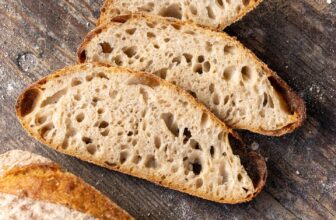
Aerated with one rise
How does it turn out? “No soda” soda bread works quite well and the results are delicious. Even though the rise of the dough comes from a long fermentation and gluten tends to strengthen with time, the crumb is still cakey-tender. This is likely because we use whole wheat all purpose flour, milled from lower gluten hard red winter wheat berries. Wheat grown in Ireland tends to be a soft winter wheat so this seemed like a good choice.
Using wholemeal flour also made sense historically and practically. In the past, wholemeal flour was commonly used for daily breads because white flour was more expensive. Also the bran in unsifted flour inhibits gluten formation, furthering our goal of a tender crumb. Along these lines we also recommend a process similar to traditional soda bread: minimal mixing, no stretching and folding or other dough handling, and a quick gentle shaping—in the case of this recipe: after one rise.
Sourdough or Yeast: Our sourdough version includes a lot of ripe sourdough starter and the yeast version very little instant yeast, giving them similar rise times: 4-6 hours to reach 75% expansion. However, if you plan to refrigerate the yeast version before shaping and baking, minimize the room temperature rising to 1-2 hours, aiming to refrigerate the dough at 25-50% expansion. Unlike the sourdough version, which becomes almost dormant in the refrigerator, the yeast version will continue rising in the refrigerator. To learn more about slowing down a yeast bread, check out our article: The Slow Lazy Method with Instant Yeast.
History: Soda bread in Ireland was traditionally more of a daily staple rather than a holiday bread, and it was often with made with whole wheat flour, which in Ireland came from a relatively soft winter wheat. Refined “white” flour and the inclusion of sugar, eggs, and dried fruit varied with availability and affluence. When soda bread has raisins or currants, it is actually called Spotted Dog or Railway Cake in Ireland. Chemical leaveners for baking have existed since at least the 1600s, but soda bread grew in popularity after the mass production (1846) of sodium bicarbonate aka baking soda. Prior to that, chemical leaveners included sodium carbonate (1791), potassium carbonate aka pot-ash, which earned the first U.S. patent in 1790 and is still used in some German gingerbread recipes, and ammonium carbonate aka hartshorn salt from as far back as the 1600s and still used in some dry German cookie and cracker recipes. Sources: Tasting History and The Society for the Preservation of Irish Soda Bread

Served with Irish butter


Soda bread is a traditional quick bread from Ireland and in this recipe we’ve slowed it down for delicious flavor and digestibility—and to show that it is possible to use different leavening and still have a tender-soft crumb. Instead of baking soda, our recipe has one long sourdough or yeast rise, followed by a quick shaping and right into the oven with the scored dough.
Ingredients
Sourdough
Yeast
Instructions
- The sourdough version of this dough at 78°F takes 5-6 hours to expand by 75%. It can be shaped and baked immediately or refrigerated overnight for more flavor and a helpful stiffness of the dough during shaping. Don’t be surprised if the dough contracts a bit in the refrigerator; this is just the gas compressing with the cold.
- The yeast version of this dough at 78°F takes 4-5 hours to expand by 75% and can be shaped and baked immediately. If you want to refrigerate the yeast dough overnight, don’t let it expand to 75%. Only let it rise at room temperature until it is about 25-50% expanded, 1-2 hours, because it will continue rising in the refrigerator.
- Warm the milk to 60-85°F so the dough isn’t very cold.
- In a large bowl, mix all of the ingredients. The dough will be relatively sticky and loose.
- Clean up the sides of the bowl with a dough scraper or spatula, note the level of the dough, cover, and let the dough rise.
- When the dough has expanded by about 75%, you can refrigerate it overnight – OR – move to the shaping and baking stages immediately. See the note above about refrigerating the yeast version.
- Preheat your oven and baking vessel to 425°F for at least 20 minutes.
- Gently scrape the dough out of the bowl onto a floured work surface. Try to keep it in one piece. Dust the top with more flour and shape the dough into a ball.
- Score the dough with a deep cross and load it into the preheated baking vessel.
- Immediately lower the oven temperature to 400°F and bake for 45 minutes covered, followed by another 15 minutes uncovered. The internal temperature of the bread should be over 205°F when the bread is done.
- Serve warm with butter, jam, or cheddar cheese. Store wrapped in plastic or aluminum foil to keep the bread soft.
Notes
* In the yeast version, using buttermilk versus milk is up to you. The buttermilk is not necessary since there is no baking soda to activate. From a flavor standpoint, sourdough leavening offers some acidity in that version, so we recommend using regular milk.