10+ Cool Things to Do in Williamsburg VA • Traveling with Purpose

Traveling with Purpose contains affiliate links to products or services that I recommend. Any purchases made through these links don’t add anything to your purchase price, but they help me pay my bills and bring you quality travel tips and inspiration. As an Amazon Associate, I earn from qualifying purchases. Thanks so much for your support!
Are you considering a trip to the original capital of the colony of Virginia? You’ll find so many amazing things to do in Williamsburg, VA, and the surrounding area. Whether you love history, nature, food, water fun, the Arts, and beyond, you can find it on the East Coast of Virginia.
With America’s 250th birthday upon us, there’s no better time to plan a trip to the Williamsburg, Virginia area — but let’s be honest, figuring out where to start can feel a little overwhelming. Between Colonial Williamsburg, Yorktown, and everything in between, there’s the historic area, the museums, the battlefields, the ghost tours, the fife and drum corps marching by at random… how do you fit it all in without wasting half your trip on stuff that’s kind of a snooze?
I’ve been there, flipping through brochures trying to figure out what’s actually worth my time versus what’s just there for the tourists. The good news is, after digging in (and getting a little lost in the 18th century myself), I’ve put together a list of the genuinely cool things to do across this whole area — the ones that make you forget you’re not actually living through the birth of a nation.
Celebrate America’s 250th Birthday
If you’re a history buff, 2026 is basically your year. With the whole country gearing up to celebrate 250 years since the Declaration of Independence, this corner of Virginia is about to be the place to be. You’re literally walking the streets where it all started and standing on the battlefield where it all wrapped up — and with special exhibits, events, and reenactments planned around the anniversary, there’s never been a better time to see it come to life. So grab a coffee, and let’s plan a trip to Williamsburg and Yorktown that you’ll actually be talking about long after you’re home, and long after the big 250th celebrations wrap up.
Did you know that Williamsburg served as the capital of the colony of Virginia from 1699 to 1780? Because of that, it has a significant place in American History. The region was also an important part of the Revolutionary War. Even without those distinctions, you’ll find tons of modern and historical things to do in Williamsburg VA for all ages.
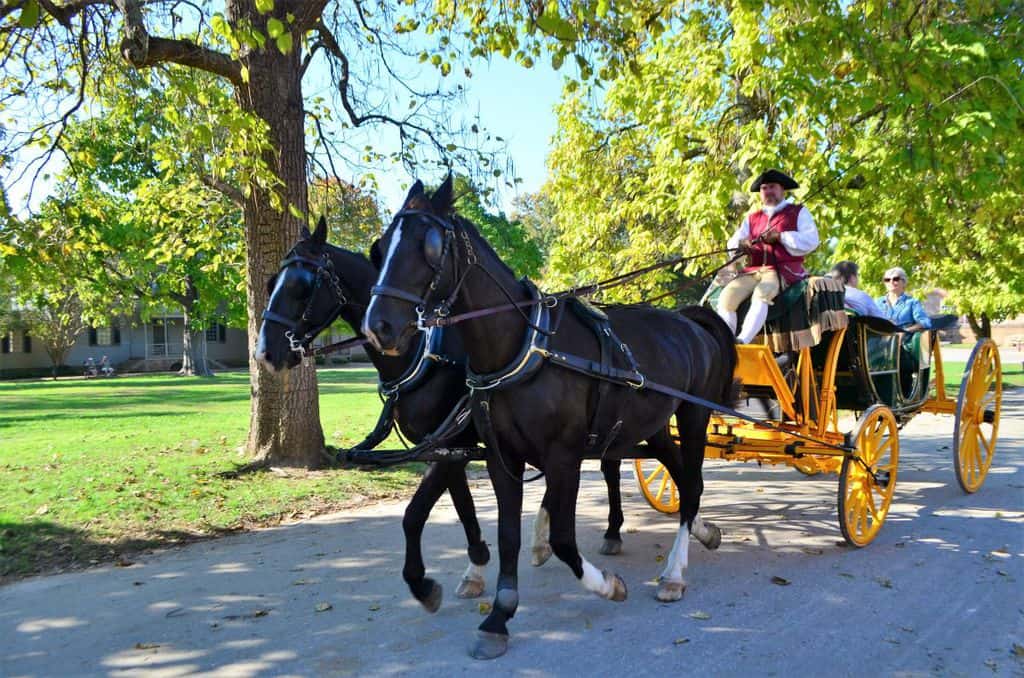
One of the biggest attractions in the Williamsburg area is “Colonial Williamsburg”. It’s considered the world’s largest living history museum – a historically preserved town with excellent Colonial-period re-enactors, artisans, and craftspeople in the shops and roaming the streets. When you visit, you’ll have a chance to engage with them to get a taste of what life was like in the 18th century. Over 300 acres of the village feature more than 40 historic sites, like churches, homes, and stores. Archaeology continues here as well.
You’ll have a chance to take guided tours of the 18th-century Governor’s Palace and the original Virginia Capitol Building, where early Americans met and made world-changing decisions. The building was completed in 1705 and destroyed by fire in 1747. Unfortunately, its replacement burned down in 1832. A precisely restored building was opened to the public as part of Colonial Williamsburg in the 1930s.
Watch Tradespeople Create Historically Accurate Pieces with Colonial Tools
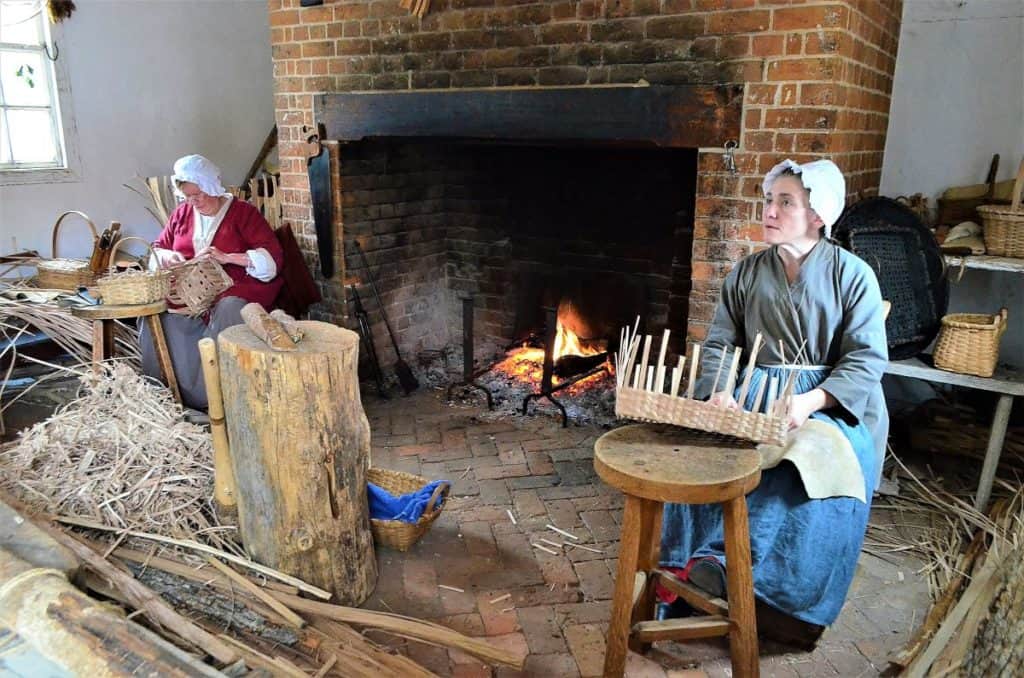
You can watch as modern tradespeople from more than 20 trades demonstrate historical 18th-century techniques and sell Colonial artisan crafts like furniture, wood vessels, musical instruments, silver and other metalwork, hand-woven baskets, and hand-printed and bound books. If you love seeing these ancient trades demonstrated, you can also watch online on “Trades Tuesdays“.
Four historically restored taverns serve foods from the period, like Hunter’s Game Pie or local seafood. The two world-class art museums, Abby Aldrich Rockefeller Folk Art Museum and DeWitt Wallace Decorative Arts Museum house more than 70,000 examples of historical and current decorative pieces, fine art, folk art, and mechanical specimens.
Discuss the Concerns of the Day
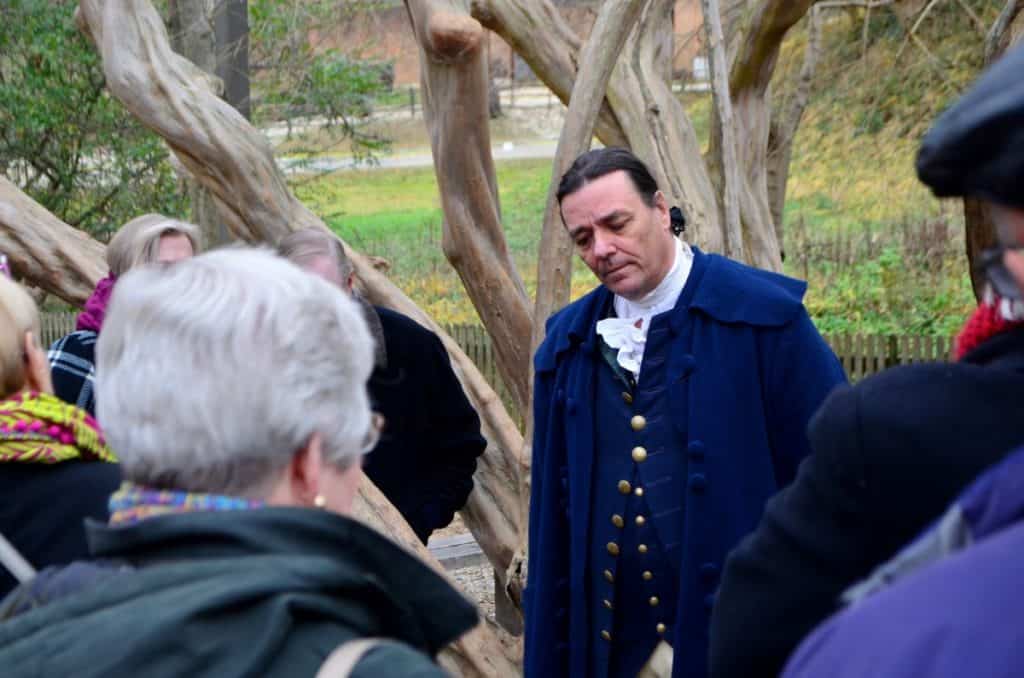
As you talk with re-enactors at Colonial Williamsburg, they’ll often address the relevant concerns of the Colonial period, like independence from England, slavery, women’s rights, law, taxes, religious freedom, colonization, creating a new government, and more. If it sounds like their perspectives are outdated, it’s because the re-enactors present the ideas that were common in the 18th-Century, not what they’ve evolved into today. You might be surprised at how many of their concerns are still a focus of our lives in the 21st Century.
Volunteers and staff try as much as possible to work within the parameters of the period. One example is the 30 gorgeous gardens sprinkled around the property. Workers use Colonial techniques, heirloom seeds, and 18th-century tools to plant, cultivate and harvest period species of flowers, fruits, vegetables, herbs, and trees. Woodworkers and seamstresses use only hand tools. No power tools are allowed.
Colonial Williamsburg offers single-day, multi-day, and annual passes for adults and children. If you also plan to visit the other Historic Triangle sites of Jamestown and Yorktown you can buy a special 7-day ticket. This ticket gives you access to five historic sites—including all of Colonial Williamsburg, Yorktown, and Jamestown historic sites, trade shops, and museums—for seven consecutive days from the first date of use. Find out more about all your options here.
The Battle of Yorktown
Another world-altering event that happened along the York River near Williamsburg was the decisive Battle of Yorktown during the Revolutionary War. In the Fall of 1781, the American colonies’ army won the decisive victory over the British Army in a battle that was the turning point of the war to win independence from England. There are two different sites where you can learn more about the Battle.

Yorktown National Battlefield (Colonial National Historical Park) – 15 miles southeast of Williamsburg, Virginia, you can find out more about this famous battle at this National Park Service Historic Site. Stop by the Visitor Center to see a film and exhibits about the battle, take a battlefield driving tour, and participate in guided ranger walks and talks about the defining battle of the Revolutionary War.
American Revolution Museum at Yorktown – 25 miles south – this Museum features artifacts, exhibits, and a 180-degree surround screen for the film reliving “The Siege of Yorktown”. Outside you can enlist in the Continental Army in a re-created encampment to learn about the life of a soldier and take in daily demonstrations on medical treatment, camp life, and cooking. Watch demonstrations of the firing of muskets and artillery. You can also explore a farm, based on a real-life 18th-century family. Help with chores in the house, kitchen, tobacco barn, gardens, and crops.

Places to Eat, Drink and Stay Near Williamsburg, Virginia
Awesome Dining Options near Williamsburg
Pierce’s Pitt Barbeque is less than 10 miles from the park. Pierce’s was rated as one of the “Top 10 BBQ Joints in America” by National Geographic. Their menu features smoked ribs, chicken and beef brisket, southern-style collard greens and their 80-year-old BBQ recipe. They also offer family-style meals to go. 447 East Rochambeau Drive, Williamsburg, VA 23188, 757.565.2955
Beer, Wine, Mead and More near Williamsburg VA
Williamsburg Winery (15 miles from the park) – offers the perfect spot for a winery tour and tasting as well as a variety of dining options and a wonderful setting to stay overnight. 5800 Wessex Hundred, Williamsburg, VA, 757.229.0999
Aleworks Brewing Company is less than 10 miles from the park. Check out the Brewery Tours and Guided Tastings at this local craft brewery. Pickup and delivery are also available in the region. 189B Ewell Rd, Williamsburg, VA 23188, 757.220.3670
Silver Hand Meadery If you’re spending the day in Williamsburg, you’ve got to add Silver Hand Meadery on Monticello Ave to your list. After soaking up all that colonial history, it feels kind of perfect to wind down with something even older — mead is considered the world’s oldest fermented drink, way older than wine or beer.
The tasting room has a really laid-back vibe, and there’s more variety than you’d expect, with flights ranging from dry to sweet so you can figure out what you like as you go. It’s an easy, low-key stop to tack onto a day of walking around the historic area, and honestly, there’s something fun about capping off a history-filled day with a drink that’s actually older than the history you just explored.
Unique Lodging in Williamsburg Area
Historic Colonial Houses Lodging – Did you know that you can stay overnight in one of the historic homes nestled in Colonial Williamsburg? Imagine stepping back 200 years in time to read your favorite book by a crackling fire and sleep in a cozy canopy bed, surrounded by beautiful period decor. A variety of options, from single-room dwellings to multi-room homes, and unique premium houses (all with full baths) are available to enjoy overnight for singles or small groups. Individual Tavern Guest Rooms are also available for a historic experience.
An added bonus is that all the income from the Colonial House rentals supports the educational mission of The Colonial Williamsburg Foundation, the not-for-profit organization that operates the Historic Area.
Here are some other excellent lodging options that will immerse you in the historical vibe of Williamsburg and the surrounding area.
Williamsburg Whitehouse Inn

Williamsburg Resort by Holiday Inn

Colonial National Historical Park (Jamestown Colony) – 18 miles southwest – Visit this historical site to see archaeological digs, and re-created dwellings from 1607. You can also see Artisan craftspeople demonstrating glass-blowing. Or take a guided tour of the first permanent English settlement in America.
Other Historical Sites Near Williamsburg VA
Less than an hour’s drive from Williamsburg, you’ll find at least 5 different plantations that are open for visitors in Charles City County, along the James River. Settlements, farms, and plantations in this area began in 1613, and some of the history has survived, despite several battles fought in the region.
This is also where things get a little more complicated, and honestly, that’s worth talking about. The James River Plantations are stunning to look at — grand homes, manicured gardens, river views — but they were also built and run on the labor of enslaved people, and how each site handles that part of the story varies a lot. Some, like Carter’s Grove, which depicts both sides of plantation life from the perspective of both the owners and the enslaved, have made a real effort to tell the fuller story through exhibits and dedicated tours.
Others lean more heavily into the architecture and the famous families who lived there, with slavery mentioned only briefly, if at all. Visitors and reviewers have noted that many tours historically painted plantation life as “happier times,” leaving certain narratives out, though that’s been shifting over the past several years as more sites add interpretive programs and even work to locate descendants of the enslaved people who lived there.
My honest advice: if a full picture matters to you (and it should), look up ahead of time whether a specific plantation offers a dedicated tour focused on enslaved life, since the regular house tour doesn’t always go there.
Berkeley Plantation

Consider visiting the birthplace of generations of statesmen of the Harrison family, Berkeley Plantation. It’s the home where several presidents lived and at least 10 presidents (including George Washington) visited. Union Major General George McClellan was headquartered on this land with his troops during the Civil War.
These Private Specialty Tours may be available
- Enslaved Tour: Exploring the lives and contributions of Berkeley’s Enslaved
- Ghost and Hauntings Tour-Stories of Berkeley’s paranormal activities
- Civil War Tour – Captures the stories of the Civil War soldier while camped at Berkeley
- Candlelight Christmas Tour – After-hours candlelight tour of Berkeley’s mansion
Sherwood Forest Plantation
The 10th President of the United States, John Tyler lived at Sherwood Plantation his last 20 years of life, from 1842 to 1862 and the Tyler family descendants liv there continuously since then. In addition to its well-known residents, Sherwood Forest Plantation is also famous for being the longest frame house in America. It was extended in 1845 to its present length of over 300 feet long. Self-guided grounds tours are Guided House tours are available by appointment.
Slavery at Sherwood Forest Plantation
Sherwood Forest, home of President John Tyler, takes an unusually thorough approach to this history. Rather than glossing over it, the current owners have built out an extensive research project documenting the dozens of men, women, and children enslaved by the Tyler family at Sherwood Forest, with research into their lives still ongoing.
The plantation’s website features individual profiles compiled from surviving letters, census data, and Freedmen’s Bureau records, tracing specific people by name — their families, their work, and in several cases, their escapes to freedom during the Civil War. It’s a sobering but valuable stop if you want plantation history that doesn’t look away from the people whose labor built these estates.
Shirley Plantation

The Shirley Plantation dates back to 1613 and is America’s oldest farm and family-owned business. 11th and 12th-generation family members still live in the home and work the property.
Diving Deeper into the People of Shirley Plantation
Shirley Plantation takes a broader, more structural approach to this history than a name-by-name archive. Rather than focusing on individual stories, the Shirley Plantation website organizes its history page into distinct sections covering the indigenous Weyanoke people who farmed the land before colonization, the indentured servants who worked the property starting in 1616, and the enslaved Africans and their descendants who became Shirley’s primary labor force by the early 1700s.
The site is candid about the gaps in the record, noting there is little documentation about the enslaved prior to 1816 and no known first-hand accounts from the enslaved themselves. Rather than filling those gaps with assumptions, Shirley instead points visitors toward outside genealogical and archival resources — including university special collections and a dedicated enslaved ancestor database — for those who want to dig deeper. It’s a more academic, research-oriented presentation than some other plantations along the river, useful if you’re looking to do your own follow-up reading after the visit.
If you plan to be in Virginia in the latter part of April, be sure to check out Virginia’s Historic Garden Week at the James River Plantations or one of the other tour locations sprinkled throughout the state. It’s the perfect way to see some of the historic homes that aren’t normally open to the public. A few years ago, I had the chance to tour “Nordt Family Farm“, one of the plantations in Charles City County that’s privately owned and normally off-limits to the public. The owner of the farm raises her own sheep, creates yarn from the wool, then weaves Merino wool into beautiful blankets and wearable pieces (see the ones on Etsy below). The farm/plantation was also featured in a Thanksgiving issue of “Martha Stewart Living” magazine. It was amazing!
Check out these other posts on my blog about more to do in Virginia.