13 Life Lessons from the Game of Tennis


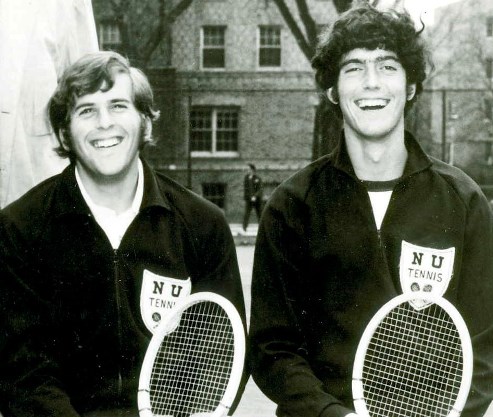
With Jon Vegosen (left), former President and member of the board of directors of the United States Tennis Association, in our Northwestern University tennis days.
ConantLeadership Founder, Doug Conant, originally published this post over a decade ago. Now, we present this piece, updated with new content, as part of our “Golden Anniversary” collection: a treasury of Doug’s thought leadership, revamped to help you meet the current moment, as we celebrate his 50 years in leadership.
Like everyone, my life has been a series of ups and downs. (Fortunately, the ups have greatly outweighed the downs.) Now, in my 70s, I find myself reflecting anew on lessons from my youth that helped guide me through the rough patches. This reflection always leads me back to the game of tennis.
For context, I started playing tennis relatively late into my youth and had a modestly good run. After being cut from my freshman high school team, I went on to become a highly ranked player in the Midwest and was ultimately recruited to attend Northwestern University on a tennis scholarship to play for the well-known tennis coach, Clare Riessen.
I was a four-year starter on the Northwestern team, and in my last two years, played No. 2 singles and No. 1 doubles. Over those four years, I achieved a winning record against a challenging schedule. After graduating, I stayed at Northwestern to attend the Kellogg School of Business to get my MBA and to help Coach Riessen as an assistant coach.
Tennis shaped me into the person I am today.
When I wasn’t studying or coaching, I was teaching tennis in different venues around the Chicagoland area—including serving as head counselor at the New England Tennis Camp in Groton, Massachusetts.
Later in life, I served on the Board of Trustees for the International Tennis Hall of Fame, was inducted as a contributor to the Intercollegiate Tennis Association (ITA) Hall of Fame, and in 2019 the ITA awarded me its David A. Benjamin Achievement Award, which honors past participants of varsity tennis who have achieved excellence in their chosen careers and as contributors of society.
Cumulatively, I practiced tennis for thousands of hours, played hundreds of competitive matches, and taught the game to a countless number of people. It has shaped me into the person I am today, teaching me so much about what it takes to be a competitive player, an impactful coach, and an effective leader. I also learned pivotal lessons that became profoundly helpful in my day-to-day life. Here are a ‘baker’s dozen’ life lessons from the game of tennis that have stood the test of time on and off the court.
1. Follow Your Passion
In the spring of 1966, I was cut during tryouts from the “freshman only” boys’ tennis team. This meant that 20 freshman boys (including most of my friends) were chosen ahead of me. It would have been easy to give up then and there, but I dedicated myself to following my passion for the sport, spending hundreds of hours practicing alone by hitting balls against walls in the neighborhood. By the next year, my competitive profile improved and I became one of the better junior players in the Midwest. I learned that passionately pouring yourself into a cause could yield substantial returns.
Read more about following your passion—and building grit along the way.
2. Redouble Your Efforts
Tolstoy was right: “Happiness does not depend on outward things, but on the way we see them.” In my case, after the setback with the boys’ freshmen tennis team, I could have chosen to walk away from the sport entirely. Instead, I redoubled my efforts. And that decision led to a series of experiences that have been life-shaping. We all have the power of choice in our lives: the power to choose our response to any and every situation. Tennis taught me to choose to make the best of every setback.
Read more about redoubling your efforts and holding yourself accountable.
Every day is “game day.”
3. If It Is to Be, It Is Up to Me
Tennis taught me to take total responsibility and ownership over my performance profile every day. I learned that these ten two-letter words dictated my success: “If it is to be, it is up to me.” When playing (particularly singles), I discovered that there was nowhere else to turn but inward when trying to find my way through a difficult match. When teaching, the student was counting on me to provide wise counsel. Again, there was nowhere else to turn; it was up to me. This became an incredibly important lesson in my business career.
Read more about making things happen.
4. Practice Makes Perfect
Tennis taught me that the level of success I achieved in competition was directly proportional to the intensity of practice I put in before competing. It’s hard to imagine achieving any level of enduring competitive success without intense practice and hard work. In that sense, this particular lesson is all about bringing a fierce resolve and sense of purpose to your work every day, knowing that every day is “game day.”
5. Better Is Best
Tennis taught me that the pursuit of mastery would rarely be characterized by monumental breakthroughs. Incremental, steady progress was more realistic. I found the key to my success was to be mindful every moment, and to try to do a little better every day. Big breakthroughs are always welcome, but real wins—and real resilience—are made from small-yet-consistent improvements over time.
Read more about mastering the craft of leadership, one step at a time.
6. Play to Your Strengths
Tennis taught me that our greatest success lies in finding ways to get maximum leverage of our strengths, rather than trying to fix our weaknesses. This lesson has great power in the area of corporate strategy. The most successful companies typically understand their strengths and maniacally focus on leveraging them to their greatest advantage, while smartly managing their weaknesses. I have found the same principle highly relevant when developing my own leadership philosophy.
Read more about leveraging your strengths in real time.
7. Critical Thinking Is Critical
Whether playing or teaching tennis, I was always exerting myself physically in some way. I learned that my mind, and critical thinking skills, had to be equally as active as my body. To win, I needed to critically analyze each move, and make adjustments as necessary. In many ways, this is a lesson of vigilance: the need to be hyper-alert to the world around you in order to craft a winning point, a winning tennis lesson, or a winning proposition in whatever you choose to pursue.
Read more about how to think critically as a leader in the age of AI.
You need both character and competence.
8. Civility Matters
One of the most wonderful aspects of tennis is that it promotes civility and character development, while also demanding competitive excellence. As a teenager, my temper had the capacity to get away from me. But the game of tennis taught me to channel that energy into the next shot, not to project it elsewhere. To me, civility and the development of good character are what point you forward to your ‘true north’ in tennis and in life.
9. Character Matters and Performance Counts
Tennis taught me that not only does good character matter, it must also be fully leveraged with great competence. It’s only when you develop both virtues that you can differentiate yourself in any meaningful way. The life of Arthur Ashe is the incarnate example of this lesson. Ashe worked tirelessly to cultivate his character as well as his competence in tennis, leading to exemplary performance on the court—and more importantly—well beyond it. Tennis is a performance sport; you need both character and competence to achieve high performance. The same thing is true in the pursuit of excellence in any field.
Read more about making meaningful wins as a leader.
10. ‘Pressure Is a Privilege’
These words come from the title of a book written by tennis superstar Billie Jean King. To me, they speak to the need for competitors to have a mindset that delights in being “in the arena” and having the opportunity to do something special. Tennis taught me that we must have the “eye of the tiger” when things become difficult, rise to the challenge of the moment, and find a way to prevail with integrity. It’s in these tough moments that we can feel fully alive. The opportunity to perform under pressure is indeed a privilege.
Read more about why pressure is a privilege.
11. How Can I Help?
Tennis taught me one of the most profound lessons of my life journey: The power of asking “How Can I Help?’” When teaching tennis, I only had a half-hour to create a special learning experience for the student. Over thousands of lessons, I learned that if I approached each lesson with an earnest and genuine desire to help, everything flowed in a natural and productive way, and we made the most of our time. To this day, I approach each interaction with a spirit of curiosity about how I can help the other person, and it creates a foundation for much more constructive discussions.
Read more about the power of asking “how can I help?”
12. ‘Seek First to Understand’
While I learned these exact words from Stephen Covey, I first encountered the wisdom of this lesson when I was teaching tennis. Much like the lesson of being earnestly helpful, this one requires the ability to engage in genuine curiosity and listening. I’ve found that you can’t be truly helpful if you don’t try to understand the perspective of the people with whom you work. When my students felt heard, they were more likely to accept my guidance and corrections. Then, we were able to achieve excellence, build trust, and smooth out the path forward together. The same is true in leadership.
Read more about making every interaction count.
The more I give, the more I get.
13. Have Fun
Tennis taught me that the people who have the most success on and off the court are those who derive joy from their journey. It is hard to imagine someone dedicating themselves to their craft without having some fun along the way. The demands are too great; you simply must find a way to enjoy the ride. And if you can’t, you should pick another path. Life is too short.
Read more about why work can (and should be) fun.
And the Beat Goes On . . .
These lessons from the game of tennis have become foundational in all aspects of my life. And in the spirit of “How can I help?,” I’ve always looked for ways to give back to a game that has given so much to me. I’ve been a long term supporter of the Northwestern Tennis program, a member of and a major contributor to the International Tennis Hall Of Fame, a contributor to and member of the Intercollegiate Tennis Hall of Fame, a supporter of the Harlem Junior Tennis and Education Program, a passionate supporter of the Arthur Ashe Learning Center, a supporter of the Legacy Youth Tennis program in Philadelphia, and a supporter of several United States Tennis Association initiatives.
Interestingly, I have found that the more I give back to tennis, the more I get from it in terms of learning, growth, and personal fulfillment. Put another way: The more I give, the more I get. I guess that could be life lesson #14. Clearly, the lessons keep coming!
___
Want to work with us? Drop us a line, request information about Speaking Engagements, or talk to Emma Anthony, our Director of Leadership Programs.
Ready to learn and apply more life and leadership lessons? Start with these resources:
- LinkedIn Learning Course: Finding Your Leadership Purpose with Doug Conant
- LinkedIn Learning Course: Finding Your Leadership Vocabulary with Doug Conant
- STEPS: A Leadership Course for Administrative Professionals
- The ConantLeadership Video Library featuring conversations with top leadership luminaries like Indra Nooyi, Bill George, Brené Brown, Amy Edmondson, and many more
- The ConantLeadership blog: Find hundreds of resources on ‘Leadership That Works’
- The Leadership That Works Newsletter: A Monthly Roundup of the Best Leadership Resources from Around the Web
- Get the first chapter of The Blueprint: 6 Practical Steps to Lift Your Leadership To New Heights FREE
- Download the free companion workbook to The Blueprint
 About the Author: Doug Conant is Founder and CEO of ConantLeadership, former Chairman and Current Board Member of CECP, former CEO of Campbell Soup Company, Former President of Nabisco, former Chairman of Avon Products, and co-author of two bestselling leadership books, TouchPoints, and The Blueprint.