3 Questions to Boost Productivity & Cut Drama in 1 Conversation

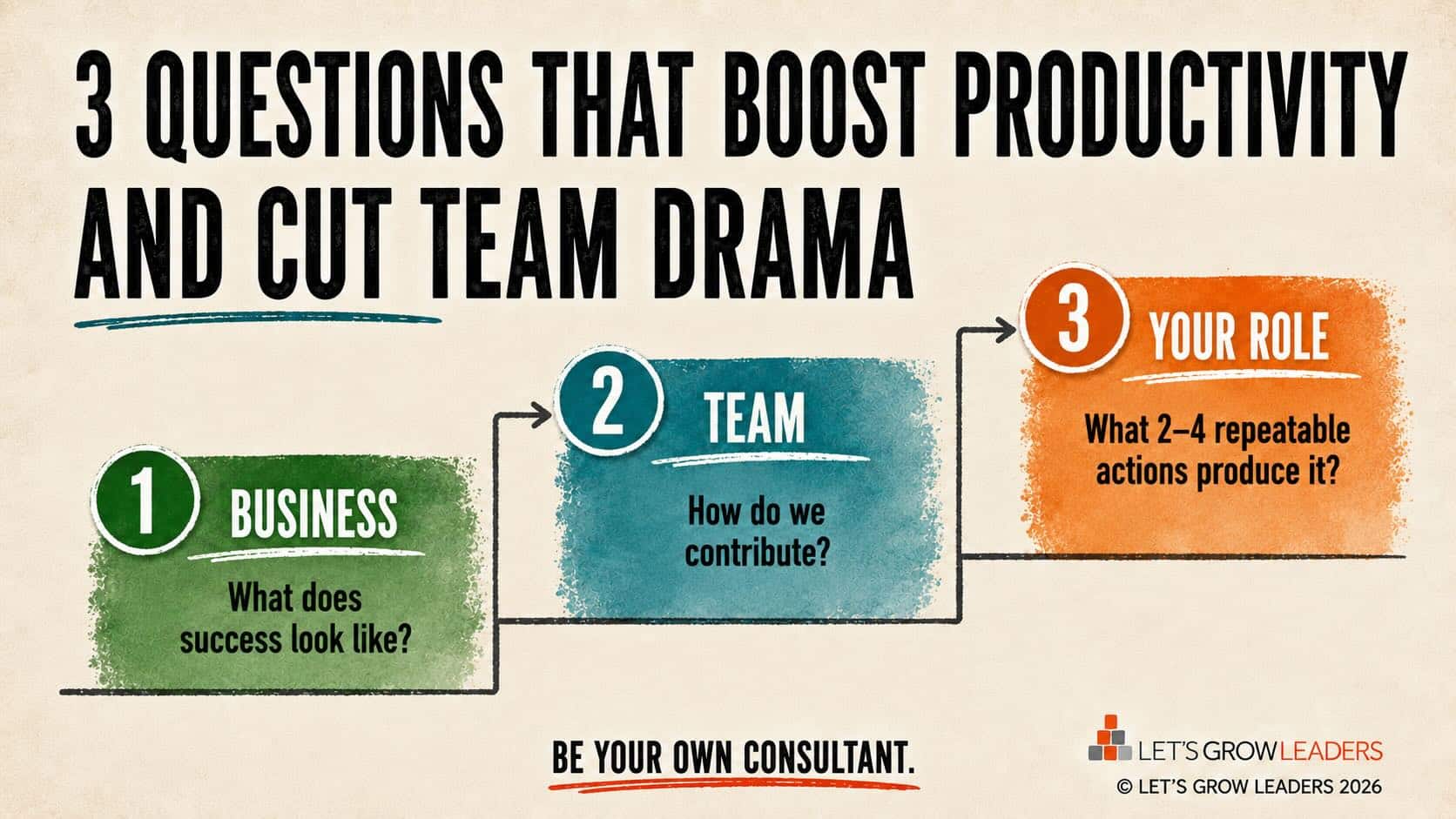
Leaders can boost their team’s productivity and cut through drama and conflict with a single self-assessment practice we call “be your own consultant.” It centers on three questions: (1) What does a successful outcome look like for the business? (2) How does your team, unit, or department contribute to that outcome? (3) How, specifically, does your role contribute — what are the 2-4 specific, repeatable actions you take to produce that result? Answering all three surfaces the unclear expectations and misaligned effort that usually drive both underperformance and interpersonal drama. And these questions work at any level of leadership, from CEO to frontline manager.
Boost Productivity by Ensuring Your Team Can Answer These Questions
Do you ever feel like your team’s busy but doesn’t have enough to show for their work? They work toward deadlines, fill the calendar, but all that work doesn’t add up to what the business actually needs. Most leaders never learned to boost productivity by looking at their function the way an outside consultant would: a set of activities that either move the needle on the organization’s real goal, or don’t.
That’s the thinking behind what we call “be your own consultant.” Before you bring in outside expertise, and before you assume friction or disengagement on your team is a people problem, run yourself through the same three questions we ask our consulting clients. These questions work whether you’re the CEO, a mid-level manager, or a frontline leader.
Ask them in order. Each one depends on the answer before it, and skipping straight to question three — the one about your own daily work — is exactly how teams end up busy without being effective.
1. What does a successful outcome look like for the business?
2. How does your team, unit, or department contribute to that outcome?
3. How, specifically, does your role contribute? What are the 2-4 specific, repeatable things you must do to achieve those results?

The highest performing teams and organizations have clear alignment in their answers to these questions. Every individual knows how they make a difference every day. Every team knows whatthey must do to help the organization succeed. And the organization is clear about the difference it makes. The specific words might vary, but the CEO, a middle-manager, and a frontline employee will have aligned answers.
Let’s look at each question and then some examples of how different teams and individual employees might answer them.
Question 1: Start With the Shared Goal
1. What does a successful outcome look like for the business?
The first question asks what matters most to your organization. If you’re familiar with Let’s Grow Leaders, we call these the Strategic MITs (Most Important Things). What are your strategic objectives? You shouldn’t invent your team’s answer to question one. It should trace back to one company-level outcome that every function in the business ultimately serves.
Question 2: Localize the Shared Goal
2. How does your team, unit, or department contribute to that outcome?
This second question takes that strategic goal and breaks it down to a team or group’s most important work. Knowing the difference your team makes for the big picture not only provides clarity for prioritization, decision-making, and how best to use resources, it also connects the work to meaning and purpose.
A task is never just a task. There’s a good reason for the work (and if not, why waste time with it?)
Question 3: Personalize the Shared Goal with Specific Habits
3. How, specifically, does your role contribute? What are the 2-4 specific, repeatable things you must do to achieve those results?
Even in organizations that can answer the first two questions clearly, we often find a gap in the answers to number 3. What are the specific repeated activities (habits) that lead to success?
It seems like an easy question, but too often, people know a set specific tasks that they’re required to do, but they don’t understand what outcomes those tasks achieve or which tasks are most important relative to the team and strategic goals. For many team members, they genuinely don’t know how to make the difference their role requires.
If you ask your team these questions and their answers aren’t what you would hope, don’t treat it as a failed quiz. This is an opportunity for you to invest in greater clarity, boost productivity, and reduce unnecessary drama and friction.
How This Plays Out on Three Different Teams
Let’s look at three examples of how teams and individuals might answer these questions. We’ll look at three different teams: finance and accounting, product marketing, and engineering.
Question 1: What does a successful outcome look like for the business?
In our hypothetical business, let’s choose a big-picture strategic goal: revenue growth that’s profitable and sustainable. This will be the same strategic goal for all three teams.
Question 2: How does your team, unit, or department contribute to that outcome?
Finance and Accounting
Finance and accounting’s contribution is to protect the “sustainably” half — they close the books accurately and on schedule, manage cash flow, keep the company compliant, and produce forecasts that leadership trusts.
Product Marketing
Product marketing drives the “grows” side of the strategic goal, translating what the product does into language customers care about, arming sales with positioning and messaging, running launches that build real awareness, and feeding customer insight back into the business.
Engineering
Again, the same company-level goal — but engineering’s job is making sure the product itself can carry that growth reliably and securely. Every outage, security gap, or performance problem that erodes customer trust works directly against “profitably and sustainably.”
Question 3: How, specifically, does your role contribute? What are the 2-4 specific, repeatable things you must do to achieve those results?
Finance and Accounting: staff accountant handling accounts payable
A staff accountant’s 2-4 repeatable things might be:
- process invoices within 48 hours of receipt
- reconcile the AP sub-ledger weekly without fail
- flag any anomaly the same day it appears rather than waiting for month-end
- close their portion of the books by the second business day of every month.
Product Marketing: product marketing manager
A product marketing manager’s repeatable actions might be:
- interview at least two customers or prospects monthly to keep messaging grounded in reality
- ship one piece of sales enablement content every sprint
- sit in on sales calls or win/loss reviews weekly to identify what’s working and what’s not
- own the messaging brief for every launch so sales, support, and customer success start from the same page on day one
Engineering: backend engineer
For a backend engineer, 2-4 repeatable activities might include:
- review and test every pull request before merging
- hold the service to its uptime target and treat any breach as a same-week priority
- resolve critical bugs within an agreed response window
- dedicate a fixed portion of each sprint to paying down technical debt instead of deferring it indefinitely
Notice the pattern here: three very different teams with three very different sets of daily work, but every one of them can trace a straight line from what they do this week back to the one outcome the whole organization’s working toward. That’s what alignment looks like in practice, and it’s the difference between a team that’s busy and a team that’s effective.
Boost Productivity with Specificity
Too often, leaders settle for vague corporate jargon like “collaborate effectively.” That’s a fine concept, but what does it mean? For that product marketing manager, there’s a specific observable activity: sit in on weekly win/loss reviews with the specific intent of learning what’s working and what can improve.
When your teams are specific about the results they contribute and individuals are specific about the habits that lead to success, you have foundation for performance. When something doesn’t work, together you can analyze what’s getting in the way and fix it or try something else. And if it’s a performance issue, now you also have the foundation for a fair, specific performance conversation.
But without this level of clarity, you’ll be stuck in endless circles of frustrations and drama as everyone argues about how to “just collaborate more effectively.”
Your Turn
We invite you to start by asking yourself these three questions. If you’re not sure of the answers, start there.
If you’re confident in your answers, next, go ask your team these three questions. Don’t make it a quiz. Show up with genuine curiosity and see what they say.
If their answers aren’t what you would hope, this is an opportunity for you to invest in greater clarity, boost productivity, and reduce unnecessary drama and friction.
And if you want to master performance conversations so you can lead with clarity and confidence, check out our live-online Human-Centered Performance Management Accelerator (This is the same program normally only available to corporations that bring us in directly.)