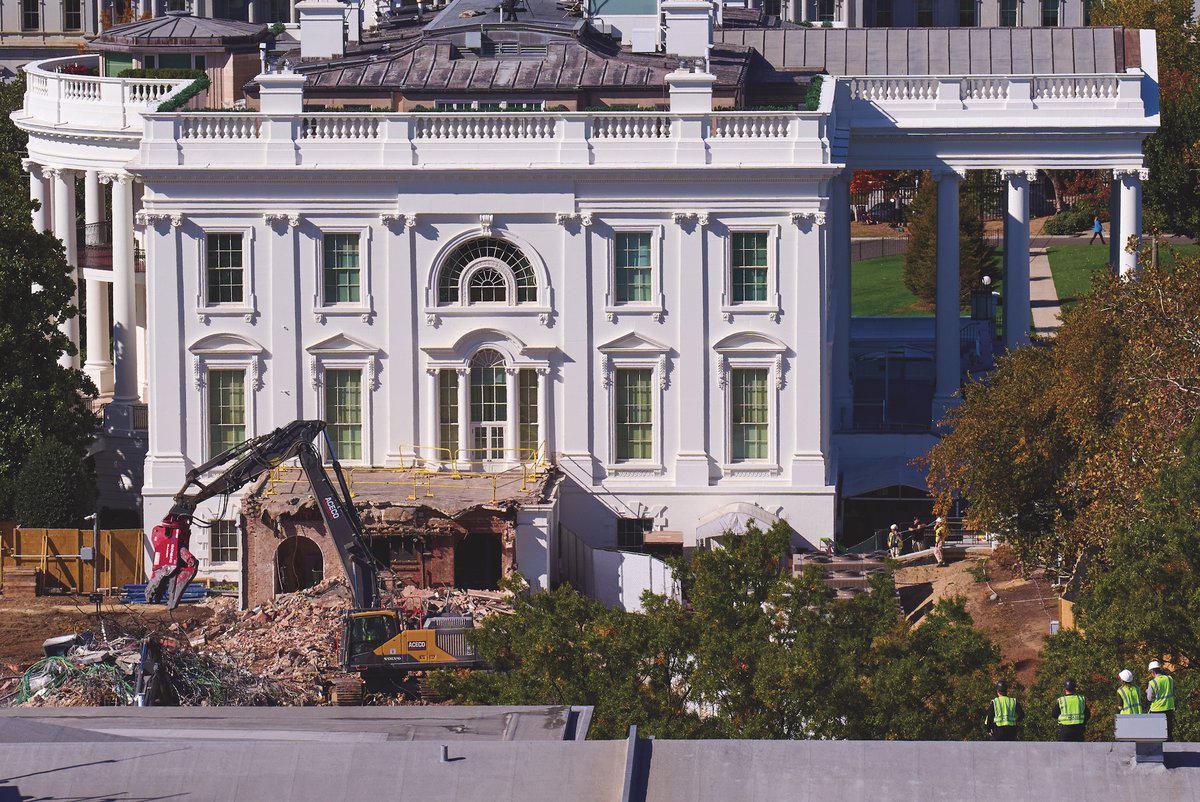

Images of the White House East Wing in ruins bring to mind a disaster movie. It’s one thing to understand intellectually that the country you knew is being dismantled piece by piece. It’s quite another to see photographs of perhaps the best-known building in the United States, a symbol of our Republic and the peaceful transition of power, demolished via wrecking ball.
When I first saw the images, I couldn’t help but think of the movie Independence Day, a 1996 blockbuster starring Will Smith. In the movie’s most famous scene, alien invaders destroy the White House as the President and his daughter barely escape on Air Force One. Here in our 2025 reality, demolishing a significant chunk of the White House was an inside job. With no oversight from Congress or any federal agencies, President Donald Trump appears to have acted unilaterally. This happened during a government shutdown, when federal employees were furloughed without pay or forced to work without pay. Instead of alien invaders, a democratically elected President destroyed the White House from within.
It’s worth noting that while Trump hasn’t sought any approval, he hasn’t been working alone, either. His administration has released a list of donors funding the White House ballroom he is replacing the East Wing with, and it’s a who’s who of tech conglomerates and the billionaires who profit from them. Some of these donations seem like mob-style shakedowns akin to what we’ve seen in lawsuit settlements Trump has made with corporations like Disney and Paramount, law firms, and universities. Others seem to come from willing participants who share the MAGA worldview and the destructive goals of Project 2025.
Movies like Independence Day rarely address what happens next or how those impacted clean up the rubble. Since returning to the White House, Trump and his administration have used every lever of power available to them and claimed a mandate to fundamentally change the United States forever. It’s long been clear to me that the only path forward for the country is for Trump to be removed from office. But as he’s already been impeached twice, charged in both state and federal courts, and deplatformed from social media only to handily win back the presidency, accomplishing this can feel like an impossible task.
After spending the past decade exposing the far-right takeover of the United States in the fight to save democracy, my view is that we’ve lost the battle. We can’t piece America back together again. We can only move forward and rebuild. That’s not necessarily a bad thing. Many of us can probably concede that the United States, never a perfect nation, has been broken for some time. Wealthy individuals and the companies they run have long consolidated their power and continually squeezed the rest of us. If we no longer bear the burden of saving a system broken beyond repair, there’s an opportunity to envision something new. We can rebuild a nation that strives to care for its citizens and values the common good. We can create a government in which everyone has a seat at the table rather than only the wealthiest among us.
But acknowledging this raises a lot more questions than it answers. The MAGA right has a clear vision of what they want America to become, written out as Project 2025 and currently being implemented by the Trump Administration with a speed and intensity most of us didn’t think possible. Americans who oppose this vision have no such clarity. An anti-fascist, anti-MAGA coalition is clearly forming through organized resistance to U.S. Immigration and Customs Enforcement (ICE) and events such as the No Kings Day protests, but outside of stopping Trump from enacting his agenda, there’s no baseline agreement as of yet on what comes next. It’s clear what we’re fighting against, but not yet clear what we’re fighting for.
Divides have also emerged. The schism between Democratic leadership in Congress and the party’s base receives the most press attention. But many in business, academia, and the media have chosen to capitulate to the Trump Administration’s shakedowns rather than fight back or organize for collective action. As I’ve written in my own newsletter, it no longer makes sense to view political alignment in the United States as left to right. Instead, we might consider a spectrum of tolerance for the MAGA regime from those who embrace it on one end, to those who capitulate to it, to those who choose to fight it.
Then there are the midterm elections, which are just under one year away. In our political system, as it exists on paper, the midterms offer the most obvious course correction. But Trump and the Republican Party are hastily redistricting in red states to add more potential Republican Congressional seats, and historically have been willing to deny the validity of elections. For the first time, I’m deeply troubled that elections may not be free or fair, or respected, should Democrats win back control of Congress.
As I consider all of this and try to make sense of it all, two questions have formed in my mind. One, what should be the overall goal of the movement to resist MAGA authoritarianism? Two, what does winning actually look like?
I’ve started asking these questions of anyone I consider an ally or a potential ally: to friends and family in Kentucky, where I’m from; to political, government, and NGO staffers that I know professionally or from living in Washington, D.C.; and to friends and neighbors in Seattle, where I currently live. I’m genuinely curious where people’s heads and hearts are at. What is the worst-case scenario they fear, but also, what is the outcome they most hope for?
A few overarching themes have emerged from these conversations. First, many share a sense that the United States, on its current course, is unsustainable and can’t continue as it currently exists. Many also feel that elites and institutions have failed us, or are now actively working against us on Trump’s behalf. There’s interest in harnessing our economic power, and in tactics like a general strike, withholding federal taxes, or, in some cases, outright secession from the union. There’s also growing concern about civil war and other types of political violence and unrest. The people I speak with are curious about the idea of a Constitutional convention or a nonviolent revolution.
Some Americans who oppose Trump have gravitated toward the 3.5 percent rule, a political theory that posits that it takes around 3.5 percent of a population actively participating in sustained nonviolent protests to effect political change. The theory, developed by International Center on Nonviolent Conflict researcher Maria Stephan and Harvard University political scientist Erica Chenoweth, has been around for almost twenty years, and today is often cited in media reports, organizer trainings, and communications about actions like the No Kings protests.
According to Chenoweth and Stephan’s research, nonviolent resistance movements have almost always succeeded once that 3.5 percent threshold has been met. They cite four reasons why the movements that have been successful have worked better than violent internal conflict: They encourage mass participation and momentum from a broad swath of a nation’s population; they elicit defections and loyalty shifts from the opposition’s base of support; they remain nonviolent even as state violence and repression increase; and participants innovate and try new tactics such as noncooperation and economic disruption.
As a framework, 3.5 percent is incredibly helpful, especially the fourth plank, which expands beyond mass demonstrations to include forms of resistance that create friction. What’s often left unsaid in our current conversation is the goal: removal of the autocrat from office. I can understand the reluctance to say this out loud. Trump has so far withstood all other attempts to remove him from government, and his second administration is vindictive. Yet we must be clear: The whole point of mass resistance isn’t to wait out those in power, but to force their hand.
After working in more than thirty countries, former U.S. State Department contractor Noel Dickover says he no longer believes the United States is a democracy.
“The goal for democracy advocates has to be twofold,” explains Dickover, who during the Obama Administration helped strengthen the State Department’s Office of eDiplomacy. “One, stop the dictatorship by whatever means is at our disposal. Two, invest in long-term democracy building efforts to enact long-term change in the future.”
Dickover emphasizes that there is no easy way out and that in his experience, rebuilding a fallen democracy takes decades.
“There’s nothing we can do in the next few years to bring back what is now gone,” he says. “The most important thing right now is stopping the march toward dictatorship. Whether steps to stopping the dictatorship avidly harm democracy is a moot point now. This applies to gerrymandering Democratic states to counter Trump’s packing of Congress, for instance.”
After Trump’s rapid consolidation of power, removing him from office won’t be enough, says Bridget Todd, a veteran digital organizer and host of the podcast There Are No Girls on the Internet. “It’s not just the administration we’re fighting against,” she tells me. “It’s also the tech companies and billionaires who have joined forces with the administration to pursue their own profits and hegemony over people’s rights.”
It’s essential that we in a civil society do everything possible to ensure the midterm elections take place and are free and fair. Especially in the wake of the overwhelming success of Democrats in Virginia, New Jersey, and New York City in this year’s elections, which showed that the anti-Trump momentum and votes exist if voters are allowed to cast their ballots and have them counted.
We’ve already seen elections undermined in states like Pennsylvania and North Carolina, where local Republicans worked to take powers away from newly elected Democratic governors. Nationally, the Trump Administration and elected Republicans are doing everything they can to undermine the midterm elections and their results, including passing increasingly draconian voter suppression legislation, attempting to further gut the Voting Rights Act in the courts, and hastily trying to redraw the maps in states where Republicans hold all three branches of government to add more GOP Congressional seats. (California fought back with its own successful ballot measure, Proposition 50, to redraw the maps and add more Democratic seats.)
“The GOP has no plans to allow free and fair elections in 2026 or beyond, and we need to be clear-eyed about that,” says Evan Sutton, a political strategist and an organizer of the Tesla Takedown movement. “We need to think way outside the box—about what the red lines are, how we build coalitions to support elections, and what we’re prepared to do in both the lead-up to and immediate aftermath of upcoming elections.”
While the level of federal interference remains to be seen, much of the frontline responsibility of the elections will fall to local officials.
“Thankfully, elections in this country are locally run,” says Todd. “And most county clerks and election officials, regardless of their party affiliation, take their job very seriously and are committed to fair and free elections. They are the hope for democracy in America. We should be doing everything we can to support and affirm the independence of local elections.”
At the same time, we must acknowledge that winning the midterms and forcing the Trump Administration to respect the results won’t be enough to declare victory. Trump has made it clear he believes that his word and deed are now the law of the land. Though a majority of Americans oppose this view, powerful institutions like the U.S. Supreme Court, wealthy special interests, the MAGA base of voters, and extremist groups like the Proud Boys have all shown a willingness to support Trump’s beliefs and agenda.
If the old system is gone, and winning elections won’t be enough to save us, it’s time to innovate. The best example I’ve seen of this to date is Tesla Takedown, the protest movement that worked to amplify Elon Musk’s image as a toxic figure and hurt him financially. The effort has permanently harmed Tesla’s brand safety and bottom line. It also drove a wedge between Trump and Musk, forcing the latter out of his role as head of the Department of Government Efficiency.
Sutton, one of the movement’s organizers, says that resistance should “find opportunities to throw sand in the gears and make it clear that the cost for becoming part of the fascist machine is higher than the cost of fighting back.”
We’re seeing more innovation across the country. The “freedom frogs” of Portland, Oregon—a tactic in which people dress in inflatable frog costumes to disrupt ICE and protest its occupation of their city—have inspired a cadre of inflatable costume characters protesting in communities large and small. An organized boycott of Target over its reversal on diversity, equity, and inclusion policies has hurt the company’s bottom line. An impromptu boycott over the suspension of late-night talk show host Jimmy Kimmel resulted in an almost immediate reversal by Disney, and conglomerates Sinclair and Nexstar, returning him to the local airwaves on TV stations they own.
Some states are harnessing their own political and economic power through the court system, legislation such as California’s Prop 50, and cooperation between governors and state attorneys general to organize and collectively fight the Trump Administration. Voters are organizing to encourage their state and local elected officials to hold the line against Trump. Ideas ranging from fiscal disobedience to soft secession to blue states organizing their own emergency Constitutional convention have entered the discourse and are being discussed over coffee and in group chats, by both veteran activists and curious citizens.
Most people I spoke to declined to put their thoughts on this point on the record for this article, but Todd told me she’s open to new ideas.
“Donald Trump and his cronies are pushing for fascism, or possibly even monarchy. They’re not going to be successful, but the left needs to do a better job of articulating an alternative,” she says. “I don’t know if soft secession is part of that, and I’ll be honest that the idea of a new Constitutional convention makes me anxious, but these are conversations we need to have. The status quo is not working.”
As anyone who has played blocks with a toddler can tell you, it’s easier to destroy than to build. A few seconds of exuberant aggression can bring down a structure that took hours to build. Removing Trump from office is the obvious next step. What comes after that is a much more difficult and cumbersome undertaking. The 2010 Arab Spring is a cautionary tale: Many of the countries that overthrew their rulers have since returned to an autocratic government.
Depending on how you look at things, 2026 is either America’s 250th anniversary or its first. Our democracy, the institutions that upheld it, and a structure that symbolized it have fallen. It’s on us to not simply clean up the rubble, but to build something new in its place.
I have no desire to rebuild the East Wing or the system of checks and balances that has fallen and failed us. I want to be inspired by new ideas, new energy, and new voices I haven’t yet heard from. Despite everything, I still believe in the nation we can be and the ideals I believe most of us seek to uphold. It just can’t look like the United States we knew before.