Analysis: Infantino’s FFE offer was a federation rip off. $100bn would have been a fairer incentive

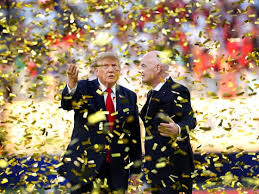
August 27 – Despite stakeholder fury and legal threats, FIFA president Gianni Infantino has remained steadfast in his refusal to allow an independent financial and governance audit into his abandoned plan to sell off FIFA’s commercial and events operation business to a private equity financed new company FIFA Football Enterprise (FFE).
Infantino has not even convened an emergency meeting of FIFA’s Council, a body he rules with the iron fist of democracy.
UEFA’s launch of discovery proceedings in three US jurisdictions last week has ratcheted up the crisis further. And despite Infantino and his staff pushing the line to member associations that this is just a political manoeuvre by opposing forces, make no mistake, this is the biggest crisis FIFA has faced since its formation in 1904 by seven European national associations. Bigger than the FIFAgate crisis of 2015, and a crisis that goes to the very core of its function. FIFAgate did not divide the world’s national federations, it brought them together. Division has been the core strategy for Infantino as he has targeted Europe’s revenue streams and the votes of the smaller, easily manipulated nations, in the other confederations.
At the heart of InfantinoGate is money. And his seemingly voracious desire for more and more of it. World Cup 2026 had every up for sale, even tiny patches of the World Cup final pitch. Now the whole lot was suddenly being sold off – for considerably less than the 2026 World Cup generated in revenue.
Private equity investors and financial advisors are adding their voices to the unbaked nature of the FFE plan, arguing that Infantino’s proposed sale was fatally flawed, both in terms of governance process (were they even his rights to sell) but also in the valuation of the rights that were substantially under-priced.
FFE was a project developed in secrecy and launched without any discussion with FIFA’s national associations. There was only one party investing – Thrive Capital – that is closely linked to US president Donald Trump’s family. Thrive is led by Joshua Kushner, the brother of Trump’s son-in-law Jared.
Even Kushner has now said he would not have become involved he had known the scale of the global outrage to the proposed acqusition – perhaps he should have looked at the structure and ownership of what he thought he was buying.
“Never mind the issue of whether these rights were Infantino’s to sell, what should be equally concerning for FIFA’s members is that there was no call for tenders, or the consulting of multiple investment funds that you would expect with an offer of this scale. That meant there was no competition for the rights and that a deal was done on a fixed price. He then attempted to railroad it through FIFA’s federations with a promise of a one-off $20 million payment that had a deadline attached. It is hustling on a grand scale,” said one private equity investor who advises on football and spoke to Insideworldfootball on the condition of anonymity.
In a process involving a commercial subsidiary where the goal is to sell a percentage of shares to a financial fund, do you start with a consultation or a call for tenders, or do you begin by selecting a preferred candidate?
Infantino chose the latter.
The price on the Thrive deal was $4.2 billion for 21%, valuing the whole business at about £20 billion.
“It is a premium asset, arguably the most valuable competition asset in the world, and it is being shopped as though it was distressed media. The World Cup is exclusive, there can only be one, and it can only be sold once. The value of that breaks all multiples that media and entertainment companies are valued on,” another sports investor told Insideworldfootball.
A closer look at comparative investments and the multiples of revenue paid show the scale of the under sell. An undersell that seems to scream ‘scam’ – in 2018 Infantino attempted to sell off all rights for $25 billion. That proposal was rapidly rejected by the FIFA Council. In 2026, following the biggest earning World Cup ever at $15 billion+, the value seems to have dropped by $5 billion.
In their filings for discovery in the US, UEFA says “the implied $20 billion valuation for FFE equates to a revenue multiple of only approximately 5.3 times FIFA’s annual competition-related revenue (calculated by dividing the $20 billion valuation by the roughly $3.75 billion in average annual revenue FIFA generated over the 2023–2026 cycle).”
UEFA says that recent sales of minority stakes in comparable sports and media rights businesses reflect higher multiples, notably CVC Capital Partners’ 2021 investment in LaLiga’s commercial rights that, at $20 billion, had a valuation of approximately 12 times revenue.
France’s LFP sold a 13% stake in its commercial operations to the CVC fund for €1.5 billion – following a tender process involving dozens of funds – which values the business at €12 billion.
If the French league is worth €12 billion on its own, is it conceivable that the World Cup is worth $20 billion?
Most private equity investors in sport reckon that FIFA’s commercial rights can reasonably be estimated to be worth $100 billion, and potentially a lot more if they were put out for tender. So 20% of this business is really worth about $20 billion, rather than the $4 billion Infantino proposed.
It would be fair to assume that neither Infantino, his advisors or the investor he had lined up are stupid people. It also seems the bulk of FIFA’s national federations aren’t stupid either, and therein lies the mistake in Infantino’s assumptions – he should have perhaps paid them more respect, after all, the rights he is selling are theirs.
The question Infantino should be answering (or what FIFA’s member federations should be asking themselves) is why he proposed to sell the World Cup rights with such a massive discrepancy in value—and, crucially, without a call for tenders?
The discovery filing should also reveal all the documents and communications between Infantino and his co-conspirators. That will include the exact nature of any side deal agreed with Infantino as regards his on-going employment and any shares or commissions he might have been due.
The case against Infantino is building and his support is dwindling. The longer he attempts to hold on to his control of the world’s game the uglier it will get.
The potentially fraudulent off-market pricing of FIFA’s commercial and media rights is an issue that all FIFA member associations need answering. It is, after all, their money and it has already been pointed out that the $20 million one-off inducement Infantino was offering to sign off on the sale, could comfortably be paid out of FIFA’s reserves. No outside money or sell off needed.
The Dutch FA (KNVB) over the weekend suggested a raft of potential reforms for discussion. One of them was that 90% of FIFA’s revenues could be the target distribution number to federations.
So taking $4 billion annual revenue, that is about $17 million for each of FIFA’s 211 federation. That is $17 million every year. And that is four times more than Infantino’s much trumpeted annual gifting of a potential $4 million (it is hard to get the full $4 million off him as member associations will tell you, but that is another story/scandal).
Contact the writer of this story at [email protected]