Collavini: Where Tradition Meets Innovation in Collio

For more than a century, the Collavini family has helped shape the identity of Friuli Venezia Giulia, championing native grapes while embracing innovation in the vineyard and cellar.
In Friuli Venezia Giulia, where the Alps meet the Adriatic and vineyards roll across the hills along the Slovenian border, wine has long been shaped by a convergence of cultures, climates and traditions. Few producers embody that intersection more distinctly than Eugenio Collavini.
Founded in 1896 by Eugenio Collavini, the family winery has evolved over more than a century while remaining firmly rooted in the territory. Today, the estate is managed by Manlio Collavini and his sons Giovanni and Luigi, continuing a family legacy built on both respect for tradition and a willingness to challenge convention.
Located in Corno di Rosazzo, the winery’s vineyards extend across the Collio and Colli Orientali DOC appellations, two of Friuli Venezia Giulia’s most important wine-growing zones. While Collavini has earned recognition for its expressive white wines, the family’s story is equally one of experimentation, particularly in its pioneering work with sparkling wine.

A Family Legacy of Innovation
While the Collavini story began with Eugenio, it was his grandson, Giovanni Collavini, who helped propel the estate into the modern era. His approach combined an appreciation for Friulian wine traditions with a willingness to explore new techniques and possibilities.
Among his most significant contributions was his pioneering work with Ribolla Gialla Metodo Classico. Beginning in the 1970s, Giovanni explored the potential of Ribolla Gialla as a traditional-method sparkling wine, helping establish a style that would become an important part of Friuli’s modern wine identity. His association with the grape eventually earned him the affectionate distinction of “The Lord of Ribolla Gialla.”
Collavini was also an early adopter of temperature-controlled fermentation, helping preserve the delicate aromatic qualities for which Friuli’s white wines are known. This philosophy remains central to the winery today: innovation is not a departure from tradition, but another way of expressing it.
The Terroir of Collio
To understand Eugenio Collavini Viticoltori, it is essential to understand Collio.
Situated in the northeastern corner of Friuli Venezia Giulia along the Slovenian border, Collio is a landscape of rolling hills, vineyards and forests. Its position between the Adriatic Sea and the Alps creates a distinctive mesoclimate. Maritime influences moderate summer temperatures, while the surrounding mountains provide protection from colder northern winds (bora), creating an ideal environment for grape cultivation. The region’s significant diurnal temperature shifts help grapes retain acidity while developing aromatic complexity.
The area’s signature soils are equally important. Known locally as ponca, these layers of marl and sandstone are characteristic of the hills and provide excellent drainage while contributing structure and mineral character to the wines.
The result is a terroir particularly suited to white grapes, which account for about 85% of the region’s grape production. Friulano, Ribolla Gialla, Malvasia Istriana, Sauvignon Blanc, Pinot Grigio and Chardonnay all find distinctive expressions here, producing wines that can range from crisp and mineral to richly textured and age-worthy. But, Collio is not limited to whites. Native red varieties such as Refosco dal Peduncolo Rosso and Schioppettino demonstrate the depth and diversity of the territory.
Sustainability, Tradition and Experimentation
Collavini’s commitment to innovation extends beyond winemaking techniques. The estate continues to focus on responsible vineyard management and production practices, seeking to balance environmental stewardship with the preservation of wine quality and regional identity. This includes reducing chemical inputs, promoting biodiversity and using energy efficient technologies.
What makes the Collavini approach particularly compelling is that innovation is rarely pursued simply for its own sake. Instead, it is used to reveal what the grapes and the territory can offer. That philosophy becomes especially apparent when tasting through the wines.

The Wining Hour with Collavini Wines
I first became acquainted with Collavini through a virtual tasting, which provided an opportunity to explore the winery’s history, philosophy and wines in greater depth. I later had the pleasure of meeting Luigi Collavini at an Italian wine event in New York, bringing the story and the people behind the wines into sharper focus.
One detail that stayed with me was the story behind the winery’s distinctive dachshund logo. The dog was a tribute to Ribolla, Manlio Collavini’s beloved first dachshund. Following Ribolla’s death, Manlio incorporated the dachshund into the company logo as a lasting tribute. It is a small but telling detail—an example of how family, personality and affection remain woven into the identity of the estate.

Tasting the wines offers another perspective on that identity.
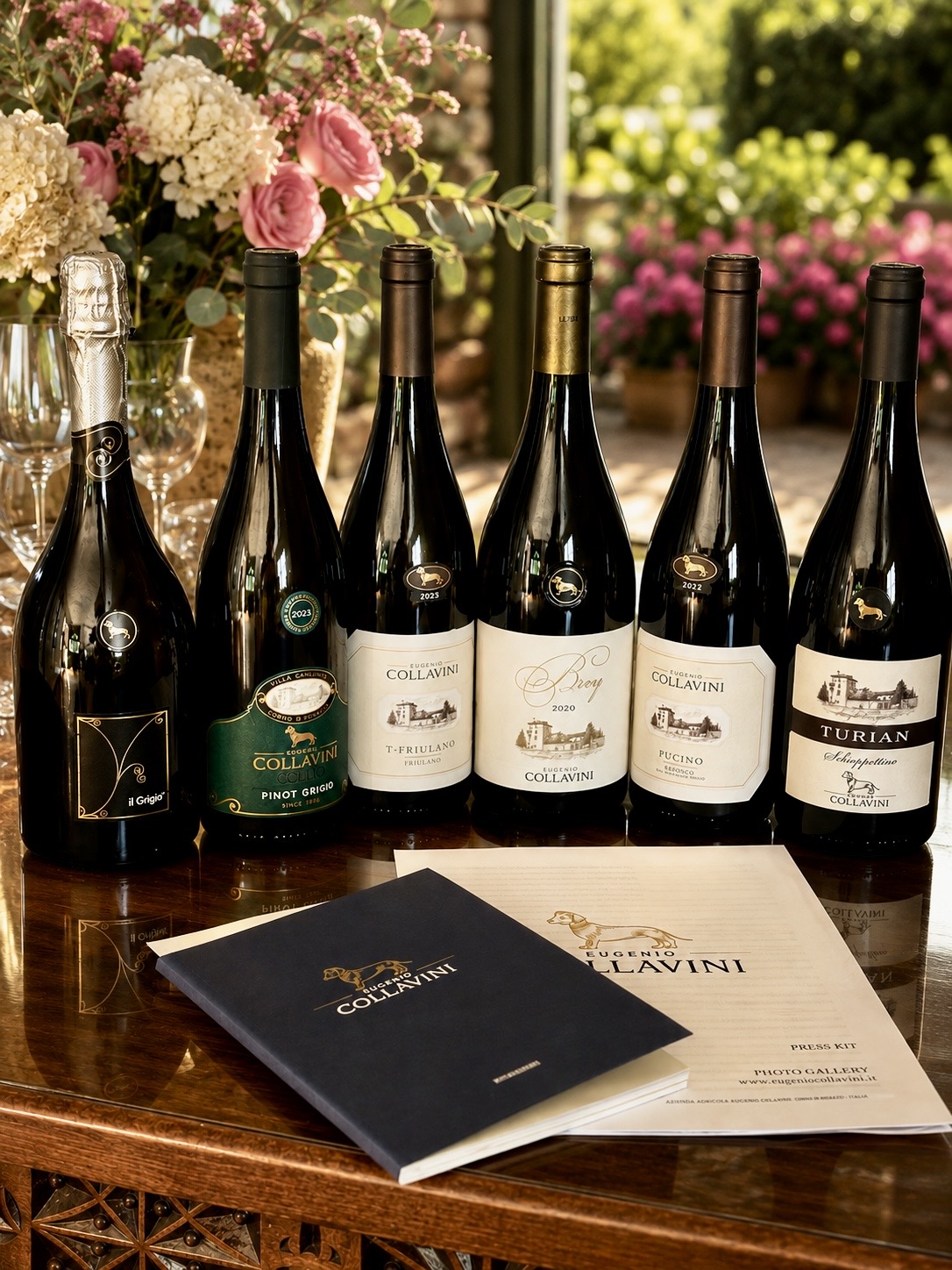
Collavini Il Grigio Spumante – Non-Vintage
Il Grigio is one of Collavini’s most distinctive expressions of innovation. Created in 1971, this sparkling wine is made from 100% Pinot Grigio, showcasing the variety in an unexpected form. Fresh and lively, it demonstrates Collavini’s willingness to look beyond conventional interpretations of a grape and explore what else it can become.
Collavini Pinot Grigio Villa Canlungo DOC Collio 2023
Collavini’s Pinot Grigio reflects the richer, more structured side of the variety in Collio. The wine displays aromas and flavors of pear, apple and citrus, accompanied by delicate floral notes.
Compared with simpler expressions of Pinot Grigio, the Collio version has greater texture and structure, with a persistent finish and the subtle copper hue that can result from skin contact. It is an excellent example of how site can transform a familiar international variety into something distinctly regional.

T-Friulano DOC Collio 2023
If Pinot Grigio demonstrates the adaptability of Collio, Friulano represents its cultural identity. T-Friulano is a dry, medium-bodied expression made with gentle pressing and fermentation and aging in stainless steel. It offers pear, green apple, delicate floral notes and characteristic almond, with fresh acidity and a subtle almond finish.
Friulano’s combination of freshness, texture and savory character makes it an exceptionally versatile food wine. It is particularly well suited to Friulian specialties, seafood and prosciutto.
Broy DOC Collio 2020
Perhaps no wine better captures Collavini’s philosophy of tradition and innovation than Broy.
The name derives from broili, the small gardens traditionally cultivated beside old Friulian homes. The wine is a blend of 50% Friulano, 30% Chardonnay and 20% Sauvignon Blanc, bringing together a native variety with two international grapes and exemplifies Collavini’s ability to merge traditional with innovationi.
Broy is rich and aromatic, showing ripe pear, white peach, citrus and delicate floral notes, along with subtle almond and mineral nuances. The palate is beautifully balanced—fresh and vibrant while still possessing considerable substance. The wine also reflects Collavini’s experimental spirit through the use of appassimento (drying of the grapes), concentrating the fruit while retaining freshness and balance.
Broy has earned considerable recognition over the years, including repeated appearances among Italy’s Tre Bicchieriselections, and has become one of the winery’s signature wines.

“Pucino” Refosco dal Peduncolo Rosso DOC Friuli 2022
Moving from white grapes to red, Pucino demonstrates another side of Friuli’s indigenous heritage.
Refosco dal Peduncolo Rosso offers dark berry fruit, earthy nuances and spice. Firm acidity and tannic structure provide definition, while the wine’s rustic character reflects the personality of this historic Friulian grape.
It is a reminder that the region’s wine identity extends well beyond its celebrated white varieties.
Turian Schioppettino DOC Friuli Colli Orientali 2020
Schioppettino offers perhaps the most intriguing red expression in the tasting.
For Turian, handpicked Schioppettino grapes are collected in trays and spread on mats in drying lofts, allowing the fruit to develop greater concentration and aromatic intensity. Following destemming, the grapes undergo fermentation on their skins for approximately three weeks. The wine then spends about 18 months in Allier French oak barriques.
The result is a structured and distinctive red that demonstrates how an indigenous grape can be interpreted through a combination of traditional methods and modern cellar techniques.
A Legacy That Continues
What makes Collavini compelling is not simply its longevity. Many Italian wineries can point to centuries of history. What distinguishes Collavini is the family’s willingness to allow that history to evolve.
From Eugenio’s founding of the winery in 1896 to Giovanni’s pioneering work with Ribolla Gialla Metodo Classico, and now to Manlio and his sons Giovanni and Luigi, each generation has added another chapter without abandoning the foundation laid by the previous one.
The wines tell that story clearly. Friulano and Ribolla Gialla connect Collavini to the indigenous traditions of Friuli. Pinot Grigio, Chardonnay and Sauvignon Blanc demonstrate the region’s ability to embrace international varieties. Il Grigio and the winery’s Metodo Classico wines reveal an innovative spirit, while Broy brings many of those ideas together in a single bottle.
Ultimately, Eugenio Collavini’s story is not one of choosing between tradition and innovation. It is about understanding that the two can exist together. That philosophy continues to find its most compelling expression: wines that are unmistakably rooted in place, yet never afraid to look forward.