Congress Controls Executive Power – emptywheel

This series addresses the high crimes and misdemeanors committed by the Roberts Majority of SCOTUS. Reforming the Court must begin with impeachment of these six. This should be a campaign issue for every Democrat.
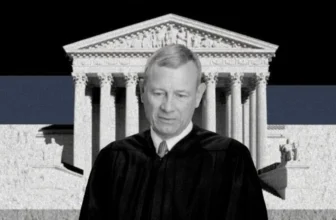
John Roberts’ opinion in Trump v. US seals the Roberts Court as the worst in history, even worse than the Taney Court that led to the Civil War. Roberts and the five Republican members of the Court said that the president cannot be held accountable for crimes except in the most unlikely circumstances, and then only with the consent of a majority of SCOTUS. The decision is based on the Constitution and cannot be undone by Congress.
But that wasn’t enough for the Roberts Majority. It held that the president is in charge of all actions of the Department of Justice, and by extension, of all agencies and departments of the government. The Roberts Majority handed to Trump the power to use government to punish his perceived enemies, get revenge for whatever slights he feels, and to frighten the people who live here, citizen and non-citizen alike. Roberts knew exactly what he was authorizing:
The indictment’s allegations that the requested investigations were “sham[s]” or proposed for an improper purpose do not divest the President of exclusive authority over the investigative and prosecutorial functions of the Justice Department and its officials. And the President cannot be prosecuted for conduct within his exclusive constitutional authority. Trump is therefore absolutely immune from prosecution for the alleged conduct involving his discussions with Justice Department officials. Citation omitted.
The unitary executive theory in context
This preposterous holding is grounded in the unitary executive theory. Roberts, of course, doesn’t acknowledge the theory. It hinges on the first sentence of Art II §1 of the Constitution: “The executive power shall be vested in a President of the United States of America.”
That provision parallels the first sentence of Art. III § 1: “The judicial power of the United States, shall be vested in one Supreme Court, and in such inferior courts as the Congress may from time to time ordain and establish.”
Contrast those provisions with the first clause of Art. I, § 1: “All legislative powers herein granted shall be vested in a Congress of the United States.…” All of the legislative powers of Congress are prescribed in the Constitution, in Art 1. § 8, and the Amendments. There are also express limitations on the legislative power.
The Judicial Power is described in Art. II, § 2. It extends to “all cases in law and equity” involving specified matters. For example, it covers suits between citizens of different states, and cases arising under the laws of the United States.
The Executive Power is treated differently. There is a list of specific powers of the president in Art. ii § 2. Then in § 3 there is a list of specific duties of the President, including the duty to make an annual report to Congress, and the mandate, “he shall take care that the laws be faithfully executed”. Neither the judiciary nor the legislature are given specific duties.
Trump, of course, does not take care that the laws are faithfully enforced. The Roberts Majority doesn’t require faithful execution of laws and exempts Trump from personal accountability for non-compliance.
Congress controls the Judicial Power
Congress has passed a number of laws limiting the jurisdiction of the judiciary. For example, it requires a minimum amount in controversy of $75,000 in cases between citizens of different states. 28 U.S. Code § 1332. It has stripped the jurisdiction of the judiciary.
Congress has other ways to control the judiciary. Steve Vladeck lists several here. Even the bizarre Roberts Majority won’t question the controls Congress can impose on the judiciary. Most likely.
Congress controls the Executive Power
The President has several express powers under the Constitution, including, for example, the role of Commander-In-Chief of the Army and Navy. Congress can’t undo that.
But, suppose Congress never authorized the creation of an army or a navy. Presidents can’t raise an army without Congress because Congress has to appropriate funds to pay the soldiers and buy the weapons. There would be no executive power in that case.
In the same way, a president can appoint heads of departments with the advice and consent of the Senate. But if Congress doesn’t create departments, that’s an empty power. If Congress doesn’t authorize compensation and expenses, the power to appoint ambassadors and other ministers is empty. If Congress doesn’t pass laws criminalizing conduct, the power to pardon is empty. In fact, none of the constitutional powers of the executive branch has any meaning without Congressional action.
Suppose Congress sets us a Congressional Tariff Group under the Congressional Research Service, a branch of the Library of Congress. The Group is tasked to draft standards for fair trade for Congressional approval, to collect international trade statistics with respect to a specified set of goods, and to report to the President and the Congress every month. If a country does not meet the standards the president is authorized to propose imposing tariffs. To do so the president must notify Congress in writing of their intention to do so and the likely effects of such imposition on international relations, revenues, and US consumers and workers. If within 30 days Congress doesn’t act, the tariffs go into effect.
In this setting, who is exercising executive power? I’d say this is how executive power really works. Congress passes laws that may require or permit the President to do stuff. Congress can set the conditions for any action it authorizes. The more precise the instructions and the greater the degree of control, the more it looks like Congress is exercising executive power.
Consider this hypothetical: Congress doesn’t like the holding of Trump v. US on the issue of prosecutorial power. So, it cuts the DOJ budget to $5 million, allows the hiring of 10 lawyers and staff, and moves them to Salt Lake City.
Then Congress fires all the US Attorneys and requires District Court Judges to appoint prosecutors who will serve for 5 years or until dismissed. The votes in both cases would be by majority of the district judges in the entire state. They would have both civil and criminal jurisdiction in their areas. They would then select a national Lead Attorney from their number who would serve a separate term of 6 years, and would set policy for the group, subject to review by Congress. In other words, a group controlled by Congress would replace the Department of Justice.
What is the executive power in this case? Precisely whatever the President can get the 10 lawyers and staff in Salt Lake City to do. This, I think, demonstrates that Congress has to power to decide the extent of the executive power. Not SCOTUS, and certainly not the president. It demonstrates that Trump v. US is a power grab by the Roberts Majority, and an attack on the Constitution. It shows that the Roberts Majority refuses to recognize that the only power of the President is to carry out the instructions of Congress. Trump v. US is in its effect a high crime.
Impeach Roberts, Thomas, Alito, Gorsuch, Kavanaugh, and Barrett.