End of Abyss Review – Void Stranger


When you first enter The Facility, you can feel the oppressive atmosphere without running into a single monstrosity or firing a single shot. Developer Section 9 Interactive, which previously worked at Tarsier Studios, showcases its incredible presentation skills right off the bat. The first 20 minutes are promising, as despite being accompanied by heavily armed yet calm soldiers, you feel vulnerable, like scraping the entrance of this chasm into the unknown.
Sadly, it’s not so. End of Abyss purports to be an atmospheric narrative experience in one stretch and a survival horror in the next, with the former stumbling due to tedious pacing and the latter lacking the fundamentals to back up its gameplay. There are elements of exploration, as you wander around finding keys to doors that lead to more doors that need keys, or tossing grenades at weak structures that strangely don’t crumble. That is, when you’re not swaying between difficulty spikes that make the backtracking more annoying than it already is.
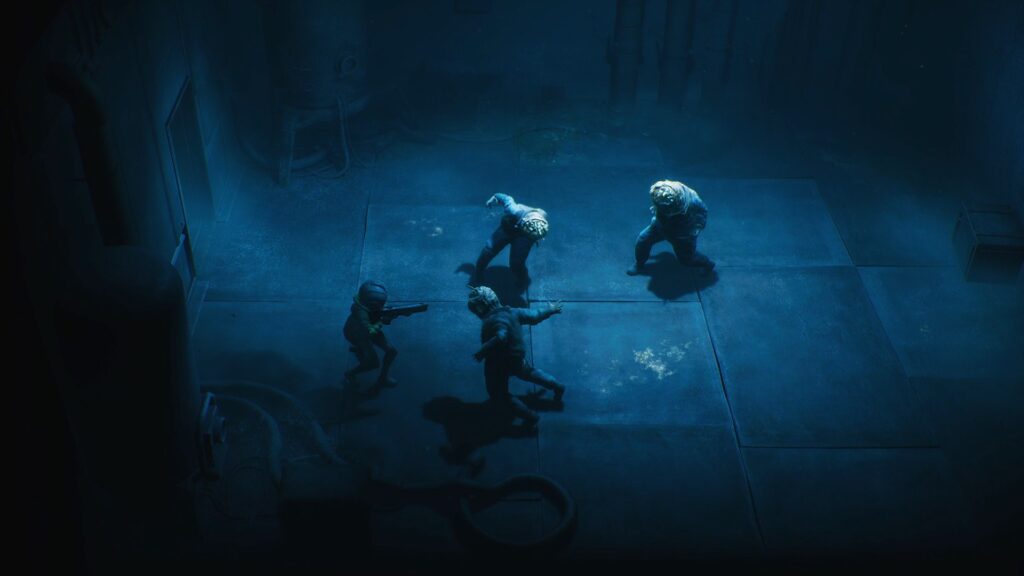
“At the very least, the environmental design is intriguing, especially as it combines winding vents and walkways with barely-lit interiors. The limited color palette lends to the eeriness, and it’s certainly to the developer’s credit.”
But the atmosphere itself is what really drew me in. The minimal dialogue allows you to take in the environment and what’s happened while different telltale signs – a slimy trail here, the odd body horror there – get your imagination running. Unfortunately, it’s hindered by the pacing, combat, and the sheer amount of backtracking. It also doesn’t help that moments where you would piece things together first-hand are outright ruined by unwanted communication.
For example, you’ll venture to the reactor to reactivate it and power this mysterious beacon. After hitting the switch, nothing happens, and you’re told it’s on backup. As you descend to investigate the other routes you just passed by, a call comes in and tells you to insert three power cores to get the reactor running again. Which wouldn’t be that offensive if it happened rarely, but it’s far more common and butts in on the feeling of isolation and danger that you should feel.
At the very least, the environmental design is intriguing, especially as it combines winding vents and walkways with barely-lit interiors. The limited color palette lends to the eeriness, and it’s certainly to the developer’s credit. However, it’s very clear early on that this isn’t quite a survival horror. While it’s a mix of overhead exploration, the combat is more twin-stick shooter-like, with aiming tied to the right stick. You also have a pistol with unlimited ammo and the ability to dodge-roll. Any tension is immediately taken away in the early going since you can effectively kite enemies and waylay them with shots. There is a bit of sway to aiming, which can be annoying at times, but otherwise, it’s relatively smooth sailing.
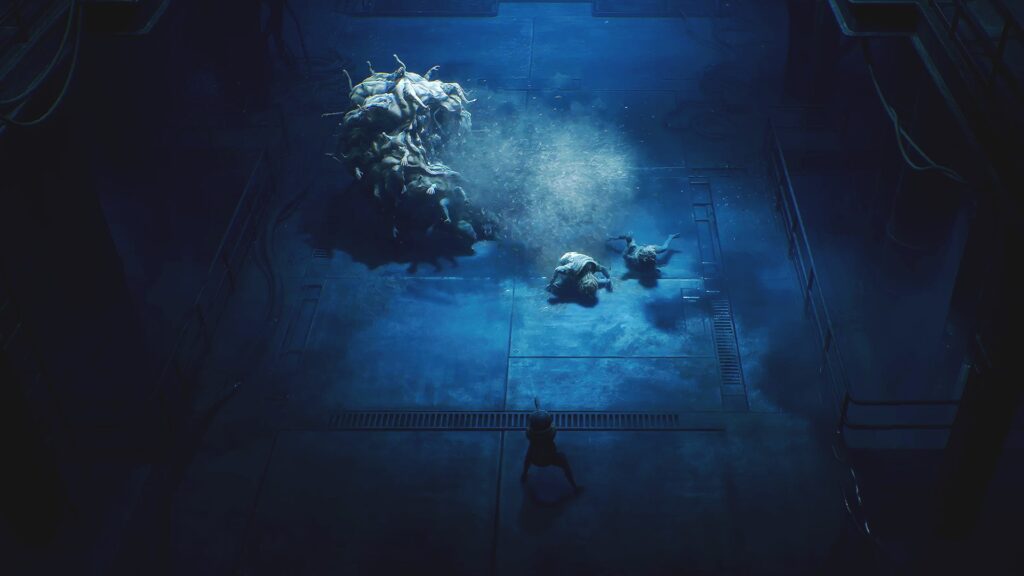
“Even if the shooting itself can feel solid, some of the design choices are strange (and annoying), to say the least. Your starting pistol can be upgraded at a workbench for ever-so-slightly more damage and a neat charge shot.”
And even if the shooting itself can feel solid, some of the design choices are strange (and annoying), to say the least. Your starting pistol can be upgraded at a workbench for ever-so-slightly more damage and a neat charge shot.
The problem is that once fully charged, it fires automatically. And while that sounds somewhat realistic, the slight bit of sway means it can miss targets by an inch. Then there’s the lack of manual reloading, which really makes the shotgun feel awful. You can only reload when it’s fully empty, and interrupt the process for a single shot in the chamber. So if you know that you’re venturing into a section with several enemies and have two shots loaded, don’t count on loading the remaining two to be fully prepared.Earlier, I mentioned a scanner, which can detect Energy Cores in the environment to blast and open specific doors, identify logs, and even scan different hostiles for information on their weaknesses. Rather than swapping to a different mode on your weapon or simply activating it as an overlay, it’s a physical device that you need to swap to and manually aim. While I feel like it could have been used more ambitiously, cutting out “Focus M” style communications completely, it’s still one of the few things in End of Abyss that feels pretty seamlessly integrated.
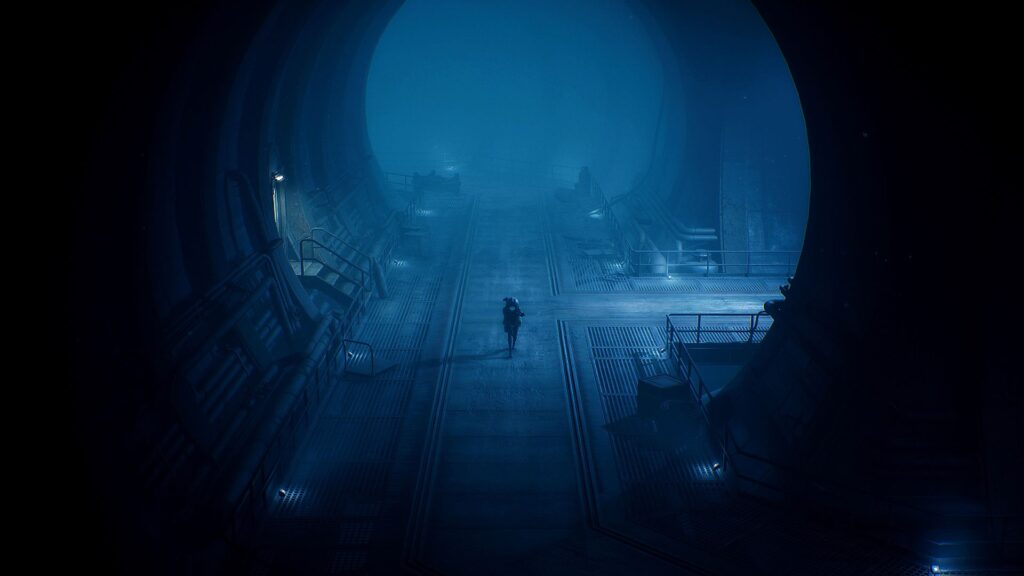
“The combination of genres and approaches feels at odds with the experience, almost like End of Abyss isn’t sure what it wants to be, and ultimately falters as a result.”
As intriguing as it can be to explore the Facility, uncovering new shortcuts and watching how a simple objective to find three other doodahs evolves into this multi-section-spanning hunt with various different challenges to overcome, the backtracking is excessive and adds to the tedium. Even if you don’t die from some of the more irritatingly high-damage enemies and are forced to restart from a save point in a completely different sector, there are long stretches where you’re just running down corridors to return to previous locations.
End of Abyss isn’t a horrible experience overall, and there are some bright spots where you settle into a groove, retrieving keys and returning to previous locations to progress. Running into a dead end and having to scan, whether it’s something on a corpse nearby or a vent, to progress is also neat. And if I haven’t emphasised it already, the art direction is fairly gorgeous.
As confined as the Facility feels, it has an impressive sense of scale, especially when traversing walkways above previous sections or encountering the giant reactor for the first time. It’s just that the core gameplay elements intentionally get in the way and drag the whole thing down. The combination of genres and approaches feels at odds with the experience, almost like End of Abyss isn’t sure what it wants to be, and ultimately falters as a result.
This game was reviewed on PlayStation 5.