Fundamental vs Technical Analysis – Forex Trading Forum

A Third Approach to Trading
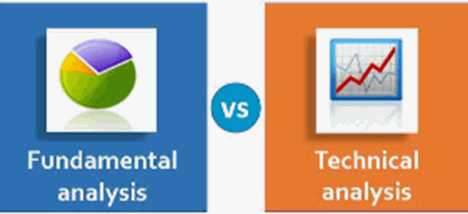
Fundamental vs Technical Analysis
For decades, traders have debated whether fundamental analysis or technical analysis is the better way to forecast movements in the foreign exchange market.
Fundamental analysts study the economic forces that should determine a currency’s value. Technical analysts focus on price action and what the market is doing now. Although both approaches provide useful information, neither one tells the entire story.
There is also a third view.
Currencies do not move solely because of economic data or chart patterns. They are influenced by institutional order flow, central bank policy, hedging activity, speculative positioning, market psychology, liquidity, automated trading, and political pressure.
The real question, therefore, is not simply whether fundamentals or technicals are better. It is how traders can combine these methods with an understanding of the forces that actually move the market.
What Is Fundamental Analysis in Forex?
Fundamental analysis attempts to determine the underlying economic value of a currency.
Analysts examine domestic and international economic conditions, including:
- Inflation
- Economic growth
- Interest rates
- Employment
- Trade balances
- Government debt
- Fiscal policy
- Central bank policy
- Capital flows
- Political stability
The objective is to decide whether a currency is overvalued, undervalued, or trading near its perceived fair value.
For example, a country with strong economic growth, rising interest rates, controlled inflation, and steady foreign investment may be expected to have a stronger currency. By contrast, weak growth, falling interest rates, political uncertainty, and persistent deficits may place downward pressure on a currency. A currency’s value can also be influenced by whether it has a trade and/or current account deficit/surplus but investment flows often supercede these as factors.
Economic models have become increasingly sophisticated. Analysts can now process enormous amounts of information and use quantitative models to estimate exchange-rate values. However, these models depend on assumptions, and those assumptions may not continue to hold as economic and market conditions change.
The Limitations of Fundamental Analysis
Fundamental analysis may provide a useful long-term framework, but it does not always answer the most important question facing a trader: When will the market react?
A currency that appears overvalued can become even more overvalued. An undervalued currency can continue falling for months or even years. Markets do not have to correct an imbalance according to an economist’s timetable.
This creates a major problem for traders. They may eventually be correct about a currency’s underlying value but lose money because they entered the trade too early or could not withstand the move against them.
Governments and central banks have repeatedly attempted to reduce excessive currency volatility. Officials may issue warnings, coordinate policy, adjust interest rates, or intervene directly in the foreign exchange market. Yet even large interventions do not always produce a lasting change.
The market may agree with policymakers over the longer term, but its definition of value and its timing can be very different.
Fundamentals may tell traders what should happen. They do not always tell them what is happening or when conditions will change.
What Is Technical Analysis in Forex?
Technical analysis begins from a different starting point.
Instead of asking what a currency should be worth, technical analysts examine price action to determine what buyers and sellers are doing. They believe that the market price reflects the combined influence of economic information, expectations, positioning, and psychology.
Common technical tools include:
- Support and resistance
- Trendlines
- Moving averages
- Momentum indicators
- Relative strength indicators
- Chart patterns
- Fibonacci retracements
- Elliott Wave analysis
- Gann techniques
- Volume and volatility studies
Technical analysis assumes that trends can persist because market psychology does not change immediately. Once a directional move becomes established, it may continue until the balance between buyers and sellers shifts.
Rather than labeling a currency economically overvalued or undervalued, technical traders may describe a market as overbought or oversold. These terms relate to price behavior and momentum rather than a theoretical calculation of fair value.
The Advantages of Technical Analysis
Technical analysis is often more useful for determining entry points, exit points, risk levels, and shorter-term market direction.
Markets frequently move before an economic change becomes obvious. Traders anticipate future events and adjust their positions before the official data confirms the shift. This is the logic behind the familiar market expression, “buy the rumor and sell the fact.”
A chart can reveal that the market has already begun to price in an expected interest-rate change, election result, or economic slowdown.
Technical analysis also helps traders recognize when the market is rejecting a narrative. If favorable news repeatedly fails to lift a currency, the lack of a positive reaction may be more important than the news itself.
Price action shows what participants are actually doing with their money, not merely what they say they expect to happen.
The Limitations of Technical Analysis
The greatest challenge with technical analysis is the enormous number of available methods.
Two traders can examine the same currency pair and reach entirely different conclusions. One indicator may suggest that the market is overbought, while another indicates that momentum remains strong. A bullish pattern on a daily chart may exist alongside a bearish setup on an hourly chart.
Timeframe selection adds another complication. A currency may be rising on the weekly chart, consolidating on the daily chart, and falling on the hourly chart. Each conclusion can be technically correct within its respective timeframe.
Technical analysis is not a mechanical answer to every trading decision. It requires experience, consistency, and an understanding of which tools are most appropriate for different market conditions.
Indicators are derived from price. They describe what has happened and help traders evaluate what may happen next, but they cannot guarantee the outcome.
A Third Point of View: Understanding Who Moves the Market
The debate between fundamental and technical analysis overlooks another essential part of forex trading: the structure of the market itself.
The foreign exchange market is not made up only of economists, chart analysts, and individual speculators. It includes:
- Commercial and investment banks
- Multinational corporations
- Hedge funds
- Asset managers
- Pension funds
- Sovereign wealth funds
- Central banks
- Governments
- High-frequency trading firms
- Algo trading systems
- Retail traders
These participants operate for different reasons.
A corporation may buy a currency to pay an overseas supplier. An asset manager may hedge the currency exposure of an international portfolio. A central bank may intervene to slow a rapid exchange-rate move. A hedge fund may establish a highly leveraged speculative position. An algorithm may react to a news headline before a human trader has finished reading it.
These transactions create the order flow that moves exchange rates.
The scale is immense. Average daily turnover in the global over-the-counter foreign exchange market reached approximately $9.6 trillion in April 2025, according to the Bank for International Settlements. Even a small percentage move can therefore represent an enormous transfer of money among market participants.
Institutional Order Flow and Liquidity
Large institutional orders cannot always be executed at a single price. A bank handling a major corporate or investment order may need to buy or sell gradually to avoid moving the market too sharply.
This activity can create persistent demand or supply that is not immediately explained by economic news.
A currency may rise despite weak data because a large buyer is active. It may fall after favorable news because institutional investors are using the rally to reduce exposure. In such cases, neither a traditional economic model nor an isolated technical indicator fully explains the price action.
Liquidity also matters. During active trading periods, the market may absorb large orders with limited price movement. During thin conditions, a much smaller order can produce a disproportionately large reaction.
This is one reason forex markets can behave differently during holidays, between major trading sessions, or immediately after unexpected news.
Japan’s New Forex Intervention Strategy: Why Surprise Has Become Its Most Powerful Weapon
Central Banks and Political Influence
Currencies are also instruments of economic policy.
Governments may prefer a weaker currency to support exports or a stronger currency to reduce imported inflation. Central banks can influence exchange rates through:
- Interest-rate decisions
- Forward guidance
- Direct intervention
- Changes in reserve policy
- Coordinated action with other central banks
- Public or unofficial comments
Central bank intervention can produce a powerful immediate reaction, especially if the market is heavily positioned in the opposite direction. However, intervention may have only a temporary effect when it conflicts with underlying monetary policy or broader economic conditions.
Political pressure can also influence a currency. Trade negotiations, sanctions, elections, geopolitical tensions, and international agreements can all alter expectations and generate major capital flows.
These forces may not fit neatly into either traditional fundamental analysis or technical analysis.
USDJPY: Technical Trend UP Before Being Ambushed By BoJ Intervention

Technology Has Changed Forex Trading
Electronic trading has made the foreign exchange market faster, more accessible, and more interconnected.
Economic reports, central bank statements, and breaking news can reach traders around the world almost instantly. Automated systems can scan headlines, interpret keywords, and place orders in fractions of a second.
Algorithmic trading has also changed how markets react around widely watched price levels. Clusters of stop-loss orders may sit above resistance or below support. Once those levels break, automated orders can produce a chain reaction that accelerates the move.
This helps explain why a quiet market can suddenly become volatile even without a major change in the economic outlook.
Technology has simplified trade execution, but it has made decision-making more demanding. Traders must now evaluate not only the information itself but also:
- How the market is positioned
- Whether the news was already priced in
- Where liquidity is concentrated
- How automated systems may react
- Whether the initial move is sustainable
- Where protective stops may be clustered
Combining Fundamentals, Technicals, and Market Structure
The most practical approach is not to reject one school in favor of another. It is to understand what each method contributes.
Fundamental analysis provides the broader economic background. It can help identify long-term pressures and explain why a currency may eventually strengthen or weaken.
Technical analysis shows the present condition of the market. It helps traders evaluate trends, momentum, important price levels, trade timing, and risk.
Market structure provides the third piece. It focuses on positioning, liquidity, institutional order flow, central bank activity, hedging demand, and the behavior of major participants.
Together, the three approaches answer different questions:
- Fundamentals: What should drive the currency over time?
- Technicals: What is the price doing now?
- Market structure: Who may be driving the move, and why is it happening at this moment?
A strong fundamental outlook accompanied by bullish price action and supportive institutional flows creates a more convincing case than any one signal alone.
When these elements conflict, the conflict itself is valuable information. If the fundamentals appear positive but the currency keeps falling, traders should respect the price action. The market may know something that is not yet visible, or large flows may be overwhelming the fundamental story.
To sum up, the argument over fundamental analysis versus technical analysis creates a false choice. Both approaches have value, but neither provides a complete picture of the foreign exchange market.
Economic fundamentals tend to matter over the longer term, but the timing of a market adjustment is uncertain. Technical analysis offers a clearer view of current price behavior, but indicators can conflict and produce different conclusions across timeframes.
The third view recognizes that markets are moved by people and institutions acting for many different reasons. Order flow, liquidity, positioning, policy decisions, political influence, hedging activity, and automated trading can dominate price action—sometimes for much longer than traders expect.
Successful forex analysis therefore requires synthesis. Traders must understand the economic background, respect the message of the price, and remain alert to the powerful participants and market forces operating beneath the surface.
In forex trading, knowledge of fundamentals and technicals is important. The ability to combine them with experience, judgment, discipline, and risk management is what turns analysis into a workable trading strategy.