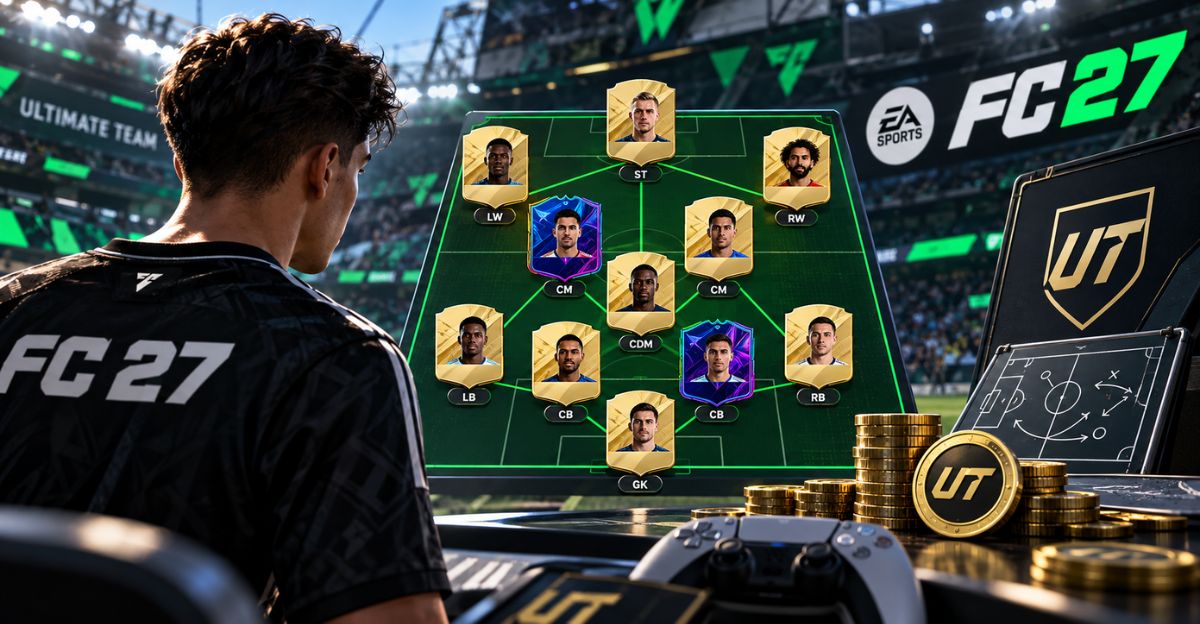
Building a strong FC 27 Ultimate Team isn’t just about collecting the highest-rated players you can afford. You can have an impressive-looking squad and still struggle if your midfield leaves huge gaps, your fullbacks push forward at the wrong time, or your attackers all play the same way.
The best upgrade is usually the one that fixes a problem you keep seeing during matches.
Start With What Your Matches Are Telling You
Before spending your coins, play three to five matches using the formation and tactics you normally prefer. Pay attention to where things go wrong.
Are you losing the ball when trying to play out from the back? Are opponents finding too much space through the middle? Are you getting into the final third but struggling to create clear chances?
Don’t make a major change because of one bad match. Look for patterns.
For example, a center-back might appear too slow when the real problem is that both fullbacks are pushing forward at the same time. Likewise, a striker might seem ineffective when the midfield isn’t creating enough chances for them.
Once you know the recurring problem, you can start looking for the right player to fix it.
Set Your Budget Around the Problem
Give yourself a simple target before entering the transfer market.
Something like, “I need a midfielder who can help stop counters and still move the ball forward,” is much more useful than simply deciding that you need a higher-rated midfielder.
If you’re researching EA FC 27 Coins while planning an upgrade, set a spending limit first and connect that budget to the role you’re trying to improve. Also check EA’s current rules before using any third-party coin service.
Don’t spend your entire balance on one player, either. Prices can change, rewards can give you unexpected upgrades, and you may discover after a few matches that another position actually needs attention.
Having coins available gives you flexibility. It doesn’t automatically tell you where to spend them.
Goalkeeper: Match Your Keeper to Your Style
Your goalkeeper doesn’t need to be the highest-rated card in the squad. What matters is how they fit the way you defend.
If you like building from the back, distribution can be important. If you tend to defend deeper and face plenty of shots, shot-stopping may matter more.
Look at what actually happens in your matches rather than judging a goalkeeper based on one spectacular save or mistake.
Defenders: Think About the Whole Unit
Defending isn’t just about picking four individually strong cards.
Look at the space your formation leaves behind when you attack. If both fullbacks regularly move forward, who covers the wide areas when possession is lost?
Sometimes the solution isn’t replacing a defender at all. A more conservative instruction on one side or a midfielder who stays deeper could fix the problem.
For center-backs, consider recovery speed, positioning and how comfortable they are when passing out from the back. For fullbacks, decide whether you want them primarily defending, helping with build-up play or constantly supporting attacks.
Two excellent attacking fullbacks can still create problems if nobody is covering the space behind them.
Before spending coins, test your instructions and tactics. You can also check out our guide to real gamer tips that actually work for more practical ways to approach your squad and matches.
Midfielders: Give Everyone a Job
A balanced midfield needs to do several things well: protect the defense, move the ball forward and support attacks.
One player can handle multiple responsibilities, but your midfield shouldn’t leave one of those jobs completely uncovered.
If all your midfielders push forward, opponents can find an easy route through the center. If everyone stays deep, your attackers may end up isolated.
When comparing midfield options, think about what happens immediately after you lose possession. Can the player help stop a counter? Can they receive the ball under pressure? Can they move it forward without slowing down your attack?
A higher-rated midfielder isn’t necessarily the right upgrade if they simply duplicate what another player already does.
Attackers: Give Yourself Different Ways to Score
A good attack shouldn’t rely on exactly the same move every time.
You might want one player who can run behind the defense, another who is comfortable combining in tight spaces and someone who can consistently finish chances. Those qualities can exist in two or even one player, but your attack should have more than one way to create danger.
It’s also important to separate chance creation from finishing.
If you’re barely getting shots on goal, buying a more expensive striker probably won’t solve the problem. Your midfield, formation or final pass could be the issue.
On the other hand, if you’re regularly creating good chances and failing to finish them, upgrading your attacking options makes more sense.
Think about where your attacks normally develop, how you like to pass and which formation you use before chasing the most popular cards.
Bench: Build for Different Match Situations
Your substitutes should give you options, not simply add more highly rated players to the bench.
Think about what you might need during a match:
- Extra pace when chasing a goal
- Defensive cover when protecting a lead
- A midfielder who can help regain control
- A different type of attacker
- An alternative passing or finishing option
A bench filled with similar attackers doesn’t give you many ways to change a match.
Before kickoff, have an idea of what you might change if you’re winning, chasing a goal or losing control of midfield.
Example: Spend 200,000 Coins on a Problem, Not a Name
Imagine you have 200,000 coins and keep losing possession after reaching the final third.
You could spend 170,000 on a popular striker and leave yourself with 30,000. But if the real problem is that your midfield can’t recover the ball and your fullback leaves too much space behind, that expensive striker may not change much.
A different approach could be spending 90,000 on a midfielder who can recover and distribute, 50,000 on a fullback who better fits your defensive shape and keeping the remaining 60,000 for future changes.
These figures are only an example, not current market prices.
The important part is the thinking behind the purchase. If two cheaper upgrades solve the problems you’re actually experiencing, they could have a bigger impact than spending almost your entire budget on one star player.
Use an Upgrade Checklist Before You Buy
Before making a major change to your squad, ask yourself four questions:
- What recurring problem should this player solve?
- Does their role fit my formation and chemistry?
- Could tactics or player instructions solve the problem instead?
- What other position will I be unable to improve after spending these coins?
That last question is easy to overlook.
A player might be an obvious upgrade individually, but spending your entire budget on them could leave two other weak positions untouched.
If you’re interested in how football games have evolved beyond traditional console experiences, our guide to popular sports video games is also worth checking out.
Test the Upgrade Before Making Another Change
Once you’ve made a major purchase, keep the rest of the squad relatively stable for a few matches.
Look for measurable differences.
Are you conceding fewer counterattacks? Are you reaching better shooting positions? Are you keeping possession more easily? Is the player actually getting involved in the situations you bought them for?
If nothing changes, don’t immediately buy another expensive card.
Go back to your original diagnosis. You may have identified the wrong problem in the first place.
You can also look at how other football games approach team building and tactics in our guide to how football transfers work, especially if you enjoy the management side of the sport as much as playing matches.
Final Thoughts
A balanced FC 27 Ultimate Team isn’t necessarily the squad with the biggest collection of high-rated cards.
It’s the team where every player has a purpose and the formation still works when the match doesn’t go according to plan.
Start by identifying the problems you actually have, then spend your coins on players who address those problems. Test your tactics before replacing players, give your bench a purpose and leave yourself enough of a budget to make further changes later.
Build around roles, not ratings, and judge every upgrade by what it does on the pitch.