I Want an Oura Ring. As a Reproductive Health Lawyer, I Know Better

In post-Dobbs America, wearables promise women self-knowledge—but they also create a trail of reproductive data we can’t fully control.

I almost bought an Oura Ring at 3:12 in the morning. I was lying awake in my small D.C. apartment, my phone casting a blue glow across my face. I couldn’t sleep. Again. My mind was already racing through the work waiting for me in the morning: Federal Register alerts, Google alerts for abortion ban and pregnancy criminalization, another headline about a woman denied reproductive care.
So I did what people do when they can’t sleep: I shopped. I opened the Target app looking for something—anything—that might help me sleep, and soon an Oura Ring was sitting in my cart.
Before checking out, I opened TikTok to see whether it was actually worth it. Soon, I was watching a woman talk about her Oura Ring the way people talk about a revelation, a religious experience. One video became 10. Women talked about the ring as if it had given them access to a version of their bodies they had never been able to understand before. It noticed signs of illness before they felt sick. It helped explain their exhaustion. It tracked their cycles and identified patterns connected to fertility and pregnancy.
Its promise was simple and seductive: The ring might know what was happening inside your body before you did.
It sounded incredible. I wanted the ring to tell me why I was so tired. I wanted it to warn me before I got sick. More than anything, I wanted to understand my own body.
For generations, women have been told their pain is normal, their cycles are mysterious and their instincts are unreliable. So when a device promises to listen to your body every minute of every day and translate its signals into something you can finally understand, it doesn’t feel like a luxury. It feels like power.
But I am not just a sleep-deprived woman scrolling at three in the morning. I am also a reproductive-rights lawyer.
I read privacy policies. I track abortion prosecutions. I know how easily information collected for one purpose can be repurposed for another. And I know that in post-Dobbs United States, data about a person’s menstrual cycle, fertility, pregnancy, location, symptoms or health changes is not politically neutral.
As I stared at the checkout screen, I couldn’t stop thinking about what the ring could give me. I also couldn’t stop thinking about what it might take.
I am not the only person worried either. In 2025, users began threatening to ditch their rings after learning Oura had acquired a company with a Department of Defense contract running on Palantir’s FedStart platform, infrastructure built for defense and intelligence agencies. If the Pentagon was in Oura’s supply chain, people wanted to know whether the government was also in their data.
As the backlash spread, CEO Tom Hale took the stage at a tech conference to insist the concern was “totally overblown,” that Oura’s systems were not connected to Palantir’s, and that “no one in the government can see your data.”
A recent Texas lawsuit turned private text messages into evidence for a wrongful-death abortion suit. … It proved the point: Any intimate digital footprint can be weaponized.
There is no evidence Oura shared user data. But the outcry highlights the discomfort: When a company holding intimate health metrics enters the defense tech orbit, users naturally worry about surveillance.
That distrust deepens when looking at who stands behind the tech. Beyond Palantir’s defense contracts sits cofounder and chair Peter Thiel, who has funded antiabortion candidates, backed the pronatalist movement, bankrolled a menstrual-tracking app created by Evie Magazine (an outlet that discourages hormonal birth control), and written that women’s suffrage undermined democracy.
A company’s infrastructure and its power brokers are not politically separate. It is hard to trust a company with intimate reproductive health data when influential figures actively work to restrict reproductive choices.
Beyond Oura’s government entanglement lies a separate risk: the potential for private individuals to exploit sensitive reproductive data. In civil court, private citizens can become enforcers. A recent Texas lawsuit turned private text messages into evidence for a wrongful-death abortion suit. It didn’t involve a wearable, but it proved the point: Any intimate digital footprint can be weaponized.
Most people hear “health data” and assume Health Insurance Portability and Accountability Act (HIPAA). I used to think that way too, before law school trained it out of me. But HIPAA generally applies to traditional healthcare providers, hospitals and health plans—not to the apps we download, the rings we wear or the wellness tools we use to monitor our bodies.
If my doctor records my menstrual history, that is protected medical information. But if my would-be-ring tracks my temperature, sleep, and cycle, that data is governed primarily by a company’s privacy policy, terms of service and corporate promises.
After Roe fell, people warned one another to delete period-tracking apps. While the panic sometimes overstated what a single app could prove, the underlying instinct was rational: Reproductive data can be collected, sold, subpoenaed and misinterpreted. In Nebraska, private Facebook messages were used to prosecute an abortion.
Fertility and body data have also become a lucrative commercial frontier. Intimate metrics are routinely collected and monetized by companies bound by no medical ethics. Federal regulators have also penalized fertility apps, including Flo and Premom, for sharing sensitive user data with third parties after promising privacy.
Oura exists in a country where reproductive health data is valuable to advertisers, insurers, employers, law enforcement and hostile state officials; and where the law has not caught up to what these devices reveal. A missed period, a temperature shift, a pregnancy, a miscarriage—none of this is criminal. But post-Dobbs, data does not have to prove a crime to become dangerous. As legal scholar Dorothy Roberts has long documented, the U.S. has a deep history of treating women’s bodies and their reproductive decisions as arenas for state control and social regulation.
Oura says it does not sell personal data, use sensitive personal information for targeted advertising and will oppose certain law enforcement requests. Those commitments matter. But they are not legal guarantees. We ‘will oppose’ is not the same as we can never be forced.
That is what makes the Oura Ring feel less like a groundbreaking health tool and more like an ultimatum. It promises knowledge, pattern recognition and a way to understand my body before it becomes a crisis. In exchange, it asks me to trust that my data will stay where I intended, that the company’s promises will hold and that the law will not be turned against me.
As a reproductive-rights lawyer, I cannot give that trust.
None of this means women have to give up understanding their bodies. Women charted their temperatures, symptoms and cycles by hand for decades before an app did it for them, and plenty still do. Wanting to understand your own body isn’t a radical ask. The problem is that the easiest version now comes wrapped in someone else’s servers, terms of service and exposure to legal demands.
But my refusing to wear the ring is not a solution, either. It does nothing to protect the millions of women who already rely on wearables and fertility apps. That is the cruelty of the bargain: Women are being asked to choose between understanding their bodies and exposing them.
Individual women are not making the wrong choice. The wrong is that this choice exists at all.
That morning, I closed the Target app and turned the volume up, knowing the flood of work emails would wake me around 7:00 a.m. I locked my phone with a loud click and set it down, still longing for the ring. Even now, as I write this, a part of me still wants to buy it. I still want to understand my body.
But I won’t buy it, because I understand my country better.
*
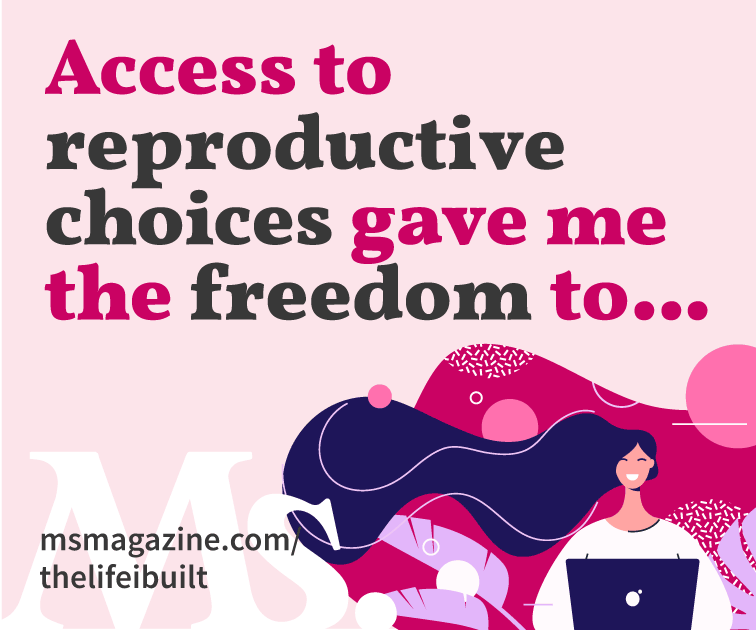
A note from Ms. editors: We want to hear from you for The Majority, a new campaign collecting stories about how reproductive freedom has enabled readers to build the lives they want and need. Poll after poll shows a majority of Americans support reproductive healthcare access. Yet public debate overlooks the lives shaped by abortion access, contraception, IVF, miscarriage care, maternal healthcare or comprehensive sex education—countless women who chose to pursue an education, have children, not have children, protect their health and chart their own future. Add your voice and complete the sentence: “Access to reproductive choices gave me the freedom to….” Together, these stories will help show not only why reproductive freedom remains a majority value, but also what it makes possible.
Look to these trusted groups if you or a loved one needs to know more about reliable abortion care: