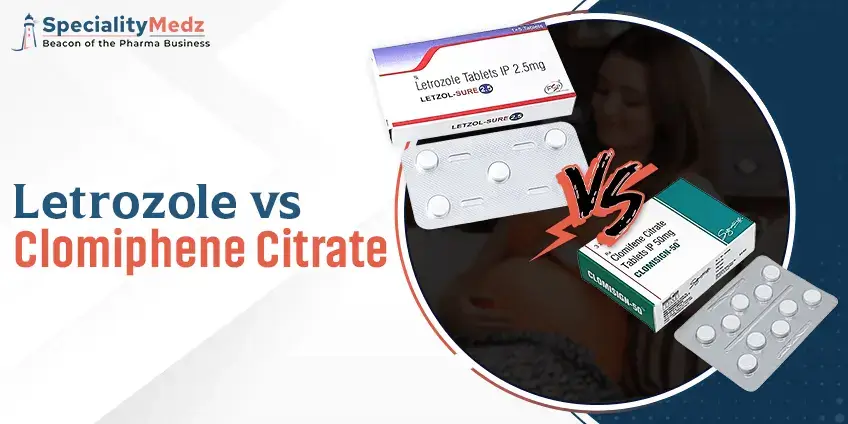
Women affected by ovulation disorders or infertility are concerned about receiving the right fertility treatment to achieve better treatment outcomes. Letrozole vs clomiphene citrate is a common comparison across the globe.
Both are popularly prescribed for stimulating ovulation, but their mechanism of action varies. The patient groups they benefit, and the success rates differ, too. As they belong to the first-line infertility treatments (among women with irregular ovulation) and women diagnosed with polycystic ovary syndrome (PCOS), it is important to have a better understanding of both. It’s the gynecologist who determines the appropriate treatment based on age, medical diagnosis, hormone levels, response to prior treatment, and overall reproductive health. Having basic knowledge provides clarity.
What is Letrozole?
Letrozole is an aromatase inhibitor formerly developed for treating hormone receptor-positive breast cancer in postmenopausal women. It later became a recognised therapy for infertility in women with ovulatory dysfunction (not ovulating regularly).
This medicine helps in inducing ovulation by temporarily reducing estrogen production and signalling the pituitary gland to increase follicle-stimulating hormone. As a result, ovarian follicles are encouraged to grow and mature. It increases the likelihood of ovulation in turn.
Available Letrozole Dosages
The prescribed dosage varies as per the diagnosis, response to the treatment, and recommendations by the fertility specialist. Any adjustments should be made only after medical supervision.
What is clomiphene citrate?
Clomiphene citrate is a widely used oral fertility medicine and has been prescribed for ovulation induction for several decades now. It is a selective estrogen receptor modulator (SERM) that works by blocking estrogen receptors in the brain.
Available Clomiphene Citrate Dosages
The fertility specialist determines the appropriate dosage according to the ovulation response and overall fertility evaluation.
Letrozole vs Clomiphene Citrate: Key Differences
Here is a brief distinction between Letrozole vs Clomiphene Citrate.
| Feature | Letrozole | Clomiphene Citrate |
| Drug Class | Aromatase inhibitor | Selective Estrogen Receptor Modulator (SERM) |
| Primary Mechanism | Decreases Estrogen production | Blocks Estrogen receptors |
| Hormonal Effects | Lowers Estrogen levels & increases FSH | Increases FSH and LH by blocking the feedback of estrogen. |
| Common Fertility Use | Induces ovulation, mainly in women with PCOS | Induces ovulation amidst several infertility conditions |
| Endometrial Effects | Has a low impact on endometrial thickness | May cause the endometrial lining to thin in some women |
| Risk of multiple pregnancies | Lower | Slightly higher |
| Current evidence | Frequently advised among women with PCOS | First-line fertility medicine with long-established efficacy |
HIGHLIGHT: Both are highly effective ovulation induction medicines, but the best choice depends on individual fertility factors, response to previous treatments, underlying medical conditions, and a fertility specialist’s recommendations.
How does ovulation induction work?
Ovulation induction is an exclusively designed fertility treatment focused on helping ovaries develop and release a mature egg. It is specifically indicated in cases when natural ovulation is irregular or absent. This process mainly helps women with certain ovulatory disorders, irregular menstrual cycles, or PCOS.
Normally, hormones released by the brain stimulate the ovaries to mature follicles containing eggs. In some women, this hormonal interaction is impaired, which further prevents ovulation. Letrozole vs clomiphene citrate helps in fixing this condition by restoring hormonal balance. This allows ovarian follicles to mature through the increasing release of follicle-stimulating hormone (FSH). Overall, it increases the chances of successful conception when used at the correct time during the ovulation phase.
Effectiveness of Letrozole for Fertility
Letrozole is highly effective for inducing ovulation in women by temporarily reducing estrogen levels and letting the brain release FSH. It is mainly advised for supporting female fertility, especially for those diagnosed with PCOS or ovulatory dysfunction.
Effectiveness of Clomiphene Citrate for Fertility
Clomiphene citrate is a low-cost yet promisingly effective fertility treatment with high conception rates within three cycles. Up to 50% of women conceive within the first three months of use.
This drug works by tricking the body into thinking it has low estrogen levels to make the hypothalamus and pituitary gland release more follicle-stimulating hormone (FSH) and luteinizing hormone (LH). Consequently, these hormones stimulate the ovaries to develop and release an egg. It ideally helps women with irregular ovulation, certain ovulatory disorders, and unexplained fertility. Many women successfully conceive after specific cycles, while others develop resistance/experience potential side effects that influence treatment decisions.
Letrozole vs Clomiphene Citrate for PCOS
People often confuse Letrozole vs Clomiphene Citrate for PCOS treatment. PCOS is one of the most common causes of infertility, and it is important to choose the best treatment option for achieving a higher success rate. Currently, letrozole is considered first-line treatment for women with PCOS who find it difficult to conceive. It has demonstrated higher ovulation rates, pregnancy rates, and live birth rates compared to clomiphene citrate, particularly in women with this condition.
Letrozole vs Clomiphene Citrate: Pros and Cons
Let’s check out Letrozole vs Clomiphene Citrate pros and cons in brief.
| Pros | Cons | |
| Letrozole | Allows uterine lining to grow to a healthy thickness for improved embryo implantation.
Results in a single dominant follicle and reduces the risk of multiple pregnancies. It is highly effective for managing PCOS and ovulation induction |
It is FDA-approved for breast cancer only but is used for inducing ovulation as an ‘off-label’ treatment.
Leads to minor side effects like fatigue, dizziness, joint pain, and headaches |
| Clomiphene Citrate | Proven track record with more than 50 years of clinical data backing its use for ovulation induction and unexplained infertility
High ovulation rates Excellent at recruiting multiple follicles in a single cycle |
Causes thinning of the uterine lining.
Often causes multiple follicles to mature May cause hot flashes, nausea, mood swings, and temporary vision disturbances |
DISCLAIMER: The pros and cons shared above are for reference purposes only. We don’t intend to mention any treatment as better than the others. Your ideal infertility treatment shall be determined by the fertility specialist only.
Summary
Infertility is a rising concern. More women are struggling with ovulation disorders like PCOS and unexplained infertility. Treatments like letrozole vs clomiphene citrate are no less than a ray of hope for managing these conditions effectively. After exploring Letrozole vs Clomiphene Citrate, it is now clear when this medicine is prescribed and what outcome to expect.
Are you seeking 100% authentic infertility and reproductive care medicines online? Specialitymedz.com is a leading manufacturer, wholesaler & supplier exporting top-quality drugs to the UK, USA, Australia, Canada & worldwide. Get in touch for a monthly supply of up to 1 million units.
FAQs on Letrozole vs Clomiphene Citrate
Which is more effective for PCOS: letrozole or clomiphene citrate?
According to some research, letrozole is more effective than clomiphene citrate for inducing ovulation in women with PCOS.
Are letrozole and clomiphene citrate safe for long-term use?
No. Both of these infertility treatments can be advised for up to 5 cycles and never for a ‘long-term’ treatment.
Can Letrozole and Clomiphene Citrate be used together?
Yes, they can be used simultaneously only if prescribed by the fertility specialists.
How many cycles should I try before switching medications?
Your fertility specialist or gynaecologist shall determine the right time to switch medicines. Generally, a 4- to 8-week trial is considered before swapping.
What is the success rate of letrozole compared to clomiphene citrate?
As per a study, the success rate of letrozole is 27.5% to 36.5% (per cycle) compared to 19.1% to 22.4% with clomiphene. The average clinical pregnancy rate of letrozole is 29.0% to 33.1%, while clomiphene has 20.9%.
Does Letrozole increase the chances of twins?
Yes, it may increase the chances of conceiving twins by up to 3% to 10% compared to the natural 1% chance.
How soon can pregnancy occur after starting treatment?
The conception timeline varies depending on the fertility procedure (IUI or IVF) and the body’s response to the same.