Market Expectations – Forex Trading Forum

Market Expectations
Financial markets do not react to economic news in isolation. They react to the difference between what happens and what investors and traders expected to happen.
A seemingly positive report does not guarantee that prices will rise. Likewise, negative news does not automatically mean markets will fall.
What matters most is how the news compares with the market consensus, how much of the expected outcome was already priced in, and whether it changes the broader economic outlook.
Market Expectations
Why Markets Do Not Always React as Expected
It would be convenient if every positive economic report produced a market rally and every negative report caused prices to fall. Unfortunately, markets are not that predictable.
A strong economic report might cause stocks to decline if investors believe it will keep interest rates higher for longer. Weak data could trigger a rally if traders think it will encourage a central bank to cut interest rates.
There is no universal formula for trading a news release. The reaction depends on expectations, positioning, sentiment, liquidity, and the broader economic environment.
What Are Consensus Market Expectations?
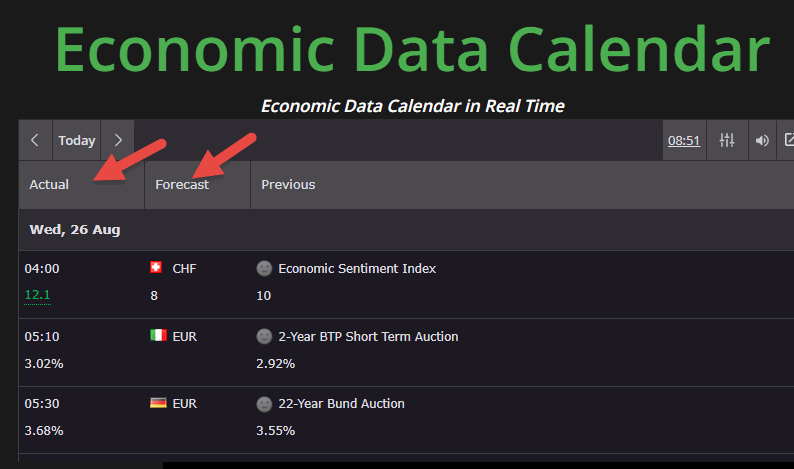
The market consensus is the average forecast produced by economists, analysts, banks, research firms, and other professional market participants.
Before an important economic report is released, forecasts are collected to establish a consensus estimate. That estimate becomes the benchmark against which the actual result is judged.
Common market-moving reports and events include:
- Inflation data
- Employment reports
- Retail sales
- Gross domestic product
- Manufacturing and services surveys
- Consumer confidence
- Corporate earnings
- Central bank decisions
- Housing-market data
- Oil and natural gas inventories
The reported number is important, but its relationship to the consensus forecast is often even more important.
Market Expectations
Global-View Economic Calendar showing Consensus fortecasts

Market Expectations – Three Ways Markets Evaluate Economic News
An economic release can generally be classified in one of three ways.
-
In Line With Expectations
The data is at or close to the consensus forecast.
An in-line result may produce a limited or short-lived reaction because the market was already prepared for it. However, even a report that matches the headline forecast can move markets if its underlying details contain surprises.
Markets reacted despite July (2026) PCE data matched expectations (XAUUSD 4633 => 4612)

-
Better Than Expected
The report is stronger or more encouraging than the market anticipated.
This does not automatically mean asset prices will rise. If investors are concerned about inflation, stronger growth could be considered negative because it may delay interest-rate cuts or increase the possibility of further monetary tightening.
-
Worse Than Expected
The report is weaker or less encouraging than forecast.
Weak data may hurt risk-sensitive assets if it raises recession concerns. However, it could support some markets if investors believe it will encourage central banks to adopt an easier monetary policy.
The greater the difference between the actual result and the consensus forecast, the greater the potential for a significant market reaction.
Market Expectations – What Does “Priced In” Mean?
When an outcome is priced in, traders and investors have already adjusted their positions based on the expectation that it will occur.
Markets are forward-looking. Participants do not normally wait for an event to happen before reacting. They attempt to anticipate economic reports, central bank decisions, corporate earnings, and political developments.
Suppose investors widely expect a central bank to cut interest rates. Markets may begin adjusting days or weeks before the decision. If the central bank delivers the expected cut, the reaction could be limited because traders had already positioned for it.
An asset can even move in the opposite direction following apparently favorable news. This is often described as “buy the rumor, sell the fact.” Traders bought in anticipation of the event and then took profits once it became official.
Why the Initial Market Reaction Can Be Misleading
Major news releases often produce an immediate burst of volatility. Prices can rise or fall sharply within seconds as automated trading systems respond to the headline number.
This first move is the primary reaction. It may be driven by:
- News-trading algorithms
- Stop-loss orders
- Thin liquidity
- Short-term speculation
- Pre-existing market positions
- A significant difference between the forecast and actual result
The initial move does not always reflect the market’s final interpretation. Once traders examine the complete report, a secondary reaction may develop.
For example, an employment report might show stronger-than-expected job creation, producing an immediate positive response. Markets may then reverse after traders notice weaker wages, downward revisions to previous months, or an unexpected rise in unemployment.
The headline can create the first move, but the underlying details often determine whether it continues.
Understanding the Secondary Market Reaction
After the initial volatility, traders have time to examine the complete report and consider its broader implications.
They may ask:
- Does the report change the outlook for interest rates?
- Does it support or challenge the existing trend?
- Were previous figures revised?
- What do the underlying details reveal?
- Was the market positioned too heavily in one direction?
- Does the news change expectations for economic growth or inflation?
A sharp initial move that quickly reverses may indicate that the headline was misleading, the result was already priced in, or traders had positioned for a larger surprise.
When an initial move holds and extends, it may indicate that the news has produced a genuine change in market expectations.
Why Market Positioning Matters
The reaction also depends on how traders were positioned before the announcement.
If nearly everyone expects positive news and has already bought the asset, there may be few buyers left when the news arrives. Even a favorable report could lead to profit-taking.
The opposite may happen when traders are heavily bearish. A result that is merely less negative than feared could produce a sharp rally as traders close short positions.
Price behavior leading up to an event can help reveal whether expectations may already be reflected in the market.
The Market’s Reaction May Matter More Than the News
Markets tend to move most when there is a significant surprise compared with the consensus forecast. However, even a large surprise does not guarantee that prices will move in the direction traders normally expect.
This is why the reaction to the news can be more important than the news itself.
If a market cannot rally following favorable news, the positive outcome may already be priced in, or buyers may be exhausted. If a market refuses to decline following disappointing news, sellers may be losing control, or investors may have prepared for an even worse result.
The market’s ability or inability to respond to news can provide valuable information about positioning, sentiment, and underlying strength or weakness.
Market Expectations – Should You Trade Before or After a News Release?
One approach is to position ahead of an important event in anticipation that other traders will do the same. The objective is to benefit from the movement leading up to the announcement and exit before the data is released.
This avoids rolling the dice on both the outcome and the market’s reaction. However, trading ahead of an event still carries risk because expectations and positioning can change quickly.
Many experienced traders prefer to remain on the sidelines ahead of major reports and central bank decisions. They wait for the initial volatility to settle before deciding whether a sustainable trading opportunity has developed.
There is no single approach suitable for every trader. The decision depends on strategy, experience, risk tolerance, and the ability to manage extreme volatility.
Market Expectations – How Traders Can Prepare for Important News
Before a scheduled event:
- Identify the consensus forecast.
- Review the range of forecasts.
- Examine market sentiment and positioning.
- Consider what may already be priced in.
- Identify important details beyond the headline.
- Prepare scenarios for stronger, weaker, and in-line results.
- Decide whether to trade before the event or wait.
- Use appropriate risk management.
To sum up, spreads can widen, liquidity can disappear, and prices can move sharply in both directions around major news. In extreme conditions, stop orders may not be filled at the requested price.
Markets do not simply react to whether news is good or bad. They react to how the result compares with expectations, what was already reflected in prices, how traders were positioned, and whether the news changes the economic outlook.
The initial move can be fast and misleading. The secondary reaction often provides a clearer picture of what the news really means.
Understanding consensus expectations, positioning, and price behavior cannot eliminate risk, but it can help traders avoid emotional decisions and identify better-informed opportunities.