Mother of PC Harper ‘bitterly disappointed’ that son’s killers remain eligible for early release – UK politics live | Politics

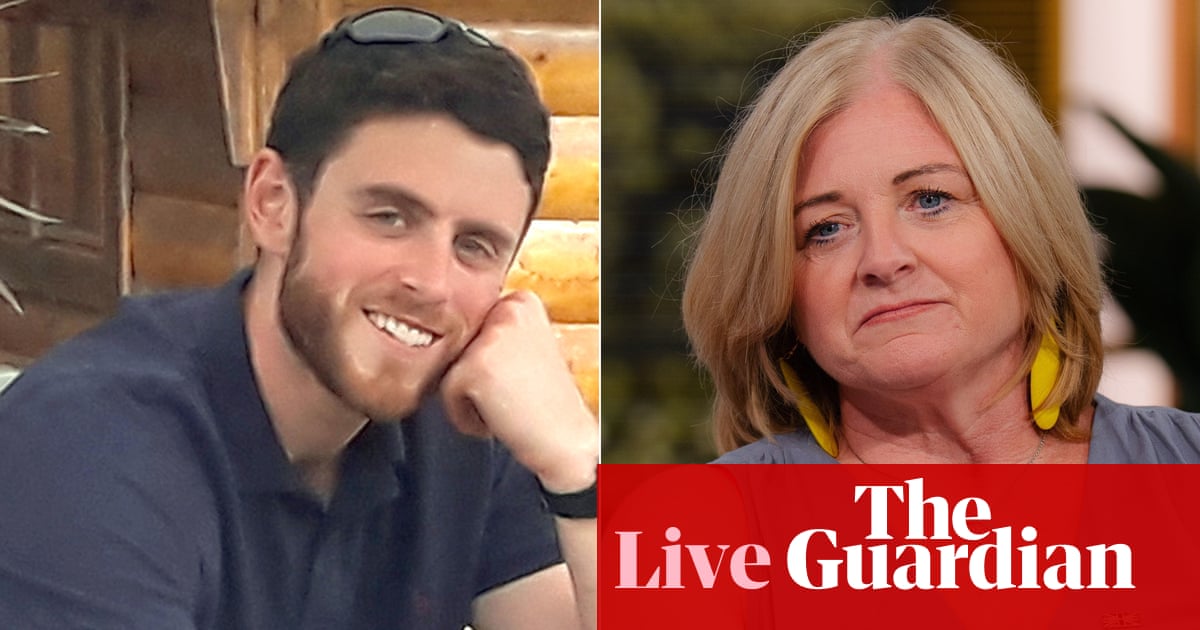
PC Harper’s mother ‘bitterly disappointed’ that her son’s killers remain eligible for early release
Good morning and welcome to our live coverage of UK politics. The mother of PC Andrew Harper said her family are “bitterly disappointed” that her son’s killers remain eligible for early release after the government revised plans to tackle the overcrowding crisis in prisons.
Following pressure from victims, MPs and frontline prison officers, rapists, child sexual abusers and groomers will be excluded from the scheme for England and Wales, the government said on Monday.
But domestic abusers and killers will still be eligible for early release, including two men jailed for their role in the death of PC Harper, who sustained fatal injuries while responding to a quad bike theft in Sulhamstead, Berkshire, in August 2019.
“Quite frankly, we shouldn’t be in this position,” Debbie Adlam, PC Harper’s mother, told BBC Breakfast.
She said it was “completely right” that rapists and paedophiles are not going to be released under the government’s latest plans, but added “they shouldn’t have been considered in the first place”.
Allow content provided by a third party?
This article includes content hosted on platform.x.com. We ask for your permission before anything is loaded, as the provider may be using cookies and other technologies. To view this content, click ‘Allow and continue’.
Speaking to BBC Newsnight, Adlam said she was “devastated” that two of her son’s killers remain eligible for early release. She told the programme:
It feels like we’re letting Andrew down again. We’ve been through the justice system, we thought we’d done as best as we could. Now we’re standing up to fight again … so I just feel really let down, for Andrew’s sake as well as ours.
The justice secretary, Alex Norris, told Sky News this morning that the latest changes to the early release scheme would see 5,000 prisoners released over 10 months, down from 6,000.
He said the government won’t need further emergency release schemes as sentencing changes would provide “long-term security” for prison capacity.
Writing in the Telegraph, the prime minister, Andy Burnham, said he asked the justice secretary to consider the early release of more female prisoners, “given the lower risk they generally pose” in order to prevent further overcrowding.
Burnham said he had “pushed to the very limits of what is possible” but was unable to exempt more criminals from the early release scheme without the prison system “collapsing within months”.

PC Harper’s wife, Lissie Harper, has expressed anger at the prospect that two of her late husband’s killers could be released early, calling it “an affront to justice” and “an utter betrayal”. The justice secretary said he understood the family’s “anger” and offered an apology.
He told Sky News:
Were we not to make these changes, then we would run out of prison places in this October or November.
I know that’s difficult. I know that’s created harm, and it’s not Lissie Harper’s fault, and I’m sorry that she’s been put into this situation as a result, I genuinely am.
Key events

Jessica Elgot
Our deputy political editor Jessica Elgot offers this analysis of Andy Burnham’s handling of the prisoner early release scheme, suggesting it offers him “his first taste of unpopularity”:
If Andy Burnham wanted to demonstrate he was the anti-Keir Starmer, the first fortnight could not have gone better. Instead of painting a gloomy picture of tough times and an economic black hole that would only improve with sacrifices such as cutting winter fuel allowance, Burnham’s first week was a blitz of small wins including cutting bus fares.
But the new prime minister can only control so much. And like Starmer, within his first days in office he found himself facing immediate decisions where every call will make you unpopular. And – like Starmer – blaming your predecessor counts for nothing with an angry public.
On Monday, the first day of the prime minister’s planned holiday with his family, the call had to be made on the early release of prisoners to stop the prison system becoming overwhelmed. Burnham excluded those convicted of rape, serious child sexual offences and grooming from the scheme. But some killers – including two who were convicted of the manslaughter of PC Andrew Harper – will be eligible.
In an article for the Telegraph, where frustration seeped from every syllable, Burnham admitted he had not wanted to take that decision and had hoped to find a way to stop even more convicts from being released early, some just a third into their sentences. “The truth is I wanted to go even further … I have pushed to the very limits of what is possible to do,” he said
Read more here: Jessica Elgot – Prisoner early release scheme gives Burnham his first taste of unpopularity
Probation service ‘ill-equipped’ to take on additional work from tightening of early release rules, union warns
The probation officers’ union Napo has welcomed the new exemptions (prisoners who committed rape, grooming and serious child sex offences) from the early release scheme, saying they help to protect the public, to an extent.
But Napo warned that the government hasn’t considered the scale of the probation “workloads crisis” in its plans as it called for more funding for the service to retain staff and improve working conditions for those who will have to take on more work because of Andy Burnham’s intervention.
“It is not clear if the prime minister or the Lord Chancellor (justice secretary) have a clue about how ill-equipped the probation service is take on this additional work,” Napo, the largest union representing staff working in the probation service, said.
“For example, there are huge numbers of vacancies in Victim Liaison Roles, so we are not sure how the extra Victim Contact Scheme work will be done.
“Plans to release thousands of domestic abuse perpetrators and stalkers early from prison does not boost victim protection. It means that more people, largely women, will be killed or harmed.
“There’s no additional funding to retain probation staff, especially experienced ones, despite endemic staffing problems in many key roles across England and Wales.”
Napo’s general secretary, Ian Lawrence, said:
Everyone is talking about prisons, and yes it is bad, but the crisis in probation is far worse. But yet again, our members are being overlooked while all the attention is on prison. Without probation none of this can happen, so the service needs to be front and centre to this discussion.
Napo is currently in a formal trade dispute with HMPPS over workloads and we are currently in an indicative ballot of our members due to close on Monday. We expect a strong response from our members indicating a wish to ballot for industrial action.
The overall prison population in England and Wales has ballooned over recent decades in part because of longer sentences, a high level of people in prison on remand and court backlogs.
Keir Starmer inherited the prison overcrowding crisis from the Conservatives when he became prime minister in July 2024 – and it has now been passed on to Andy Burnham.
Successive administrations were blamed for not building enough prison places to accommodate the growth in prisoners while the crumbling prison estate remained underfunded. As the Howard League explains:
The prison population has almost doubled in the last 30 years. After a rapid increase in the 1990s and 2000s, it began to stabilise in the 2010s and decreased slightly during the Covid-19 pandemic, but it has since risen again to reach record heights.
This is not a response to rising crime – in fact, recorded crime has fallen – but a sign of how changes in sentencing policy, led by politicians, have had a dramatic impact. Prison sentences have been handed down more and more, and they have got longer and longer over time.
Campaigns calling for the creation of new offences, or the introduction of longer sentences, to address specific issues or problems have contributed to this shift. The impact of these campaigns can be far-reaching – when politicians make sentences longer for one crime, it often leads to calls for longer sentences for other crimes. And so it goes on.
Some 86,495 people were in prison in England and Wales as of 3 August, according to the latest data published by the Ministry of Justice.
This is 2,026 below the record high of 88,521 reached on 6 September 2024, just before the current early release scheme began.
Conservative leader Kemi Badenoch says that the overcrowding crisis in prisons needs to be resolved but not at the expense of releasing “killers” early.
“This is not about money right now. This is about safety. This should be a problem for the government, not a problem for all of the people who have to see their perpetrators walking up and down the street,” she told broadcasters.
In a post on X earlier today, Badenoch said her party had a better plan than Labour’s, which includes building more prisons, renting prison spaces abroad and removing foreign criminals.
When subsequently asked about the cost of renting prison spaces from other countries she told broadcasters that no price can be put on “keeping the citizens of this country feeling safe and secure”.
As we have been reporting, two of PC Andrew Harper’s killers, Jessie Cole and Albert Bowers, remain eligible for early release after their 2020 convictions for manslaughter despite an outcry from the officer’s family that prompted a review of the early release plans.
Pupils in Scotland receive exam results, with record number of National 5 passes
Pupils in Scotland’s schools received their exam results this morning, with exam pass rates at all levels having risen this year, including a record number of National 5 passes.
Almost 270,000 receiving a passing grade at National 5, up from about 262,000 last year. Pass rates for National 5, Higher and Advanced Higher also increased across the board, to 79.2%, 76.7% and 77.6% respectively.
Scotland’s education secretary, Màiri McAllan, has congratulated all the young people receiving their results today, saying it is a “proud day” for them and the country’s education system.
“These are incredibly positive results across the board, with academic passes up at every level – National 5, Higher and Advanced Higher – as well as record numbers of vocational qualifications,” McAllan said in a statement. She continued:
This is testament to the breadth and strength of Scotland’s education system, the professionalism of our teachers and school staff, and the hard work of our young people.
It is particularly pleasing to see another narrowing in the attainment gap between the most and least deprived areas.
This builds on similar progress in the gaps for literacy and numeracy levels, as well as for the number of young people entering initial positive destinations, which has narrowed by almost two-thirds since 2009-10.
The Guardian’s political correspondent, Ben Quinn, has written an interesting analysis piece exploring how Rupert Lowe’s olive branch to Nigel Farage has piled more pressure onto the Reform leader. Here is an extract:
Lowe’s offer to work together came after Restore finished fourth in the Greater Manchester mayoral election, ahead of the Liberal Democrats and Tories – a relatively impressive feat for an electoral startup only months old.
The party also finished third in the Makerfield byelection, the strongest Westminster electoral performance since at least 2010 by a party that has not only endorsed explicitly far-right positions but welcomed far-right activists into its ranks.
Many of its policy positions – a referendum on the death penalty, bans on halal and kosher slaughter and a deportation policy informed by an ethnonationalist view of British identity – make any deal with Restore almost impossible for Reform if the latter is going to broaden its base.
That’s even aside from Lowe’s other demand: that the former Tory ministers in Reform’s ranks – such as Robert Jenrick – are denied a place in any Reform government.
Yet the enduring popularity of Lowe among a chunk of rightwing British voters, including Reform supporters, means Farage has to at least pay lip service to his rival’s overtures.
While Restore’s vote share in Manchester and Makerfield – 8.7% and 6.8% respectively – indicated the party was a long way from winning seats, such results could cost Reform swathes of constituencies in a general election where the vote on the right was split.
The Telegraph is reporting that Reform UK’s Nigel Farage is in talks to strike an electoral alliance with Restore Britain.
Rupert Lowe, the former Reform MP who now leads Restore, wants an agreement that would see candidates in certain seats stand down at the next general election to increase the chances of Reform or Restore winning in those constituencies.
Senior Restore party figures have told the Telegraph that it believes it will be competitive in Great Yarmouth, the Norfolk seat Lowe has represented as an MP since 2024, and across areas of Greater Manchester.
At a press conference yesterday morning, Farage said he responded to Lowe’s weekend offer of a deal between their parties, adding that he was “open-minded” about talks. The Reform UK leader said he had suggested a call to Lowe, who subsequently disputed Farage’s version of events. The Telegraph reports that Lowe has now responded, with talks between the two leaders expected to take place.
Lowe has been a thorn in Farage’s side since he was stripped of the Reform party whip last year after being accused of bullying and making alleged threats against the then party chair, Zia Yusuf, claims that he denies.
But Reform has been losing momentum to Labour and voters to Restore, with a series of disappointing recent electoral performances, including the Makerfield byelection and the Greater Manchester mayoralty byelection.
We are not expecting any media appearances from Andy Burnham today as he is reportedly taking a holiday.
The prime minister took office on 20 July – but will be taking a break from his day-to-day duties to spend time with his family, according to PA Media.
He will remain in direct contact with officials and continue holding meetings during the overseas break, which is reportedly being taken outside the UK.
Louise Haigh, the first secretary of state, will be the most senior minister in the cabinet during the absence.
Reform UK chair Lee Anderson is among those who have criticised the timing of the break. It is not unusual for prime minister’s to take short holidays in August, when parliament is off for recess.
The justice secretary, Alex Norris, is out defending the government’s early release policy on the broadcasters this morning.
He was Asked on ITV’s Good Morning Britain why people who kill police officers could not be excluded from the scheme like those who committed rape, grooming, and serious child sex offences were. In reference to PC Harper’s killers, Norris said:
Because we have to go on the basis of the conviction. The conviction in this case was on manslaughter. We simply cannot restrict and remove entirely people who have been convicted of manslaughter.
Asked whether the government could have made an exception for PC Harper’s killers, Norris said: “No, you couldn’t do that. Fundamentally, it comes down to the offence for which someone’s been convicted and their sentence type.”
“You can’t go one by one and decide which ones should and shouldn’t come out.”
Prison and probation staff put under ‘extreme pressure’ due to late changes to sentencing act, association warns
The Prison Governors’ Association (PGA) has warned that changing the sentencing act at such a late stage has heaped “huge pressure” on already stretched prison staff, making mistakes “more likely”.
The association says it is unclear on how many prisoners will now have their sentences recalculated and remain in prison after the government said last night that rapists, child sexual abusers and groomers will be excluded from early release plans for England and Wales.
“We don’t know if it is tens, hundreds or thousands that will be excluded from the so called “progression model’,” it said in a press release.
“The prime minister has acted following calls from victims of crime to do so at a very late stage putting huge pressure on prison and probation staff to get the work of identifying prisoners now excluded and recalculating their sentences done,” it added.
“This pressure, when the work has already been done once and many staff will be away on holiday, makes mistakes more likely.”
PGA president Tom Wheatley said:
Government needs to decide on a direction and stick to it, changing course at a late stage causes scarce resources to be used unnecessarily and puts prison and probation staff under extreme pressure.
Prisoners serving time for some sexual or violent offences where the automatic release stage is set at two-thirds will become eligible for release at the halfway point, provided they have not committed serious breaches of prison rules, as my colleagues note in this story.
This applies to two of PC Harper’s killers – Jessie Cole and Albert Bowers – who were jailed for 13 years in 2020 for manslaughter. Henry Long, the main perpetrator, will not be subject to early release.
The prime minister, Andy Burnham, said on Tuesday that he would delay the planned early release of thousands of prisoners across England and Wales by a month until October.
It follows the suspension of Keir Starmer’s plans to release up to 6,000 offenders from prison early in September amid official predictions that prisons will be full in November.
Burnham suspended the scheme in his second week as PM after coming under intense pressure from MPs, victims, campaigners and frontline prison officers to halt the early release of serious sexual and violent offenders.
In a statement, Burnham said:
I asked for an urgent review of the prisoner release scheme. I fully understand the anger, anxiety and distress that’s been caused. I’ve heard that loud and clear. That’s why we’re making significant changes: offenders who have been sentenced for rape, serious child sex offences and other grooming offences will be excluded from the changes.
The domestic abuse commissioner, Dame Nicole Jacobs, said the decision to exclude those who have abused their partners was “wrong” and “puts victims’ lives at risk”.
You can read more in this story by my colleagues Rajeev Syal and Alexandra Topping:
PC Harper’s mother ‘bitterly disappointed’ that her son’s killers remain eligible for early release
Good morning and welcome to our live coverage of UK politics. The mother of PC Andrew Harper said her family are “bitterly disappointed” that her son’s killers remain eligible for early release after the government revised plans to tackle the overcrowding crisis in prisons.
Following pressure from victims, MPs and frontline prison officers, rapists, child sexual abusers and groomers will be excluded from the scheme for England and Wales, the government said on Monday.
But domestic abusers and killers will still be eligible for early release, including two men jailed for their role in the death of PC Harper, who sustained fatal injuries while responding to a quad bike theft in Sulhamstead, Berkshire, in August 2019.
“Quite frankly, we shouldn’t be in this position,” Debbie Adlam, PC Harper’s mother, told BBC Breakfast.
She said it was “completely right” that rapists and paedophiles are not going to be released under the government’s latest plans, but added “they shouldn’t have been considered in the first place”.
Allow content provided by a third party?
This article includes content hosted on platform.x.com. We ask for your permission before anything is loaded, as the provider may be using cookies and other technologies. To view this content, click ‘Allow and continue’.
Speaking to BBC Newsnight, Adlam said she was “devastated” that two of her son’s killers remain eligible for early release. She told the programme:
It feels like we’re letting Andrew down again. We’ve been through the justice system, we thought we’d done as best as we could. Now we’re standing up to fight again … so I just feel really let down, for Andrew’s sake as well as ours.
The justice secretary, Alex Norris, told Sky News this morning that the latest changes to the early release scheme would see 5,000 prisoners released over 10 months, down from 6,000.
He said the government won’t need further emergency release schemes as sentencing changes would provide “long-term security” for prison capacity.
Writing in the Telegraph, the prime minister, Andy Burnham, said he asked the justice secretary to consider the early release of more female prisoners, “given the lower risk they generally pose” in order to prevent further overcrowding.
Burnham said he had “pushed to the very limits of what is possible” but was unable to exempt more criminals from the early release scheme without the prison system “collapsing within months”.
PC Harper’s wife, Lissie Harper, has expressed anger at the prospect that two of her late husband’s killers could be released early, calling it “an affront to justice” and “an utter betrayal”. The justice secretary said he understood the family’s “anger” and offered an apology.
He told Sky News:
Were we not to make these changes, then we would run out of prison places in this October or November.
I know that’s difficult. I know that’s created harm, and it’s not Lissie Harper’s fault, and I’m sorry that she’s been put into this situation as a result, I genuinely am.