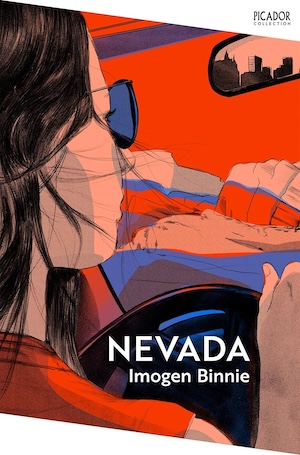

Fiction – Kindle edition; Picador; 294 pages; 2022.
Imogen Binnie’s Nevada is a funny, raw and deeply personal novel about gender, identity and the difficulty of understanding yourself.
First published in 2013 and recently reissued by Picador as part of its classics series, it has been credited with starting a transgender literary movement, despite the author claiming she doesn’t “really feel like a genius visionary who invented literature centring marginalised experiences” (page 254). That’s because she believes that idea “occludes the work other people had done that made Nevada possible”.
And yet, as she states in the Afterword, this remarkable novel provided succour to many:
I’m proud of and humbled by how many people have told me that it’s given them comfort, clarified their thinking, changed their lives, saved their lives, and otherwise been good to them” (page 253).
New York life
The story is narrated by Maria Griffiths, a trans woman in her late 20s living in New York, who works in a bookstore and exists in a kind of emotional statis, unsure whether to break up with her live-in girlfriend or not.
She’s difficult, detached, sometimes selfish and often spectacularly bad at dealing with other people. She’s remained in the same uninspiring job because to go elsewhere would mean exposing herself to the uncertainty of starting somewhere new, where people might discover she’s trans.
She transitioned several years earlier, but that hasn’t magically resolved the years of confusion, repression and self-doubt that she’s lived with her whole life. She constantly thinks about being trans, even when she would desperately like to forget it.
There’s an exhausting mundane reality about it all. Shaving, makeup, clothes, voice, hormone injections and the constant awareness of how other people might perceive you all become part of the mental workload.
Because shaving and putting on a bunch of foundation every day are emotionally exhausting reminders of being trans (page 33).
But there’s a wonderfully unsentimental intelligence to Maria’s views on gender, which are funny, abrasive and actually rather profound:
Eventually you can’t help but figure out that, while gender is a construct, so is a traffic light, and if you ignore either of them, you get hit by cars. Which, also, are constructs” (page 29).
Gender awakening
The second half of the novel develops a slightly different tone and viewpoint as it shifts to a second character, James, whom Maria meets in Nevada on a harried road trip to the West Coast.
James is a young person who is beginning to confront the possibility that he might be trans. He’s in a heterosexual relationship, but he’s plagued by sexual confusion, self-doubt and fear, and it’s Maria who suggests maybe there’s a “solution” he hasn’t struck upon yet.
Does he wish he was a girl? Fucking — obviously he wishes he was a girl. You don’t spend twenty-nine hours a week thinking about being a girl and masturbating without wondering, like, I wonder if this pattern is trying to tell me something (page 181).
James wrestles with the idea that he could be trans while at the same time trying to convince himself it isn’t true. It’s painful to watch, and Maria, while having her heart in the right place, does come across as a bit pushy.
Which is probably where I should put up my hand and admit that Maria isn’t an entirely likeable character and that some of her behaviour is questionable — like stealing her ex-girlfriend’s car, for instance. But her voice is so feisty and snarky and profound that it’s an exciting experience to be inside her head, even if her personality is occasionally frustrating.
I found the novel a story of two halves, and the latter one, which is billed as a road trip, a lot weaker than the first. That said, I appreciate the intent of these dual stories, to show that there’s no one route to discover or understand your gender, or that there’s a homogenous trans experience that all trans people go through.
That seems to be the heart and purpose of Nevada. It isn’t a novel about transition in the conventional sense but rather about the mess left behind by years of not knowing how to understand yourself, and about how difficult it can be to construct a life once you finally begin to understand what it is you need.

This is my 12th book for #20BooksofWinter2026 hosted by Annabel at AnnaBookBel. I purchased it on Kindle in June 2024 for reasons I don’t remember.
In 2026, I’m trying to read as many books as possible from my TBR. This is #29.
Discover more from Reading Matters
Subscribe to get the latest posts sent to your email.